
You can pair both parks in one trip with very little transfer driving. The direct link from Yellowstone’s South Entrance to Grand Teton is about 1 hour in light traffic, and the two park boundaries are only 31 miles apart.
Here’s the short version: I’d plan 5 to 7 days if I want time for geysers, wildlife, lakes, and mountain views without rushing. If I only have a short trip, 3 to 4 days works best by ending Yellowstone in the south, driving through the Rockefeller Parkway, and then spending the last day or two in Grand Teton.
What matters most:
- Best direct route: Yellowstone South Entrance to Grand Teton via John D. Rockefeller Jr. Memorial Parkway
- Best trip length: 3 to 4 days minimum, 5 to 7 days if I want more stop time
- Best order: Yellowstone first, Grand Teton second
- Best early stops: Grand Prismatic, Old Faithful, Hayden Valley, Artist Point, Jenny Lake, Oxbow Bend, and Mormon Row
- Best overnight areas: Old Faithful, Canyon/Grant Village, Flagg Ranch, Colter Bay, Signal Mountain, or Jackson
- Best start time: By 7:00 a.m. for lighter traffic and better parking
- One pass for both parks: America the Beautiful Pass – $80
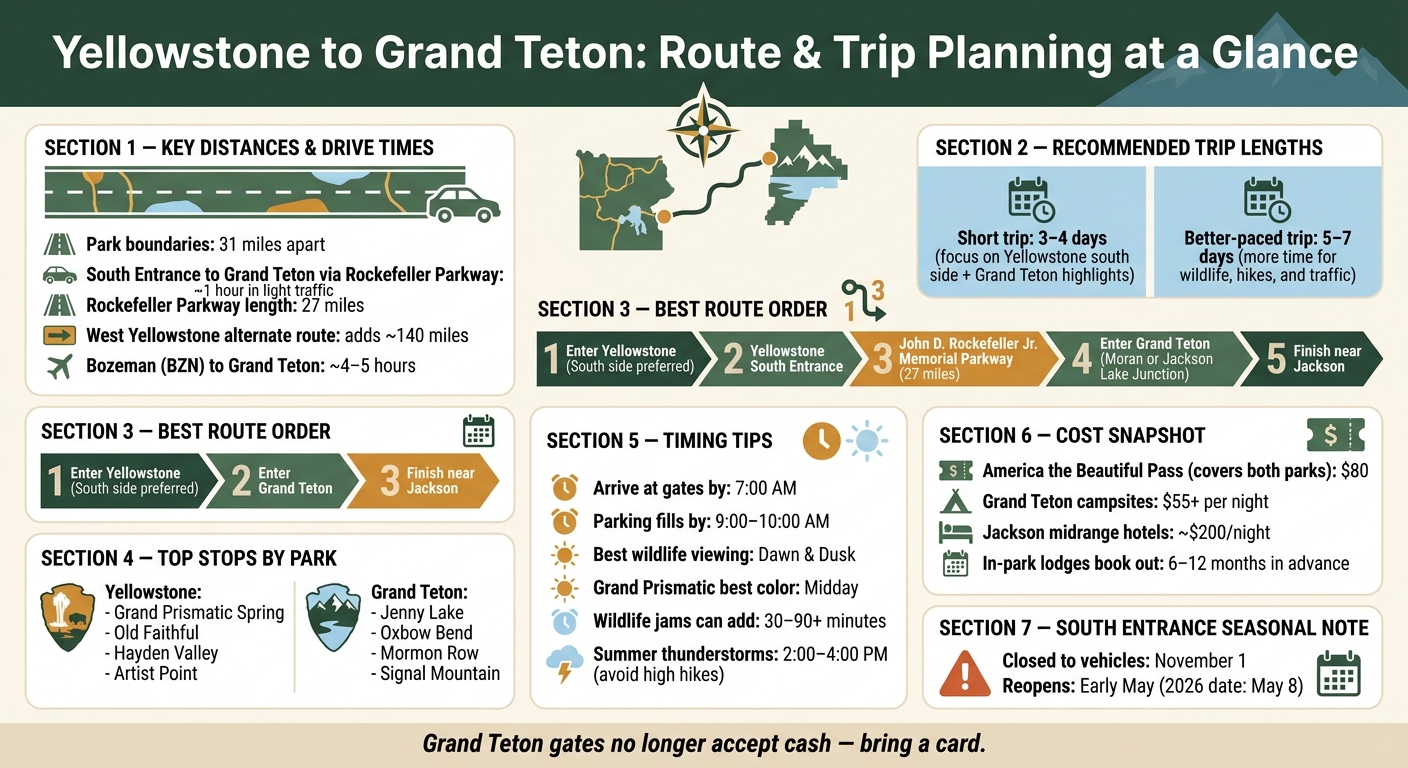
Yellowstone to Grand Teton: Route & Trip Planning at a Glance
Yellowstone + Grand Teton 8-Day Itinerary 🏔️
Quick Comparison
| Topic | Best Pick | What to Know |
|---|---|---|
| Direct park-to-park drive | South Entrance via Rockefeller Parkway | Shortest link; closed to vehicles in winter |
| Short trip | 3 to 4 days | Focus on Yellowstone’s south side, then Grand Teton highlights |
| Better-paced trip | 5 to 7 days | More room for traffic, wildlife stops, and hikes |
| Yellowstone transfer stop | Flagg Ranch or Grant Village | Good for an early move into Grand Teton |
| Grand Teton base | Colter Bay or Jackson | Colter Bay is closer to the north; Jackson has more services |
| Best wildlife timing | Dawn and dusk | Traffic jams can add 30 to 90+ minutes |
| Best busy-site timing | Early morning | Parking often fills by 9:00 a.m. to 10:00 a.m. |
In other words: if I want the trip to feel simple, I’d keep Yellowstone stops grouped on the lower loop, sleep near the south end, then move straight into Grand Teton and finish near Jackson.
2. Best route options and entry points
Yellowstone South Entrance to Grand Teton via John D. Rockefeller Jr. Memorial Parkway
If your Yellowstone time wraps up in the south corridor, this is the most direct way into Grand Teton. Leave through the South Entrance and you roll straight onto the 27-mile John D. Rockefeller Jr. Memorial Parkway. There are only about 31 miles between the two park boundaries.
This route makes the most sense if you’re ending your Yellowstone stay near Old Faithful, Grant Village, or West Thumb. On the drive, you’ll pass Lewis Falls and start to see Jackson Lake before the Tetons finally show themselves. Timing matters here, though. The South Entrance closes to wheeled vehicles on November 1 and opens again in early May. For 2026, the scheduled reopening date is May 8.
Before heading out, top off your tank at Grant Village or Flagg Ranch. Services are sparse in this stretch.
West Yellowstone and Bozeman route options
Not every trip lines up with Yellowstone’s south end. If you’re flying into Bozeman (BZN) or spending most of your time near the West Entrance, you’ll want a different plan.
| Starting Point | Route | Best for | Tradeoffs |
|---|---|---|---|
| Yellowstone South Entrance | US 89/191/287 via Rockefeller Parkway | Most direct; best after Old Faithful, Grant Village, or West Thumb | Heavy traffic in peak summer; closed Nov–May |
| West Yellowstone | US 20 to ID 32 to WY 22 (Teton Pass) | Loop trips or skipping parkway traffic | Adds about 140 miles; steep grades at Teton Pass |
| Bozeman (BZN) | US 191 south through Gallatin Canyon | Airport access; north-to-south trip starting at Mammoth Hot Springs or Lamar Valley | Longest drive to Grand Teton; about 4–5 hours to reach the Teton side |
Coming from West Yellowstone, the Idaho route takes you along US 20 to ID 32 and then over Teton Pass on WY 22 into Jackson. It can work well for a loop or if you want to avoid traffic on the parkway. The catch? It’s a longer, curvier drive, and Teton Pass can get rough when weather turns bad.
The Bozeman route fits best if you’re flying into BZN and want to begin in Yellowstone’s north end, like Mammoth Hot Springs or Lamar Valley, then work your way south toward Grand Teton.
Which entry points to use for each park
For the direct park-to-park transfer, use Yellowstone’s South Entrance.
Once you reach Grand Teton, your best entry point depends on where you want to go first:
- Jackson Lake Junction is where the Rockefeller Parkway connects with Grand Teton’s main roads. It’s a smart first stop if you’re heading toward Colter Bay or Signal Mountain.
- Moran Entrance near Oxbow Bend is the first access point you’ll hit from the north. Pick this one if you want an early wildlife stop on the drive.
- Moose Entrance sits at the south end of the park near the Craig Thomas Discovery and Visitor Center. Use it if you’re staying in Jackson or want to stop at the visitor center.
If you’re driving Grand Teton from north to south, start near Moran or Jackson Lake Junction and finish at Moose.
Once you’ve picked your entry points, planning the route into a three- or four-day stop sequence gets much easier.
sbb-itb-00512f3
3. Day-by-day stop plan for a 3- to 4-day trip
Group your stops so you’re not zigzagging all over the map or burning half the day in the car. The easiest setup is to move south to north for lodging, which keeps each day tighter and less tiring. This plan works best when you visit Yellowstone first and go straight into Grand Teton after that.
Day 1: Yellowstone lower loop and south-end overnight
Start in Yellowstone’s south end and only work north as far as West Thumb. First stop: Grand Prismatic Spring in Midway Geyser Basin. Then take the 1.6-mile round-trip Fairy Falls/Grand Prismatic Overlook trail for the best view. Midday usually gives you the best color.
After that, head to the Upper Geyser Basin and Old Faithful. Check the predicted eruption schedule before you go so you can time the stop well.
In the afternoon, finish at West Thumb Geyser Basin along Yellowstone Lake. It’s a short boardwalk walk, and it makes sense as your last stop before staying near Old Faithful for the night. Getting to Grand Prismatic by 7:00 AM helps a lot. Parking fills fast, and the crowds are much lighter early. Staying here also sets you up for an early wildlife run through Hayden Valley the next morning.
Day 2: Hayden Valley, canyon stops, and transfer to Grand Teton
This is your transition day from Yellowstone into Grand Teton. Start early in Hayden Valley, then continue to the Grand Canyon of the Yellowstone before driving south into Grand Teton.
Build in extra time for Hayden Valley. Traffic can slow down for 30 minutes or more when animals get close to the road and wildlife jams form. It’s part of the deal here.
At the canyon, Artist Point on the South Rim gives you the big view of the Lower Falls, and it’s worth the short walk from the parking area. After that, continue south through Yellowstone and into Grand Teton. Your first stop there can be Oxbow Bend or Jackson Lake Junction, then stay near Colter Bay or Jackson Lake Junction. By evening, you’ll be set up in the park’s north or central lodging area and ready for a full Grand Teton day.
Day 3: Grand Teton scenic loop and Jackson finish
Spend this day fully inside Grand Teton and finish in Jackson or Teton Village. Follow the park’s main scenic loop and start at Jenny Lake. If you take the boat shuttle across, the hike to Hidden Falls drops to about 1 mile each way instead of 4 miles. That’s a smart trade if you want the stop without eating up too much of the day.
From there, continue to Schwabacher Landing and Mormon Row, then wrap up at Signal Mountain or in Jackson.
If you still have time, drive up Signal Mountain before ending the loop. The road opens up a full panoramic view of Jackson Hole. Finish in Jackson or Teton Village based on where you’re staying and how early you need to leave the next morning.
Optional Day 4: Hikes, boating, or a slower exit day
Use Day 4 to ease off the pace, not to squeeze in more road time. Good picks include a Snake River float trip, which gives you a completely different view of the Tetons from the water, or the Jackson Hole Mountain Resort Aerial Tram for a high-altitude look across the range.
If photos are a big part of the trip, this is also the day to circle back to Oxbow Bend or Schwabacher Landing at sunrise.
4. Where to stay: camping and hotel zones along the route
Where you stay has a big effect on how much driving you do each day. A smart overnight stop can cut down the next day’s miles and make the whole route feel a lot less tiring.
Best Yellowstone base areas by trip stage
On a south-to-north trip, it helps to move your base as you go. Stay near Old Faithful for geysers, Canyon Village for Hayden Valley and the Grand Canyon, then use Grant Village or Headwaters at Flagg Ranch before heading into Grand Teton.
Flagg Ranch stands out as the best transfer-night stop on this route. It sits right between the two parks, so even though services are limited, it’s hard to beat if your goal is the easiest park-to-park handoff.
Best Grand Teton lodging areas
Colter Bay works well as a first stop when you’re coming down from Yellowstone. It has a grocery store, marina, cabins, and RV sites, which makes it handy if you need to restock or want a simpler arrival day.
Signal Mountain gives you lakefront lodging and camping, plus on-site dining and easy access to the park’s main scenic areas.
Jenny Lake is the top central base for hikers. The campground is tent-only, and spots go fast.
If you want the most food, services, and hotel choices, stay in Jackson. Midrange hotels there often start at around $200 per night.
Camping vs. hotels on this route
Both can work. Lodges make the trip easier. Campgrounds usually cost less.
In-park lodges such as Old Faithful Inn and Jackson Lake Lodge often book 6 to 12 months ahead. Grand Teton campsites can cost $55+ per night, and the most wanted spots face much of the same booking rush.
So what should you pick? It comes down to what matters most to you:
- Convenience if you want to stay close to the sights
- Savings if you’re trying to keep costs down
- Transfer speed if you want the smoothest move between Yellowstone and Grand Teton
| Stay Type | Best Use | Typical Pros | Drawbacks |
|---|---|---|---|
| In-Park Lodges | High convenience | Immediate access to sights; historic atmosphere | High nightly rates; book 6–12 months out |
| In-Park Camping | Budget-focused | Most affordable; central to trails | Requires gear; limited amenities |
| Gateway Hotels | Flexibility | More dining options; reliable cell service | Requires daily entry; longer drive times |
| Flagg Ranch | Park-to-park transfer | Perfectly positioned between both parks | Limited services; isolated location |
| Jackson (Town) | South Teton base | Full amenities; restaurants; airport access | Expensive; long drive to northern Yellowstone |
Fill up in West Yellowstone, Gardiner, or Jackson before heading deeper into the parks. Gas usually costs more inside Yellowstone and Grand Teton.
5. Timing, traffic, wildlife, and final planning notes
Best times to drive for lighter traffic and wildlife viewing
Once you’ve set your route and overnight stops, timing has a huge effect on what your day feels like. Start early and try to reach entrance gates by 7:00 a.m.. That matters because parking at busy places like Jenny Lake and Old Faithful often fills by 9:00 a.m. or 10:00 a.m. in peak summer. If you get there early, you spend less time hunting for a spot and more time out seeing the park.
Dawn and dusk are also the best windows for wildlife. That’s when grizzly bears, wolves, elk, and moose are most active. If seeing animals is high on your list, those hours give you your best shot.
Timing also changes what certain sights look like. Grand Prismatic Spring usually looks best around midday, when the steam is thinner and the colors show more clearly.
Midday tends to be the roughest stretch for road traffic and parking. If you end up driving then, it’s smarter to ease into the day than to cram in too much mileage.
Best seasons and realistic daily pacing
Daily timing matters, but season can make or break this drive too. Summer is the busiest stretch. Late spring and fall are often easier to move through, though some services may be limited.
The biggest route issue is the South Entrance. When it’s closed, you lose the direct park-to-park connection. That can change the whole shape of your plan, so it’s worth checking before you go.
Give yourself extra time on every drive. Wildlife jams can add 90 minutes or more, and that’s not rare enough to ignore. Summer afternoons also often bring thunderstorms between 2:00 p.m. and 4:00 p.m., so morning is the better time for high-altitude hikes.
Key takeaways for planning the park-to-park drive
A few small planning steps can save a lot of hassle:
- Download offline maps before leaving Jackson or West Yellowstone. Cell service is nearly non-existent inside both parks, and GPS can be unreliable.
- Bring a credit or debit card for entrance fees, since Grand Teton gates no longer take cash.
For the smoothest transfer day, use the South Entrance via John D. Rockefeller Jr. Memorial Parkway. Start early, keep your schedule loose, and leave room for traffic, parking delays, and wildlife stops.
FAQs
Do I need reservations for lodging or camping?
Yes. Lodging and camping in and around Yellowstone and Grand Teton often fill up months ahead, especially in summer.
For in-park lodges, plan to book 6 to 12 months in advance. Campgrounds in both parks also need reservations during summer, so it’s best to book as early as you can.
Can I do Yellowstone and Grand Teton without changing hotels?
Yes. Plenty of travelers see both parks without switching hotels. A common setup is to stay in West Yellowstone, Montana, since it has lots of lodging and easy access.
The drive between the parks can still take a few hours, depending on your exact route and stop points. But spending a full day in Grand Teton and driving back that evening is doable.
In winter, seasonal road closures between the parks can change that plan, so it helps to check road conditions before you go.
What should I do if the South Entrance is closed?
The South Entrance to Yellowstone closes every year from November 1 through early May because of snow.
That means the road between Yellowstone and Grand Teton is closed to regular vehicles during that stretch, so you’ll need to plan for a detour.
Before you head out, check the official National Park Service websites for the latest seasonal road closure updates.