
Yellowstone has more than 10,000 hydrothermal features, and many sit next to thin ground over water hotter than 200°F (93°C). If I want a safe, simple visit, I should focus on the main public basins, use the boardwalks, and time my stops around parking, steam, and crowds.
Here’s the short version:
- Best-known hot spring stop: Grand Prismatic Spring at Midway Geyser Basin
- Shortest easy stops: West Thumb and Fountain Paint Pot
- Longest walk: Upper Geyser Basin, with about 4.9 miles of boardwalk routes
- Best full view of Grand Prismatic: Fairy Falls Overlook, 1.6 miles round trip
- Best general rule: Stay on the boardwalk and keep kids within arm’s reach
- Best crowd-avoidance plan: Go before 8:00 a.m., after 5:00 p.m., or near midday only for Grand Prismatic’s color view
- Main limits: No soaking, no pets on thermal boardwalks, and no picking up dropped items
If I had to sum up the park in one line, it would be this: hot springs pool, geysers erupt, mudpots bubble, and fumaroles hiss. That simple split helps me know what I’m looking at right away.
A few facts matter most for trip planning:
- Mammoth Hot Springs stands out for its terrace formations and changeable mineral deposits
- Norris Geyser Basin is the park’s hottest and most acidic major basin
- West Thumb gives me lakefront thermal views with a short, flat walk
- Midway is home to the largest hot spring in the U.S.
- Upper Geyser Basin pairs hot springs with the park’s busiest boardwalk network
- Lower Geyser Basin is a short stop with several feature types in one loop
Explore Yellowstone’s UNBELIEVABLE Hot Springs – Must See Thermal Features in the Park!
sbb-itb-00512f3
Quick Comparison
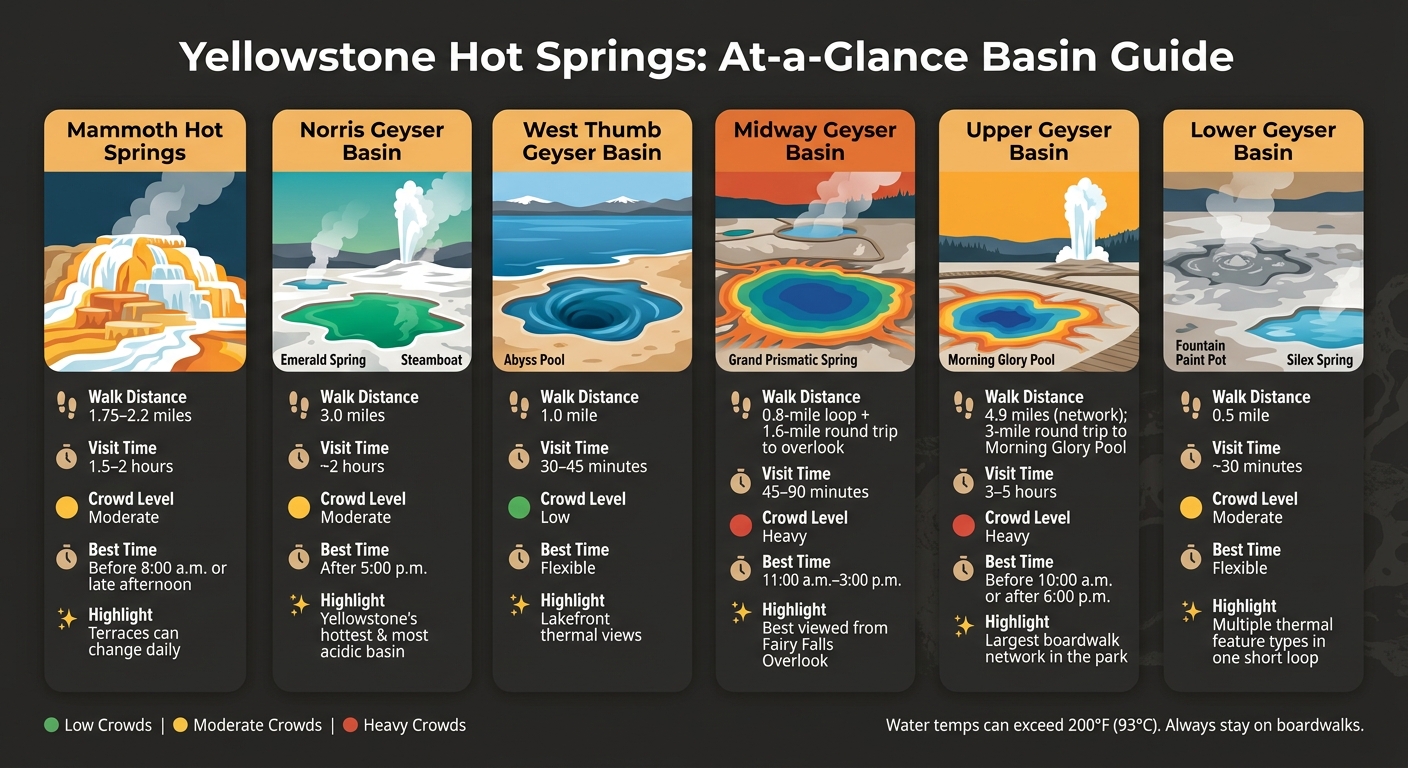
| Area | Main draw | Walk | Time to plan | Crowd pattern |
|---|---|---|---|---|
| Mammoth Hot Springs | Travertine terraces | 1.75–2.2 miles | 1.5–2 hours | Moderate |
| Norris Geyser Basin | Hot, acidic basin; Porcelain Basin views | 3.0 miles | About 2 hours | Moderate |
| West Thumb | Hot springs by Yellowstone Lake | 1.0 mile | 30–45 minutes | Lower |
| Midway Geyser Basin | Grand Prismatic Spring | 0.8-mile loop + overlook option | 45–90 minutes | Heavy |
| Upper Geyser Basin | Morning Glory Pool and dense thermal area | 4.9 miles | 3–5 hours | Heavy |
| Lower Geyser Basin | Fountain Paint Pot loop | 0.5 mile | About 30 minutes | Moderate |
Bottom line: if I want the best mix of safety, views, and time use, I should pick a few basins that fit my route, bring layers and water, download maps before I lose service, and treat every thermal area like fragile ground over boiling water.
Main Yellowstone hot spring areas open to visitors
Yellowstone Hot Springs: Basin Comparison Guide
Yellowstone’s six main thermal areas each give you a different kind of stop. Some are short and easy. Others need more walking and a bit more time. The simplest way to plan? Start with the places that match your route, then use the table below for a quick side-by-side look.
Mammoth Hot Springs, Norris Geyser Basin, and West Thumb Geyser Basin
Mammoth Hot Springs is a travertine terrace system formed by calcium carbonate deposits. Canary Spring and Orange Spring Mound are two of the best-known formations. What makes Mammoth stand out is how fast it can shift – the terraces can change constantly, sometimes even within a single day. A boardwalk loop covers the Lower Terraces on foot for about 1.75 miles, and the Upper Terrace Drive helps you see more by car if time is tight.
Norris Geyser Basin is Yellowstone’s hottest, oldest, and most acidic thermal area. It has two main sections. Porcelain Basin feels open and stark, with milky blue pools and hissing fumaroles. Back Basin is more wooded and includes Steamboat Geyser, the world’s tallest active geyser, which can erupt more than 300 feet high. The trails here include steep grades and stairs. If you use a wheelchair, the Norris Museum overlook gives you a direct view into Porcelain Basin.
West Thumb Geyser Basin sits right along the shore of Yellowstone Lake, which gives it a setting the other basins don’t have. Abyss Pool is one of the main stops near the water’s edge. The walking loop here is short and flat.
Upper, Midway, and Lower Geyser Basin stops
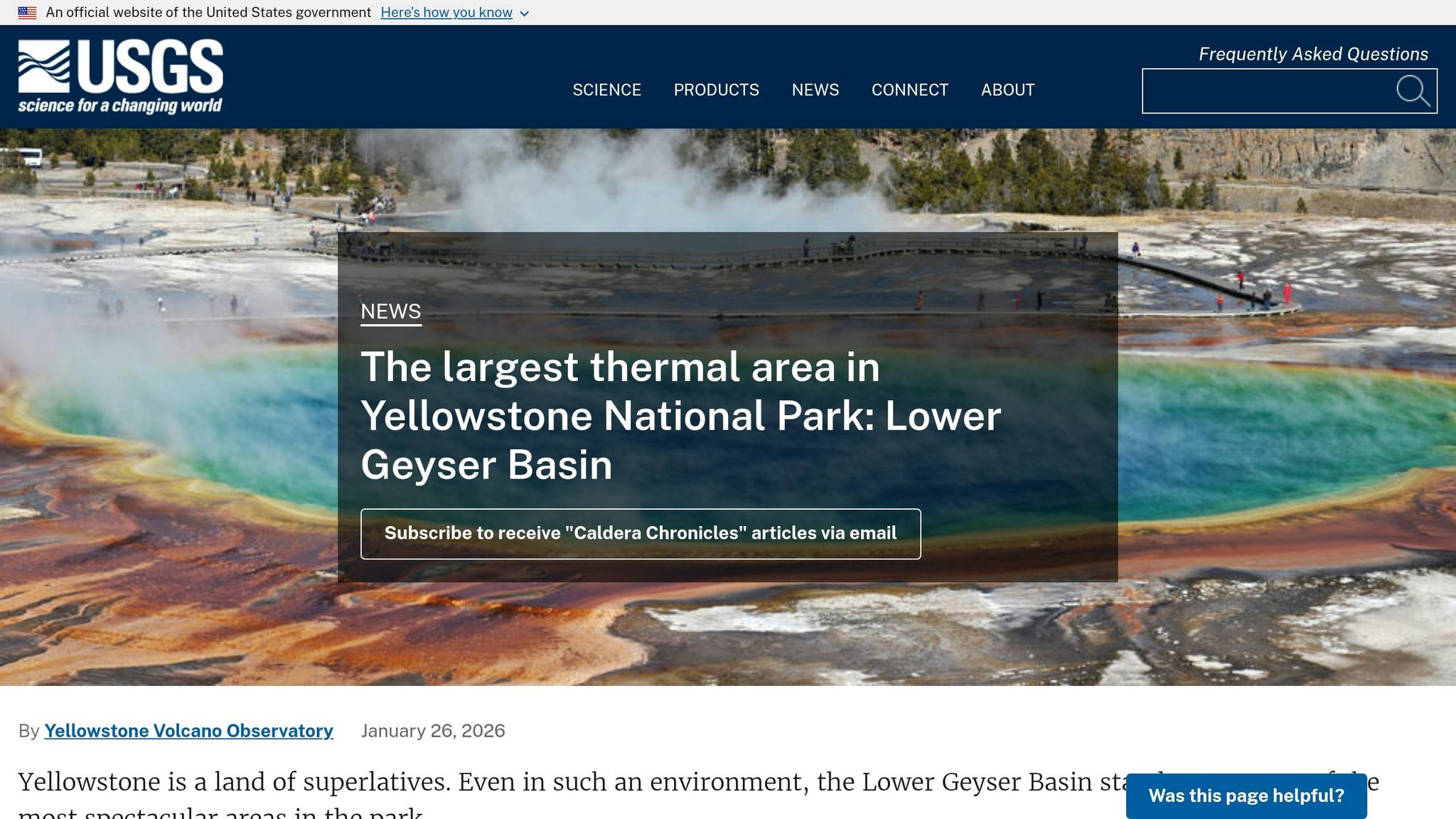
Midway Geyser Basin is home to Grand Prismatic Spring, the largest hot spring in the United States and the third largest in the world. It measures more than 300 feet across and over 121 feet deep. The boardwalk gets you close, but the overlook is where the full scene opens up. Park at the Fairy Falls trailhead and walk 0.8 mile to the overlook, or 1.6 miles round trip, for the best view. Around midday is often the best time to go, since the morning mist has usually cleared and the colors show more clearly.
Upper Geyser Basin, centered on Old Faithful, also includes Morning Glory Pool. Water temperatures there can reach up to 171°F (77°C). The pool is about 1.5 miles from the Old Faithful Visitor Center, so getting there means a 3-mile round-trip walk.
Lower Geyser Basin is best known for the Fountain Paint Pot trail. The 0.5-mile Fountain Paint Pot loop includes Silex Spring and several other thermal features. It’s a good stop when you want to see a lot without a long walk.
Hot spring area comparison table
Here’s a fast side-by-side comparison of the main stops.
| Area | Signature Hot Spring | Typical Visit Time | Crowd Level | Why It’s Worth Stopping |
|---|---|---|---|---|
| Mammoth Hot Springs | Canary Spring, Orange Spring Mound | 1.5–2 hours | Moderate | Travertine terraces that can change daily |
| Norris Geyser Basin | Emerald Spring | 1.5–2 hours | Moderate | Yellowstone’s hottest and most acidic basin; Steamboat Geyser is nearby |
| West Thumb | Abyss Pool | 30 minutes | Low | Thermal pools right on the shore of Yellowstone Lake |
| Upper Geyser Basin | Morning Glory Pool | 2+ hours | High | Dense mix of geothermal features; 3-mile round trip to Morning Glory Pool |
| Midway Geyser Basin | Grand Prismatic Spring | 45–90 minutes | High | Largest hot spring in the U.S.; best seen from the overlook |
| Lower Geyser Basin | Silex Spring | 30 minutes | Moderate | Short loop with several thermal features in one stop |
Boardwalk routes and how to view hot springs safely
Yellowstone’s boardwalks do one big job: they keep people off ground that can look solid but may be nothing more than a thin crust over scalding water. In thermal areas, that boardwalk isn’t just a path. It’s the line between a safe visit and a bad mistake. So it helps to pick stops based on route type and walking distance, then check the rules before you step out.
How boardwalk loops are laid out in major basins
Yellowstone’s thermal routes usually fall into two groups: short loops and longer basin networks. Some are easy, quick walks. Others can take up a big chunk of your day.
| Basin | Boardwalk Length | Time | Notes |
|---|---|---|---|
| Upper Geyser Basin | 4.9 miles | 3–5 hours | Large network with multiple spur trails |
| Norris Geyser Basin | 3.0 miles | About 2 hours | Back Basin has stairs and steep grades |
| Mammoth Lower Terraces | 1.75–2.2 miles | 1.5–2 hours | Lower Terrace boardwalks; Upper Terrace Drive can be done by car |
| West Thumb | 1.0 mile | 30–45 minutes | Flat loop along the lake |
| Midway Geyser Basin | 0.8 miles | 30 minutes | One loop; the overlook is on a separate trail |
| Fountain Paint Pot | 0.5 miles | 30 minutes | Short, level loop |
If you want a long thermal walk, Upper Geyser Basin is the main event. If you’re short on time, West Thumb, Midway, and Fountain Paint Pot are much easier to fit into a busy day.
Where to find the best viewing points at each stop
Getting onto the boardwalk is only half the story. The best view often comes down to height and angle.
For Grand Prismatic, use the Fairy Falls Overlook if you want the full picture. From the boardwalk, you’re down at ground level, which limits what you can see. At Norris, the museum overlook gives you a straight view into Porcelain Basin without doing the full loop, which helps if time is tight or walking is limited. In Upper Geyser Basin, Observation Point gives you a much broader look over the Old Faithful area than you get from below.
How to plan a one-day route between thermal areas
Yellowstone’s thermal spots group pretty neatly into two route clusters. The north cluster links Mammoth Hot Springs and Norris Geyser Basin. The southwest cluster puts Upper, Midway, and Lower Geyser Basin close together by car.
If you want to hit the main hot spring areas without wasting time doubling back, start before 8 a.m. at Mammoth, head to Norris, spend the middle of the day at Old Faithful and Upper Geyser Basin, then end at Midway. That timing works well because midday light helps bring out Grand Prismatic’s colors.
A few trip-planning details matter here:
- Midway’s parking lot fills fast from 10 a.m. to 6 p.m.; if needed, use legal roadside pullouts and walk to the trailhead.
- Cell service is unreliable across the park, so download trail maps before you arrive.
Once your route is set, the next step is simple: stick to the thermal-area rules that keep both visitors and these fragile features safe.
Safety rules and legal restrictions in thermal areas
Once you pick your route, the rules stay pretty much the same at every thermal stop: stay on the boardwalk, respect closures, and treat the area like fragile ground. That starts with the boardwalk itself.
Stay on boardwalks and keep children close at all times
In hydrothermal basins, the ground can be a thin crust sitting over boiling water. Thermal water can top 200°F (93°C), which is hot enough to cause fatal burns. Going off-trail in thermal areas is illegal and can lead to arrest or fines.
Keep children within arm’s reach on boardwalks.
The next rules deal with water, pets, and dropped items.
No soaking, swimming, pets, or retrieving dropped items
Soaking, swimming, or bathing in thermal water is illegal in Yellowstone. Swimming is also illegal except in a small number of mixed-water areas, so check the current NPS status before you get in.
Pets aren’t allowed on thermal boardwalks or in hydrothermal areas. Keep them in vehicles, campgrounds, and other developed areas.
If you drop something into a thermal feature, leave it there. Don’t try to get it back, and don’t throw anything in on purpose. Coins, trash, and rocks clogged Morning Glory Pool’s vents and changed its color from blue to green.
Safety rules summary table
| Rule | Why it exists | Risk prevented |
|---|---|---|
| Stay on boardwalks and designated trails | Ground is a thin, unstable crust over boiling water | Falling into scalding water; severe burns or death |
| No swimming or soaking in thermal water | Features are fragile and water is scalding | Severe burns and permanent resource damage |
| No pets | Thermal areas are hazardous for animals | Pet injury or death; damage to bacterial mats |
| Supervise children at all times | Many trails lack guardrails | Accidental falls into hydrothermal features |
| Do not throw or retrieve items | Objects clog vents and alter water chemistry | Resource damage and personal burn risk |
| Do not touch mats or formations | They are highly sensitive | Irreversible damage to hydrothermal features |
Best times to visit Yellowstone hot springs and final planning notes
Best seasons and times of day to avoid crowds
Most Yellowstone roads close from early November through mid-April, which makes summer the main season for seeing the park’s thermal areas.
That said, timing still matters a lot. Most thermal spots are busiest from 10:00 a.m. to 6:00 p.m., when parking gets tight and the boardwalks fill up. If you go a little earlier or later, the visit usually feels much easier.
Here’s a simple way to plan:
| Area | Best Time to Visit | Why |
|---|---|---|
| Mammoth Hot Springs | Before 8:00 a.m. or late afternoon | Easier parking and better light for photography |
| Norris Geyser Basin | After 5:00 p.m. | Parking is easier and the basin is quieter |
| Grand Prismatic Spring | 11:00 a.m. to 3:00 p.m. | Direct overhead sunlight makes the colors brighten |
| Old Faithful area | Before 10:00 a.m. or after 6:00 p.m. | Avoids the busiest window |
There’s a tradeoff here. Morning often means more steam, which can give the basins a moody look. Midday is usually better for Grand Prismatic Spring, since overhead sun helps its colors show up more clearly. And because mountain weather can turn on a dime, it’s smart to check conditions before heading out.
What to bring and what to expect on site
Once you’ve picked your time, pack for shifting weather. Bring layers, a rain jacket, extra food, and extra water. On the boardwalks, you can run into sun, wind, and drifting steam all in the same stretch.
A few things also catch first-time visitors off guard:
- Cell service is unreliable, so download the NPS app and save offline maps before you arrive.
- Expect a strong sulfur smell from hydrogen sulfide gas.
- Midway’s parking lot fills up fast around midday, so you may need to park along the road and walk an extra quarter-mile.
Conclusion: Key points for a safe and worthwhile visit
Yellowstone’s hot springs are much easier to enjoy when you plan ahead. Stick to the boardwalks, aim for early morning or later in the day when you can, and come ready for changing weather. The springs do the rest.
FAQs
Which Yellowstone hot spring area is best for first-time visitors?
Upper Geyser Basin is the best pick if you only have time for one Yellowstone hot spring area. It’s home to Old Faithful, more than 100 other hot springs, and four other major active geysers.
What makes it stand out for first-time visitors is how easy it is to get around. There’s a simple loop of boardwalks and paved paths, so you can see a lot without a lot of guesswork.
Midway Geyser Basin comes in a close second, mainly for Grand Prismatic Spring.
Can I see Grand Prismatic Spring without a long walk?
Yes – the Midway Geyser Basin boardwalk is the most direct option. It’s short, flat, and gives you a close-up look at Grand Prismatic Spring.
If you want the overlook view, that’s a different stop. You’ll need to drive separately and then do a roughly 1.6-mile round-trip walk from the Fairy Falls parking lot.
What should I do if parking lots are full?
If a parking lot is full, head to another area or come back at a less busy time. Traffic backups are common at popular thermal sites, so it helps to stay patient and flexible.
For fewer crowds and fewer parking headaches, go early in the morning or later in the day. If your first stop is full, spend some time at one of Yellowstone’s many other attractions, trails, or geyser basins.