
When deciding where to visit, it helps to know the difference between World Heritage Sites and National Parks. Both recognize places of great importance, but they serve different purposes:
- World Heritage Sites are globally recognized by UNESCO for their universal value. These can be natural, cultural, or mixed sites, and they remain under the control of their home country. The U.S. has 26 such sites, including Yellowstone and the Grand Canyon.
- National Parks are U.S.-managed areas, protected for their natural beauty and historical significance. There are 433 units in the National Park System, offering recreational activities like hiking and camping.
Key differences:
- World Heritage Sites: International recognition, evaluated by UNESCO, focus on global importance.
- National Parks: U.S. federal oversight, designated by Congress, balance conservation with public access.
Quick Comparison
| Feature | World Heritage Site | National Park |
|---|---|---|
| Recognition | International (UNESCO) | U.S. Federal (Congress) |
| Purpose | Global value | National importance |
| Decision Maker | UNESCO Committee | U.S. Congress |
| Examples | Statue of Liberty, Mesa Verde | Yellowstone, Yosemite |
Understanding these differences can guide your travel plans, whether you’re seeking globally recognized landmarks or exploring U.S. protected areas.
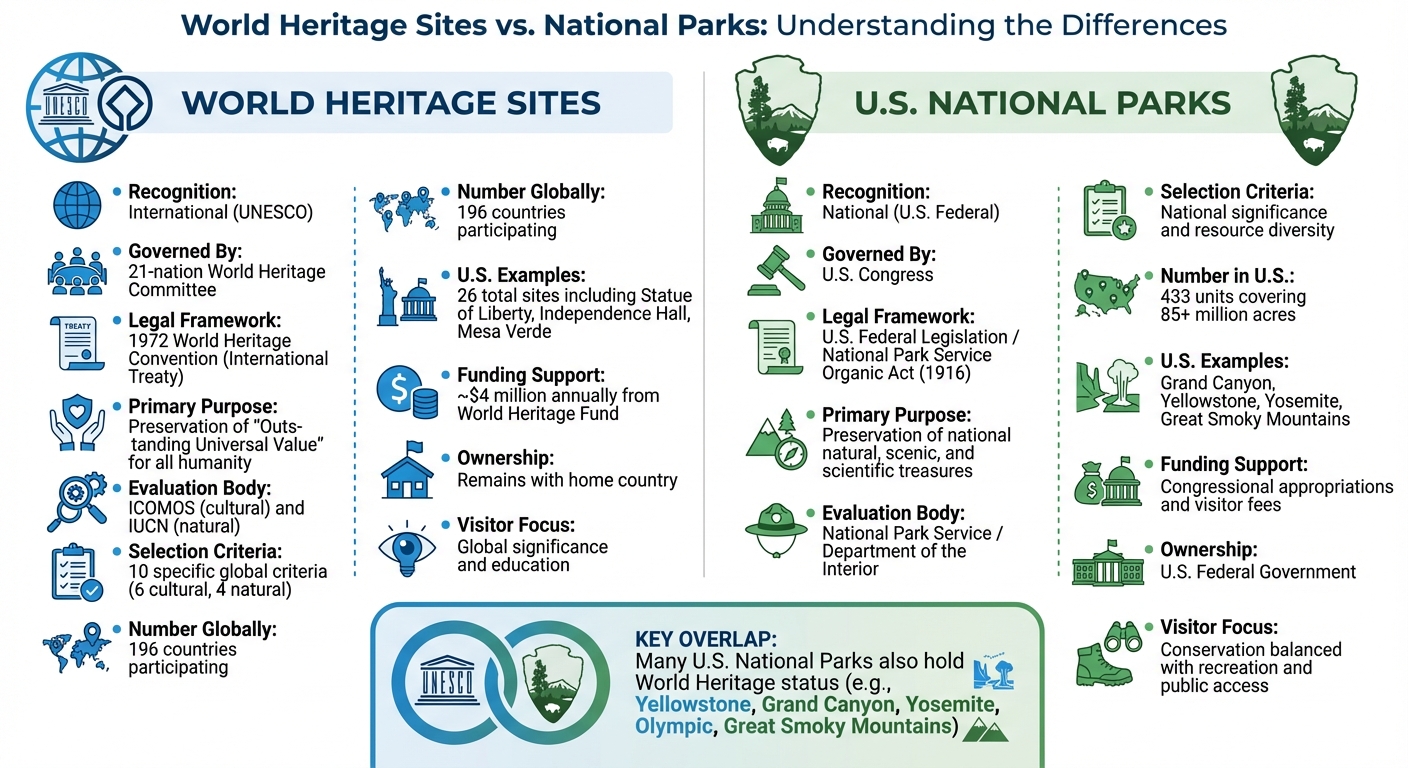
World Heritage Sites vs National Parks: Key Differences Comparison Chart
World Heritage Site Designation
What Is a World Heritage Site?
A World Heritage Site is a landmark recognized under the World Heritage Convention, overseen by UNESCO, for its "Outstanding Universal Value" that transcends national borders. These sites can be categorized as cultural (like historic monuments), natural (such as distinctive ecosystems), or a combination of both. By 2024, 196 countries had ratified the World Heritage Convention.
"Heritage is our legacy from the past, what we live with today, and what we pass on to future generations. Our cultural and natural heritage are both irreplaceable sources of life and inspiration." – UNESCO
Importantly, the designation does not transfer ownership; the country where the site is located retains full control. Instead, it brings international recognition and potential access to resources, such as an annual allocation of about $4 million from the World Heritage Fund to aid conservation efforts. Achieving this status requires meeting specific selection criteria.
Selection Standards
World Heritage sites are chosen through a rigorous evaluation process based on clearly defined international criteria. To be included on the World Heritage List, a site must satisfy at least one of ten selection criteria, which are divided into cultural (i–vi) and natural (vii–x) categories.
Cultural criteria focus on elements like human creative genius, historical importance, and architectural excellence. Natural criteria, on the other hand, emphasize features such as extraordinary natural beauty, geological processes, and biodiversity. Cultural sites must demonstrate authenticity, while natural sites must show integrity. Expert panels – ICOMOS for cultural nominations and IUCN for natural ones – conduct evaluations, and the final decision is made by the 21-member World Heritage Committee.
| Criterion | Category | Focus Area |
|---|---|---|
| (i)–(vi) | Cultural | Human creative genius, historical significance, architectural achievements, cultural traditions |
| (vii)–(x) | Natural | Exceptional natural beauty, geological history, ecological processes, biodiversity conservation |
| Mixed | Both | Properties satisfying both cultural and natural criteria |
These criteria are applied to real-world sites, showcasing their global importance.
Examples of World Heritage Sites
Yellowstone National Park holds the distinction of being the first U.S. site to receive World Heritage status in 1978. This recognition highlights its significance not only to the nation but also to the global community.
Other U.S. National Parks with this designation include the Grand Canyon, Yosemite, Olympic, and the Great Smoky Mountains. In 1995, Yellowstone faced challenges when the World Heritage Committee added it to the List of World Heritage in Danger due to threats from mining activities impacting its aquifer. However, after mitigation efforts and consistent reporting, the park was removed from the Danger List in July 2003. This example demonstrates how the designation can encourage international cooperation and accountability in conservation efforts.
sbb-itb-00512f3
National Park Designation in the U.S.
What Defines a National Park?
National Parks are all about preserving the rich natural and cultural treasures found across the United States. Unlike World Heritage Sites, which have global recognition, National Parks focus on safeguarding assets that are uniquely American.
A National Park falls under the management of the National Park Service, part of the Department of the Interior. President Woodrow Wilson established the National Park Service on August 25, 1916, by signing the "Organic Act". Its mission? To protect and conserve the country’s natural landscapes and cultural heritage for both today’s visitors and future generations.
Currently, the National Park System includes 433 units, covering over 85 million acres in all 50 states, the District of Columbia, and U.S. territories. While the system includes various designations like National Seashores, National Battlefields, and National Monuments, these are often collectively referred to as "parks". However, a true National Park stands out because it spans a large area and contains a mix of natural and cultural resources, unlike monuments that typically focus on a single feature.
Standards for National Park Status
To earn the prestigious National Park designation, sites must meet strict criteria. They need to demonstrate national importance through features like scenic landscapes, scientific value, or ecosystems that are distinct – whether that’s a dense forest, sprawling grassland, arid desert, or striking geological formations.
"Generally, a national park contains a variety of resources and encompasses large land or water areas to help provide adequate protection of the resources." – U.S. National Park Service
National Parks also play a critical role in preserving geological history and providing habitats for rare or endangered species. Interestingly, more than half of the units in the National Park System focus on protecting historical sites or commemorating significant events and figures from U.S. history. This dual mission ensures that both natural wonders and cultural stories are preserved for generations to come.
Examples of U.S. National Parks
Great Smoky Mountains National Park, located on the border of North Carolina and Tennessee, is a perfect example of the system’s diversity. It not only protects an incredible array of natural resources but also safeguards cultural heritage tied to the region. On the other hand, California’s Yosemite National Park is a testament to geological grandeur, with its towering granite cliffs and dramatic waterfalls telling the story of Earth’s dynamic processes.
These parks demonstrate how the U.S. National Park designations strike a balance – preserving nature and history while remaining accessible to the public. This sets the stage for exploring how management and protection efforts vary across the system, as discussed in the next section.
Key Differences Between World Heritage and National Park Designations
Purpose and Recognition
The main distinction between these two designations lies in their scope and audience. World Heritage Sites are recognized for their "outstanding universal value to humanity", making them global treasures. In contrast, National Parks focus on preserving the natural and cultural resources of the United States specifically for the benefit of its citizens and visitors.
Think of World Heritage status as an international accolade awarded by UNESCO’s 21-nation committee, while National Park designation is a federal acknowledgment granted by the U.S. Congress. As the National Park Service explains:
"The World Heritage Convention… is the American national park idea being carried out worldwide".
This global framework has immense reach – 196 states have signed the World Heritage Convention, making it one of the most universally recognized international agreements. Up next, let’s dive into how these designations are achieved.
Standards and Designation Processes
The processes for earning these designations are quite different. World Heritage Sites must satisfy at least one of ten international criteria, which include six cultural and four natural benchmarks. These sites are evaluated by ICOMOS (for cultural sites) and IUCN (for natural sites) before the World Heritage Committee makes its final decision.
On the other hand, National Parks go through a domestic process driven by U.S. federal legislation. Congress determines whether an area qualifies for National Park status based on its national significance, scenic beauty, and ability to protect diverse resources. This overlap in purpose is why many U.S. National Parks also hold World Heritage status. For instance, Yellowstone and Mesa Verde were the first U.S. sites added to the World Heritage List back in 1978. These distinct processes reflect the unique missions of each designation in safeguarding natural and cultural landmarks.
Comparison Table
Here’s a quick comparison of the two designations:
| Feature | World Heritage Site | U.S. National Park |
|---|---|---|
| Recognition | International (UNESCO) | National (U.S. Federal) |
| Primary Purpose | Preservation of "Outstanding Universal Value" for all humanity | Preservation of national natural, scenic, and scientific treasures |
| Legal Framework | 1972 World Heritage Convention (International Treaty) | U.S. Federal Legislation / National Park Service Organic Act |
| Decision Maker | 21-nation World Heritage Committee | U.S. Congress |
| Evaluation Body | ICOMOS (cultural) and IUCN (natural) | National Park Service / Department of the Interior |
| Criteria | 10 specific global criteria | National significance and resource diversity |
| U.S. Examples | Statue of Liberty, Independence Hall | Grand Canyon, Yellowstone, Yosemite |
It’s important to note that World Heritage designation does not affect ownership – the U.S. retains full authority over its 26 World Heritage Sites. Both systems also include measures to protect endangered locations. For example, UNESCO maintains a "List of World Heritage in Danger", which currently includes the Everglades National Park.
26 Hidden UNESCO World Heritage Sites in the USA That Nobody Talks About!

Management and Protection Differences
When it comes to managing globally and nationally recognized sites, the strategies in place highlight key differences in oversight and operational control.
World Heritage Site Management
World Heritage designation relies on international collaboration without transferring ownership or control to UNESCO. As the National Park Service explains:
"The Convention is based on key principles. Each nation retains sovereignty and control over its World Heritage Sites."
Rather than taking direct control, UNESCO provides oversight and guidance. The World Heritage Centre in Paris coordinates a 21-nation committee that monitors the sites and offers recommendations. Local authorities remain responsible for day-to-day management. Three advisory bodies – IUCN, ICOMOS, and ICCROM – evaluate site conditions and provide technical expertise. Countries are required to submit periodic reports detailing their conservation efforts. If a site faces serious threats, it can be placed on the "List of World Heritage in Danger", which currently includes 52 sites worldwide. This designation aims to prompt corrective action.
To support these efforts, the World Heritage Fund allocates approximately $4 million annually to assist sites in need. Over the Convention’s 50-year history, only three sites have been permanently removed from the list: the Arabian Oryx Sanctuary in Oman, Germany’s Elbe Valley, and Liverpool Maritime Mercantile City in the UK.
National Park Management
U.S. National Parks, on the other hand, operate under federal oversight. The National Park Service (NPS), part of the Department of the Interior, handles daily operations, enforces conservation policies, and manages visitor services. Park rangers ensure compliance with regulations, protect wildlife, and assist visitors. Funding for these efforts comes from Congressional appropriations and visitor fees, which support activities like trail upkeep, wildlife monitoring, and search and rescue efforts. This direct federal control shapes the overall visitor experience in National Parks.
Effects on Visitors
The differences in management have a noticeable impact on visitors. National Parks are designed to balance conservation with recreation, providing amenities like campgrounds, visitor centers, ranger-led programs, and well-maintained trails. This approach reflects the NPS mission to make parks accessible and enjoyable for the public.
World Heritage Sites, however, prioritize preserving their "Outstanding Universal Value" and educating visitors about their global importance. Visitors to sites with both national and international recognition may encounter materials that emphasize a site’s global significance while still enjoying recreational amenities. World Heritage designation can also drive dramatic increases in tourism. For instance, Angkor Wat saw its visitor numbers jump from 22,000 annually in 1992 to 5 million by 2022. Similarly, Venice, which hosted 25 million visitors in 2019, has introduced entrance fees to manage overcrowding.
For U.S. travelers, even at sites with dual recognition, the experience is shaped by NPS management, with familiar features like federal entrance fees, clear regulations, and the presence of park rangers ensuring a consistent and accessible visit.
Conclusion
Understanding the differences between World Heritage Sites and National Parks can help you make more informed travel decisions. National Parks are areas of national importance that balance conservation with public enjoyment. They often feature amenities like well-maintained trails, campgrounds, and ranger-led programs. On the other hand, World Heritage Sites are recognized for their "Outstanding Universal Value", meaning their significance transcends national borders.
While these designations sometimes overlap, they operate under distinct systems. The United States is home to 26 World Heritage Sites, including Yellowstone and the Grand Canyon, many of which are also National Parks. This overlap reflects the shared goal of preserving exceptional landscapes and cultural landmarks, though the two systems approach this goal differently.
National Parks are managed federally, with funding from Congressional appropriations and visitor fees. World Heritage Sites, however, remain under national sovereignty but benefit from international collaboration and resources like the World Heritage Fund, which allocates about $4 million for emergency conservation efforts.
For visitors, these differences translate into unique experiences. If you’re looking for outdoor activities like hiking, camping, or wildlife watching, National Parks may be your best bet. But if you’re drawn to destinations celebrated worldwide for their cultural or natural significance, World Heritage Sites offer a different kind of adventure.
The National Park Guide can help you navigate these distinctions and explore the 423 sites within the U.S. National Park System. Whether you’re planning your first trip or your fiftieth, knowing what each designation represents ensures your travels align with your interests and enhance your overall experience.
FAQs
Can a place be both a World Heritage Site and a U.S. National Park?
World Heritage Sites and U.S. National Parks can absolutely overlap. World Heritage Sites, designated by UNESCO, are recognized for their universal value, whether cultural, natural, or both. On the other hand, U.S. National Parks prioritize conservation and recreation for the public. Some places, such as Yellowstone and Olympic National Park, meet the standards for both, earning global recognition while staying within the U.S. national park system. These dual designations highlight their importance on both a national and international scale.
Does UNESCO control or change the rules at World Heritage Sites in the U.S.?
UNESCO doesn’t manage or change the rules for U.S. World Heritage Sites. Instead, it offers guidelines and sets international standards to safeguard these sites. However, the actual management and protective measures for each site are entirely handled by the U.S. government. This approach ensures alignment with global standards while keeping control at the local level.
What does being on the “World Heritage in Danger” list actually do?
When a site is added to the “World Heritage in Danger” list, it draws global attention to the challenges it faces. These challenges might include natural disasters, pollution, or conflicts. This designation encourages international cooperation and support, leading to the creation of action plans aimed at safeguarding the site’s universal value and ensuring it remains intact for generations to come.