
Surviving in the wilderness requires preparation. Packing the right gear can mean the difference between safety and danger. Here’s a quick list of the ten most important items to include in your survival kit:
- Multi-Tool Knife: Compact and versatile, it handles tasks like cutting, repairing, and fire-starting.
- First Aid Kit: Essential for treating injuries with bandages, antiseptics, and trauma tools.
- Button Compass and Maps: Reliable navigation tools when GPS fails.
- Headlamp with Extra Batteries: Hands-free light for nighttime tasks and emergencies.
- Paracord: Durable cord for shelter building, repairs, or traps.
- Fire Starter Kit: Ferro rods or waterproof matches to ignite fires in any condition.
- Water Purification Tools: Tablets or filter straws to make water drinkable.
- Emergency Blanket and Poncho: Protection against cold, rain, and wind.
- Whistle and Signal Mirror: Tools to help rescuers locate you quickly.
- Duct Tape: A fix-all for gear repairs and emergency solutions.
Why These Items Matter
Each item addresses key survival needs – shelter, water, fire, navigation, and signaling for help. With over 600,000 people going missing annually in the U.S., preparation is critical. Equip yourself with these essentials before heading out into the wild.
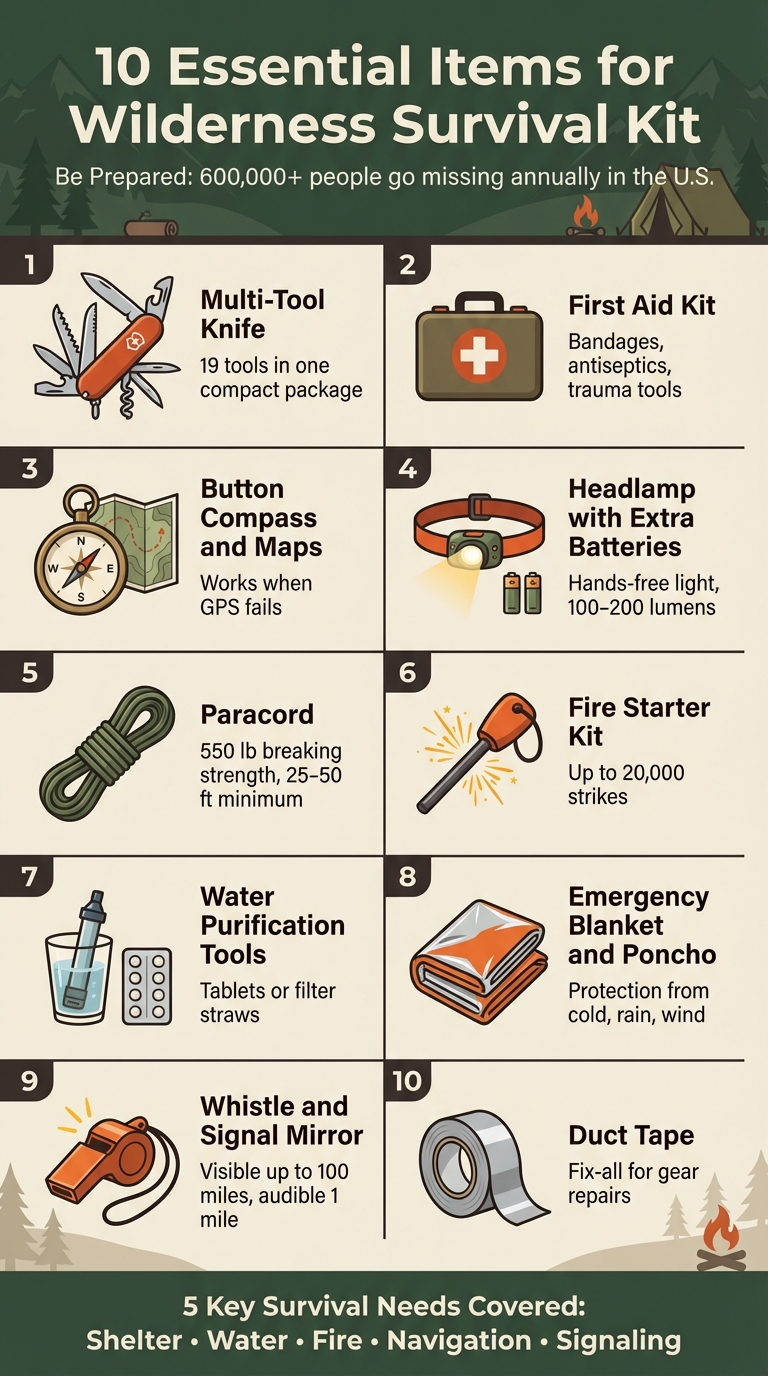
10 Essential Items for Wilderness Survival Kit
1. Multi-Tool Knife
Multi-functionality
A multi-tool knife combines several essential tools into one compact package. Think pliers, screwdrivers, wire cutters, saws, and can openers – all in a single unit. Take the Leatherman Signal, for example. It’s built with outdoor survival in mind and comes equipped with 19 tools, including a fire starter and whistle. This level of versatility lets you tackle tasks like sharpening sticks for shelters, cutting cordage, fixing broken gear, or prepping meals – all without lugging around a bag full of separate tools.
"Instead of carrying separate tools like a knife, saw, and driver, you can carry one multitool that does it all. This keeps your pack lighter and your gear simpler while making sure you’re ready for unexpected jobs." – Leatherman
Durability
Durability is key when it comes to multi-tools. Look for stainless or high-carbon steel blades – they stay sharp longer and fight off rust. Secure locking mechanisms are another must-have, ensuring tools stay firmly in place during tough jobs and reducing the risk of accidental closures. For instance, the Leatherman Wave Plus, with over 2,500 reviews and a 4.7/5-star rating, offers all-locking tools for $129.95. If you’re looking for even more options, the Leatherman ARC provides 20 tools at $249.95.
Portability
A good multi-tool should be lightweight and easy to carry. Compact designs with ergonomic, non-slip handles are especially handy in wet or freezing conditions. The Leatherman Skeletool CX is a great example – it weighs just a few ounces, includes seven essential tools, and costs $99.95. Keep your multi-tool within reach by attaching it to your pack’s MOLLE webbing or stashing it in an outer pocket, so it’s ready when you need it most.
Essential for Survival
Emergency features like fire starters, whistles, and glass breakers can be lifesavers. Regularly check that your tool’s locking mechanisms work and keep the blades sharp to ensure it’s ready for action. These features are invaluable for building fires, constructing shelters, or signaling for help in an emergency. While multi-tools are great for versatility and repairs, pairing one with a fixed-blade knife is wise if you expect to do heavy chopping for firewood or shelter building. Once your multi-tool is sorted, don’t forget to pack a solid first aid kit for those unexpected medical needs.
sbb-itb-00512f3
2. First Aid Kit
Essential for Survival
A first aid kit is a must-have in any survival setup, acting as your lifeline when dealing with injuries in the wilderness. Stock it with essentials for wound care: fabric bandages (in various sizes), gauze pads, wound closure strips, antiseptic towelettes, povidone-iodine, antibiotic ointment, and a 12cc irrigation syringe. Don’t forget nitrile gloves – they’re vital for maintaining hygiene and avoiding cross-contamination.
To handle a range of situations, include tools like trauma shears, tweezers, an oral thermometer, and a rescue mask. For sprains or fractures, pack SAM splints (durable and waterproof), elastic wraps (4-6 inches), triangular bandages, and self-adhering Coban wrap. Foot care is also critical – blisters can derail a trip fast. Moleskin dressings and "2nd Skin" gel bandages can prevent small issues from escalating into major problems.
"It’s usually cheaper to buy a pre-made first aid kit, and then add extra supplies based on your needs, than it is to build one from scratch." – Sarah Buer, former marketing coordinator, NOLS Wilderness Medicine
Much like a multi-tool, a compact and well-equipped first aid kit is non-negotiable for wilderness emergencies.
Durability
Keeping your supplies in good condition is just as important as having them. Moisture can ruin sterile items, so seal dressings in clear plastic to protect them. Store delicate tools, like rescue masks, in hard-shell cases to prevent damage. Before every trip, inspect your kit to ensure sterile items remain sealed and medications are still valid.
"Be sure to protect sterile dressings from moisture by sealing them in clear plastic packaging." – Sarah Buer, NOLS
Portability
Your first aid kit should be easy to grab in an emergency. Keep it in a clearly labeled, accessible pouch, and make sure everyone in your group knows where it’s stored. Label medications with instructions for use to avoid confusion. After every trip, restock the kit immediately so it’s ready when you need it. Store it alongside other essential gear to keep your survival system organized and efficient.
3. Button Compass and Maps
Essential for Survival
When your phone runs out of battery or GPS signals are lost in remote areas, a button compass paired with a topographic map becomes your lifeline. Unlike electronic devices, which depend on batteries and signal reception, a compass works with Earth’s magnetic field. GPS units often fail in areas with no cell coverage or dense vegetation where signals can’t penetrate. While a compass helps you find direction, a topographic map provides detailed information about trails, roads, and terrain features that a compass alone can’t reveal. For off-trail hiking or when snow obscures paths, these tools are indispensable.
One important detail to remember is magnetic declination – the angle between true north and magnetic north. For instance, in Olympic National Park, this declination shifts westward by 7.5 minutes each year and is currently about 15.5° east.
"While a GPS may be better at pinpointing your exact location from any spot on Earth, it requires something you won’t be able to provide in a worst case scenario — a charged battery." – Charles W. Bryant, Author, MapQuest Travel
Thanks to their compact design, these tools are easy to carry and always within reach.
Portability
Button compasses are incredibly portable. They can be clipped onto watch bands, backpack straps, or even tucked into your pocket without adding noticeable weight. Popular options include the Suunto Clipper L/B NH Compass ($25.99, rated 5.0/5.0) and the Slip-on Wrist Compass ($8.99), both of which ensure you always have a navigation tool on hand. To keep your map safe and accessible, fold it to highlight your planned route and store it in a waterproof bag.
Durability
Mechanical compasses are built to endure tough conditions. They’re waterproof and free of electronic components, making them reliable even in extreme weather conditions that could damage smartphones or GPS devices. Similarly, physical maps require no power and provide a comprehensive, always-visible view of your surroundings. Before heading out, make sure to get a topographic map of your destination and practice your orienteering skills in a controlled environment.
Multi-functionality
These tools are more than just durable; they often come with extra features. Many compasses include integrated signal mirrors on their underside, which can be used for navigation or emergency signaling. On clear days, a mirror flash can be seen from up to 100 miles away. This added functionality makes a compass an even more valuable tool, despite its small size.
4. Headlamp with Extra Batteries
Essential for Survival
When darkness falls, a headlamp becomes a must-have tool. Unlike flashlights or lanterns, headlamps allow you to keep your hands free for critical tasks like setting up a shelter, providing first aid, or navigating tough terrain. According to the National Park Service, this hands-free functionality makes headlamps the top choice for outdoor lighting:
"Headlamps are the preferred light source because they are hands-free." – National Park Service
With around 2,000 deaths annually in the U.S. attributed to weather exposure, having a reliable light source can be life-saving. It’s not just about seeing your surroundings – it’s about finding shelter, building a fire, and staying safe. Many headlamps also feature a strobe mode, which can act as an emergency signal to alert rescue teams when other methods fail at night.
Durability
A survival-ready headlamp needs to handle tough outdoor conditions. Look for models with an IP68 rating, which means they’re dust-proof and can survive being submerged in water up to 6.5 feet deep for 30 minutes. The Fenix HM50R V2.0, priced between $135 and $200, is a standout for its ruggedness, featuring a full aluminum casing and IP68 certification. It’s often described as "bombproof" for its durability. For cold-weather adventures, opt for a headlamp with a removable battery pack. You can keep the batteries warm in your pocket to extend their life in freezing temperatures.
Multi-functionality
Modern headlamps offer more than just basic lighting. Key features to look for include:
- A high-lumen beam (100–200 lumens) for navigating trails.
- A low-lumen mode for tasks around camp.
- A red-light mode to preserve your night vision.
The Petzl Actik Core, priced around $88 and rated "Best Overall", delivers an impressive 625 lumens. It also supports both rechargeable lithium-ion and standard AAA batteries, giving you flexibility and peace of mind with backup options.
Portability
Weighing just 1.7–3.1 ounces, headlamps are easy to carry. Don’t forget to pack extra batteries in a waterproof container to ensure they stay dry. Before heading out, test your headlamp and check the battery expiration dates. Models with a lockout feature are especially handy – they prevent accidental activation in your pack, which could drain the battery before you even use it.
5. Paracord
Essential for Survival
When you’re out in the wild, making rope from scratch is next to impossible. Sure, you could try crafting cordage from natural materials like spruce boughs or birch bark, but that’s a time-intensive bushcraft skill – not something you can whip up on the fly, especially in urgent situations like setting up shelter in the dark.
"Cordage is hard to improvise. You can make cordage but it is definitely a skilled, long-term bushcraft project, and not something you’re going to do in the dark when you realize you aren’t going to walk your way to safety that night." – Swift Silent Deadly
This is why having reliable cordage is a must. Packing at least 25–50 feet of 550 paracord is smart, but if you can, go for 100 feet. It’s a lifesaver when you’re in a pinch.
Multi-functionality
Paracord is like the Swiss Army knife of cordage – it’s great for both heavy-duty and more delicate tasks. Need a waterproof shelter? Use it to secure plastic sheeting or contractor trash bags, and you’ll have a dry spot in minutes. Compare that to the hours it would take to gather and prepare natural materials.
But that’s not all. Paracord is perfect for dragging game, bundling firewood, setting up traps or snares, and even hanging food out of reach from animals. Its versatility extends further with its seven inner strands. You can strip these out to handle finer jobs like sewing or even fishing. Toss a few hooks into your kit, and you’re ready for emergency fishing. Want quick access? A paracord bracelet ensures you’ve always got some on hand.
Durability
Made from tough nylon, 550 paracord is built to handle demanding tasks in the wild. Whether you’re climbing steep terrain, dragging heavy loads, or setting up a makeshift clothesline in rough weather, it won’t let you down. That "550" in its name? It’s a nod to its 550-pound breaking strength, which makes it dependable for almost any challenge nature throws your way.
6. Fire Starter Kit
Essential for Survival
Fire is a game-changer in survival situations. It provides warmth, purifies water, and can signal for rescue when needed. Between 2006 and 2010, weather exposure claimed around 2,000 lives annually in the U.S.. Yet, most people struggle to start a fire without tools. A reliable fire starter kit ensures you can ignite a flame, even in cold, wet, or otherwise tough conditions.
Durability
When choosing a fire starter kit, durability is key. Ferrocerium rods stand out for their longevity, with some models – like the Wolf & Grizzly or Überleben Zünden – offering up to 20,000 strikes. That translates to thousands of fires from one tool, far outlasting matches or lighters. Materials like titanium-coated stainless steel or 6061 anodized aluminum further enhance the tool’s resilience.
Magnesium shavings, which burn at an intense 5,400°F, can ignite damp tinder, making them invaluable in poor weather. Waterproofing is another crucial feature. Kits with IPX4-rated water-resistant capsules or waterproof housings protect tinder and strikers from rain or accidental submersion. For added convenience, tools like the UST BlastMatch (around $20) are designed for one-handed use, making them practical if you’re injured.
Multi-functionality
Some fire starter kits go beyond their primary purpose by incorporating extra survival tools. For example, the Outdoor Element Firebiner (around $15) combines a ferro rod with a screwdriver, blade, and bottle opener, all within a compact carabiner. Others include whistles that can reach 100 decibels, built-in flashlights, or safety blades.
Even the lanyards in some kits serve dual purposes – crafted from paracord with a jute core, they can double as emergency tinder. To ensure reliability, it’s smart to carry at least two ignition methods, such as a ferro rod paired with waterproof matches or a lighter. Specialized tinder, like Tinder-Quik tabs or magnesium shavings, can also save valuable time when starting a fire.
Portability
Fire starter kits are designed to be compact and lightweight, typically under 5 inches long and weighing just 2–3 oz. They easily slip into a pocket or emergency kit without adding bulk. MOLLE-compatible storage options allow for quick access during emergencies.
For instance, the Wolf & Grizzly Ferro Rod (around $27) measures 4.9" x 0.8" and still delivers up to 20,000 strikes. Even more comprehensive options, like the Weyland Fire Starting Kit (around $29.95), remain portable while including extras like fatwood tinder and a collapsible stainless steel bellows to help oxygenate flames.
7. Water Purification Tablets and Filter Straw
Essential for Survival
When you’re in the wilderness, having access to clean water is just as important as finding shelter or starting a fire. Untreated water can carry harmful pathogens and even microplastics, which pose serious health risks. Dehydration can set in quicker than you think, leading to serious physical and mental impairments.
"With just mild dehydration you can become lethargic, dizzy, and confused. Your body loses its ability to cool itself and you risk severe heat-related injuries like heat stroke." – SwiftSilentDeadly
Chemical water purification tablets, like the Katadyn Micropur MP1 (approximately $20 for a pack of 30), offer a fast and efficient way to make water safe to drink. These tablets typically work in about 30 minutes, which is much faster than boiling water – an often time-intensive process requiring fire preparation and cooling. A pack of 10 tablets can treat around 2.5 gallons of water, enough for a three-day emergency.
Filter straws, on the other hand, provide nearly instant access to drinkable water. The Sawyer Mini, for instance, costs about $33.99, weighs only 2 ounces, and can filter up to 100,000 gallons of water with its 0.1-micron filter. Another option, the LifeStraw Peak Squeeze, weighs 3.8 ounces and has a lifespan of around 2,000 liters (about 528 gallons).
Durability
When it comes to longevity, high-quality filter straws are built to withstand extensive use. The Sawyer Squeeze, for example, comes with a lifetime guarantee and can filter 1 liter of water in just 40 seconds. However, filters can clog if used with water containing a lot of sediment or silt. The Grayl Geopress, which has received an average rating of 4.91 out of 5.0 from 58 reviews, can handle about 350 cycles (around 65 gallons). That said, its performance can diminish in murky conditions. To extend the life of your filter, you can use a pre-filter like the Pathfinder Millbank Bag ($23.99, rated 4.92/5.0) to remove suspended solids before filtration.
Water purification tablets, on the other hand, are incredibly reliable since they don’t have any moving parts that could fail. Just make sure to store them in a dry place and check their expiration dates regularly. The National Park Service advises inspecting all survival gear and replacing expired items to ensure you’re always prepared.
Portability
Both options are designed for convenience and portability. Tablets are lightweight and compact enough to fit into any pocket. Filter straws, like the Sawyer Mini, are small enough to fit in the palm of your hand and can be easily packed into a running vest or survival kit. The Sawyer Mini can also attach directly to standard water bottles or be used for direct drinking. Pairing a filtration system with a 32-ounce wide-mouth stainless steel bottle is a smart move – it makes collecting water from shallow sources easier and aligns with standard tablet dosages.
Multi-Functionality
Filter straws are impressively versatile. The Sawyer Squeeze can be used as a personal straw, attached to a water bottle, or even connected to a gravity-fed system for group use. For larger needs, the Platypus GravityWorks system treats up to 4 liters (about 1 gallon) at a time, making it perfect for base camps. Just hang the system and let it filter water while you focus on other tasks.
For extra security, it’s wise to carry both tablets and a filter straw as a backup. Many filters also come with backflush syringes, which help maintain flow rates when dealing with silty water. This combination of methods ensures you’re well-prepared for any water-related challenges in the wild, complementing the other essentials in your survival kit.
8. Emergency Blanket and Poncho
Essential for Survival
When you’re out in the wilderness, shelter isn’t just a convenience – it’s a lifeline. Alongside your multi-tool and first aid kit, compact shelter options like an emergency blanket and poncho are must-haves for handling unpredictable weather. The National Park Service emphasizes this, stating, "Shelter is one of the most important elements during an emergency survival situation. It can protect you from severe weather conditions and exposure to the elements". Without proper protection, hypothermia can set in quickly, especially when you’re wet and cold.
An emergency blanket is a game-changer for extreme conditions, as it reflects and traps your body heat to help maintain warmth. Meanwhile, a poncho or rain jacket provides a crucial barrier against rain and wind. The National Park Service also advises, "Nature is unpredictable. Be prepared for sudden changes in weather conditions. Pack an extra layer of clothing that reflects the most extreme conditions you could encounter". These lightweight, compact solutions ensure you’re ready for whatever nature throws your way.
Portability
Both the emergency blanket and poncho are designed with portability in mind. Emergency blankets fold into a size small enough to slip into any pocket, while ponchos can be rolled into compact bundles that fit seamlessly into your survival kit. They add minimal weight to your pack, which is critical when you’re navigating the backcountry.
Multi-Functionality
These items aren’t just about weather protection – they’re versatile tools in survival scenarios. The emergency blanket can double as insulation, ground cover, or even a signaling device thanks to its reflective surface, which makes you more visible to rescuers. A poncho, on the other hand, works as rainwear but can also be repurposed into a tarp for covering gear or creating a lean-to shelter. And if either one gets damaged, a bit of duct tape can quickly restore its functionality. Knowing how to set up your emergency blanket in different ways can expand your shelter options and boost your survival chances.
9. Whistle and Signal Mirror
Essential for Survival
When you’re lost, getting rescued quickly can make all the difference. Research shows that survival rates drop sharply from 90% in the first 24 hours to less than 10% after 72 hours. That’s why carrying a whistle and a signal mirror is so important – they significantly improve the chances of being located by rescuers. According to the U.S. Air Force Survival Handbook, the signal mirror is "Probably the most underrated signaling device found in the survival kit", and it stresses that "Effective signaling is the single most important factor in rapid rescue".
A signal mirror can reflect sunlight and be seen from up to 100 miles under ideal conditions. Even a small mirror, just 1 square inch in size, is visible from 7 miles away. Whistles, on the other hand, can be heard from up to 1 mile away, far exceeding the range of a human voice. Plus, using a whistle takes much less energy than shouting, which is critical when conserving your strength. Both tools rely on the universal distress signal: three whistle blasts or three flashes of light, repeated after a pause. Make sure these tools are easy to access in your survival kit.
Portability
Whistles and signal mirrors are lightweight and compact, so you can always keep them close. Attaching them to a lanyard or a 550-cord necklace ensures they’re accessible even if you lose your pack. They can also be clipped to a Personal Flotation Device (PFD) or survival belt, keeping them within reach when you need them the most.
Durability
Choose a plastic, pealess whistle with a sound output of at least 100 decibels (and up to 142 decibels). Since it has no moving parts, it won’t fail in wet or freezing conditions, and plastic won’t stick to your lips in cold weather. For signal mirrors, military-grade options with retroreflective sighting grids are ideal, as they allow precise aiming at targets up to 50 miles away. Glass mirrors provide the best reflectivity, outperforming plastic or stainless steel alternatives.
Multi-Functionality
In conditions where visibility is poor – like fog, darkness, or dense vegetation – a whistle’s high-pitched sound travels farther than visual signals. To use a signal mirror effectively, form a "V" with your fingers, place the target (such as a plane or rescue team) within the "V", and aim the reflected light at it. Sweeping the horizon systematically can help attract attention, especially if you hear aircraft nearby. If you don’t have a signal mirror, other reflective surfaces like a smartphone screen, foil, or even a CD can work in a pinch.
Wilderness Survival Kit: 10 Essentials You NEED
10. Duct Tape
Wrapping up your survival kit essentials, duct tape is the go-to item for both practical fixes and emergency solutions.
Multi-Functionality
Duct tape is a must-have for any wilderness survival kit. The National Park Service includes it under the "Repair Kit and Tools" category in its 10 Essentials system. Its uses are almost endless: fixing broken tent poles, patching up torn clothing, sealing leaky water containers, or even securing bandages when your medical supplies run low. Essentially, it’s the kind of tool that can save the day when things go sideways. As The Hiking Adventure puts it:
"Duct tape: A versatile tool for repairing gear or creating makeshift solutions"
Whether you’re facing gear malfunctions or unexpected weather delays, a few strips of duct tape can make all the difference in keeping you safe and moving forward.
Durability
Good duct tape is built to last. It holds up against rain, sunlight, and extreme temperatures without losing its stickiness. That said, it’s smart to check your tape periodically since the adhesive can break down over time. Opt for a trusted brand and replace your stash regularly to ensure it’s ready to perform when you need it most.
Portability
Despite its many uses, duct tape won’t weigh you down. You can save space by wrapping a few feet of it around a pencil, trekking pole, or water bottle. Keep it in a spot that’s easy to reach, like an outer pocket of your backpack, so it’s always on hand when the situation demands it.
Essential for Survival
Duct tape earns its place in the 10 Essentials system – a list of critical items for outdoor safety developed by The Mountaineers and highlighted in Mountaineering: The Freedom of the Hills. When you’re far from help, being able to make quick repairs can stop small problems from spiraling into major ones.
With duct tape in your kit, you’re better prepared to handle the unexpected and keep your gear functional in a pinch.
How to Pack and Organize Your Survival Kit
When assembling your survival kit, organization is key to ensuring you can quickly access what you need during an emergency. A modular approach works best – divide items into categories like first aid, tools, and fire-starting gear. Use color-coded compartments or small, separate packs to keep everything in order and avoid a chaotic mess when time is critical. As Paul Nicolazzo, Founder of the Wilderness Medicine Training Center, puts it:
"Packaging that is organized and well thought-out protects valuable and irreplaceable equipment. It permits fast and easy access to emergency gear without ‘vomiting’ kit contents everywhere."
Waterproofing and Labeling
Protecting your gear from water damage is non-negotiable. Seal soft items in small, waterproof bags, and transfer any liquids into durable 1–2 oz Nalgene bottles to avoid leaks. For heavier items, like your stainless steel water bottle, opt for a sling bag or fanny pack to keep the weight close to your body and improve balance.
Label each compartment clearly and include a laminated list of the contents for quick reference. This ensures you can locate items immediately when every second counts.
Quick-Reference Gear Table
To streamline packing, use a table to track the weight, dimensions, and primary purposes of your gear. Here’s an example:
| Item | Weight (Approx.) | Dimensions/Capacity | Primary Use |
|---|---|---|---|
| Stainless Steel Bottle | 12–16 oz (empty) | 32 oz capacity | Hydration, boiling water |
| 550 Paracord | 3–5 oz | 25–50 feet | Shelter building, gear repair |
| Contractor Trash Bag | 2–3 oz | 5’4" x 4′ (opened) | Emergency shelter, poncho |
| Signal Mirror | 2–3 oz | 2" x 3" | Visual signaling |
| Water Tablets | < 1 oz | 10-tablet strip | Chemical water purification |
| ACR Whistle | < 1 oz | Compact/Pea-less | Auditory signaling |
Packing Tips
Store frequently used items in outer pockets for easy access, while heavier gear should sit at the bottom of your bag to maintain balance. Regularly check expiration dates on medical supplies and water purification tablets, replacing them as needed to keep your kit ready for action.
Conclusion
Heading into the wilderness without the 10 essentials is a gamble no one should take. Whether you’re planning a short hike or a multi-day trek, having the right gear can make all the difference in your safety and preparedness.
The National Park Service puts it plainly:
"The 10 Essentials are a collection of first aid and emergency items that can help you in the event of minor injuries, sudden weather changes, or unexpected delays."
Real-world events underscore how critical this preparation is. Take the case of Julian Sands, an experienced hiker and actor who went missing in California’s San Gabriel Mountains near Mount Baldy in January 2023. Despite exhaustive search efforts, his remains were not located until June 27, 2023. This tragic story reminds us that even seasoned adventurers are not immune to the risks of the outdoors.
The 10 essentials, outlined earlier, work together as a system to address critical needs like shelter, hydration, and signaling for help. As The Hiking Adventure aptly noted:
"A well-prepared survival kit ups one’s chances of surviving the odds."
Before your next outdoor adventure, take the time to double-check your gear. Make sure every essential is accounted for. For more detailed advice on preparing for your trip, visit The National Park Guide.
FAQs
How do I choose the right multitool?
To select the best multitool for wilderness survival, prioritize key functions such as a knife, pliers, screwdrivers, and cutting tools. Look for a sturdy, stainless steel design that’s both compact and lightweight, with a reliable locking mechanism for safety. For extra utility, features like a saw, bottle opener, or fire-starting tool can be incredibly helpful. Focus on durability, practicality, and safety to ensure it’s up to the challenges of survival situations.
Should I carry both a filter and tablets?
When heading into the wilderness, it’s a smart idea to pack both a water filter and purification tablets. A filter is great for removing debris and many harmful contaminants, while tablets add an extra safeguard against microorganisms that might slip through. By carrying both, you’re better equipped to handle a variety of water sources and unexpected situations. Experts often recommend this dual approach to ensure safety and reliability when accessing drinking water outdoors.
What’s the best way to pack these items?
Packing your wilderness survival kit requires a compact, durable container – think a rugged backpack or a sturdy survival box. To keep things organized, sort items into categories like navigation or first aid. Use small pouches or resealable bags to separate these groups, making it easier to find what you need quickly. Place essentials like maps or first aid supplies in spots that are easy to reach. For added protection, consider waterproof bags to shield your gear from moisture, keeping everything functional when you need it most.