
Planning an event in a U.S. national park? Whether it’s a wedding, charity run, or commercial filming, you’ll likely need a Special Use Permit from the National Park Service (NPS). These permits regulate activities to protect park resources, ensure public safety, and manage visitor experiences. Here’s what you need to know:
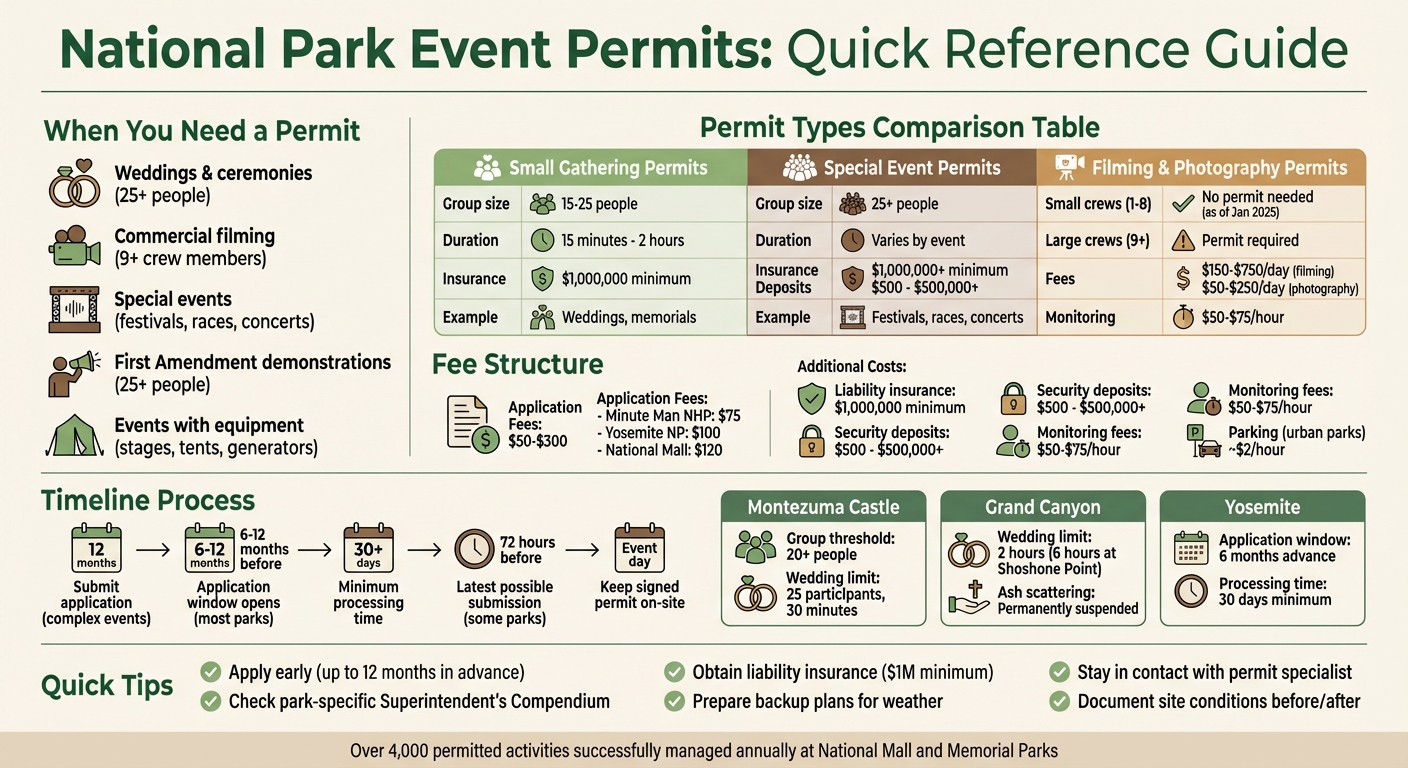
- When Permits Are Required: For events like weddings, races, family reunions, or commercial activities (e.g., filming with crews over 8 people or using equipment). Rules vary by park, so always check specific guidelines.
- Fees: Application fees range from $50 to $300. Additional costs may include liability insurance (minimum $1 million), security deposits, and monitoring fees ($50–$75/hour).
- Processing Times: Submit applications early – up to 12 months in advance for complex events. Simple permits may take 30 days, while larger ones can take months.
- Key Rules: Permits often limit group sizes, event duration, and equipment use. Some parks restrict items like balloons, drones, or alcohol. Always follow park-specific regulations.
For a smooth process, apply early, provide detailed plans, and maintain communication with park staff. Permits ensure your event respects the park while creating a memorable experience.
National Park Event Permit Requirements and Fees Comparison Guide
When You Need a National Park Event Permit
Certain organized activities in national parks go beyond typical visitor use and require special permits. The National Park Service (NPS) defines these as events outside the scope of standard park activities. Here’s a breakdown of when permits are needed and how rules can differ depending on the park.
Events That Require Permits
The size of your group often determines whether a permit is necessary. For example, First Amendment demonstrations require permits if the group exceeds 25 people. Other events like weddings, family reunions, company picnics, festivals, sporting events, pageants, regattas, and historical reenactments typically need permits as well.
Commercial activities, such as charging admission, selling tickets, or conducting commercial filming and photography, also require approval. However, small-scale filming and photography with eight or fewer individuals using only hand-held equipment are exempt. For larger productions, fees start at $150 per day for groups of 1–10 people and increase to $250 per day for groups of 11–30.
If your event involves setups like stages, tents, platforms, generators, or sound systems that could impact park resources, you’ll need a permit. Even activities that seem simple, like scattering ashes, often require permits and are restricted to specific, pre-approved areas. In some parks, such as the Grand Canyon, permits for scattering cremated remains have been permanently suspended.
Park-Specific Requirements
Permit rules can vary significantly between parks. While all parks follow the 36 CFR 2.50 regulatory framework, individual parks tailor their rules based on their size, purpose, and the resources they aim to protect. For instance, Montezuma Castle requires permits for groups of 20 or more on trails, while New River Gorge sets the threshold at 22 for organized hiking or biking events. At New River Gorge, wedding ceremonies at most overlooks are limited to 25 participants and a maximum of 30 minutes. Meanwhile, at the Grand Canyon, wedding ceremonies are capped at two hours, except at Shoshone Point, where ceremonies can last up to six hours.
To understand specific rules for a park, check the Superintendent’s Compendium, which outlines regulations on group sizes, restricted areas, and prohibited items. Many parks ban items like helium or water balloons, fireworks, bounce houses, and even rice or birdseed to protect wildlife and natural resources. Alcohol policies also vary – some parks allow it with prior approval and liability insurance, while others prohibit it altogether in permitted areas. For detailed information, use the "Find a Park" tool on the NPS website to locate the permit page for your chosen park.
sbb-itb-00512f3
Types of Event Permits
Once you’ve figured out whether you need a permit, the next step is understanding the specific types available. The National Park Service (NPS) offers different permits depending on the size, purpose, and commercial nature of your event. Knowing which one applies to your plans will help you gather the right paperwork and budget for any associated costs.
Small Gathering Permits
Small gathering permits are typically for private events like weddings, family reunions, memorials, or other intimate ceremonies. The requirements vary by park, but permits are often needed when group sizes exceed a set limit. For instance, at Shenandoah National Park, a wedding with 16 or more guests or the use of props and decorations requires a permit. Meanwhile, at Isle Royale, ceremonies with 15 or fewer people are allowed for up to 15 minutes without equipment. Larger groups, up to 25 participants, can book designated spots like the Rock Harbor Lighthouse for a two-hour event.
These permits help protect park resources and ensure all visitors have a positive experience. You’ll likely need general liability insurance, and certain items – like balloons, confetti, drones, and live flowers – are prohibited. Keep in mind that holding a permit doesn’t mean you’ll have exclusive use of the area; the space remains open to the public.
Special Event Permits
Special event permits cover larger public activities that draw crowds or require more extensive use of park resources. Events like festivals, concerts, races, walk-a-thons, regattas, pageants, and historical reenactments fall under this category. These permits come with stricter documentation requirements, including liability insurance (minimum $1,000,000 with the U.S. Government listed as an additional insured), security deposits, or surety bonds [3,7].
If your event involves temporary structures – such as tents over 450 square feet, stages taller than 30 inches, generators, or sound systems – you’ll also need safety plans, fire marshal permits, and site inspections [19,20]. Depending on the scale of your event, cost recovery deposits can range from $500 to over $500,000. Applications for these permits can usually be submitted up to a year in advance, but complex events may take months to process [1,17].
Next, let’s look at how permits apply to filming and photography activities.
Filming and Photography Permits
Filming and photography permits are required for professional productions that go beyond certain limits. Thanks to the EXPLORE Act (effective January 4, 2025), small crews of eight or fewer using only hand-carried equipment in public areas won’t need a permit. However, crews of nine or more – or those using props, sets, or heavy equipment – must apply [16,22].
Commercial filming, defined as recording videos intended for a paying audience, always requires a permit. Location fees start at $150 per day for crews of 1–10 people and go up to $750 for crews larger than 50. Still photography permits cost $50 per day for groups of 1–10 and $250 for groups over 30 [16,13]. If your filming or photography is part of an already permitted event, like a wedding or race, you generally won’t need a separate permit or additional fees [16,22]. Parks also often require general liability insurance and charge hourly monitoring fees – usually $50–$75 per hour – for NPS staff oversight [16,12].
How to Apply for an Event Permit
Preparing Your Application
Start by gathering all the necessary documents and information. Most parks require a Special Use Permit application, which you can usually find on the park’s website under sections like "Plan Your Visit" or "Permits". You’ll need to provide key details about your event, such as the type of activity (e.g., wedding, race, or festival), the date and time, the specific park location, and the number of participants expected.
For larger events, you may need to include additional materials like:
- A detailed site map
- A list of equipment
- A schedule for setup and cleanup
- Proof of liability insurance
- A security deposit or surety bond, if required
If your event involves anything out of the ordinary, it’s a good idea to schedule a pre-application meeting with park staff. This can help ensure your application is complete and meets all requirements.
Submitting Your Application
Once your documents are ready, follow the park’s specific process to submit your application. Most parks allow you to apply up to 12 months in advance, but they typically require at least 30 days’ notice for processing. However, timelines can vary. For instance:
- Yosemite National Park: Applications are accepted up to six months in advance, with a minimum 30-day processing time.
- Minute Man National Historical Park: Applications are accepted up to 12 months ahead and, in some cases, as late as 72 hours before an event.
Make sure to confirm the submission method for your park. Some parks accept applications via email or fax, while others require mailed originals along with payment. Payments must be made by credit card, through pay.gov, by cashier’s check, or by money order – cash is not accepted. For example, Minute Man National Historical Park currently only processes payments via checks.
Once your permit is approved, keep the superintendent-signed permit on-site during your event as proof of authorization.
Permit Fees and Processing Times
After submitting your application, review the fee structure and processing timeline. Permit fees vary depending on the park and the event’s scale. Standard application fees typically range from $50 to $300. Here are a few examples:
- Minute Man National Historical Park: $75 non-refundable processing fee
- Yosemite National Park: $100 application fee
- National Mall and Memorial Parks: $120 application fee
In addition to the application fee, you might encounter extra costs for things like overtime, utilities, or post-event maintenance. For example, refundable deposits for large events at the National Mall can range from $500 to over $500,000, depending on the event’s scale. Other potential fees include monitoring charges (usually $50–$75 per hour for staff oversight) and parking fees (approximately $2 per hour at urban parks).
| Park | Application Fee | Earliest Application Window | Minimum Lead Time |
|---|---|---|---|
| Minute Man National Historical Park | $75 | 12 months | 30 days (72 hours minimum) |
| Yosemite National Park | $100 | 6 months | 30 days |
| National Mall & Memorial Parks | $120 | Varies by event complexity | Varies |
Processing times depend on the complexity of your event. Simple permits can often be approved within a few weeks, while more elaborate events – requiring things like site inspections and safety plans – may take several months. High-demand locations, such as Yosemite’s Lower River Amphitheater, are often booked months in advance, so submitting your application early is always a smart move.
Tips for a Successful Permit Application
Start Early and Stay Connected
Submitting your application early is key. Many national parks allow applications up to a year in advance, and popular spots often fill up quickly – sometimes a full year ahead of time.
The National Park Service emphasizes the importance of early communication:
"Early consultation with park staff will help you submit a complete application that they will be able to process in a timely manner".
After submitting, stay in regular contact with your assigned permit specialist. They can help you navigate any additional steps and ensure your application stays on track. Once your application is in, it’s equally important to adhere to the conditions outlined in your permit.
Follow Permit Conditions Carefully
Your permit will include specific conditions, and following them is non-negotiable. Common requirements include liability insurance – usually with a minimum of $1,000,000 – and sound level restrictions, which typically range between 65–85 dB depending on the area. Make sure your insurance certificate lists the "United States of America, Department of Interior, National Park Service" as an additional insured party.
Pay close attention to rules designed to protect park resources. For events involving heavy equipment or large crowds, you might need turf protection measures or specific setup guidelines to prevent damage to park grounds. Conduct a walk-through with park officials before and after your event to document site conditions and avoid potential damage charges.
Prepare Backup Plans
Even the most meticulously planned events can face unexpected hurdles like bad weather, scheduling conflicts, or unforeseen complications. Before submitting your application, confirm alternative dates and locations with the permit office.
If rain occurs before your event, check with your permit specialist to see if the site conditions can handle your event without harm. Having backup plans – whether for indoor venues, postponements, or scaled-down versions of your event – demonstrates your commitment to protecting park resources while ensuring your event runs smoothly. These contingency measures not only reduce risks but also show park officials that you’re serious about preserving the integrity of the park.
Conclusion
Getting an event permit isn’t just a formality – it’s a way to protect the beauty and safety of our parks while ensuring a memorable experience for everyone involved. Permits help safeguard both the natural environment and historical landmarks, all while keeping public safety front and center.
If you’re planning an event, it’s wise to submit your application as early as possible. Many parks allow applications up to a year in advance. Since requirements and restrictions can vary widely from park to park, always check the official .gov website for the specific location you have in mind. The National Park Service highlights the importance of working closely with park staff to create events that respect and protect public lands.
Budgeting is another key part of the process. Expect permit fees to range from $100 to $120, along with liability insurance starting at $1,000,000. Additionally, cost recovery fees can vary widely, from $500 to over $500,000, depending on the size and scope of your event. Careful financial planning and maintaining thorough documentation will help keep the process smooth. It’s also a good idea to document site conditions with park specialists to avoid any misunderstandings later.
Each year, over 4,000 permitted activities are successfully managed at iconic locations like the National Mall and Memorial Parks. The system works best when organizers plan ahead, follow the guidelines, and stay in touch with their permit specialists. By keeping resource protection at the heart of your planning, you’ll not only ensure a safe and successful event but also honor the incredible spaces that make these experiences possible.
FAQs
What do I need to do to get a Special Use Permit for a wedding in a national park?
To get a Special Use Permit for a wedding in a national park, here’s what you need to do:
- Pick an approved location: Start by selecting a spot within the park that’s designated for weddings.
- Reach out to the park: Contact the park office to make a tentative reservation for your chosen date and location.
- Submit the application: Complete and send the official 10-930 (or 10-930s) application, including a COVID safety plan, at least 14 days before your wedding day.
- Pay the fee: A non-refundable $50 application fee is required. If you’re applying with less than 14 days’ notice, you might need to pay an extra $150 cost-recovery fee.
- Finalize the permit: After approval, you’ll receive the permit via email. Sign it and send it back to confirm.
Keep in mind, specific rules and timelines can vary depending on the park, so it’s smart to double-check the details directly with the park office.
How much do national park event permits cost, and how long does it take to get one?
Permit fees and processing times can differ greatly from one national park to another. Each park sets its own costs and timelines based on factors like the size of the event, its potential impact on visitors, and the resources required to manage it. For smaller, straightforward events, the process might take just a few days. However, larger or more complex events could take weeks or even months to finalize. Parks that see heavy traffic, such as Yellowstone or Rocky Mountain, often charge higher fees due to the additional resources needed to protect their environments.
Most parks charge an application fee to account for staff time, but the exact amount varies. To avoid surprises, it’s best to visit the specific park’s website to review their fee schedule and get an idea of the processing times before submitting your application.
What items or activities are commonly restricted for events in national parks?
When planning an event in a national park, it’s important to know that certain items and activities are restricted. These rules are in place to protect the park’s natural beauty, safeguard wildlife, and ensure the safety of all visitors. Commonly prohibited items include fireworks, open flames, and amplified sound that exceeds noise limits. Alcohol may also be restricted unless you’ve obtained a specific permit. Sensitive areas often have additional rules, such as bans on motorized vehicles, generators, or large anchored structures like tents.
Other items that might be off-limits include portable grills, hazardous materials, weapons, and unapproved pets or equipment that could disrupt the local wildlife. Your event permit will detail all the specific restrictions, so it’s crucial to review it thoroughly. Ignoring these guidelines can lead to fines, permit revocation, or even the cancellation of your event.
To avoid any issues, double-check your permit and plan ahead to leave restricted items at home.