
Want to explore U.S. national parks but need trails that are easier to navigate? This guide covers everything you need to know about accessible trails, designed for people with mobility challenges, families with strollers, and older adults. Accessible trails feature stable surfaces, gentle slopes, and nearby amenities like parking and restrooms, making nature more approachable for everyone.
Key Takeaways:
- What makes a trail accessible: Firm surfaces (paved, boardwalks), wide paths, gentle grades, and clear signage.
- Why accessibility matters: 25% of U.S. adults live with disabilities, and accessible trails ensure more people can enjoy national parks.
- Planning tips: Use park websites, call rangers for updates, and consider tools like the Access Pass for free entry and discounts.
- Top parks with accessible options: Zion, Bryce Canyon, Sequoia, and more offer wheelchair-friendly trails and additional features like shuttles and tactile exhibits.
Start planning today with resources like The National Park Guide and the NPS Mobile App for detailed trail info, maps, and updates.
Key Features of Accessible Trails
Design Elements of Accessible Trails
Accessible trails are thoughtfully designed to ensure they cater to a wide range of users. Several key elements make these trails more functional and inclusive.
The surface type is one of the most important considerations. Reliable surfaces include paved asphalt, smooth concrete, and wooden boardwalks. Properly maintained compacted dirt or crushed aggregate can also work, but uneven terrain can create barriers for users. Another critical factor is the slope. These trails are designed with gentle grades and level landings spaced at regular intervals, offering users a chance to rest or reposition. Benches with backrests and adjacent open spaces for wheelchairs or companions are often included.
Trail width and passing space are also essential. Trails must be wide enough to allow two wheelchairs to pass comfortably. Many trails also feature pullouts, which provide extra space for users to step aside or access trail exhibits.
Signage plays a surprisingly large role in accessibility. Interpretive signs on these trails often include high-contrast text, large fonts, and tactile elements like raised lettering or relief maps. These are mounted at heights that are easily reachable for those seated in wheelchairs. For example, at Arches National Park, trailhead signs provide detailed information, such as maximum grade percentages and minimum tread widths, to help visitors assess the trail’s suitability before starting their journey.
Accessible Experiences Beyond the Trail
Accessibility in parks doesn’t stop at trails. Many parks offer additional experiences designed to welcome all visitors.
Some parks allow vehicles with accessible placards to use roads that are typically closed to general traffic, granting access to otherwise unreachable viewpoints. Ranger-led programs, such as evening talks at amphitheaters, are often hosted in venues equipped with assistive listening devices and sound systems. Redwood National and State Parks is a great example of this setup.
Certain parks go above and beyond by providing specialized equipment. At Pictured Rocks National Lakeshore, visitors with color blindness can use EnChroma filters on observation scopes. The park also features the Sand Point Marsh Trail, a 0.5-mile wheelchair-accessible boardwalk complete with a 4-foot-wide surface, railings, and benches along the way. Meanwhile, Big Bend National Park’s visitor center includes tactile exhibits like relief maps, animal furs, and fossils, making the experience more engaging for visitors with visual impairments.
Federal Accessibility Guidelines Explained
The design of accessible trails in national parks is guided by the Architectural Barriers Act (ABA) of 1968, which governs facilities built or altered with federal funding. The U.S. Access Board is responsible for developing the technical standards that bring the ABA’s requirements to life.
"The U.S. Access Board is a federal agency that promotes equality for people with disabilities through leadership in accessible design and the development of accessibility guidelines and standards for the built environment." – U.S. Access Board
These federal guidelines ensure that trail surfaces are firm and stable, a quality measured using a tool called a rotational penetrometer. A study by the National Center on Accessibility, conducted over 51 months, evaluated 11 different trail surface materials. It found that all-aggregate surfaces, when constructed to specific criteria, can maintain firmness and stability with minimal maintenance.
While many people associate accessibility with the Americans with Disabilities Act (ADA), it’s important to note that the ADA primarily applies to state and local government facilities. In national parks, the ABA is the guiding framework. Despite this distinction, both laws share the same overarching goals of functionality and inclusivity.
Familiarizing yourself with these standards can help you better plan and enjoy your accessible park adventures.
sbb-itb-00512f3
Planning Your Accessible Trail Visit
How to Research Accessible Trails
Start by visiting each park’s official NPS Accessibility page to make sure your trip aligns with the accessible features you’re looking for. Every national park includes an "Accessibility" section under its "Plan Your Visit" area. Here, you’ll find detailed information about trails, such as surface materials, grade percentages, tread widths, and available facilities.
Many parks also provide downloadable Accessibility Guides, and some even offer Braille versions. For the most up-to-date trail conditions – especially after weather events like rain or snow – it’s a good idea to call the park directly. Rangers can provide real-time updates on temporary issues like ruts, washouts, or closures that might not be listed online. If you’re deaf or hard of hearing, you can use the Telecommunications Relay Service (TRS) to get in touch with the park.
When choosing trails, look for ones labeled "fully accessible" instead of "partially accessible." For example, Big Bend National Park’s Window View Trail is a 0.3-mile path that’s fully wheelchair accessible, while the Rio Grande Village Nature Trail is only accessible for the first 0.25 miles. This distinction can make a big difference when planning your day.
Before heading out, consider applying for the America the Beautiful – Access Pass. This free lifetime pass is available to U.S. citizens or permanent residents with permanent disabilities. It grants free entrance to all federal lands and includes a 50% discount on camping fees. You can apply online or pick one up at any park visitor center at no cost.
Using Apps and Digital Tools
Once you’ve gathered the basics, digital tools can help fine-tune your plans. Park websites often go beyond simple maps, offering detailed trail metrics like typical grade, maximum grade, cross slope, and minimum tread width. These specifics can help you determine whether a trail is suitable for your mobility device. For instance, Arches National Park’s website notes that 21% of the Balanced Rock Trail exceeds an 8% grade – a key detail if you use a manual wheelchair.
"Each park has its own accessibility section on its website, where details can be found about planning a trip to that park with accessibility needs in mind." – National Park Service
Another helpful tool is the UniDescription app, available for free on iOS and Android. This app provides audio descriptions of park brochures, making visual materials accessible to visitors with visual impairments. Additionally, check the park’s digital "Alerts" section for up-to-date notices about trail obstructions. These alerts are updated regularly and can help you avoid unexpected closures or rough conditions.
NPS websites are designed to meet Section 508 standards and WCAG 2.0 Level A & AA guidelines, ensuring they’re compatible with screen readers and other assistive technologies.
With these digital resources ready, you’ll be better equipped to prepare your gear and handle any changing trail conditions.
What to Pack and How to Prepare
Your gear should match the trail’s surface. For instance, a paved trail may require different equipment than one with compacted gravel or wooden boardwalks. If you’re unsure whether your mobility aid can handle the terrain, contact the park in advance. Some visitor centers even offer wheelchairs or specialized beach wheelchairs for loan.
Even well-maintained accessible trails can develop ruts, potholes, or soft spots after heavy rain. To avoid surprises, check the weather forecast, call ahead to confirm trail conditions, and download offline maps. Be sure to note the park’s contact number, as cell service may be limited in remote areas.
If you’re planning to attend a ranger-led program, confirm whether the route to the amphitheater is paved and ask if assistive listening devices are available. For specialized activities like adaptive rafting, reach out to authorized outfitters ahead of time. For example, Big Bend River Tours can provide information on accommodations for disabled visitors.
The Best US National Parks For Wheelchair Accessible Travel
National Parks With Strong Accessible Trail Options
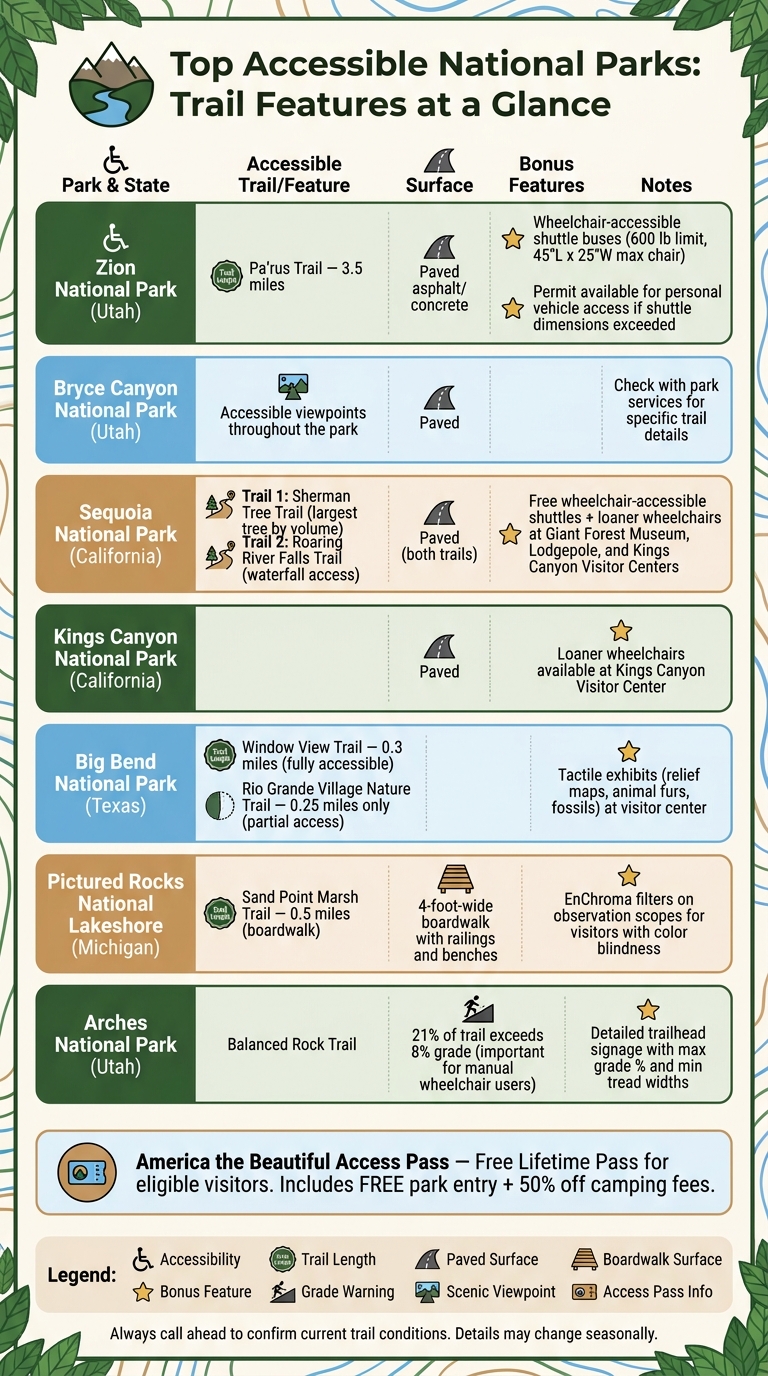
Top Accessible National Parks: Trail Features at a Glance
Some national parks stand out for their accessible infrastructure, making them easier to navigate and enjoy. These parks build on earlier planning tips by offering well-designed, accessible features.
Sequoia and Kings Canyon National Parks
Discover the towering natural wonders of Sequoia and Kings Canyon through accessible trails. The Sherman Tree Trail provides a paved path leading to the General Sherman Tree, the largest tree in the world by volume. Another accessible option is the Roaring River Falls Trail, a paved route that leads to a stunning waterfall. To enhance your visit, take advantage of the free wheelchair-accessible shuttles and loaner wheelchairs, available at the Giant Forest Museum, Lodgepole Visitor Center, and Kings Canyon Visitor Center.
Heading west, Utah offers another set of national parks with excellent accessible features.
Utah’s Mighty Five National Parks
Utah’s Mighty Five parks are designed with accessibility in mind. At Zion National Park, the Pa’rus Trail is a 3.5-mile paved path that meanders along the Virgin River, accommodating both wheelchairs and strollers. Zion also offers shuttle buses equipped with wheelchair lifts, though it’s important to note the lifts have a 600-pound weight limit and size restrictions (chairs must be no larger than 45 inches long and 25 inches wide). If your equipment exceeds these dimensions, you can request a permit for personal vehicle access at the Zion Canyon Visitor Center. Bryce Canyon has earned praise for its accessible viewpoints, making it another great option for visitors with mobility needs.
| Park | Accessible Trail/Feature | Surface Type |
|---|---|---|
| Zion | Pa’rus Trail (3.5 mi) | Paved asphalt/concrete |
| Bryce Canyon | Accessible viewpoints* | Paved |
| Sequoia | Sherman Tree Trail | Paved |
| Sequoia | Roaring River Falls Trail | Paved |
*Trail details may vary – check with park services for the most accurate information.
Tips for Getting the Most Out of Accessible Trails
Navigating Elevation Changes and Surface Transitions
Even trails labeled as "accessible" can present unexpected challenges, such as steeper ramps or uneven surfaces, especially in parks with rugged landscapes. For example, a path leading to an amphitheater or visitor center might include a grade steeper than anticipated. To avoid surprises, it’s a good idea to check trail conditions with park rangers before your visit.
When researching trails, focus on descriptions with specific terms like "flat paved surface", "wide dirt trail," or "boardwalk." These phrases often indicate more consistent and predictable footing. Short, self-guided nature trails – typically around 0.3 miles – are often better maintained and more suitable for wheelchair users. If you encounter new hazards during your visit, report them to park rangers immediately to help keep the trails safe for everyone.
"While not all facilities are fully accessible, park rangers are happy to assist any visitor with special needs." – Big Bend National Park
Being prepared for surface changes is important, but having a companion can make the experience even more enjoyable and safe.
Traveling With Friends or Caregivers
Having a friend or caregiver along can make a big difference, especially on trails with steep grades of 5% or more. Manual wheelchair users may need extra help in these situations, so having someone nearby is essential. If your group includes multiple wheelchair users, it’s smart to call ahead and confirm shuttle capacities. For example, Zion National Park’s standard shuttles can accommodate two wheelchairs, but their "Ride with a Ranger" program uses a larger bus that can hold up to four wheelchairs, making it a great option for larger groups exploring Zion Canyon.
If camping is part of your plan, look for parks with accessible group sites. Zion’s Watchman Campground, for instance, offers two group sites with level surfaces, extended picnic tables, and raised fire pit grills, as of May 2026. Additionally, power-assisted mobility devices can be a game-changer for trails with uneven slopes or loose surfaces, helping everyone in the group keep pace.
After your trip, consider sharing your experience to help improve accessibility for future visitors.
Sharing Accessibility Feedback With Parks
Your firsthand experience can play a vital role in improving trail accessibility. Providing specific feedback to park leadership helps them identify areas that need attention. For instance, you can reach out to the Park Superintendent – Arches National Park can be contacted at 435-719-2299 or via mail at PO Box 907, Moab, UT 84532. Be as detailed as possible when describing the issue, including the location and how it impacted your visit.
If a facility doesn’t meet federal accessibility standards under the Architectural Barriers Act (ABA) of 1968, you can file a formal complaint with the U.S. Access Board, which oversees these standards. For concerns about discrimination in federally conducted programs, contact the Department of the Interior Office of Diversity, Inclusion and Civil Rights (ODICR) by writing to 1849 C Street NW, Washington, DC 20240, or by calling 202-208-1530.
As Big Bend National Park emphasizes:
"We are continually working to upgrade facilities for accessibility and to improve park access for all visitors." – Big Bend National Park
Conclusion: Start Planning Your Accessible National Park Trip
Accessible trails in national parks can provide unforgettable experiences with a bit of preparation. Start by researching park-specific accessibility details, such as trail surfaces, grades, and other key metrics. Reach out to park staff directly to confirm conditions or inquire about available equipment to ensure a smooth visit.
If you qualify, don’t forget to apply for the Access Pass, which grants free entry and a 50% discount on camping fees at many federal sites. Another must-have is the NPS Mobile App – download it and save offline maps, as cell service in parks is often limited.
Before heading out, check the "Alerts" section on the park’s website for updates on trail conditions, shuttle services, or ranger-led programs. Temporary closures due to weather, wildlife, or other factors can impact your plans, so it’s always a good idea to call ahead.
For additional guidance, visit The National Park Guide. It’s a great resource for exploring what each park offers, from trails to essential tips. Whether you’re planning your first accessible trip or returning to a beloved park, having the right information can make all the difference. Let The National Park Guide help you plan with confidence!
FAQs
How do I tell if a trail is truly wheelchair-friendly?
To find a trail that’s wheelchair-friendly, focus on key features like paved, wide, and level paths. Look for amenities such as accessible restrooms, parking, and benches to make the experience more comfortable. Trails designed for accessibility typically have smooth surfaces, gentle slopes, and clear signage at the trailhead. It’s also helpful to check if there are nearby accessible spots like picnic areas or scenic viewpoints. Always review trail descriptions and available amenities beforehand to ensure they align with your specific needs.
What should I do if an “accessible” trail is damaged or closed?
If an accessible trail is damaged or temporarily closed, reach out to park rangers or staff for help. They can share updates on the situation, suggest alternate routes, or point you toward other activities that suit your needs. Before heading out, check the park’s website for the latest trail conditions, and use tools like accessible maps to plan ahead. Park staff are committed to making sure everyone has a safe and enjoyable visit.
Can I borrow a wheelchair or other adaptive gear at the park?
Many national parks offer wheelchairs or other equipment designed to assist visitors with mobility needs. Park rangers are on hand to help visitors requiring additional support. Be sure to contact the specific park you plan to visit ahead of time to confirm availability and get more details.