
Fall is one of the best times to visit many U.S. national parks: crowds often drop after Labor Day, hiking weather gets cooler, and leaf color peaks at different times from late September into November.
If I were planning a fall park trip, I’d focus on three things first:
- Timing: high-elevation parks often peak in late September, while places like Shenandoah and Acadia tend to peak in mid-October, and Zion can peak in late October to November
- Access: some roads, lodges, and campgrounds start closing by mid-to-late October
- Crowds: some parks get quieter in fall, but foliage hotspots like the Smokies and Shenandoah can still be packed on weekends
A few numbers make the case fast. In Grand Teton, visits drop from about 700,000 in summer to just over 200,000 in October. At the Grand Canyon, the average high drops from 92°F in August to 75°F in October. And in the Great Smoky Mountains, fall color spreads across nearly 100 species of deciduous trees.
Here’s the short version of what this guide covers:
- Where fall color usually peaks
- Which parks stand out for autumn trips
- How weather and daylight shape each day
- Which permits and reservations you may need
- What to pack for cold mornings, warm afternoons, and fast weather shifts
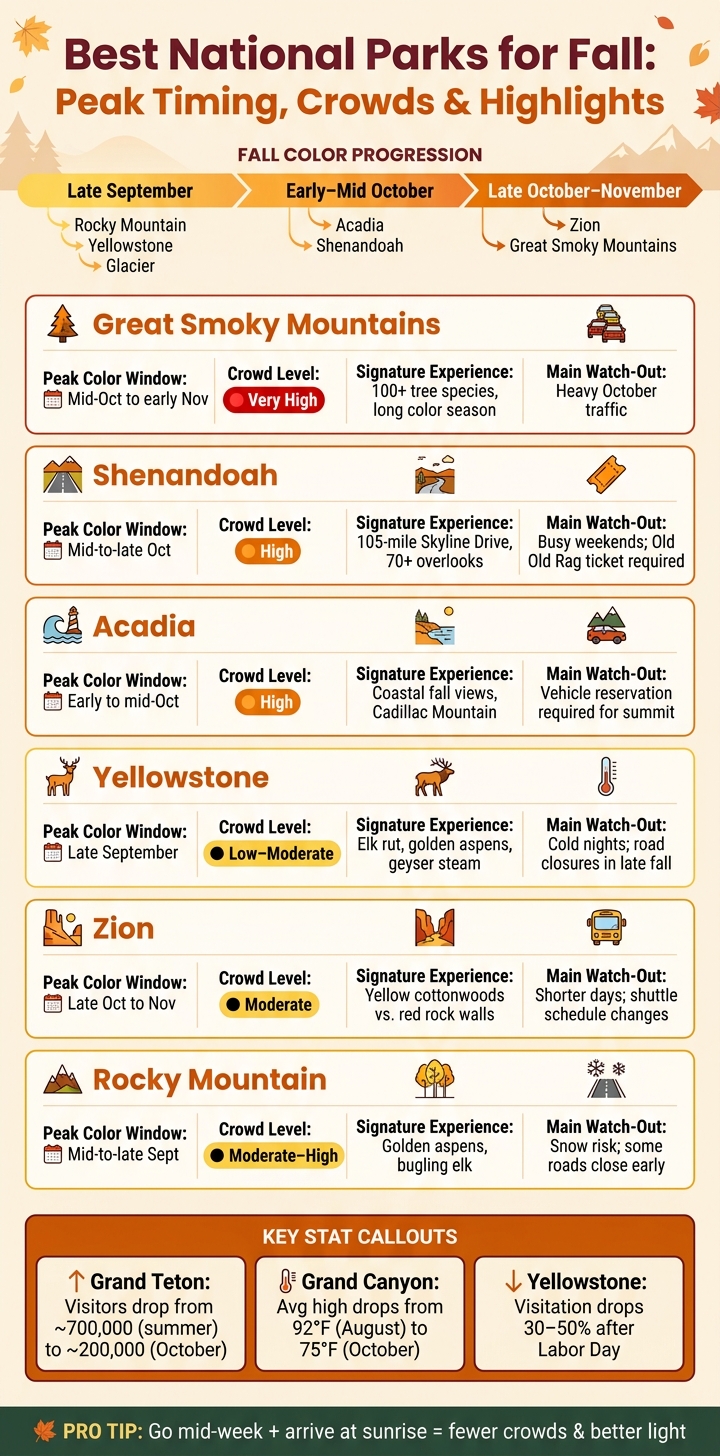
Best National Parks for Fall: Peak Timing, Crowds & Highlights
TOP 5 U.S. National Parks to See Fall Foliage
sbb-itb-00512f3
Quick Comparison
| Park | Best Fall Window | Main Draw | Main Watch-Out |
|---|---|---|---|
| Great Smoky Mountains | Mid-October to early November | Long color season, many tree species | Heavy October traffic |
| Shenandoah | Mid-to-late October | Skyline Drive overlooks | Busy weekends, Old Rag ticket |
| Acadia | Early to mid-October | Coastal fall views, Cadillac Mountain | Vehicle reservation for summit road |
| Yellowstone | Late September | Elk rut, aspens, cooler days | Cold nights, road closures later in season |
| Zion | Late October to November | Yellow cottonwoods against red rock | Shorter days, seasonal shuttle changes |
| Rocky Mountain | Mid-to-late September | Aspens and elk bugling | Snow risk, road limits |
Bottom line: if I wanted the smoothest fall trip, I’d go mid-week, start early in the day, and check road alerts and permits before booking anything.
What Fall Is Like in U.S. National Parks
Fall usually means lighter crowds in many national parks. But the bigger story is how fast conditions can change. Days get shorter, nights get colder, and access starts to shift from week to week.
In western mountain parks like Yellowstone, visitation typically drops 30–50% after Labor Day. That can make the park feel far less packed. At the same time, desert parks become much nicer for hiking once the summer heat backs off.
Fall also brings more moving parts. High-elevation roads can close early, and some lodges and campgrounds begin shutting down by mid-October. In the Great Smoky Mountains, for example, seven of the park’s ten developed campgrounds close after late October. So the calendar alone doesn’t tell the whole story. A park might still be “open,” but the parts you want to use may not be.
Here’s how that plays out in a few major parks:
| Park | Typical Temps | Crowd Levels | Road/Facility Status | Pros | Cons |
|---|---|---|---|---|---|
| Yellowstone | Highs 40s–60s°F; lows 20s–30s°F | Moderate (30–50% drop) | Open until late Oct./Nov. | Elk rut, fewer crowds, fewer insects | Early snow risk, cold nights |
| Shenandoah | 49°F–60°F | Very crowded on weekends | Skyline Drive open; very busy on weekends | Spectacular foliage, crisp air | Weekend traffic, fully booked lodging |
| Zion | 50s–70s°F | Moderate | Timed entry through Oct. 31 | Manageable hiking temps, golden cottonwoods | Shorter days, cold water in the Narrows |
One thing trips people up every year: crowds, foliage, and access do not change on the same timeline.
That’s why fall isn’t always calm. In parks like Shenandoah, peak foliage weekends can be some of the busiest times of the year.
Wildlife is another big reason people love this season. Bears spend fall actively foraging before hibernation. And in Yellowstone, Grand Teton, and Rocky Mountain, the elk rut brings bugling and sparring into open valleys, which often makes animals easier to spot.
Foliage Timing by Region and Elevation
When you plan a fall park trip, the key question isn’t just where. It’s when.
Leaf color doesn’t show up everywhere at once. In many parks, elevation matters more than latitude because colder air at higher altitudes pushes the color change earlier.
On the ground, that usually means:
- Late September is often peak color in high-elevation Rockies parks like Grand Teton, Glacier, and Rocky Mountain.
- Mid-October is the main window for Acadia and Shenandoah.
- Lower-elevation and Southwest spots, including Zion’s canyon floor, often peak in late October into November.
As Bill Wade, Executive Director of the Association of National Park Rangers, noted:
"Foliage changes would start in Shenandoah in early to mid-October and ‘move’ south into the Great Smoky Mountains National Park in late October."
What Fall Weather Looks Like Across Parks
The same elevation that affects foliage also brings colder nights and early snow.
A fall afternoon can feel mild, then the temperature drops hard after sunset. In mountain parks, nighttime lows in the 20s°F are common. A day-to-night swing of 30–40°F is normal, and first-time visitors often don’t pack for that kind of spread.
Rain, frost, and early snow are all possible depending on the park and the week. High-elevation roads like Trail Ridge Road in Rocky Mountain National Park and Going-to-the-Sun Road in Glacier usually close by mid-to-late October because of snow accumulation. If those drives are on your list, earlier fall is the safer bet. Snow can shut them down fast.
Top National Parks for Fall Foliage and Autumn Scenery
Once you’ve got the timing down, the next step is simple: pick the park that gives you the kind of fall trip you want.
Some parks are all about peak leaf color. Others add wildlife, mountain drives, or sharp landscape contrast. The parks below offer the strongest mix of color, scenery, and seasonal access.
| Park | Peak Color | Signature Fall Experiences | Expected Crowd Level |
|---|---|---|---|
| Great Smoky Mountains | Mid-Oct to early Nov | Newfound Gap Road, Clingmans Dome, Cades Cove | Very High |
| Shenandoah | Mid-to-late Oct | 105-mile Skyline Drive, Old Rag summit, Dark Hollow Falls | High |
| Acadia | Early to mid-Oct | Cadillac Mountain sunrise, Jordan Pond, Park Loop Road | High |
| Yellowstone | Late Sept | Golden aspens, elk rut, geyser steam | Low to Moderate |
| Zion | Late Oct to Nov | Virgin River cottonwoods, red rock contrast | Moderate |
| Rocky Mountain | Mid-to-late Sept | Golden aspens, bugling elk | Moderate to High |
Use the table for a quick scan, then dig into the park notes to see what can make or break the trip.
Great Smoky Mountains, Shenandoah, and Acadia
These three parks are the big names for fall color in the eastern U.S. They’ve earned that status. But they also come with traffic, permits, and road planning that can catch people off guard.
Great Smoky Mountains has more than 100 native tree species, which gives the park a wide mix of reds, golds, and burgundies. Its elevation range, from 875 to 6,643 feet, spreads peak color across several weeks. That sounds great on paper, and it is, but it also helps explain why October gets slammed. As the National Park Service puts it:
"October is the busiest month of the year in the Smokies. Due to the high volume of visitors, travel times within the park can be significantly longer."
Shenandoah pulls people in with the 105-mile Skyline Drive and its more than 70 overlooks. It’s one of those drives where you’ll want to stop every few minutes. On weekends, though, traffic can pile up fast. If Skyline Drive or the Old Rag area is part of your plan, pay close attention to access rules. Old Rag requires a day-use ticket to help manage overcrowding. Going mid-week can change the whole feel of the visit.
Acadia in Maine usually hits peak color in early to mid-October, when maples and yellow birches stand out against granite peaks and the Atlantic coastline. That mix gives Acadia a different fall look than the mountain parks farther south. Cadillac Mountain, the park’s highest point, has 360-degree fall views. It’s one of the top sunrise spots in the park, but access takes planning: Cadillac Summit Road needs a separate $6 reservation in addition to the park entrance fee.
Yellowstone and Zion in Fall
Fall in Yellowstone is not just about leaves. It’s more of a full seasonal scene. Late September brings golden aspens, active wildlife during elk rut, and steam rising from geysers in cooler air. That mix can feel bigger than a standard foliage trip. The trade-off is timing. Roads and lodges start closing in stages in late fall, so it’s smart to check park alerts before heading out.
Zion peaks later than most parks on this list. Cottonwoods along the Virgin River turn bright yellow from late October through November. Against the canyon’s red rock walls, the color contrast is hard to beat. Late fall can also bring changes to the shuttle schedule, so check current park alerts before you go.
Those conditions affect when to hike, when to drive, and when to lock in lodging, which is the next planning step.
Fall Conditions, Activities, and Daily Planning
Once you’ve picked a park, fall weather and daylight shape what you can do each day. And that can change a lot by park type.
Mountain parks may freeze overnight. Eastern forest parks tend to stay milder. Desert parks finally cool down enough for long hikes without feeling like an oven. At the Grand Canyon, the average high drops from 92°F in August to 75°F in October.
How Weather and Daylight Affect Your Daily Plans
Days get shorter in fall, so sunsets come earlier. That means you should start hikes sooner and set a firm turnaround time before dark. The upside? Earlier darkness makes stargazing easier in parks like Arches.
Mountain mornings can also feel much colder than the forecast makes them seem. An early start still makes sense, but you’ll want layers until the sun is fully up.
Road access can shift fast this time of year. Glacier’s Going-to-the-Sun Road often closes by the third week of October. High-elevation roads in Yellowstone and Rocky Mountain also usually close to vehicles sometime between October and November. Before you head out, check road-specific alerts, not just the park homepage.
Fall Activities Worth Planning Around
Plan your day around the park’s rules and timing. If you try to force your ideal activity into the wrong window, you’ll hit a wall fast.
| Park | Activity | Timing & Notable Limits |
|---|---|---|
| Rocky Mountain | Elk rut viewing | Sept–Oct; meadows are often closed to foot traffic |
| Glacier | Going-to-the-Sun Road drive | Open until approx. 3rd week of Oct |
| Arches | Stargazing & hiking | Timed-entry permits required through Oct 31 |
| White Sands | Full Moon Hikes | Specific dates in Sept and Oct; ranger-led |
| Capitol Reef | Heirloom fruit harvest | Fall; self-pick in Fruita orchards for a small fee |
| Acadia | Cadillac Mountain sunrise | Peak foliage mid-Oct; vehicle reservations often required |
Rocky Mountain is a good example of why this matters. In September and October, meadows are often closed to foot traffic to protect the elk rut. Rangers enforce those closures, so stay on established roads and trails.
Events, Closures, and Wildfire Overlap
Fall also comes with date-specific programs and seasonal shutdowns. White Sands full-moon hikes and Death Valley‘s ’49ers Encampment only happen on set dates. Many campgrounds and lodges close in late September or October, so check operating dates before you book anything.
For current foliage, road conditions, and closure updates, look at official park alerts and park social channels.
Those same dates and conditions should guide both your bookings and your packing.
Reservations, Packing, and Planning Resources
Once you know when peak color hits, lock in your lodging, permits, and gear.
How to Book for Peak Fall Weekends
Peak fall weekends fill up fast. October is the busiest month of the year at Great Smoky Mountains National Park, and parks like Shenandoah and Acadia get crowded during peak color weekends. Campgrounds and lodges in high-demand areas often fill months in advance. Some Rocky Mountain sites need reservations up to six months ahead.
Timed-entry permits and vehicle reservations also take planning. Arches requires them through October 31, Rocky Mountain through October 14, with Bear Lake Road through October 20, and Acadia’s Cadillac Summit Road through October 27. Book as soon as reservations open.
Once those reservations are set, turn to your gear. Fall weather can change in a hurry.
What to Pack for Variable Fall Conditions
Pack for a mix of warm afternoons, cold mornings, and rain in the same trip. In Grand Teton National Park, daytime highs can land in the 50s to 70s°F, while nighttime temperatures can drop into the 20s or 30s°F.
| Packing Category | What to Bring | Why It Matters |
|---|---|---|
| Clothing Layers | Moisture-wicking base layer, fleece or down puffer, waterproof shell | Helps you handle warm afternoons, cold mornings, and sudden rain |
| Footwear | Waterproof hiking boots, moisture-wicking socks | Better traction on wet leaves, mud, or early snow |
| Head & Hands | Warm knit hat, insulated gloves | Important for high-elevation mornings |
| Lighting | Headlamp with extra batteries | Shorter days mean darkness comes earlier |
| Navigation | Paper map or downloaded offline map | Cell service is often spotty in mountain parks |
| Hydration | Refillable water bottle | Dry, high-altitude air can make dehydration more likely |
High-elevation parks can get early snow in September, so a waterproof outer layer is a must.
Where to Find Reliable Trip-Planning Information
Before you leave, double-check every booking and closure on official park pages. These are the main sources worth saving.
| Resource | Where to Go | What You’ll Find |
|---|---|---|
| Park Alerts | NPS.gov (each park’s "Alerts" page) | Road and trail closures, fire restrictions, weather warnings |
| Reservations & Permits | Recreation.gov | Campsites, backcountry permits, and timed-entry reservations |
| Foliage Tracking | State foliage reports (e.g., Maine Foliage, VT Foliage Report) | Weekly peak color updates by region |
| Webcams | NPS webcams | Real-time weather and leaf color visuals |
| Ranger Programs & Events | NPS Event Calendar | Guided hikes, ranger-led programs, and seasonal events |
| Trip Planning Ideas | The National Park Guide | Park-specific travel information and planning guidance |
Always check the park’s own alert page on NPS.gov, not just the main homepage. That’s usually where seasonal closures, fire restrictions, and permit changes show up first.
Conclusion: Getting the Most Out of Fall in National Parks
Fall pays off when you plan it out. Once you know the rough peak window, turn that into an actual trip plan: choose the right park, book early, and keep an eye on the forecast. Timing matters a lot here. Peak fall color depends on how your travel dates line up with a park’s elevation and latitude.
Miss peak color by a few days? Don’t write the trip off. The following week can still look great, and you’ll often deal with fewer people. If you want the best shot at strong color and easier parking, get to the trailhead at sunrise and go mid-week. That first hour on the trail is usually much quieter.
The best fall trips come from lining up three things: peak color, road access, and available daylight. Grand Teton National Park is a good example. It drops from around 700,000 monthly visitors in summer to just over 200,000 in October. That shift changes the whole feel of the park. Crowds thin out, the light gets softer, and it becomes a lot easier to slow down and enjoy where you are.
For park-by-park planning, The National Park Guide covers individual parks in detail.
FAQs
When should I book a fall national park trip?
It depends on the park and what you want from the trip. Peak color and weather shift by region. In northern parks and higher-elevation parks, fall color often peaks from mid-to-late September. In southern parks and lower-elevation parks, the best window is usually mid-October to early November.
Fall color doesn’t stick around for long, so it helps to check the park’s official website for current foliage updates before you go. If your goal is lighter crowds, aim for a midweek trip. And one more thing: some parks require advance reservations, so it’s smart to check that early.
Which fall parks are best for avoiding crowds?
For smaller crowds in fall, focus on parks that calm down after Labor Day or have lots of open space. Yellowstone and Grand Teton get much quieter once Labor Day passes. Capitol Reef, on the other hand, is rarely crowded even during summer.
If fall color is the goal but you want to skip the traffic, Little River Canyon is a hidden gem. Yosemite also feels much calmer in fall than it does during peak summer.
How can I tell if peak foliage has passed?
Watch for bare branches and leaves turning brown instead of bright reds, oranges, and golds. Peak fall color often lasts only seven to 10 days, so those signs usually mean the best show is over.
If that happens, don’t call the whole trip off. Try a different elevation or another part of the park. Higher ridges may be past peak, while lower valleys or sheltered trails can still be full of color.
For the latest conditions, check the official National Park Service page for your park.