
Yellowstone National Park offers some of the best geyser trails in the world, featuring breathtaking geothermal features and vibrant landscapes. Whether you’re looking for easy, family-friendly paths or challenging backcountry adventures, there’s a trail for you. Here’s a quick guide to the top five trails:
- Upper Geyser Basin Loop: A 3-mile, easy trail showcasing iconic geysers like Old Faithful and colorful hot springs.
- Observation Point Trail: A 1.5-mile hike with a slight incline, offering panoramic views of Old Faithful.
- Lone Star Geyser Trail: A 5-mile, flat trail leading to the impressive Lone Star Geyser, perfect for a quieter experience.
- Shoshone Geyser Basin Trail: A challenging 17-mile round trip to a remote basin with over 100 geothermal features.
- Black Sand Basin Trail: A short, easy walk filled with vibrant pools and geysers, ideal for families.
Quick Tip: Always check the eruption schedules at the Visitor Center and carry bear spray for safety. Stick to marked paths to avoid dangerous thermal areas.
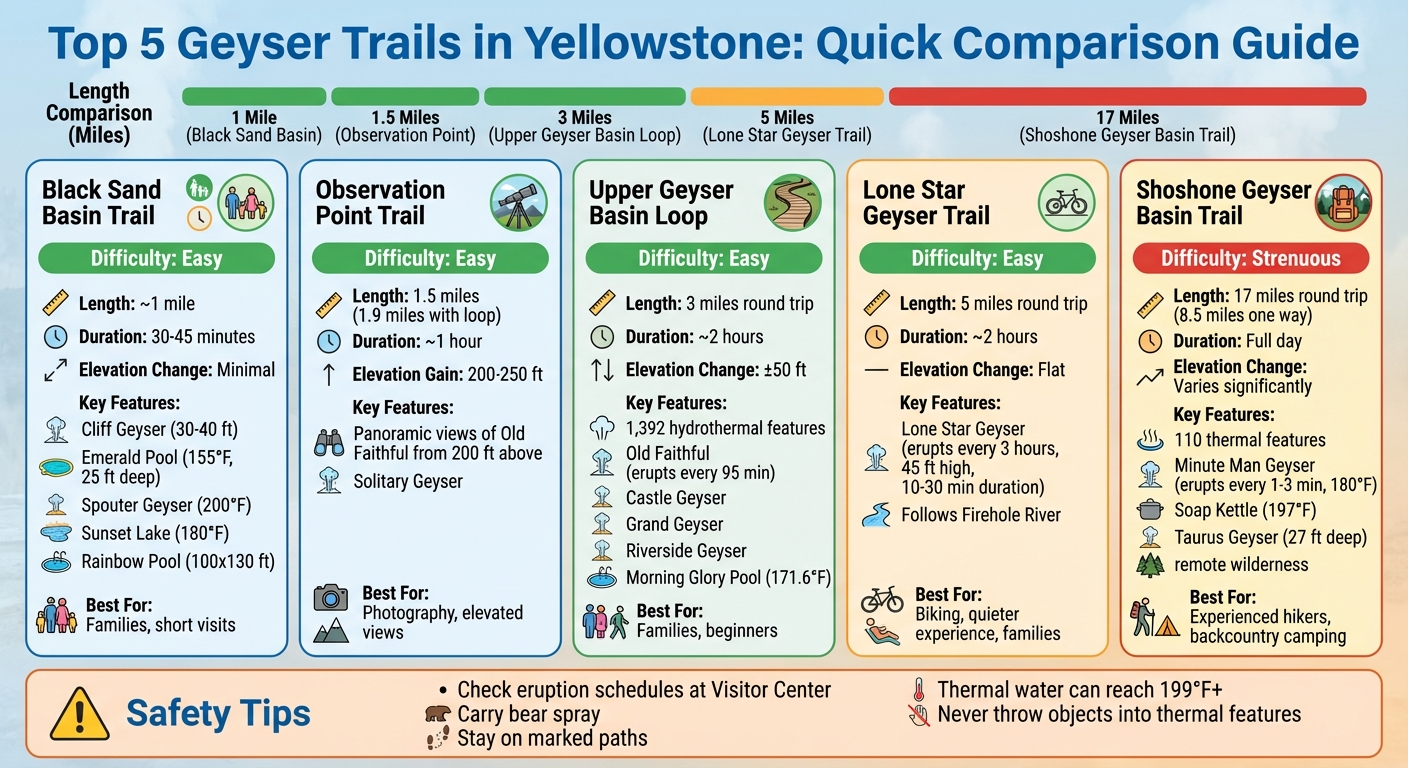
Yellowstone Geyser Trails Comparison: Difficulty, Length, and Highlights
1. Upper Geyser Basin Loop
Trail Difficulty
The Upper Geyser Basin Loop is an easy trail, making it a great choice for beginners and families. The route features level, paved paths and boardwalks, ensuring accessibility for most visitors.
Trail Length
This loop spans 3 miles and usually takes about 2 hours to complete. The time estimate includes stops to enjoy geyser eruptions and the vibrant hot springs along the way. With just ±50 feet of elevation change, the trail remains consistently simple to navigate.
Key Highlights
In less than half a mile, you’ll encounter an incredible 1,392 hydrothermal features. Highlights include:
- Old Faithful, erupting approximately every 95 minutes.
- Castle Geyser, known for its 12-foot cone that looks like a castle.
- Grand Geyser, offering a stunning and predictable fountain display.
- Riverside Geyser, which creates a 60-degree water arc over the Firehole River.
On the other side of the Firehole River, you’ll find the Geyser Hill area, home to over 40 geysers, including the impressive Beehive Geyser. Be sure to visit Morning Glory Pool, a striking hot spring with a deep blue center and an average temperature of 171.6°F.
For the best experience, check the eruption schedule at the Visitor Center and plan your visit early to avoid crowds.
Next, take on the challenges of the Observation Point Trail.
sbb-itb-00512f3
2. Observation Point Trail
Trail Difficulty
The Observation Point Trail is considered easy, making it a great choice for beginners. While there is a gradual incline, it’s manageable for most hikers.
Trail Length
This out-and-back trail covers 1.5 miles in total. If you decide to take the loop that passes by Solitary Geyser, the distance extends to about 1.9 miles. Most hikers complete the journey in under an hour. To make the most of your visit, plan to arrive 20–30 minutes before Old Faithful’s eruption for an unforgettable view.
Elevation Gain
The trail features an elevation gain of around 200–250 feet. Sitting approximately 200 feet above the geyser basin floor, the viewpoint offers a stunning, elevated perspective of the thermal features below. The climb is worth it for the breathtaking scenery.
Key Highlights
This trail gives you a quieter, elevated vantage point to witness Old Faithful’s eruptions, away from the crowds. Starting near the Firehole River bridge, the path winds through a serene forest before opening up to sweeping views of the Upper Geyser Basin. If you take the return loop, don’t miss Solitary Geyser, located just 0.3 miles from the junction. As with any Yellowstone hike, it’s wise to carry bear spray.
Best Trail in Yellowstone National Park! Upper Geyser Basin
3. Lone Star Geyser Trail
The Lone Star Geyser Trail offers an easy and scenic way to explore Yellowstone’s geothermal features, following in the footsteps of the Observation Point Trail.
Trail Difficulty
This trail is perfect for beginners and families, thanks to its flat and straightforward path along an old paved road bed. It’s one of Yellowstone’s most accessible backcountry geyser trails and is open to hikers, bicyclists, and even cross-country skiers during the winter months.
Trail Length
The trail stretches 5.0 miles round trip, making it a manageable half-day adventure. Its level terrain makes biking a popular option, cutting down travel time significantly. Photographer Noah Lang even points out that the flat path is ideal for biking.
Key Highlights
The main draw here is the Lone Star Geyser, a stunning cone-type geyser that erupts roughly every three hours, though the timing can vary by 1–2 hours. These eruptions shoot water up to 45 feet high and last between 10 and 30 minutes, ending with an impressive steam display. Visitors may also catch two or three shorter eruptions, which reach the same height but only last about 5 minutes.
The trail runs alongside the picturesque Firehole River and starts near Kepler Cascades. To maximize your chances of seeing an eruption, check the logbook at the geyser site for recent activity or ask for predictions at the Old Faithful Visitor Center. If you’re visiting in summer, pack bug spray to fend off mosquitoes, and don’t forget bear spray, as this area is known for grizzly activity.
4. Shoshone Geyser Basin Trail
The Shoshone Geyser Basin Trail is a true test for seasoned adventurers, offering a remote and rugged experience. Unlike the more accessible paths like the Upper Geyser Basin or Lone Star trails, this one demands serious backcountry skills and preparation. It’s a wild and untamed alternative for those craving a challenge.
Trail Difficulty
Safety is always a priority on any hike, but Shoshone raises the stakes. This trail isn’t for casual hikers – it’s designed for individuals with solid backcountry experience. Its remote setting, lack of developed infrastructure, and undefined safety measures make it a serious undertaking. Self-sufficiency is non-negotiable here. The risks are real, as highlighted by a tragic incident in 1988 when a visitor fell into a thermal pool.
Trail Length
The trail stretches 8.5 miles one way, making it a 17-mile round trip. This distance makes it suitable for a long day hike or an overnight backcountry camping excursion. For those seeking an alternative route, you can also reach the basin by canoeing across Lewis and Shoshone Lakes.
Key Highlights
Shoshone Geyser Basin is home to around 110 thermal features, each more fascinating than the last. Here are some standout highlights:
- Minute Man Geyser: Erupts every 1–3 minutes, shooting water 10–40 feet high at a blistering ~180°F.
- Soap Kettle: A 4-foot-tall cone adorned with golden sinter beads, erupting 4–6 feet every 9–21 minutes at 197°F.
- Taurus Geyser: A stunning deep blue pool, 8.5 feet wide and 27 feet deep.
- Knobby Geyser: Known for eruptions that reach heights of 10–25 feet.
- North Group: The basin’s largest collection of small springs, showcasing vibrant colors created by iron oxides and cyanobacteria.
This trail isn’t just a hike – it’s an adventure into one of Yellowstone’s most untouched and mesmerizing areas.
5. Black Sand Basin Trail
Black Sand Basin is a perfect spot for families or those looking for an easy, scenic hike. Just a mile north of the Old Faithful Visitor Center, this trail is a gateway to some of Yellowstone’s most colorful geothermal features. The name comes from the black obsidian sand – tiny fragments of volcanic glass – that dot parts of the area.
Trail Difficulty
This trail is about as easy as it gets in Yellowstone, making it an excellent choice for beginners or families with kids. The paths are flat and well-maintained, and you might even catch a ranger-led interpretive walk (check the Old Faithful Visitor Center for schedules).
Key Highlights
Despite its small size, Black Sand Basin is packed with fascinating geothermal features:
- Cliff Geyser: Shoots water 30–40 feet high, with its crater filling up just before an eruption.
- Emerald Pool: A stunning pool with a green center surrounded by yellow and orange hues. It’s 25 feet deep and sits at about 155°F.
- Spouter Geyser: Almost always erupting, this geyser sends water 5–7 feet into the air at a toasty 200°F.
- Opalescent Pool: Known for its "bobby sock trees", where lodgepole pines have been bleached white by silica deposits.
- Sunset Lake and Rainbow Pool: Sunset Lake boasts water at 180°F and vibrant microbial mats, while Rainbow Pool spans about 100 by 130 feet, showcasing its own dazzling colors.
Keep reading to see how this trail compares to others in our detailed table.
Trail Comparison Table
For a quick overview, here’s a side-by-side look at some of the most popular trails:
| Trail Name | Difficulty | Length (Round Trip) | Elevation Change | Key Highlights | Estimated Duration |
|---|---|---|---|---|---|
| Upper Geyser Basin Loop | Easy | 3 miles | ±50 ft | Includes iconic geysers like Old Faithful, Castle, Grand, and Riverside, plus Morning Glory Pool | ~2 hours |
| Observation Point Trail | Easy | 1.5 miles | ±250 ft | Provides a panoramic view of Old Faithful and the surrounding geyser basin | ~1 hour |
| Lone Star Geyser Trail | Easy | 5 miles | Not specified | A quieter trail perfect for those seeking solitude and fewer crowds | ~2 hours |
| Shoshone Geyser Basin Trail | Strenuous | Varies | Varies significantly | A remote trail offering a rugged wilderness experience | Full day |
| Black Sand Basin Trail | Easy | Approximately 1 mile | Minimal | Showcases vibrant thermal pools and eye-catching geothermal formations | 30–45 minutes |
The Upper Geyser Basin Loop and Black Sand Basin Trail are great for families, featuring paved paths and boardwalks that make them accessible to all ages. If you’re up for a short climb, the Observation Point Trail rewards you with a stunning elevated view of Old Faithful. For those looking to escape the crowds, the Lone Star Geyser Trail and Shoshone Geyser Basin Trail offer more seclusion and a chance to explore Yellowstone’s wilder side.
Don’t forget to stop by the Visitor Center to check the predicted eruption times for geysers like Old Faithful, Castle, Riverside, and Grand. It’s a handy way to plan your adventure.
Conclusion
Yellowstone’s geyser trails offer a little something for everyone. From the easily accessible boardwalks of the Upper Geyser Basin and Black Sand Basin to the more adventurous, off-the-beaten-path trek to Shoshone Geyser Basin, there’s no shortage of ways to experience the park’s geothermal marvels. Whether you’re marveling at Old Faithful from Observation Point or soaking in the quiet beauty of Lone Star Geyser, every trail showcases a different aspect of Yellowstone’s incredible geothermal activity. With over half of the world’s active geysers located here, Yellowstone truly stands out as a geothermal treasure.
Exploring these wonders safely requires preparation and respect for the environment. The thermal areas are breathtaking but dangerous – thin crusts of ground often cover boiling water that can reach temperatures of 199°F or more. Tragically, over 20 people have lost their lives after entering or falling into the park’s hot springs. To stay safe, always stick to marked paths, carry bear spray, and keep a safe distance from wildlife. Protecting the fragile thermal features is equally important. Avoid throwing objects, stepping on delicate formations, or touching the hot runoff. As Carl Schreier explains:
Coins, sticks, stones, handkerchiefs, or soap thrown into a Yellowstone thermal feature can cause it to erupt prematurely, or more likely, cause it to clog, wither, and die.
Before you head out, check The National Park Guide for the latest trail updates and eruption schedules. Yellowstone’s hydrothermal features are constantly changing, so having current information is key to a safe and enjoyable visit.
Take the time to explore Yellowstone’s one-of-a-kind geothermal wonders, but remember to tread lightly, plan wisely, and leave the park just as you found it.
FAQs
When is the best time to hike these geyser trails?
The ideal season for hiking Yellowstone’s geyser trails is summer, thanks to the favorable weather. If you want to dodge the crowds, try hitting the trails early in the morning or later in the afternoon. Late spring and early fall can also be good times to visit, though you might encounter snow or muddy paths depending on the conditions.
Do I need bear spray on the easy geyser trails?
Carrying bear spray, even on easy geyser trails in Yellowstone, is a smart safety measure. Wildlife, including bears, can appear unexpectedly, even on popular and frequently traveled paths. Stay vigilant, keep your distance from animals, and always follow the park’s safety guidelines to enjoy your visit responsibly.
How do I find accurate geyser eruption times?
For the most up-to-date geyser eruption schedules, visit the National Park Service website for Yellowstone. They regularly update eruption intervals and recent activity. Another great resource is GeyserTimes.org, which tracks real-time data for various geysers.
If you’re planning to see Old Faithful, the park provides predicted eruption times. While it’s famously regular, its intervals can range from 60 to 110 minutes, with an average of about 90 minutes. These tools will help you plan your visit and catch the geysers in action.