
America’s preservation laws protect historic buildings, landmarks, and natural sites from threats like development and urban renewal. The federal government and states play distinct but interconnected roles in these efforts. Federal laws, led by the National Park Service, set nationwide standards, manage the National Register of Historic Places, and provide funding through programs like the Historic Preservation Fund. States enforce stricter protections through local laws, zoning, and tax incentives, often focusing on privately owned properties and regional needs.
Key points:
- Federal laws focus on procedural reviews (e.g., Section 106) and financial incentives (e.g., tax credits) for projects involving federal funding or permits.
- State laws often include enforceable restrictions like demolition bans and design mandates for properties listed on state or local registers.
- Collaboration happens through programs like State Historic Preservation Offices (SHPOs) and Certified Local Governments (CLGs), ensuring federal and local efforts align.
This layered system balances federal oversight with state and local enforcement, ensuring America’s heritage is preserved while addressing regional priorities.
The Role of the State Historic Preservation Office in the Federal Preservation Network
sbb-itb-00512f3
Federal Preservation Framework
Federal preservation is built on a century of key legislative milestones. It all began with the Antiquities Act of 1906, which gave the President the authority to designate national monuments on federal lands. This act led to the creation of over 150 national monuments and laid the foundation for protecting cultural and scientific resources. Later, the Historic Sites Act of 1935 established a national preservation policy and introduced the National Historic Landmarks program, which recognizes sites of national importance.
The National Historic Preservation Act of 1966 (NHPA) stands as the most far-reaching preservation law in U.S. history. It created the National Register of Historic Places, a list that now includes more than 94,000 properties. Two sections of this law are particularly influential:
- Section 106: Requires federal agencies to assess how their projects might impact historic sites and allows the Advisory Council on Historic Preservation to provide feedback.
- Section 110: Directs federal agencies to set up preservation programs to identify and protect historic properties under their control.
Key Federal Laws and Policies
Beyond the NHPA, other laws address specific preservation needs. For example, the Archaeological Resources Protection Act of 1979 safeguards archaeological sites on public and tribal lands. The Native American Graves Protection and Repatriation Act (NAGPRA) ensures the return of Native American human remains and sacred items to tribes and descendants. In 2014, Congress streamlined federal preservation laws by consolidating them under Title 54 of the United States Code, making National Park Service programs more accessible.
The Historic Preservation Fund (HPF) provides essential financial support for preservation. Authorized to receive $150 million annually from outer continental shelf mineral receipts, the fund’s actual appropriations vary year to year. States must provide a 40% match for these federal funds, and recent increases in federal appropriations highlight the growing recognition of the HPF’s role in preservation efforts.
Federal Agencies Involved
The National Park Service (NPS) oversees most federal preservation initiatives. It manages the National Register of Historic Places, the National Historic Landmarks program, and develops the Secretary of the Interior’s Standards for the Treatment of Historic Properties. The Advisory Council on Historic Preservation (ACHP), an independent agency, supervises the Section 106 review process. While the ACHP doesn’t have veto power, its comments must be considered by federal agencies even if projects proceed.
Under Section 110, every federal agency operates a Federal Preservation Office (FPO). These offices are tasked with identifying, evaluating, and protecting historic properties within their jurisdiction. Agencies like the Department of Defense and the Department of Agriculture run these offices, reflecting a federal commitment that complements state-level efforts. The Secretary of the Interior provides overall leadership, sets criteria for the National Register, and offers technical guidance to federal agencies.
Federal Incentives for Preservation
The federal government also uses financial incentives to promote preservation. The Federal Historic Preservation Tax Incentives program offers a 20% tax credit for rehabilitating income-producing historic buildings. Since 1976, this program has spurred over $96 billion in private investment across more than 44,000 projects.
Other initiatives, like the Historic Surplus Property Program and the National Historic Lighthouse Preservation Act, allow state and local governments to acquire historic federal properties at no cost. These programs transfer ownership of unused federal buildings, giving communities a chance to preserve landmarks that might otherwise be lost. Additionally, at least 10% of annual HPF funding must be allocated to Certified Local Governments (CLGs) that demonstrate a strong commitment to preservation.
Together, these tools form a robust federal framework that paves the way for state-level efforts to address preservation needs at a more localized level. The next section will explore how state laws build on these federal strategies.
State-Level Preservation Framework
State initiatives play a crucial role in shaping preservation efforts to fit local needs and historical contexts. While federal laws provide the overarching structure, state governments enforce preservation through their powers of regulation, taxation, and eminent domain. These efforts build on federal guidelines but are more directly applied using state-specific tools and policies.
State Preservation Laws and Authority
Federal listings often serve as honorary recognitions, but state and local designations come with enforceable restrictions. When a property is listed on a state or local register, owners may face strict limitations on demolition or alterations. Julia H. Miller explains it well:
Unlike listing in the National Register, designation under local ordinances often affects a property owner’s ability to change his or her property in ways that would harm its historic or architecturally significant character.
For example, Connecticut expanded its Environmental Protection Act in 1982 to provide legal options against the "unreasonable destruction" of historic structures. This law offers more robust protections than federal regulations, which typically require agencies to consider impacts rather than actively prevent damage.
Variations in State Approaches
State preservation programs vary widely to address unique regional needs and priorities. For instance, New Hampshire has specific initiatives to preserve historic barns, while Florida channels its resources into safeguarding South Beach’s iconic Art Deco architecture.
The criteria for state registers also differ. Some states use the National Register’s standards as a foundation, while others craft their own criteria. Additionally, some states expand their preservation focus to include intangible heritage – such as folklore, traditional music, and languages – alongside physical sites. States also vary in funding strategies, utilizing tools like grants, rehabilitation tax credits, or property tax exemptions to support preservation efforts.
Collaboration with Local Governments
States strengthen preservation efforts by empowering local governments through enabling legislation. These laws allow municipalities to establish historic districts and create preservation commissions. Local commissions are then responsible for reviewing and approving changes to protected properties.
Funding partnerships are another critical element. States are required to allocate at least 10% of their federal Historic Preservation Fund (HPF) grants to Certified Local Governments (CLGs). This ensures that preservation funding reaches communities, supporting projects like restorations, surveys, and educational initiatives. The 59 State Historic Preservation Offices across the U.S. – covering all states, territories, and the District of Columbia – act as vital connectors, managing federal grants while aiding local preservation efforts.
The Federal-State Partnership in Preservation
The collaboration between federal and state governments plays a key role in advancing preservation efforts across the United States. Established under the National Historic Preservation Act of 1966, this partnership creates a structured system that connects federal policies with state-level implementation and local action. This approach ensures that national preservation standards are applied uniformly while still respecting regional differences. By integrating federal guidelines with state and local efforts, the system strengthens preservation laws and their application. To understand how this works in practice, it’s important to explore the roles of State Historic Preservation Offices (SHPOs) and Certified Local Governments (CLGs).
State Historic Preservation Offices (SHPOs)
SHPOs act as the bridge between federal preservation programs and local initiatives. Appointed by state governors, SHPOs carry out a variety of responsibilities, such as nominating properties for the National Register of Historic Places, maintaining records of historically significant sites, and consulting with federal agencies during Section 106 reviews. According to the Advisory Council on Historic Preservation:
The SHPO role is one of assisting the federal agency in Section 106, and not one of assuming ‘responsibility’ for it, making decisions for federal agencies, or replacing independent federal agency judgment.
SHPOs also oversee annual grants from the Historic Preservation Fund, which are distributed by the National Park Service. These offices play a critical role in ensuring that preservation efforts align with both federal standards and local needs.
Certified Local Governments (CLGs)
The CLG program brings preservation efforts closer to local communities. Local governments must go through a joint certification process, gaining approval from both the SHPO and the National Park Service to achieve CLG status. Once certified, these municipalities gain access to funding, as states are required to allocate at least 10% of their Historic Preservation Fund grants to CLG projects. CLGs also establish their own preservation commissions and develop engagement processes to involve their communities. The National Park Service evaluates each CLG’s performance at least once every four years to ensure standards are upheld. However, as of September 2020, none of the 200 Tribal Historic Preservation Offices had launched a CLG program on tribal lands, leaving SHPOs as the primary preservation resource in these areas. This program highlights how federal oversight and local autonomy work together to protect historic resources.
Balancing Federal and State Roles
The partnership between federal and state entities relies on shared responsibilities and funding. For example, states are required to match 40% of the grants they receive from the Historic Preservation Fund, while federal agencies oversee National Register listings. At the same time, CLGs handle local zoning and design reviews, ensuring that preservation efforts meet the specific needs of their communities. The Historic Preservation Fund, authorized to receive $150 million annually through fiscal year 2023, provides critical financial support for these efforts. Additionally, the Federal Historic Preservation Tax Incentives program has driven over $96 billion in private investment for restoring historic properties since 1976. This balance of federal guidance and local execution ensures that preservation efforts are both effective and adaptable to local contexts.
Comparison of State and Federal Preservation Laws
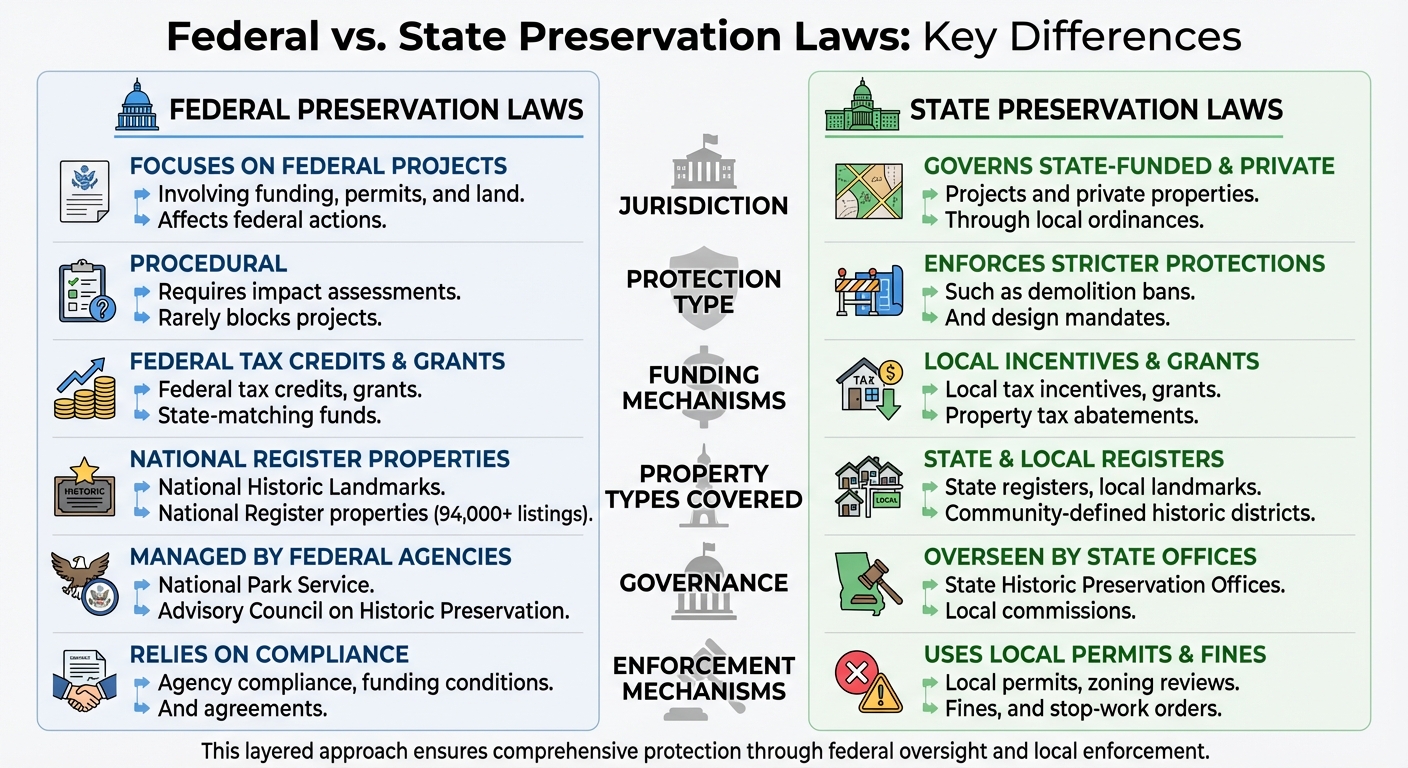
Federal vs State Historic Preservation Laws: Key Differences in Jurisdiction, Protection, and Enforcement
State laws complement the federal framework by addressing local needs, offering tailored protections for heritage sites. While federal preservation laws primarily focus on government-related projects – those involving federal funding, permits, or land – state and local laws often take the lead in safeguarding privately owned historic properties. As Sarah Heffern from the National Trust for Historic Preservation puts it:
"Local laws and regulations are the first line of defense in saving many historic places and can usually get the job done."
Federal laws, like Section 106, emphasize procedural steps such as assessing the impacts of projects on historic resources. In contrast, local ordinances often impose stricter requirements, such as design standards and demolition restrictions. For example, a property listed on the National Register of Historic Places receives recognition but no legal restrictions unless federal involvement is present. On the other hand, local designation typically comes with enforceable rules about alterations and preservation.
Funding structures also differ significantly. Federal programs, such as the Historic Preservation Fund, provide up to $150 million annually, requiring a 40% match from states. The Federal Historic Preservation Tax Incentives program, active since 1976, has spurred over $96 billion in private investment by offering a 20% tax credit for rehabilitating certified historic structures. States often build on these federal efforts with their own incentives, including tax credits, grants, and property tax reductions, tailored to support local preservation priorities.
Comparison Table: Key Factors
The table below highlights the differences and overlaps between federal and state preservation laws:
| Factor | Federal Preservation Laws | State Preservation Laws |
|---|---|---|
| Jurisdiction | Focuses on federal projects involving funding, permits, and land | Governs state-funded projects and private properties through local ordinances |
| Protection Type | Procedural: Requires impact assessments but rarely blocks projects | Enforces stricter protections, such as demolition bans and design mandates |
| Funding Mechanisms | Includes federal tax credits, grants, and state-matching funds | Offers local tax incentives, grants, and property tax abatements |
| Property Types Covered | National Historic Landmarks and National Register properties (94,000+ listings) | State registers, local landmarks, and community-defined historic districts |
| Governance | Managed by agencies like the National Park Service and Advisory Council on Historic Preservation | Overseen by State Historic Preservation Offices and local commissions |
| Enforcement Mechanisms | Relies on agency compliance, funding conditions, and agreements | Uses local permits, zoning reviews, fines, and stop-work orders |
In some cases, property owners must navigate overlapping federal, state, and local requirements. However, this layered approach can be beneficial. Federal funding, for instance, supports local efforts through programs like Certified Local Governments, which receive at least 10% of each state’s allocation from the Historic Preservation Fund. This collaboration ensures that expertise and resources are available at every level.
Conclusion
Federal and state preservation laws work hand in hand to safeguard America’s heritage. National frameworks like the National Historic Preservation Act set the stage with overarching standards and funding, while state and local governments bring the enforcement power needed to protect privately owned historic sites. As the Secretary of the Interior aptly puts it:
The preservation of historic resources is not just about saving old buildings; it’s about preserving our cultural heritage and promoting a sense of community and identity.
This system operates on three levels, creating a bridge between federal oversight and local action. At the federal level, agencies manage the National Register and allocate funds. State Historic Preservation Offices (SHPOs) take on the critical role of identifying historic sites, awarding grants, and developing statewide plans that align with federally approved goals to ensure consistency. At the grassroots level, local governments enforce preservation through commissions that oversee design standards, demolition permits, and other regulatory measures.
This collaboration strikes a balance between procedural oversight and practical protection. Federal laws, such as Section 106, require agencies to consult with SHPOs, incorporating local knowledge into national reviews [5, 6]. Meanwhile, local ordinances provide tools like design reviews and stop-work orders, which federal guidelines alone cannot enforce. Together, these layers of protection create a system that is both broad in scope and responsive to regional needs.
FAQs
Does National Register listing restrict what I can do to my property?
Listing a property in the National Register of Historic Places doesn’t mean you’re automatically limited in what you can do with it. If you’re a non-federal property owner, you’re free to modify or even demolish your property unless federal funding, permits, or assistance are part of the project. Essentially, the listing is more about acknowledgment and planning rather than imposing regulations – unless the federal government is involved.
When does Section 106 review apply to a project?
Section 106 review comes into play when a federal project has the potential to affect historic properties. Before moving forward – whether it’s approving the project or allocating federal funds – agencies are required to assess how the undertaking might impact these sites. This process ensures that historic properties are thoughtfully considered during the planning stages of a project.
How do I find my SHPO or a Certified Local Government near me?
To find your State Historic Preservation Officer (SHPO) or a Certified Local Government (CLG), head over to the National Park Service’s website, which offers resources related to preservation efforts. SHPOs, created under the National Historic Preservation Act of 1966, are responsible for managing preservation programs at the state level. The National Park Service has a detailed list of State & Tribal Historic Preservation Offices, complete with contact information, making it easier to connect with the right office or CLG in your region.