
If you want the least hassle, book a developed campground with flush toilets. But that setup can change by season, loop, or water problems, so I’d always check the park page before I reserve.
Here’s the short version:
- Developed campgrounds usually have flush toilets, sinks, lights, and potable water.
- Primitive campgrounds usually have vault or pit toilets and little to no running water.
- Mixed-loop campgrounds can change by section, so one loop may be much easier than another.
- Portable toilets often mean a temporary outage or a very basic campground.
- Campgrounds with showers are the most comfortable, but showers may be in a central building, not near your site.
- Dry campgrounds often have no running water at all, so I’d plan to bring all water needed.
A few details matter more than anything else:
- Toilet type
- Water access
- Shower access
- Seasonal changes
For example, some parks shut off flush toilets and water in cold months. At Moraine Park Campground, flush toilets are available from May 21, 2026, through October 19, 2026, then the campground switches to vault toilets for winter. At Dry Tortugas, campers are told to bring 2 gallons of water per person per day. And at some Yellowstone campgrounds, 2 showers per night are included with your site.
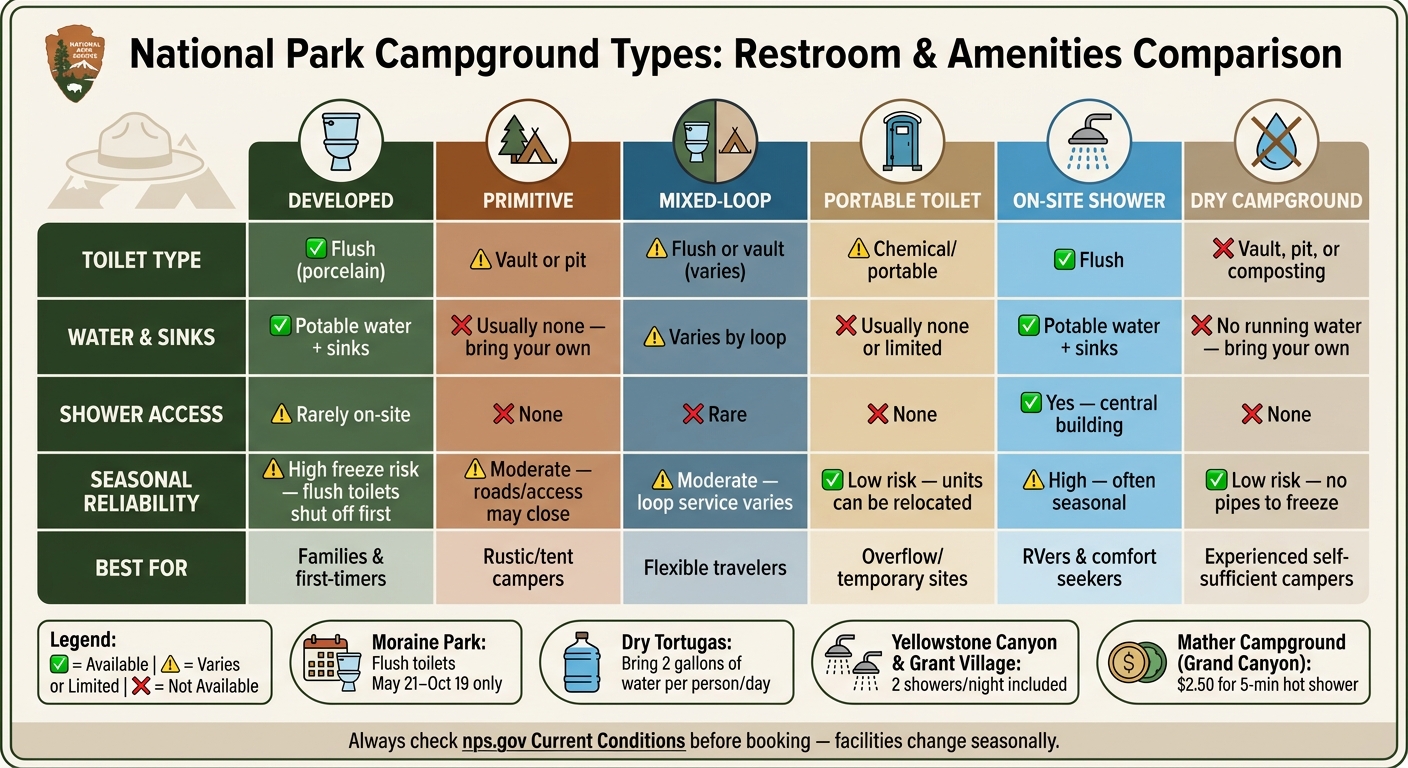
National Park Campground Types: Restroom & Amenities Comparison
Yellowstone National Park Restrooms Map | Survival Guide (Tips + Map)
sbb-itb-00512f3
Quick Comparison
| Campground Type | Toilets | Water | Showers | What to Expect |
|---|---|---|---|---|
| Developed | Flush | Usually potable water and sinks | Sometimes | Best fit for comfort and predictability |
| Primitive | Vault or pit | Often none | Rare | Basic setup, bring supplies |
| Mixed-loop | Varies by loop | Varies | Varies | Check your exact loop before booking |
| Portable toilet | Chemical/portable | Often none or limited | Usually none | Short-term fix or very basic site |
| On-site shower campground | Usually flush | Potable water and sinks | Yes, often central | Most comfort, but may cost extra |
| Dry campground | Vault, pit, or composting | Usually none | No | Bring your own water and plan ahead |
Bottom line: I’d pick a campground based on comfort, water, and season first. That simple check can help you avoid showing up to a locked restroom, no sinks, or no running water.
1. Developed Campgrounds with Flush Toilets
Developed campgrounds tend to have the most predictable restroom setup in a national park. They’re usually the most comfortable option too, though shower access and seasonal service can change from park to park. In most cases, you’ll find permanent restroom buildings with flush toilets, sinks, soap, and lights, usually placed near the center of each campground loop.
Toilet Type
Flush toilets are the easiest setup for longer stays. At Mather Campground in the Grand Canyon, restroom buildings stay open 24 hours a day, year-round. In Yellowstone, Canyon Campground has 15 public restroom buildings, and Grant Village has 17.
Shower Access
Flush toilets don’t automatically mean showers. That’s the catch. At many developed campgrounds, showers are in a separate building, often in a nearby camper services area.
At Mather Campground, showers cost $2 for 8 minutes of hot water. Yellowstone’s Canyon and Grant Village campgrounds work a little differently: both include 2 showers per night in the site rate. Madison and Bridge Bay campgrounds in Yellowstone still have flush toilets, but they do not have on-site showers.
Water and Sinks
Developed restrooms usually include potable water from indoor faucets or outdoor spigots. It’s often cold water only. If the campground has dishwashing stations outside the restroom buildings, like at Canyon and Grant Village, use those instead of the bathroom sinks. That helps prevent clogs and cuts down on bear attractants.
Restrictions and Seasonality
Seasonal closures can change the setup fast. During colder months, many developed campgrounds shut off flush toilets and running water to protect pipes. Moraine Park Campground in Rocky Mountain National Park is a good example. It offers flush toilets from May 21 through October 19, 2026, then switches to vault toilets with no running water for winter.
Mammoth Campground in Yellowstone is one of the few exceptions, with flush toilets available year-round. Once water systems shut down, restroom service often drops from full buildings to much simpler options.
2. Primitive Campgrounds with Pit Toilets
Primitive campgrounds are pretty bare-bones. In most cases, the big things to look for are simple: Is there a toilet? Is there running water? Can you get to a shower nearby?
Toilet Type
Most primitive campgrounds use vault toilets, which are now the usual setup for non-flush restrooms. A vault toilet sits above a sealed underground tank that gets pumped out on a regular schedule by service trucks. When it’s vented the right way, odor stays more under control.
Older pit toilets are still around in some places. They’re basically a hole in the ground with a structure built over it. The NPS has been moving away from them over time. If you use one, stick to human waste and toilet paper only.
Shower Access
Showers at primitive campgrounds are uncommon. If a shower matters to you, plan on using a developed campground or a nearby lodge instead. No shower also means your handwashing setup matters a lot more.
Water & Sinks
Running water and sinks are uncommon too. A few primitive campgrounds have a hand pump for water. Whiskeytown National Recreation Area‘s Horse Camp is one example. But most sites expect you to bring all the water you’ll need.
A simple setup usually includes:
- Water for drinking, cooking, and washing
- Hand sanitizer
- A small wash kit
Restrictions & Seasonality
Primitive restrooms are often the first facilities to close when cold weather rolls in. In many parks, they lock up sometime between late October and May or June, depending on location. Great Basin National Park‘s Snake Creek primitive sites, for example, have no potable water.
Check the "Operating Hours & Seasons" section on nps.gov before your trip. A restroom that was open last summer may not be open now.
Some campgrounds also split these basics by loop, so one area may have vault toilets while another has flush toilets.
3. Loop-Specific Campgrounds with Mixed Restroom Types
Even in the same campground, your loop can change a lot: toilet type, shower walk time, and water access. So restroom access isn’t always a campground-wide feature. Sometimes it comes down to where you camp, and that can have a clear effect on comfort and day-to-day convenience.
Toilet Type
Some campgrounds split restroom access by loop. At Mather Campground, all loops have flush toilets, but only Pine and Sage stay open in winter. In the off-season, that means restroom access can narrow fast.
Shower Access
At Mather, showers are in the central Camper Services building, so the walk depends on your loop. Aspen and Fir are the closest. Juniper is the farthest. If you plan to shower every day, loop choice isn’t just about the view.
Water & Sinks
At Mather, Stage 3 Water Restrictions shut off all loop-specific spigots. Campers then need to fill water at the campground entrance or at the dump station instead.
Restrictions & Seasonality
Loop closures can happen for reasons other than weather. At Bridge Bay Campground in Yellowstone, lower loops have closed early in the season because of bear activity. Before you book, check loop details on Recreation.gov and the park’s official site.
When permanent restrooms aren’t part of the setup, campgrounds may use portable toilets instead.
4. Campgrounds with Portable Toilets
Portable toilets usually show up in two cases: they’re the standard setup at more primitive campgrounds, or they’re brought in for a short stretch when a park’s main restrooms are down. So they sit in the middle ground between full restroom buildings and simpler vault-toilet sites.
Toilet Type
Park websites and brochures often label these as chemical toilets. At Bird Island Basin in Padre Island National Seashore, campers get chemical toilets, not flush toilets or showers. In a more developed campground, the same kind of setup can appear as a stopgap. Mather Campground at Grand Canyon, for example, has used portable toilets during Stage 3 Water Restrictions tied to failures in the Trans-Canyon Pipeline.
Shower Access
Most campgrounds with portable toilets do not have showers.
Water & Sinks
These areas also often go without sinks and running water. And when a developed campground is under water restrictions, the setup can get even more limited. Spigots may be turned off, and drinking water may be moved to one central location, like the dump station entrance.
Restrictions & Seasonality
When you see temporary portable toilets at a developed campground, it usually points to a service problem, not a standard feature. That may mean an outage or a water shortage. At primitive sites, though, portable toilets may simply be the default setup.
Some remote units also close by season, often because of snow. Before heading out, check the park’s official site for current water restrictions or facility alerts.
5. Campgrounds with On-Site Showers
On-site showers can make a big difference in comfort. But the details matter. Access, cost, and hours can change a lot from one park to the next. If you want the most complete restroom setup, these campgrounds tend to be the most comfortable choice.
Toilet Type
Campgrounds with showers usually also have flush toilets in nearby comfort stations. One exception is Moraine Park in Rocky Mountain National Park. It has solar shower stalls, but campers need to bring their own water and shower gear.
Shower Access
The main difference usually isn’t whether showers are there. It’s how you use them. Some are included with your stay, some take coins, and some require you to handle the whole setup yourself.
At Yellowstone’s Canyon and Grant Village, showers are located in camper services buildings. Two showers per night are included in the reservation fee, though this does not apply to group sites. Grant Village has 12 men’s, 12 women’s, and 3 family shower stalls.
At Mather Campground in Grand Canyon, showers are coin-operated at the camper services building. The price is $2.50 for a 5-minute hot shower.
Most shower buildings close midday for cleaning, and hours often get shorter later in the season. Bring your own soap, shampoo, and conditioner.
Water & Sinks
These campgrounds usually pair restroom sinks with cold running water and nearby dishwashing stations. You’ll also often find potable water spigots in the campground loops.
Restrictions & Seasonality
Shower buildings often close earlier in the season than the campground itself. So if you’re visiting in late fall or early spring, check access before you arrive. Dry campgrounds, on the other hand, usually give up showers and running water in exchange for a simpler setup.
6. Dry Campgrounds with Limited Water Access
After campgrounds with showers, dry sites sit much closer to the rough-it end of the scale. Amenities are sparse, and water access is often hit or miss. In most cases, you should expect the basics only: no running water and usually no flush toilets.
That also means restroom access is stripped down to the bare minimum.
Toilet Type
Most dry campgrounds use vault, pit, or composting toilets instead of flush toilets. At Dry Tortugas National Park, Garden Key’s composting toilets are the only restroom option, and they close daily from 10:00 AM to 3:00 PM for maintenance.
Shower Access
When water service is this limited, showers are usually off the table. Public showers are generally not available at dry campgrounds. If you want to wash up, a park-approved portable shower may be your only option, and you still need to follow wastewater rules. At Dry Tortugas, soap is prohibited even for a freshwater rinse from the ferry.
Water & Sinks
The biggest tradeoff with dry camping isn’t just the toilet setup. It’s water.
Most dry campgrounds do not have potable water, so you need to bring everything you’ll need for drinking and washing. For remote sites like Dry Tortugas, campers are recommended to bring 2 gallons of water per person per day. At Death Valley‘s high-elevation sites – Thorndike and Mahogany Flat – there is no potable water, and the nearest potable source is miles away. Some campgrounds, like Juniper Campground at Theodore Roosevelt National Park, have seasonal potable water, but water is shut off during colder months to prevent freezing.
Restrictions & Seasonality
Dry campgrounds in high-elevation and northern areas often close from late October or November through May or June. At Denali, primitive campgrounds such as Sanctuary River and Igloo Creek are open only from mid-May to mid-September and can be reached only by the park’s camper transit bus. Always check the NPS "Plan Your Visit" page for the exact campground before you head out.
Comfort, Convenience, and Tradeoffs
At this point, the biggest differences come down to comfort, water access, and how fast services drop off when temperatures fall. In day-to-day use, campground types are mostly set apart by toilet comfort, shower access, water, and how well they hold up across the seasons.
Toilet Type
Flush systems involve the fewest compromises. They’re the closest thing to a standard restroom setup, which matters after a long day outdoors. Well-vented vault toilets can stay fairly low-odor if they’re maintained well. Portable toilets sit at the bottom for comfort.
Shower Access
Showers are rare in national park campgrounds. When they do exist, they’re usually in central camper services buildings, not at the campsite itself. Most other campground types don’t offer showers at all.
That makes shower access a handy shortcut. If a campground has showers, its restroom setup is often more built out than average.
Water and Sink Access
Developed campgrounds usually include potable water and sinks. Mixed-loop campgrounds depend on the section you’re in. Primitive and dry campgrounds often mean bringing your own water from the start.
Restrictions and Seasonality
Cold weather tends to cut water access first, then toilet service. Flush systems are hit first because pipes can freeze. Vault toilets usually stay usable longer. Mixed-loop campgrounds can be harder to predict, with some loops running flush toilets in summer and vault toilets in winter or shoulder seasons.
The table below sums up the main tradeoffs across campground types.
| Criterion | Developed Flush | Primitive Vault/Pit | Mixed Loop | Portable Toilet | On-Site Shower Campgrounds | Dry Campgrounds |
|---|---|---|---|---|---|---|
| Toilet Type | Flush (porcelain) | Vault or pit | Seasonal flush/vault | Temporary units | Flush | Vault or pit |
| Shower Access | Usually none on-site | None | Rare | None | On-site, in central buildings | None |
| Water & Sinks | Faucets, sinks, potable water | Usually none; bring your own water | Varies by loop | Usually none or limited | Sinks, potable water, showers, and often laundry | No running water; bring your own water |
| Seasonality | High freeze risk; flush toilets shut off first | Moderate if access roads are snowed in | Moderate; loop service varies | Low; units can be relocated | High; often seasonal | Low; no water pipes to freeze |
Pros and Cons by Campground Type
The table below compares campground types based on comfort, water access, and how dependable the setup is from season to season. One thing to watch: restroom quality can shift a lot depending on the campground, the loop, and the time of year.
| Campground Type | Pros | Cons | Best Match for Travelers |
|---|---|---|---|
| Developed (Flush Toilets) | Most sanitary and convenient setup; some also have showers | Higher foot traffic, more noise, higher nightly fees, and reservations may fill months in advance | Families, first-time campers, long-stay visitors |
| Primitive (Vault/Pit Toilets) | Available in remote, scenic areas; often ADA-accessible | No running water or sinks; bring your own sanitizer and toilet paper; maintenance is less frequent than at developed sites; older pit toilets can be more prone to odors and flies | Tent campers and visitors seeking a rustic experience |
| Mixed-Loop | Restroom type and water access vary by loop, giving some flexibility | Facilities can vary loop to loop and may switch to vault-only or close entirely in the off-season | Flexible travelers, shoulder-season visitors |
| Portable Toilets | Can be deployed quickly in high-use or temporary areas; no permanent infrastructure needed | Comfort and cleanliness depend on service frequency; no running water | Campers at temporary closures or overflow sites |
| Campgrounds with Showers | Showers, sinks, and potable water in one central building; the most convenient option | Usually seasonal, and shower access may require a separate fee | RV campers, families, and travelers prioritizing comfort |
| Dry Campgrounds | More secluded, lower fees, and no water system to maintain | No running water at all; must arrive with full tanks or a water supply; non-flush toilets only | Experienced tent campers and self-contained RVers |
The big tradeoffs come down to toilet type, water access, and seasonal reliability. If you focus on those three points, it gets much easier to pick a campground that fits your comfort level.
Conclusion
Once you compare toilet type, water access, and shower access, the choice mostly comes down to comfort.
Developed campgrounds usually have flush toilets, running water, and sinks. That makes them the easiest pick for families, first-time campers, and anyone who wants a low-hassle trip. Primitive and dry campgrounds give up some of those comforts in exchange for quieter stays and a more self-sufficient setup.
Neither option is better across the board. The right fit depends on your comfort level and how much you want to handle on your own.
That setup can also change with the season. Campground status can shift fast because of rehabilitation work, wildlife activity, weather, or water problems.
Before you book, check the park’s Current Conditions page, Operating Hours & Seasons page, and the Alerts banner. For site-level details, look at Recreation.gov’s Amenities section.
Pay close attention to toilet type, water access, and seasonal reliability before you reserve a site. A quick check before you head out can save you from showing up to no water, a locked restroom, or a closed loop. That kind of surprise can throw off the whole trip.
FAQs
How can I confirm restroom type before booking?
Check the individual park’s official website or Recreation.gov before you book. On most National Park websites, you’ll find campground facility details in the Plan Your Visit section.
That’s the easiest way to confirm whether a site has flush toilets, vault toilets, or no restroom facilities at all. And yes, that can change from one campground to another, even within the same park.
What should I bring if my campground has no running water?
Bring your own hygiene and sanitation supplies, including toilet paper and hand sanitizer.
If there aren’t any vault toilets, pack a lightweight trowel so you can dig catholes 6 to 8 inches deep and at least 100 feet from water, trails, and campsites. You’ll also need a sealable bag to pack out used toilet paper and other hygiene items.
Do campground restrooms vary by season or loop?
Yes. Restroom facilities can change by season and by campground loop.
At many parks, flush toilets are open in summer, then switch to vault toilets in winter. Some restrooms may also close during cold weather. And within the same campground, one loop might have flush toilets while another has only vault toilets all year.
Before you go, check the official park website for current seasonal status and loop-by-loop details.