
Most national parks do not charge a separate parking fee. In many cases, your vehicle entrance fee – often $30 to $35 for 7 days – already covers standard parking. But some parks work differently, and that’s where people get tripped up.
Here’s the short version:
- Entrance fees and parking fees are not the same
- Some parks include parking with entry
- Some parks charge a separate parking tag, like Great Smoky Mountains
- Some busy lots use reservations, shuttle rules, or time limits instead of a flat parking fee
- The America the Beautiful Pass covers many standard entrance and day-use fees, but not every parking-related cost
A few examples make this clear:
- Grand Canyon: pay the vehicle entrance fee, and standard parking is included
- Yellowstone: same basic setup
- Great Smoky Mountains: no entrance fee, but parking over 15 minutes needs a tag – $5/day, $15/week, or $40/year
- Denali: charges $15 per person, not per vehicle
- Glacier’s Logan Pass: parking may be included, but there can still be a 3-hour limit through September 7
Before I go to any park, I check five things:
- Is the cost per vehicle or per person?
- Is parking included or separate?
- Do I need a reservation or shuttle ticket?
- Is the park cashless?
- What proof do I need to show – pass, tag, receipt, or QR code?
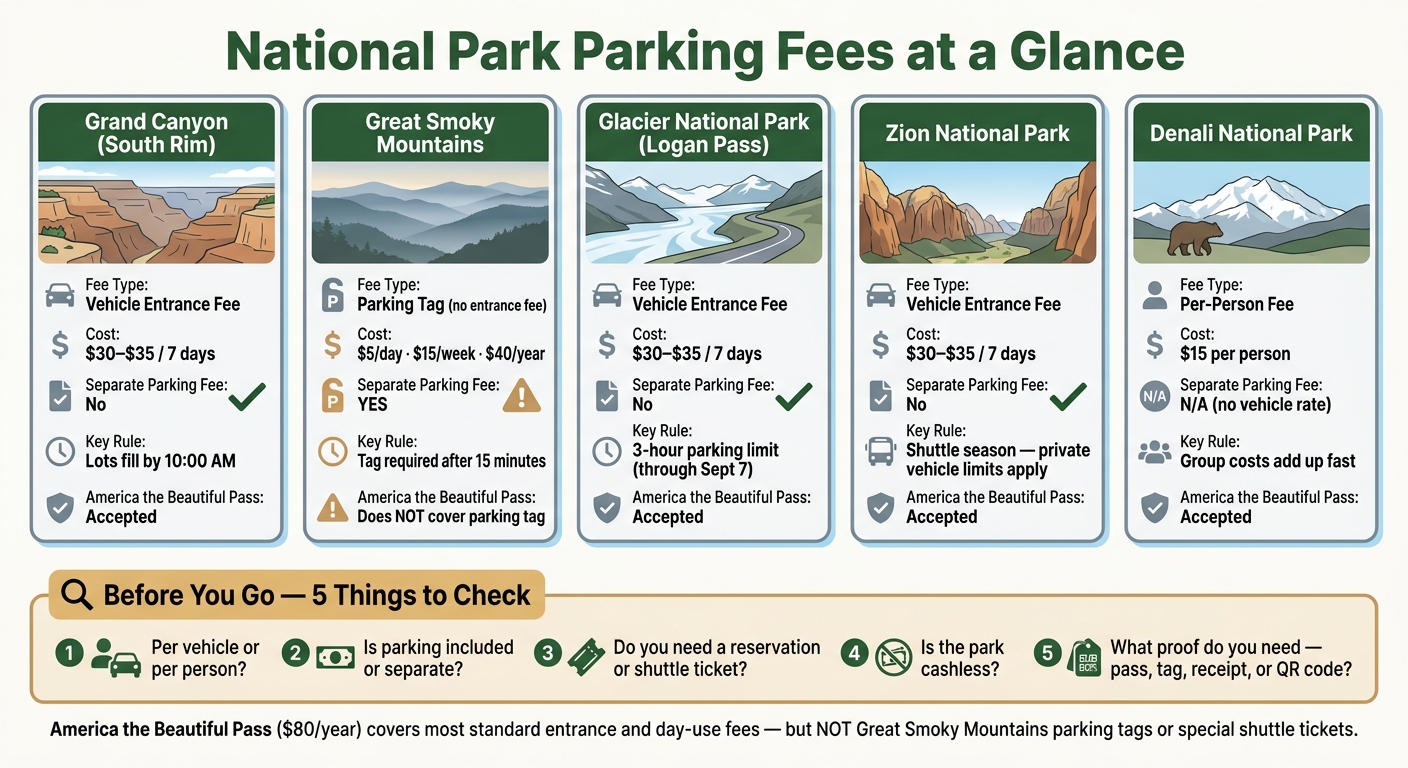
National Park Parking Fees Compared: What You’ll Actually Pay
Quick comparison
| Park | Main Cost Setup | Separate Parking Cost? | Key Rule to Check |
|---|---|---|---|
| Grand Canyon | Vehicle entrance fee | No | Lots can fill by 10:00 AM |
| Great Smoky Mountains | Parking tag | Yes | Tag needed after 15 minutes |
| Glacier (Logan Pass) | Entrance fee | No | 3-hour parking limit |
| Zion | Entrance fee | No | Shuttle season and car limits |
| Denali | $15/person | Not a vehicle fee | Group cost can add up |
Bottom line: don’t assume “park fee” means the same thing everywhere. A park may charge for entry, for parking, for a reservation, or for a shuttle-linked lot. A 2-minute check before you leave can save money, time, and a parking ticket.
Below, I break down the fee types, payment rules, free parking cases, and the mistakes I’d avoid.
sbb-itb-00512f3
Parking fees by park
Park fee setups can be all over the map. Some parks roll parking into the entrance fee. Others charge parking on its own or set rules for certain lots. At parks like Grand Canyon, Yosemite, and Zion, standard parking comes with the entrance fee. Great Smoky Mountains works differently: there’s no entrance fee, but you need a paid parking tag if your vehicle is parked for more than 15 minutes. That may sound like a small detail, but it changes what you pay and how you pay it.
How fee amounts and fee types differ
The most common setup is $30–$35 per vehicle for seven days, with standard parking included. But not every park uses that model. Denali, for example, charges per person instead of per vehicle.
Some parks also place time limits on parking or restrict access in other ways. At Glacier, Logan Pass has a 3-hour parking limit under a pilot program that runs through September 7. So even when parking is included, the lot you choose can still affect access, timing, and your plans for the day.
What to look for in a park fee table
When you read a fee table, a few details do most of the work:
- Whether the fee is per vehicle or per person
- Whether parking is included with entrance or charged on its own
- Whether there are time limits, tag rules, or shuttle-related restrictions
Use the table below to spot the fee model fast.
| Park | Fee Type | Separate from Entrance? | Verify Before You Go |
|---|---|---|---|
| Grand Canyon (South Rim) | Included in entrance | No | Lot fill times, often by 10 AM; shuttle routes |
| Great Smoky Mountains | $5/day parking tag | Yes (no entrance fee) | Tag display rules; purchase locations |
| Glacier (Logan Pass) | Included in entrance | No | 3-hour limit; shuttle ticket availability |
| Zion (Canyon) | Included in entrance | No | Shuttle season dates; private vehicle restrictions |
| Denali | $15/person | N/A (per-person only) | No vehicle rate; fees charged per individual |
That per vehicle vs. per person split matters a lot. A family or group can pay much more under a per-person setup, while a vehicle-based fee may stretch further. It also helps to check whether you’re looking at a one-day fee or a seven-day fee, since the value can be very different.
The America the Beautiful Pass ($80 for U.S. residents) covers standard entrance and day-use fees, but it does not cover the Great Smoky Mountains parking tag or special shuttle tickets. So don’t assume the pass handles every parking cost. Check the park’s page before you go.
After you know the fee type, the next step is paying and showing proof the right way.
How parking fees are charged
Parking works a little differently from park to park. Some parks fold parking into the entrance fee. Others charge for certain lots or require a separate reservation. So the first step is simple: figure out whether the park charges at the entrance, by lot, or through a parking reservation.
Parking included with entrance fees
At many fee parks, the standard vehicle entrance fee already covers normal parking for the length of the pass, which is usually 7 days.
Separate parking tags, lot fees, and time-based charges
The main exceptions are reserved lots, overflow parking, and timed-use areas.
- Reserved lots: Muir Woods ($9.50) and Cadillac Mountain ($6) need separate parking reservations.
- Overflow lots: Some parks charge $5 to $20 per day for outside lots or transit centers.
- Timed limits: Glacier’s Logan Pass allows parking for 3 hours during peak season. If you’re planning a longer hike, like the Highline Loop, you’ll need to use the shuttle instead. That requires a reservation plus a $1 processing fee.
After you know which type of parking charge applies, the next step is to check how the park takes payment and what proof you need to show.
Payment methods and proof of payment
Many parks now use cashless entrance stations. It’s best to treat that as the norm: bring a card, and save every receipt, pass, and confirmation before you get there. Download or screenshot everything ahead of time because cell service often drops at park entrances. A physical credit or debit card is smart backup too.
Once you know the park’s fees, check how it takes payment and what proof you’ll need to show.
Online payment, kiosks, and entrance stations
The table below covers the most common ways parks collect parking and entrance payments, along with what to expect from each.
| Payment Method | Where You’ll Find It | Proof Provided | Key Planning Point |
|---|---|---|---|
| Online (Recreation.gov) | Advance reservations | Digital QR code or PDF receipt | Save or screenshot your confirmation before you arrive |
| Staffed Entrance Station | Main park entry gates | Printed receipt or pass | Expect longer lines during peak hours, and note that many stations are now cashless |
| Automated Kiosk | Specific trailheads or high-demand lots | Dashboard permit | Credit/debit only; check posted signage to see which lots charge a separate fee |
| Self-Pay Envelope | Remote or primitive areas | Tear-off dashboard stub | Usually requires exact change and is being phased out at many major parks |
Display rules and common payment mistakes
The America the Beautiful Pass covers standard entrance fees, but separate parking tags and reservations still need their own proof. Great Smoky Mountains National Park is a good example: it requires a parking tag for any vehicle staying longer than 15 minutes – $5 daily, $15 weekly, or $40 annually – even though the park itself has no entrance fee.
A common mistake is typing the wrong license plate number at a kiosk or paying for the wrong lot. It sounds small, but it can cost you. Check the details before you confirm, then display the permit or pass exactly the way the posted signs say. If you ordered a physical America the Beautiful Pass online, your email receipt does not replace the card itself. If you’re using digital passes, download them to your phone’s wallet or the Recreation.gov app before arrival.
Wrong-lot parking or missed kiosk rules can still lead to a citation, even if you already paid the entrance fee.
Next, check when parking is free and which rules still apply.
Free parking options, rules, and key takeaways
After payment methods, the last thing to check is when parking is free and which rules still apply. That matters because free parking is not the same as free admission. At national parks, those two things can overlap, but they aren’t always the same.
When parking may be free
Many NPS units don’t charge an entrance fee. In those parks, parking is often free too. Cuyahoga Valley and New River Gorge are two good examples.
At parks that do charge an entrance fee, general lot parking is often included in the standard 7-day vehicle pass. So in many cases, you aren’t paying a separate parking fee at all. It’s folded into the main vehicle entry fee.
An America the Beautiful Pass ($80/year for U.S. residents) also covers standard day-use fees, including general parking at most federal recreation sites.
Fee-free days can help cut costs too. But here’s the catch: those days usually waive the entrance fee, not always any separate parking fee.
Even when parking costs $0, the lot can still have rules that affect access.
Rules, exceptions, and final planning checklist
Free parking doesn’t always mean open-ended parking. Some lots have time limits. Others need a permit. And in some places, you may need to use a shuttle instead of driving straight to the trailhead.
Busy trailhead lots can also fill up early, especially on summer weekends. So even if parking is free, showing up early still matters.
Use this quick checklist before you head out.
| Check | What to Confirm |
|---|---|
| Entry vs. parking fee | Does the park charge both, or just one? |
| Pass coverage | Does your America the Beautiful Pass cover this lot? |
| Lot-specific rules | Are there time limits, shuttle-only zones, or permit requirements? |
| Payment method | Cash, card, or online reservation – and what proof to display? |
| Managing agency | Check which agency manages the lot; state-managed lots may charge separate day-use fees. |
FAQs
Does my entrance fee include parking?
Usually, a national park entrance fee covers admission, access to park roads, and standard facilities. But it doesn’t always cover parking.
At many parks, parking is included. Still, some busy parks charge a separate parking fee. And some parks with no entrance fee may still require a paid parking permit.
Because rules can vary from park to park, check the park’s website or contact the visitor center before your trip.
Will my park pass cover parking costs?
No. An America the Beautiful pass covers standard entrance and day-use fees at federal recreation sites, but it does not cover parking fees.
Parking charges are separate from entrance passes and timed-entry reservations. At some parks, parking may cost $5 to $20 per day, especially at busy trailheads and certain parking areas.
Do I need a parking reservation or shuttle ticket?
It depends on the park. Many parks offer free shuttles, but some ask you to book ahead for certain roads or areas where private cars aren’t allowed.
For example, Glacier National Park asks passengers ages 2 and older to have a shuttle ticket for Going-to-the-Sun Road. That ticket usually comes with a $1 processing fee.
Check the official park website before your trip. Rules can change by park, season, and demand.