
The National Parks Access Pass is a free, lifetime pass for U.S. citizens or permanent residents with permanent disabilities. It allows entry to over 2,000 federal recreation sites and provides discounts on certain fees. Here’s what you need to know:
- Eligibility: U.S. citizenship or permanent residency and a permanent disability that limits major life activities.
- Required Documents:
- Proof of Identity: U.S. passport, driver’s license, or state-issued ID.
- Proof of Disability: Physician’s statement, VA disability letter, or SSDI/SSI award letter.
- How to Apply:
- In Person: Free and immediate issuance at federal sites.
- Online: $12.50 fee; physical pass via USGS Store (3 weeks) or digital pass via Recreation.gov (instant).
- By Mail: $12.50 fee; processing takes about 5 days plus transit.
- Benefits: Covers entrance fees, day-use fees, and offers a 50% discount on some amenities like campsites and boat launches.
This pass is non-transferable and does not cover timed-entry or private concession fees. Apply today to enjoy lifetime access to federal recreation lands.
FREE National Park Passes: How to Get One!
sbb-itb-00512f3
Who Is Eligible for the Access Pass
To be eligible for the Access Pass, you need to meet two main criteria: U.S. citizenship or permanent residency and a permanent disability that limits major life activities.
Residency and Citizenship Requirements
You’ll need to provide one valid photo ID to prove your citizenship or residency. Accepted forms of ID include:
- A U.S. passport
- A state-issued driver’s license or ID
- A Permanent Resident Card
What Qualifies as a Permanent Disability
The USDA Forest Service explains a permanent disability as:
"This defines a permanent disability as a permanent physical, mental, or sensory impairment that substantially limits one or more of the person’s major life activities."
This means the condition must be permanent and significantly impact daily life. Temporary conditions, however, do not qualify. Any physical, mental, or sensory condition that meets this definition is acceptable.
Age and Disability Rating Guidelines
The Access Pass has no age restrictions or specific disability rating requirements. According to the National Park Service:
"The Access Pass may be issued to US citizens or residents of any age that have been medically determined to have a permanent disability (does not have to be a 100% disability) that severely limits one or more major life activities."
In short, there’s no minimum or maximum age, and your disability doesn’t have to be rated at 100%. As long as your condition is permanent and substantially limiting, you meet the eligibility requirements.
Keep reading to find out which documents you’ll need to submit with your application.
Documents You Need to Apply
To get started, you’ll need two key things: proof of your identity and proof of your disability. Both are non-negotiable, and the details are important.
Proof of Identity
You can confirm your identity with a valid photo ID, such as a U.S. passport, driver’s license, or state-issued ID card.
Proof of Disability
For disability verification, you need to provide one document from the categories listed below:
| Document Category | Examples of Accepted Documents |
|---|---|
| Licensed Physician Statement | A signed letter from your doctor |
| Federal Agency Document | VA disability letter, SSDI or SSI award letter |
| State Agency Document | Documents from a vocational rehabilitation agency |
Each of these options works equally well, so go with what’s easiest for you to obtain.
Avoiding Common Mistakes
One frequent mistake is submitting a physician’s statement that’s too vague. To be valid, the letter from your doctor must include the word "permanent" and clearly state that your disability "severely limits one or more major life activities". A general note about your health won’t cut it.
Another common misunderstanding involves state-issued motor vehicle disability items, like hang tags, stickers, or license plates. These are not acceptable as proof. As the USDA Forest Service explains:
"Showing a State motor vehicle department disability sticker, hang tag, or license plate is not acceptable documentation because those items do not identify the individual to whom that disability related permit was issued."
If you’re applying in person, make sure to bring either the original documents or a clear copy for the issuing officer to review.
Next up, find out how to apply in person, online, or by mail.
How to Get the Access Pass
Once you’ve gathered your eligibility documents, you can choose from several ways to obtain your Access Pass. Each method provides the same official pass, which is accepted at federal recreation sites across the country.
Applying in Person
This is the quickest and most cost-effective way to get your pass. Simply visit a participating federal recreation site, such as a national park entrance or ranger district office, with your photo ID and disability documentation. Your pass will be issued on the spot at no cost. If an in-person visit isn’t an option, you can explore online or mail-in alternatives.
Applying Online
There are two online options available:
- USGS Store: Upload digital copies of your photo ID and disability documentation, pay a $12.50 fee, and a physical pass will be mailed to you. Delivery may take up to three weeks, including 5–10 business days for transit.
- Recreation.gov: For immediate access, you can purchase a digital pass through Recreation.gov. As noted by the USGS Store:
"A digital version of this pass, that can be used immediately upon purchase, is available only on Recreation.gov."
This digital pass can be stored on your mobile device and is accepted at all federal recreation sites.
Applying by Mail
For those who prefer mail, the process is similar to the online USGS Store option but requires a paper application. According to the USGS Store:
"Mail-order applicants for the Access Pass must submit a completed paper application, proof of residency and documentation of permanent disability… and pay the document processing fee of $5 and the handling fee of $7.50."
Send photocopies of your documents, the completed application, and a $12.50 fee to the USGS. Processing generally takes about five business days, plus additional time for transit.
Comparison of Methods
| Method | Cost | Issuance Time |
|---|---|---|
| In Person | $0 | Immediate issuance |
| Online – USGS Store (Physical) | $12.50 | Up to 3 weeks |
| Online – Recreation.gov (Digital) | Not specified | Immediate issuance |
| $12.50 | 5 business days + transit |
Important Note: Only the official physical card or digital pass will be accepted at federal recreation sites. Order receipts, photos, or copies of the pass will not grant you entry.
What the Access Pass Covers and What It Does Not
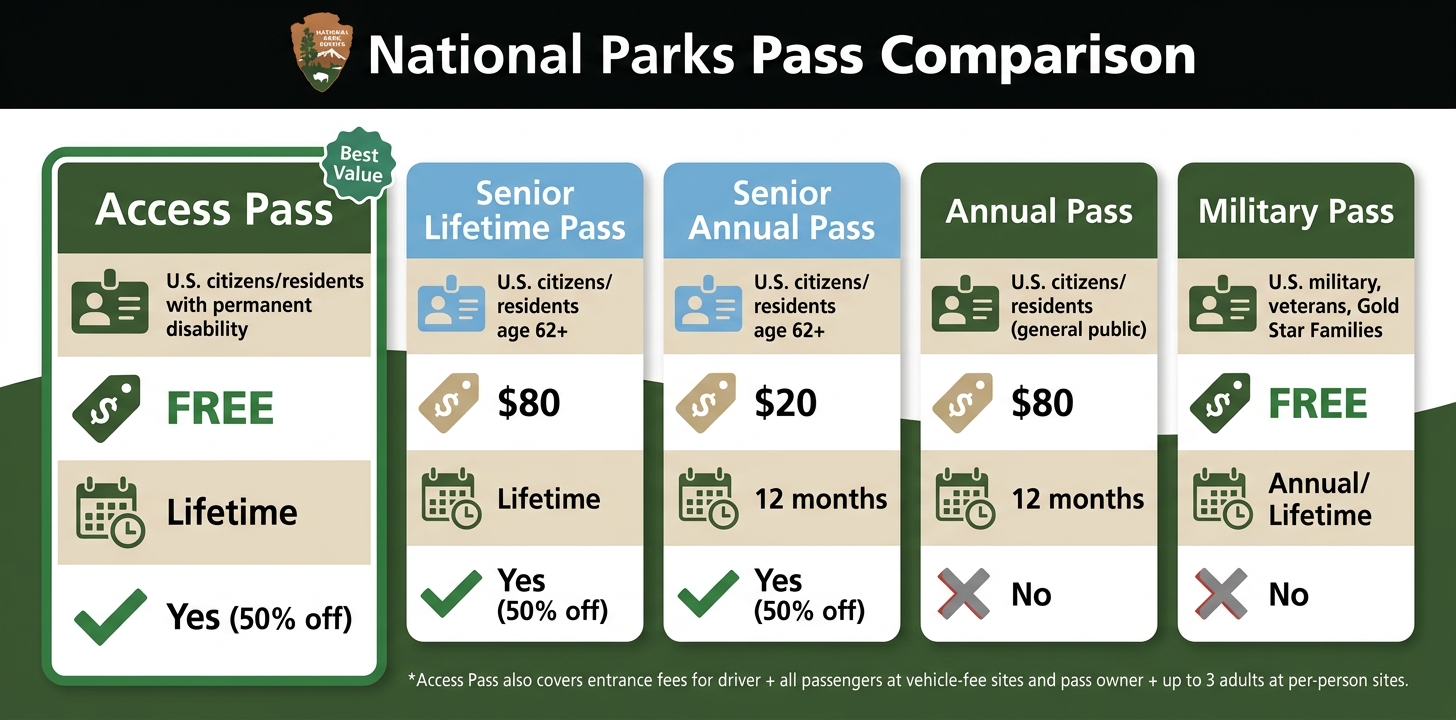
National Parks Pass Comparison: Access, Senior, Annual & Military
Let’s break down what the Access Pass includes and what it doesn’t.
What the Pass Covers
The Access Pass grants entry to more than 2,000 federal recreation sites managed by six agencies: the National Park Service, U.S. Forest Service, U.S. Fish & Wildlife Service, Bureau of Land Management, Bureau of Reclamation, and U.S. Army Corps of Engineers. It covers entrance fees and standard day-use fees at all these locations.
For sites that charge per vehicle, the pass covers the driver and all passengers. At per-person sites, it covers the pass owner and up to three adults (kids under 16 get in free). If you’re riding a motorcycle, the pass covers two motorcycles as long as one is driven by the pass owner.
Additionally, the pass offers a 50% discount on expanded amenity fees, which include individual campsites, swimming areas, and boat launches. As the USGS explains:
"The Access Pass provides the pass owner a discount on Expanded Amenity Fees (such as camping, swimming, boat launching, and guided tours)."
What the Pass Does Not Cover
The pass has its limits. The 50% discount applies only to individual campsites, not group sites or extras like utility hookups. It also does not cover timed-entry reservation fees, which are common at busy parks and usually cost around $2.
Private concessionaires operating within parks – like those offering boat rentals or guided tours – aren’t required to honor the pass or its discounts. While some might, it’s best to check fees ahead of time. Also, the pass is non-transferable and must be reapplied for if lost or stolen.
These restrictions are important to keep in mind alongside the eligibility and application rules we discussed earlier.
How the Access Pass Compares to Other Passes
When compared to other options, the Access Pass stands out for offering free entry and amenity discounts. The Annual Pass, for example, covers entrance fees but doesn’t include discounts on amenities like camping or tours. Both the Access Pass and the Senior Pass provide a 50% discount on amenities, but the Access Pass is free, while the Senior Lifetime Pass costs $80.
| Pass Type | Eligibility | Cost | Duration | Camping/Amenity Discount |
|---|---|---|---|---|
| Access Pass | U.S. citizens/residents with permanent disability | Free | Lifetime | Yes |
| Senior Lifetime Pass | U.S. citizens/residents age 62+ | $80 | Lifetime | Yes |
| Senior Annual Pass | U.S. citizens/residents age 62+ | $20 | 12 months | Yes |
| Annual Pass | U.S. citizens/residents (general public) | $80 | 12 months | No |
| Military Pass | U.S. military, veterans, Gold Star Families | Free | Annual/Lifetime | No |
If you still have an old Golden Access Passport, don’t worry – it remains valid for life. However, you can exchange it for the updated Access Pass at no cost at any issuing site.
Conclusion
The Access Pass is a valuable resource for U.S. citizens and permanent residents of any age who have a permanent disability that significantly impacts major life activities. It offers an easy way to enjoy federal recreational sites without barriers.
To get your pass, simply apply in person at a participating federal site. Bring a valid photo ID and one document verifying your disability, such as a physician’s statement, a VA letter, or proof of SSDI/SSI benefits. You’ll receive your pass on the spot. Alternatively, you can apply online through Recreation.gov and gain immediate mobile access to a digital version.
With the Access Pass, you receive lifetime free entry to over 2,000 federal sites and a 50% discount on certain amenity fees. Just make sure to check the park’s website for any additional timed-entry or reservation fees before your visit. Don’t forget to have your photo ID with you when using the pass. For more trip-planning tips, head over to The National Park Guide.
FAQs
Will my disability qualify if it isn’t rated at 100%?
A permanent disability that substantially limits one or more major life activities is sufficient to qualify for the Access Pass. Your disability does not need to be rated at 100%.
What if my doctor’s letter doesn’t say “permanent”?
If your doctor’s letter doesn’t specifically use the word “permanent,” don’t worry – it may still meet the requirements. As long as the letter confirms that you have a disability which significantly limits major life activities and is expected to last indefinitely, it can qualify. The Access Pass only requires proof of a medically determined, long-term or lifelong disability, not the explicit use of the term "permanent."
Do I still need timed-entry reservations with the Access Pass?
Yes, some national parks still require timed-entry reservations, even if you have an Access Pass. Be sure to check the specific park’s guidelines ahead of time to see if reservations are necessary for your visit.