
If you’re visiting a busy national park, you may need two things: an entrance pass and a timed entry reservation. They are not the same. In many parks, the reservation only controls when you can enter, and you still pay the park fee or show a valid pass.
Here’s the short version:
- I need to check whether my park uses timed entry at all.
- I need to see if the rule covers the whole park or just one road or area.
- I need to know the hours. Many parks only use timed entry during busy daytime windows, such as 7:00 a.m. to 3:00 p.m.
- I usually book on Recreation.gov.
- Most reservations come with a $2 nonrefundable processing fee.
- In most cases, one reservation covers one vehicle, not each person inside it.
- If I arrive before or after the timed-entry window, I may not need a reservation at all, depending on the park.
- I should save a screenshot or printout of my confirmation because cell service at the gate can be weak.
The parks mentioned here include Arches, Glacier, Rocky Mountain, Yosemite, Mount Rainier, and Acadia. Some use park-wide rules. Others only limit spots like Going-to-the-Sun Road, Bear Lake Road Corridor, Paradise, Sunrise, or Cadillac Summit Road.
Bottom line: timed entry helps parks spread out traffic during peak season, which is often the best time to visit for weather, but for me, the job is simple: check the park, check the area, check the time window, and book early if needed.
| Park | Timed entry type | Booking site | Fee |
|---|---|---|---|
| Arches | Whole park | Recreation.gov | $2 |
| Glacier | Certain areas | Recreation.gov | $2 |
| Rocky Mountain | Full park or certain area | Recreation.gov | $2 |
| Mount Rainier | Certain areas | Recreation.gov | $2 |
| Acadia | One road only | Recreation.gov | $2 |
| Yosemite | Whole park or certain areas | Recreation.gov | $2 |
A small detail can change the whole trip, so I’d treat timed entry as one of the first things to check before I go.
Timed Entry Requirements For US National Parks 2025 #shorts #nationalpark
sbb-itb-00512f3
Which National Parks Require Timed Entry
Several high-traffic parks use timed entry during peak season. That list includes Arches, Glacier, Rocky Mountain, Yosemite, Mount Rainier, and Acadia. The big thing to sort out is simple: does the reservation apply to the whole park, or only to one part of it?
Whole-Park Entry vs. Area-Specific Entry
Whole-park entry means you need a reservation to get into the park at all. Arches has used this setup. That’s the main difference between park-wide rules and area-based rules.
Area-specific entry works differently. It limits access to one road or corridor, while the rest of the park stays open.
At Glacier, that may mean the Going-to-the-Sun Road or North Fork. At Rocky Mountain, it may apply to the Bear Lake Road Corridor. At Mount Rainier, the Paradise and Sunrise corridors each have their own entry windows. At Acadia, only the Cadillac Summit Road needs a reservation.
So yes, you can still visit these parks without a reservation in some cases. You just can’t enter the restricted road or corridor unless you have one.
Timed Entry Comparison Table
Use the table below to compare where each rule applies. Since most of these parks use the same booking platform, it helps to have a guide to Recreation.gov reservations ready before the booking window opens.
| Park | Area Covered | Booking Platform | Processing Fee |
|---|---|---|---|
| Arches | Whole-park entry | Recreation.gov | $2 |
| Glacier | Going-to-the-Sun Road / North Fork | Recreation.gov | $2 |
| Rocky Mountain | Bear Lake Road Corridor or full park | Recreation.gov | $2 |
| Mount Rainier | Paradise and Sunrise corridors | Recreation.gov | $2 |
| Acadia | Cadillac Summit Road | Recreation.gov | $2 |
| Yosemite | Whole-park or specific areas | Recreation.gov | $2 |
Grand Canyon National Park currently does not require timed entry for basic park entry.
When You Need a Reservation and When You Do Not
Once you know which park or corridor uses timed entry, the next step is simple: check the hours. Timed entry is usually seasonal, and many parks only use it during peak periods. What matters most is the entry window.
Peak Season Hours and Time Windows
Timed entry is often in effect from late spring through early fall, when visitation is highest. But even during peak season, parks usually don’t require reservations all day.
In many cases, the rule applies only during the busiest daytime hours, like 7 a.m. to 3 p.m. or 9 a.m. to 2 p.m. Exact hours vary by park.
When No Reservation Is Required
If the park allows it, you can enter before the timed-entry window starts or after it ends without a reservation.
It also helps to check a checklist for national park reservations. In most parks, a timed-entry reservation covers one vehicle, not each person inside it. So one reservation will usually cover everyone riding in the car. However, keep in mind that parking fees and rules may still apply separately from your entry reservation.
How Timed Entry Reservations Are Released and Booked
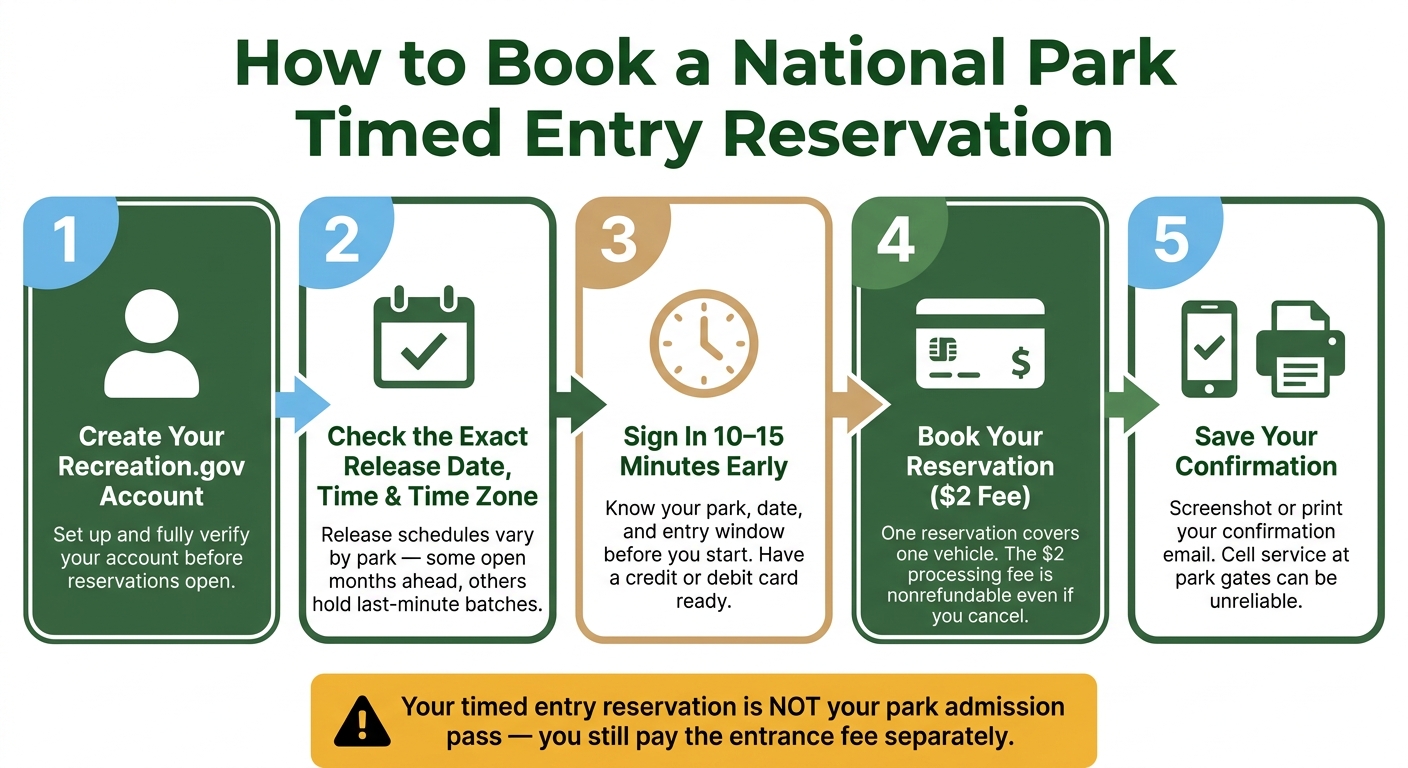
How to Book a National Park Timed Entry Reservation
Use Recreation.gov to check open dates and entry windows, then book your reservation. It helps to set up and verify your account before reservations go live. These passes are often released in batches, so timing can make or break your chances.
Plan for a nonrefundable $2 processing fee for each reservation. If you cancel, you won’t get that fee back.
Release timing matters just as much as the fee. Parks don’t all do this the same way. Some open reservations months ahead, while others save part of each day’s supply for last-minute releases. Go to the park’s Recreation.gov page and check the exact release date, time, and time zone. Popular dates can disappear fast.
Advance Releases vs. Last-Minute Releases
Parks use different release patterns. Some reservations open months ahead. Others hold back part of the daily entry supply for last-minute releases.
That small detail can change your whole plan. A date that looks sold out today might open later if the park uses a second release window. That’s why it’s smart to check the park’s Recreation.gov page for the exact release date, time, and time zone.
Steps to Take Before Reservations Open
Getting set up early gives you a better shot. Here’s the short version:
- Create your Recreation.gov account before reservations open and verify it completely.
- Sign in 10–15 minutes before release.
- Know your park, date, and entry window before you start.
- Confirm the time zone for the release.
- Have a credit or debit card ready.
After you book, save your confirmation number and email on your phone for the entrance station. Once your reservation is set, keep those confirmation details handy before you travel.
What to Do After Booking and Before You Arrive
Once you book, get your confirmation and payment set as you plan your national park trip. Your Recreation.gov confirmation email is your proof, so save a screenshot or print a copy before you leave. You’ll still need a park pass or separate fee payment at the entrance. If you don’t already have a pass, bring a credit or debit card.
Your reservation only holds your entry window. It does not cover admission.
What to Have Ready at the Entrance Station
When you get to the gate, keep the basics within reach. Have these ready before you pull up to the booth:
- Your timed entry confirmation (screenshot or printout)
- A photo ID
- Your park entrance pass or a credit/debit card for the entrance fee
A little prep here goes a long way. If everything’s ready ahead of time, the line tends to move faster.
Conclusion: Key Rules to Remember
Timed entry is an arrival reservation, not an admission ticket, so you still pay the entrance fee on its own. Only some parks use timed entry, and those rules often apply during peak hours or busy seasons. Reservations may open months ahead or show up in last-minute batches, depending on the park.
Whatever booking window your park uses, save or print your confirmation before you head out. Cell service at the gate can be spotty, and that’s a bad time to start digging through your inbox.
FAQs
Do kids need their own timed entry reservation?
It depends on the park’s policy. Timed entry rules change from one park to another, so check your destination’s guidelines before you go.
In many cases, reservations are tied to the vehicle, not each person. But some parks count every visitor toward daily capacity limits, no matter their age. Double-check the park’s rules so your whole group is covered.
Can I re-enter the park with the same reservation?
Usually, yes. At parks with timed entry, your reservation will often cover access for the whole day. That means you can come and go during your visit.
Once you pass the entrance station during your reserved time window, you can usually stay for the rest of the day. That said, rules can vary by park, so it’s smart to check the park’s own policy before you go.
What if I miss my timed entry window?
If you miss your timed entry window, check that park’s rules. Policies vary by location, so there’s no one-size-fits-all answer.
Some parks may post a small number of next-day or last-minute reservations online. In other cases, you may still get in outside peak hours, when timed entry isn’t required.
Before you go, review the park’s official entry rules so you know exactly what applies to your visit.