
There is no single RV size rule in U.S. national parks. If I were planning a trip, I’d check three things first: the campsite length, the road or tunnel limit, and any seasonal closure dates.
Here’s the short version:
- A campsite that fits your rig does not mean the road to it is open to your RV.
- Some parks limit site length. Others limit combined length, width, or height.
- A few roads have hard cutoffs, like 21 feet on parts of Glacier’s Going-to-the-Sun Road.
- Some campgrounds work for large rigs, but many top out around 30 to 40 feet.
- Seasonal closures can block access even if your reservation is confirmed.
A few fast examples from the article:
- Yosemite: some campgrounds allow 35 to 40 feet, but Yosemite Valley bars vehicles over 45 feet combined length.
- Zion: the main issue is tunnel clearance: over 7 feet 10 inches wide or 11 feet 4 inches tall means escort rules apply.
- Glacier: Going-to-the-Sun Road blocks vehicles over 21 feet long or 8 feet wide on a key section.
- Grand Canyon: Mather caps RVs at 30 feet, while Desert View goes up to 50 feet.
- Death Valley: Furnace Creek allows 35 feet, but Sunset can take rigs up to 99 feet.
What I take from all this is simple: measure your full rig, not just the trailer, and check both Recreation.gov and the park’s NPS road alerts before booking and again before driving.
RV Size Limits for State and National Parks
sbb-itb-00512f3
Quick Comparison
| Park | Main Campground/Access Limit to Watch | What Can Stop You |
|---|---|---|
| Yosemite | Campgrounds at 35 to 40 ft | 45 ft combined limit in Yosemite Valley |
| Zion | Tunnel width/height rules | Oversize vehicles need escort timing and fee |
| Glacier | 21 ft length / 8 ft width on Going-to-the-Sun Road | Road access, not just campsite fit |
| Grand Canyon | Sites from 30 ft to 50 ft | Hermit Road closure; North Rim seasonal closure |
| Yellowstone | Many campgrounds at 35 to 45 ft | Loop-specific limits and site rules |
| Bryce Canyon | Some sites up to 45 ft; some loops down to 20 ft | Loop-by-loop differences |
| Arches | 30 ft at Devils Garden | Small campground limit |
| Canyonlands | 28 ft in key areas | Tight campground caps |
| Capitol Reef | Main campground up to 40 ft | Rough backroads for large rigs |
| Acadia | Many sites up to 35 ft | Tight turns on some park roads |
| Great Smoky Mountains | Campgrounds often 35 to 40 ft | 45 ft combined road limit on Clingmans Dome Road |
| Olympic | Some campgrounds as low as 21 ft | Interior roads can block big rigs |
| Death Valley | 35 ft at Furnace Creek; 99 ft at Sunset | Trailer bans on some roads |
If I had to boil the article down to one line, it would be this: book by campsite size, drive by road limits, and double-check both before you leave.
Campground limits vs. road and tunnel restrictions
Two things matter here: will your rig fit the campsite, and can you legally get there?
How campground site limits are listed and what they do not guarantee
Campground pages on Recreation.gov and NPS park sites usually show a maximum vehicle length for each site. That number refers to the site pad length and loop clearance.
But that number has limits. It does not tell you if your setup can handle the approach road, and it does not promise you can reach the campground at all.
Roads with hard RV limits and why they matter
Even if a site fits your rig, the route to that site may not. Road limits are separate from campsite limits. They can depend on safety rules, clearance, traffic control, tight turns, steep grades, and seasonal closures.
Hermit Road in Grand Canyon National Park is closed to private vehicles from March through November. During that stretch, visitors need to use the free shuttle to reach those overlooks. Highway 67 to the Grand Canyon North Rim is usually closed from mid-October to mid-May due to snow. And here’s the part that trips people up: road alerts and closures are not linked to your campsite reservation.
That means you can have a booked site and still run into access problems. It happens more often than people expect.
Campsite rules vs. route rules: a quick comparison
Use this simple split before you book.
| Restriction Type | Where It Applies | What To Measure | Typical Trip Impact |
|---|---|---|---|
| Campground Site Limit | Individual parking pads (e.g., Mather Campground at the Grand Canyon) | Combined length of RV and tow vehicle | Limits which sites you can legally book and fit into |
| Road/Route Restriction | Park entry roads and scenic drives (e.g., Hermit Road) | Vehicle length, width, height, and seasonal access status | Can block access to campsites or viewpoints |
| Seasonal Closure | High-elevation access roads (e.g., Highway 67) | Check posted closure dates and detours | Entire sections of the park become inaccessible regardless of RV size |
Always check road alerts and seasonal closures separately from your campground reservation. The two systems don’t always match, and that’s where trip plans can go sideways.
RV length restrictions by park
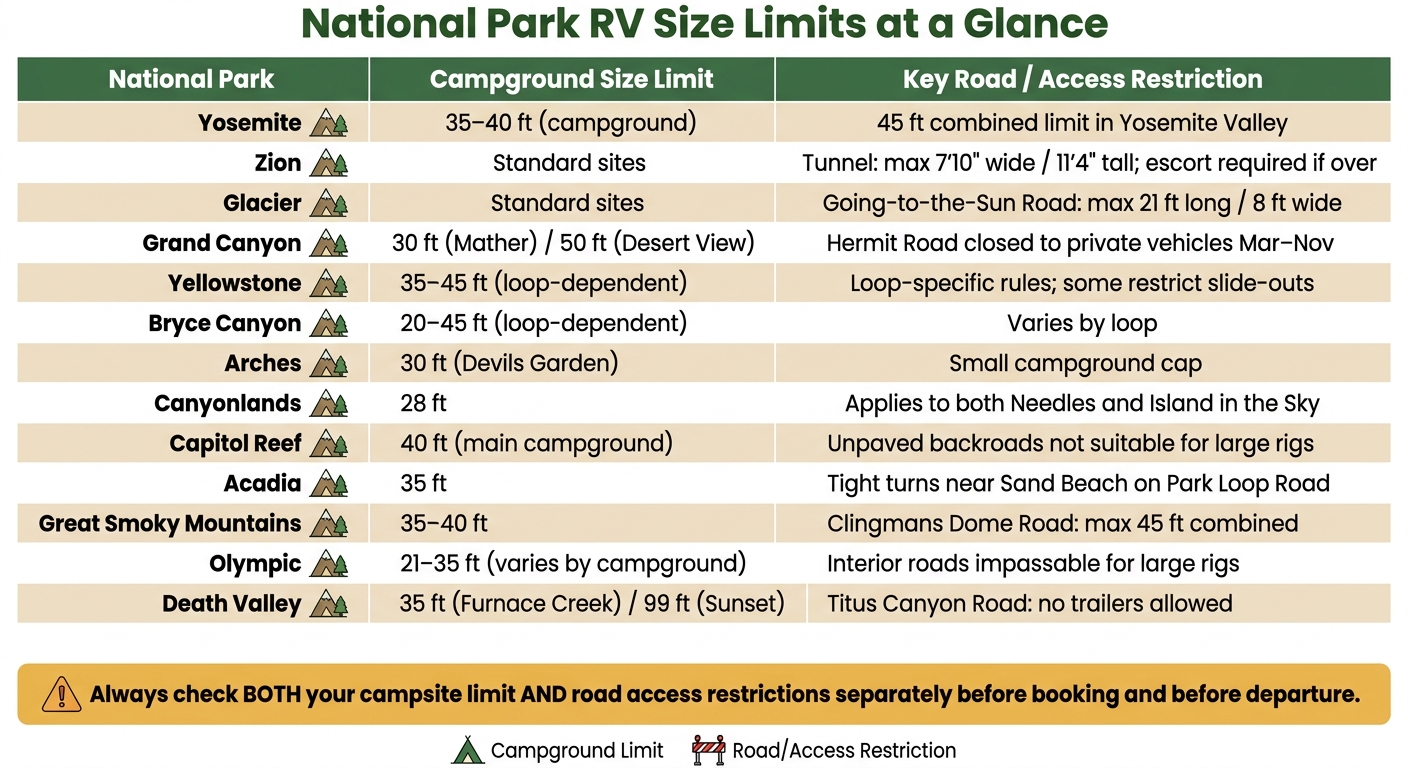
National Park RV Size Limits: Quick Reference Guide
Campground size rules and road limits don’t always line up. A site might fit your RV, but the road getting there may be the thing that stops you. That’s why it’s smart to check both before you book.
Yosemite, Zion, Glacier, and Grand Canyon
These parks are a good reminder that two rules can exist at the same time: one for the campground, another for the road.
In Yosemite, Upper Pines Campground accepts RVs up to 35 feet, while North Pines and Lower Pines allow up to 40 feet. But Yosemite Valley has a separate rule: vehicles over 45 feet in combined length aren’t allowed.
In Zion, the issue is less about campsite size and more about getting through the park. The Zion–Mount Carmel Tunnel restricts vehicles over 7 feet 10 inches wide or 11 feet 4 inches tall. If your vehicle is oversized, you must pay a fee and travel with an escort during limited hours.
In Glacier, Going-to-the-Sun Road is closed to vehicles over 21 feet in length (including tow) or over 8 feet in width between Avalanche Creek and the Logan Pass parking area.
At Grand Canyon’s South Rim, Mather Campground accepts RVs up to 30 feet, while Desert View Campground allows RVs up to 50 feet. Hermit Road is closed to private vehicles from March through November, so access there depends on the shuttle no matter how big your rig is.
The same campground-versus-road split shows up in the parks below.
Yellowstone, Bryce Canyon, Arches, Canyonlands, and Capitol Reef
In this group of parks, road access can matter just as much as campsite length.
In Yellowstone, most campgrounds cap RVs between 35 and 45 feet depending on the loop. Some loops also don’t allow generator use or slide-outs.
Bryce Canyon has a similar mixed setup. Sunset Campground accepts RVs up to 45 feet, while North Campground drops to 20 feet in some loops.
At Arches, Devils Garden Campground limits RVs to 30 feet.
In Canyonlands, the Needles District caps RVs at 28 feet at Squaw Flat Campground. Island in the Sky also limits rigs to 28 feet.
At Capitol Reef, Cathedral Valley roads are unpaved and generally not a good match for large rigs. The main campground accepts RVs up to 40 feet. Before you arrive, check Park Road Alerts for any RV-specific restrictions or closures.
Acadia, Great Smoky Mountains, Olympic, and Death Valley
A little homework goes a long way here. Check campground length caps, then look at current road alerts.
At Acadia, Blackwoods Campground accepts RVs up to 35 feet, and Seawall Campground also caps at 35 feet. Park Loop Road doesn’t have a hard length limit, but there are tight turns near Sand Beach.
In Great Smoky Mountains, Clingmans Dome Road restricts vehicles over 45 feet in combined length, and most campgrounds cap RVs between 35 and 40 feet.
At Olympic, Heart O’ the Hills Campground accepts RVs up to 21 feet, while Kalaloch Campground allows up to 35 feet. Some interior roads are unpaved and impassable for large rigs.
In Death Valley, Furnace Creek Campground accepts RVs up to 35 feet. Sunset Campground is built for larger rigs up to 99 feet and has no hookups. Titus Canyon Road is a one-way unpaved route closed to all trailers.
Choosing the right RV size for national park travel
RV length shapes almost every part of a national park trip. It affects where you can camp, which roads you can use, and how easy it is to change plans on the fly. And here’s the catch: some rigs fit the campground but still run into trouble on narrow roads or low tunnels. So it helps to narrow your options by size first, then check each park’s rules.
What to expect from small, mid-size, and large rigs
Vans, Class B, and shorter Class C rigs under 25 feet are usually the easiest choice for national park travel. They fit in nearly every NPS campground, handle tight scenic drives better, and give you the most freedom if you want to pivot at the last minute. The downside is simple: less room. You’ll have less storage and less day-to-day comfort.
Mid-size rigs in the 26–35 foot range give you more elbow room without shutting you out of many standard NPS campsites. The tradeoff is that you’ll have fewer site options and fewer hookups. In popular NPS campgrounds, reservations can open as much as 6 months ahead, so it’s smart to book early through Recreation.gov.
Large fifth wheels and Class A motorhomes at 36 feet and up give you the most living space, but they also come with real limits once you’re inside park boundaries. In many cases, these rigs work better at concessionaire-run campgrounds such as Trailer Village at the Grand Canyon, or at private campgrounds just outside the park. If hookups are a must, focus on concessionaire-run sites or private parks nearby.
Access by RV length range: a side-by-side comparison
| RV Length Range | Campground Access | Road Flexibility | Comfort Tradeoff | Planning Difficulty |
|---|---|---|---|---|
| Up to 25 ft | Highest; fits almost all NPS sites | Maximum; can handle most scenic drives and secondary roads | Limited living space and storage | Lower; more site options available at the last minute |
| 26–35 ft | Moderate; fits many standard NPS sites but may lack hookups | Good; manageable on most main park roads, but tighter routes can be a problem | Balanced; more room and storage | Moderate; popular parks often need 6-month advance booking |
| 36 ft and up | Limited; often restricted to RV villages or private parks built for larger rigs | Restricted; may be barred from scenic secondary roads or tight tunnels | High; offers full kitchens, multiple slide-outs, and full hookups | Highest; you’ll need to target big-rig-friendly campgrounds early |
Before you book, check campground length limits, route restrictions, and current road alerts.
How to verify size rules before booking and before driving
After you compare limits across parks, do one last pass to confirm your exact campsite and your exact route.
How to measure your rig the way parks count it
Before booking, measure the entire setup – tow vehicle plus trailer, or your full motorhome length – and compare that number with the exact campsite length listed on Recreation.gov.
This part matters because parks usually count the full length, not just the trailer by itself. A site that looks fine at first glance can still be too short once your whole setup is factored in.
If your route includes tunnels, tight turns, or narrow roads, check the park’s road-status page for width and height advisories before you leave. That small check can save you from a rough surprise later.
Where to check campground pages, road alerts, and reservation details
Once the campsite works, make sure the road does too.
Recreation.gov should be your first stop. Individual campsite listings show maximum RV length, and those numbers can change from one site to another in the same campground.
Then go straight to the park’s official page on nps.gov and find the road-status page. That’s where parks post vehicle-specific advisories, construction-related restrictions, and seasonal closures that may not appear in reservation listings.
Check both sources:
- when you book
- again before you leave
Road conditions, construction schedules, and park operations can shift between those two dates. What worked a month ago may not work on travel day.
Conclusion: The safest way to plan a national park RV trip
There’s no single RV size limit across national parks. Check the site-specific campground limit first, then confirm road access and seasonal restrictions before booking and one more time before departure.
FAQs
How do I measure my full RV length correctly?
Measure your RV’s total length from end to end, including every add-on and extension. That includes slide-outs, rear bumpers, and any towed vehicle or trailer.
Use that full number when you check campground rules. Then compare it with the size limits on the park’s official website or in the reservation system, so you can be sure your rig will fit the site safely.
What if my campsite fits but the road has a smaller limit?
Even if a campsite is big enough for your RV, you still need to follow the park’s rules as a whole. Many parks set height, weight, or length limits on the roads, bridges, or tunnels that lead to the campground.
If your rig is over any of those limits, getting to your site may not be safe – or even legal. Before you book, check the official park website or ask park staff about road limits and campsite dimensions.
Which national parks are easiest for large RVs?
Parks with developed campgrounds are usually the simplest pick for larger RVs, especially if they can handle a range of rig sizes.
Yellowstone is the standout here. The park has 12 campgrounds, and Fishing Bridge Campground includes 310 full-hookup sites built for larger vehicles.
Other solid options include:
- Grand Teton: Colter Bay RV Park has 112 full-hookup sites
- Death Valley: full hookups are available at Furnace Creek, Stovepipe Wells, and Panamint Springs
- Yosemite and Sequoia: some campgrounds can fit rigs up to 40–42 feet