
America’s national parks are best explored by road trips, offering unmatched freedom to discover stunning landscapes at your own pace. From towering peaks to ancient forests, these journeys combine breathtaking scenery, rich history, and the flexibility to create a personalized adventure. Here’s a quick guide to three standout routes:
- The Grand Circle (Southwest): A 1,250-mile loop connecting up to 10 parks, including Zion, Bryce Canyon, and the Grand Canyon. Best visited in spring or fall, this trip takes 8–12 days.
- Pacific Northwest: Explore volcanic peaks, lush forests, and alpine lakes in parks like Mount Rainier, Olympic, and North Cascades. Visit between July and October for ideal conditions.
- Black Hills Region: A shorter 4-day trip featuring Badlands National Park, Mount Rushmore, and Custer State Park. Perfect for a quick escape with diverse attractions.
Plan ahead with vehicle preparation, park passes, and early bookings for accommodations. Whether you prefer red rock canyons, alpine vistas, or serene prairies, there’s a route for every traveler. Let the journey itself be part of the adventure.
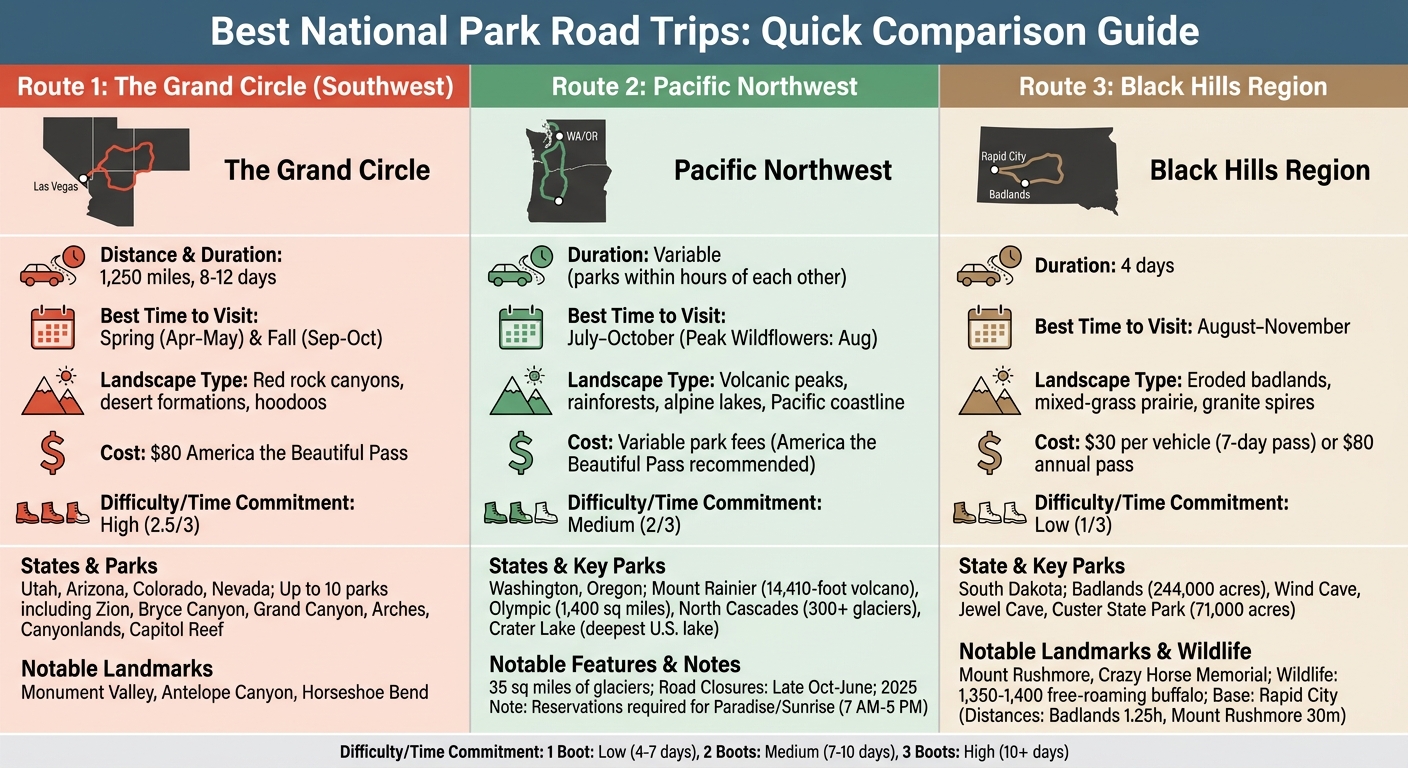
National Park Road Trip Routes Comparison: Grand Circle, Pacific Northwest, and Black Hills
117: Favorite National Park Road Trips!
sbb-itb-00512f3
The Grand Circle: Southwest National Parks Loop
The Grand Circle is a legendary road trip that showcases the breathtaking landscapes of the Southwest. Spanning 1,250 miles, this loop connects up to 10 national parks, tribal lands, and monuments across Utah, Arizona, Colorado, and Nevada. Most travelers start and finish in Las Vegas, thanks to its convenient car rental options and proximity to Zion National Park. This route captures the essence of what makes road trips through national parks so captivating – freedom to explore at your own pace.
Parks and Landmarks Along the Route
At the heart of this journey are Utah’s "Mighty Five" national parks, along with a collection of other iconic landmarks that make this trip unforgettable.
The adventure begins with Zion National Park, known for its towering sandstone cliffs and The Narrows, a slot canyon hike through the Virgin River. Nearby, Bryce Canyon boasts the largest collection of hoodoos – those quirky, weathered rock formations shaped by erosion and frost. For a quieter experience, Capitol Reef offers the stunning 100-mile Waterpocket Fold, a dramatic geological feature, along with historic fruit orchards in the Fruita district.
In Moab, you’ll find two of the most famous parks: Arches National Park, home to over 2,000 natural stone arches, including the iconic Delicate Arch, and Canyonlands National Park, a vast expanse carved into four distinct districts by the Green and Colorado rivers. Photographer Rob Decker captures the essence of the Grand Canyon perfectly:
"The Grand Canyon overwhelms our senses through its immense size: 277 river miles long, up to 18 miles wide, and a mile deep".
Beyond the main parks, the route includes stops at Monument Valley, with its striking Navajo tribal lands, the sculpted beauty of Antelope Canyon (advance booking required), and Horseshoe Bend, where the Colorado River forms a stunning 270-degree curve. If you have extra time, consider adding Mesa Verde, with its 600 ancient cliff dwellings, the ancient fossilized trees of Petrified Forest, or the dramatic cliffs of Black Canyon of the Gunnison.
When to Go and How Long It Takes
Timing your visit is key to enjoying the Grand Circle to the fullest.
Spring (April–May) and fall (September–October) are ideal, offering mild temperatures and fewer crowds. Summer, while popular, can bring intense desert heat, and the Grand Canyon’s North Rim is only accessible during this season. A typical itinerary covering the Mighty Five and the Grand Canyon takes about 8–12 days. However, if you can spare 2–3 weeks, you’ll have time to linger – spending two nights at each park allows for weather flexibility and deeper exploration.
Don’t forget to purchase the $80 America the Beautiful National Parks Pass, which covers all entry fees along the route.
Pacific Northwest: Mountains, Forests, and Volcanoes
Unlike the arid landscapes of the Southwest, a road trip through the Pacific Northwest immerses you in volcanic peaks, dense forests, and serene alpine lakes. A journey through Washington – and possibly a detour into Oregon – connects a variety of national parks, all within a few hours of each other. This means you can explore diverse terrain without spending endless hours in the car.
Which Parks to Visit
Mount Rainier National Park is home to a towering 14,410-foot active volcano that dominates the horizon. The park boasts 35 square miles of glaciers and snowfields, with Paradise being one of its most iconic spots. In fact, Paradise recorded an astonishing 93.5 feet of snow during the winter of 1971–72. August is the perfect time to visit for vibrant wildflower displays in the subalpine meadows. For incredible views, head to the Sunrise area, which is the park’s highest point accessible by car. Don’t miss the Grove of the Patriarchs trail, a gentle 1.5-mile loop that winds through ancient cedar trees.
Olympic National Park spans a massive 1,400 square miles and features a stunning range of ecosystems. Travel writer Julian Smith aptly described it:
"The natural riches that fill the fat peninsula between Puget Sound, Vancouver Island, and the Pacific could easily qualify as three or four separate parks".
Here, you can explore glacier-covered peaks at Hurricane Ridge, wander through moss-laden old-growth trees in the Hoh Rainforest, and stroll along more than 70 miles of rugged Pacific coastline, complete with sea stacks at Rialto Beach. To cut down on driving, follow a "C"-shaped route from Port Angeles to Kalaloch. For an added scenic bonus, take the Bainbridge Island ferry from Seattle.
North Cascades National Park offers a more remote experience, with over 300 glaciers – making up a third of all glaciers in the contiguous U.S. outside Alaska. Julian Smith calls it:
"America’s version of the Alps", noting it’s "as rugged as it is remote, which explains why the park gets so few visitors even though it’s just two hours from Seattle".
The park’s standout feature is Diablo Lake, famous for its striking turquoise waters. The North Cascades Highway (Washington Route 20) provides access to breathtaking spots like the Washington Pass Overlook and trailheads such as the Sahale Arm Trail, which rewards hikers with stunning glacier views.
If your trip extends into Oregon, Crater Lake National Park offers a breathtaking sight: the deepest lake in the U.S., formed within a collapsed volcanic caldera. The 33-mile Rim Drive circles the lake, providing spectacular views of its intense blue water from every angle.
With these highlights in mind, plan your itinerary to align with the best conditions for each park.
Best Times to Visit
Timing is everything for a Pacific Northwest road trip. The best window to visit is between July and October. Many high-elevation roads and trails – like Sunrise Road at Mount Rainier, Hurricane Ridge in Olympic, and Route 20 in the North Cascades – are typically closed from late October or November through June due to snow. Always check the National Park Service’s road updates before you head out, as conditions can vary depending on snowfall.
Summer in these high-altitude areas is brief but spectacular, spanning roughly from June to August. August is also the prime time for wildflowers in the mountain meadows. Meanwhile, Olympic National Park’s coastal and rainforest regions remain accessible year-round, though rain is frequent outside of summer. To beat the crowds at popular spots like the Hoh Rainforest, aim to arrive by 9:00 AM. Keep in mind that starting in 2025, Mount Rainier will require reservations for the Paradise and Sunrise areas between 7:00 AM and 5:00 PM during peak summer months.
Black Hills Region: A Shorter Road Trip Option
If you’re short on time but still want a trip packed with adventure, South Dakota’s Black Hills region is the perfect choice. This area offers a variety of landscapes and attractions, all within a few hours’ drive. From rugged badlands to underground caves and free-roaming bison, there’s plenty to explore. Using Rapid City as your base, you’ll spend less time on the road and more time enjoying the parks.
What to See in the Black Hills
Badlands National Park spans 244,000 acres of striking terrain shaped by erosion into spires and pinnacles. The 32-mile Badlands Highway Loop Road (Highway 240) takes you through the park’s north unit, offering 12 scenic overlooks of its dramatic, moonlike landscapes. For hiking, the Notch Trail is a 1.5-mile round-trip trek that includes a wooden ladder and ends with stunning views of the White River Valley. If you prefer something less strenuous, the Window Trail and Fossil Exhibit Trail are both short, 0.25-mile boardwalks that are accessible for various mobility levels.
Wind Cave National Park is known for its 33,000 acres of mixed-grass prairie and pine forests, while Jewel Cave National Monument boasts over 195 miles of passages adorned with unique spar crystals like nailhead and dogtooth formations.
Custer State Park spans 71,000 acres and is home to an impressive herd of 1,350 to 1,400 free-roaming buffalo. The park’s scenic drives are a major draw, and the 14-mile Needles Highway (SD Hwy 87 North) is a standout. This winding route passes through towering granite spires and the famous Needles Eye Tunnel, which is just 8 feet wide and 9 feet 9 inches high. Double-check your vehicle’s dimensions before attempting it. South Dakota Governor Peter Norbeck once remarked:
"This is not meant to be a super highway, to do the scenery justice you should drive no more than 20 mph and to do it full justice you should simply get out and walk".
For wildlife enthusiasts, the 18-mile Wildlife Loop Road offers prime opportunities to spot bison, prairie dogs, and feral burros, especially in the early morning or near sunset.
Beyond the parks, you’ll find the Mount Rushmore National Memorial, featuring its iconic 60-foot carvings of four U.S. presidents. Nearby, the Crazy Horse Memorial honors the Lakota leader with a massive mountain carving still under construction and houses the Indian Museum of North America. For a quirky roadside stop, visit Wall Drug near the Badlands for fun photo ops and a quick break. These attractions make for an action-packed four-day trip.
Trip Length and Logistics
A four-day itinerary works well to experience the region’s highlights without feeling rushed. Rapid City is a convenient hub, located about 1.25 hours (83 miles) from Badlands National Park and just 30 minutes from Mount Rushmore. Driving from the Badlands to Custer State Park takes around 1 hour and 40 minutes (100 miles).
Entry to Badlands National Park costs $30 per vehicle for a 7-day pass, but the America the Beautiful Pass ($80 annually) covers all U.S. national parks. The best time to visit is between August and November, when the weather is cooler, and crowds are smaller. Keep in mind that Needles Highway closes after the first snow and usually reopens by April 1. Since cell service is limited in many areas, bring paper maps and extra water. If you’re planning to tour the Minuteman Missile Delta-01 Launch Control Facility, book early as spots fill up quickly.
How to Plan Your National Park Road Trip
Getting Your Vehicle Ready and What to Pack
Before hitting the road, make sure your vehicle is up for the challenge. High-altitude routes, like the Beartooth Highway that climbs to an elevation of 10,947 feet, can test your brakes and cooling system. And for parks with steep, narrow roads – like Glacier National Park – reliable windshield wipers and confident handling are essential, especially in wet conditions.
Pack emergency supplies for both your vehicle and yourself. Essentials include a first aid kit, bear spray (if you’re traveling in bear country), a multi-tool, headlamps with spare batteries, and a power bank or portable power station. Since cell service is spotty in many remote areas, bring physical trail maps alongside a compass or GPS device. Stick to Leave No Trace principles by carrying garbage bags for your waste. If you’re traveling with pets, check park rules ahead of time, and pack items like a collapsible water bowl and waste bags to keep them comfortable and the parks clean.
With your vehicle and gear ready, the next step is understanding the costs and rules for each park.
Entry Fees, Permits, and Park Rules
Most national parks charge entrance fees ranging from $25 to $35 per vehicle. Planning to visit multiple parks? The $80 America the Beautiful pass is a smart investment, covering access to over 2,000 federally managed sites.
Before you go, check the park’s website for any timed-entry requirements or permits, which are often needed during peak seasons. Roads like Glacier’s Going-to-the-Sun Road and the Beartooth Highway close for winter, typically from October until late spring or early summer. To avoid crowds at popular destinations like the Grand Canyon South Rim, consider entering through less-busy gates, such as the East Entrance.
Now that you’re set with entry details, let’s talk about balancing your time between driving and exploring.
How to Balance Driving Time with Park Activities
Even short scenic drives can stretch into a full day if you stop frequently for overlooks, wildlife sightings, and photos. For instance, Glacier’s 50-mile Going-to-the-Sun Road can take anywhere from two hours to an entire day, depending on how often you pause to soak in the views. Keep in mind that "bear jams" (wildlife-related traffic delays) can also add extra time to your drive.
Break up long drives with short, easy hikes. Boardwalk trails or 1.5-mile loops are great options to stretch your legs and experience the park without taking up too much time. Plan activities during quieter hours – like late afternoon gondola rides or evening stargazing sessions – to make the most of your day.
Lastly, use the NPS App to stay updated on alerts and closures, helping you plan your stops more effectively.
Conclusion: Start Planning Your National Park Road Trip
Take your pick from the Grand Circle’s breathtaking red rock landscapes – like Zion’s towering 2,000-foot sandstone cliffs and Bryce Canyon’s ancient hoodoos – or head to the Pacific Northwest for alpine beauty along Glacier’s iconic 50-mile Going-to-the-Sun Road. If peaceful vistas are more your style, the Black Hills and the quiet expanses of Badlands National Park offer a serene escape.
"When you make the journey itself part of the destination, whole new worlds open up to be explored and places you never would have thought to travel become your new favorite spots." – Mikaela Ruland
Whether you’re drawn to the dramatic canyon views of the Grand Circle, the rugged alpine charm of the Pacific Northwest, or the tranquil beauty of the Black Hills, there’s a route for every kind of traveler. Families might prefer easy-access viewpoints and shorter trails, while thrill-seekers can embrace challenges like slot canyon hikes or scrambling over boulders. For those craving solitude, the Grand Canyon’s North Rim – higher and far quieter than the bustling South Rim – or the expansive quiet of the Badlands is the perfect retreat.
Make sure your vehicle is road-trip ready and secure any necessary permits in advance. Before setting out, check the latest updates on park websites for alerts or timed-entry requirements. Then, let the adventure unfold, from the Grand Canyon’s 277-mile-long gorge to Glacier’s shrinking but still awe-inspiring ice fields – a sobering reminder of how our world is changing.
The open road is calling, with towering cliffs, endless horizons, and unforgettable memories waiting to be made. Time to start your journey.
FAQs
Which road trip is best for first-timers?
For those embarking on their first road trip, choosing parks that combine stunning views with straightforward navigation is key. Destinations like the Great Smoky Mountains and the Grand Canyon are excellent options, thanks to their breathtaking overlooks and visitor-friendly amenities. For an added adventure, consider routes like Highway 89. This scenic drive links iconic parks such as Glacier National Park and the Grand Canyon, offering a smooth and enjoyable way to explore a variety of landscapes without the hassle.
How do I plan lodging and timed-entry reservations?
To secure lodging and timed-entry reservations for national parks, you can use services like National Park Reservations or US Park Lodging. These platforms make it easy to book accommodations either within the park or nearby. For parks like Yosemite, reservations can be made as far as 366 days in advance. Be sure to check the park’s official website or your preferred booking platform for availability, especially during busy seasons. Keep in mind that reservation fees may apply.
What’s the easiest way to save on park entry fees?
The simplest way to cut down on park entry costs is by taking advantage of fee-free days or investing in an America the Beautiful pass. Fee-free days occur several times a year, allowing visitors to enjoy national parks without paying entry fees. If you’re a frequent park-goer, the America the Beautiful pass is a smart choice – it grants unlimited access to over 2,000 federal recreation sites, including all national parks.