
When deciding between a mirrorless camera and a DSLR for wildlife photography, the choice depends on your priorities. Mirrorless cameras excel in autofocus, speed, and silent operation, making them ideal for tracking fast-moving animals or shooting in low light. On the other hand, DSLRs offer better battery life, durability, and real-time optical viewfinders, which are great for extended trips in remote areas.
Key Points:
- Mirrorless Advantages:
- Superior autofocus with AI-powered tracking.
- High burst rates (up to 120 fps) for fleeting moments.
- Lightweight and silent operation.
- DSLR Advantages:
- Longer battery life (800–1,500 shots per charge).
- Rugged build with proven reliability in harsh conditions.
- Optical viewfinder for lag-free tracking.
Quick Comparison:
| Feature | Mirrorless | DSLR |
|---|---|---|
| Autofocus | AI-driven, full-frame coverage | Limited to focus points near center |
| Burst Rate | Up to 120 fps | Typically 10–14 fps |
| Battery Life | Shorter, frequent swaps needed | 800–1,500 shots per charge |
| Weight | Lighter body | Heavier, better balance with lenses |
| Durability | Weather-sealed, sensor exposed | Weather-sealed, sensor protected |
| Viewfinder | Electronic, previews final image | Optical, real-time view |
| Cost (Used Market) | Higher for lenses and bodies | More affordable options available |
If you’re focused on advanced features and portability, mirrorless systems are the future. For reliability and longer field use, DSLRs remain a strong choice, especially with affordable used options available.
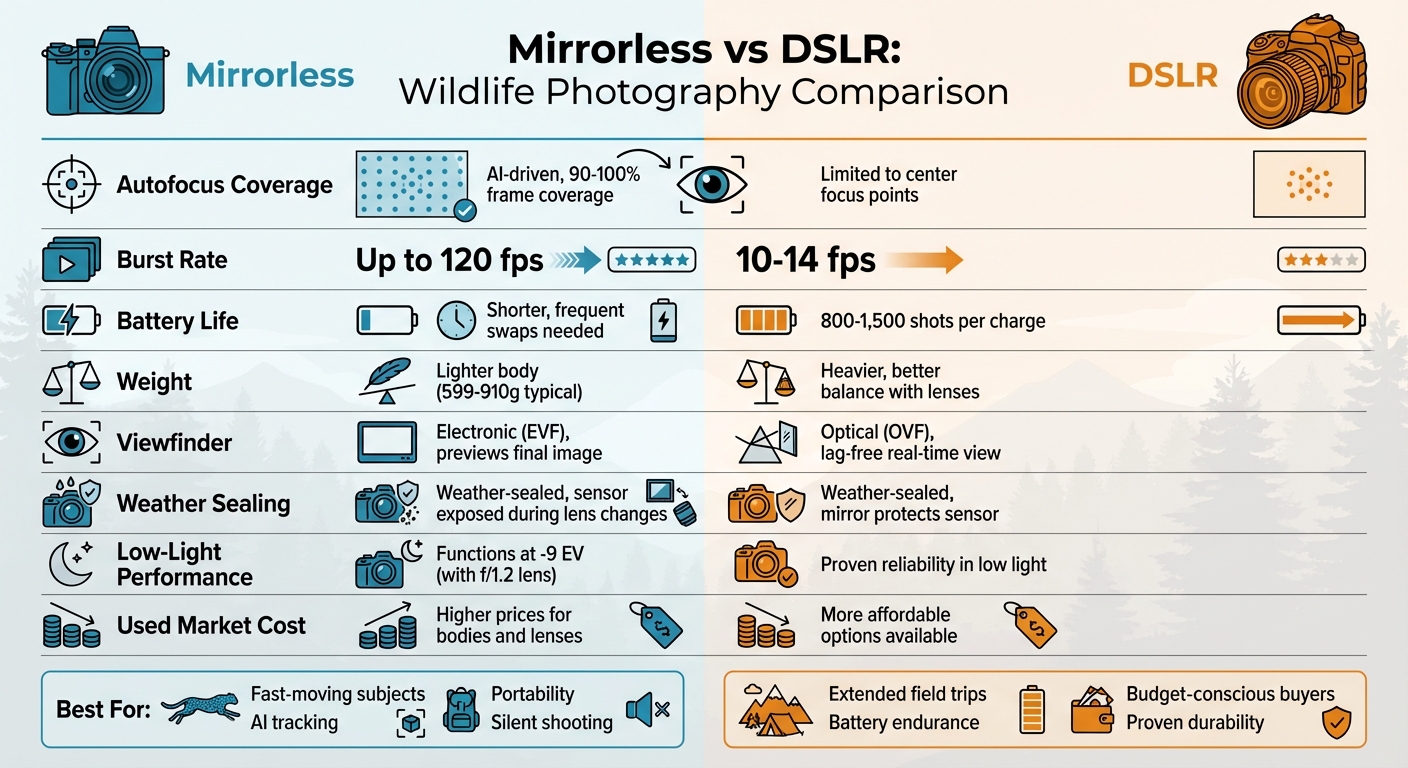
Mirrorless vs DSLR Cameras for Wildlife Photography: Feature Comparison
Mirrorless Cameras for Rugged Wildlife Photography
Autofocus and Performance
Modern mirrorless cameras have revolutionized wildlife photography with AI-driven subject detection. Unlike DSLRs that rely on a separate autofocus module, mirrorless systems use on-sensor hybrid autofocus, which provides phase-detection points across 90-100% of the frame. This means you can track your subject anywhere in the frame, not just in the center.
The autofocus "stickiness" of high-end models is particularly impressive. Cameras like the Nikon Z9 (around $5,500) and Sony A1 (approximately $6,500) can lock onto an animal’s eye and maintain focus even when the subject moves behind obstacles or temporarily leaves the frame. Wildlife photographer Libor Vaicenbacher highlights the Z9’s ability to focus in extreme low-light conditions, functioning at -9 EV with an f/1.2 lens, which is beyond what most would consider photographically useful.
Mirrorless cameras have also pushed burst rates to new heights. The Sony A9 III can shoot at 120 fps with continuous autofocus and auto-exposure, while the Canon EOS R5 II (around $4,299) and OM System OM-1 Mark II (approximately $2,400) deliver 30-50 fps. In tests involving birds in flight, the Sony A9 II achieved a 96% keeper rate for perfect focus and 99% for usable focus. Features like pre-capture buffering, which saves frames from up to one second before the shutter is fully pressed, ensure you never miss sudden action such as a bird taking flight.
To get the most out of your autofocus system, use settings like "Wide-Area (Small)" instead of "Auto-Area" when tracking small, fast-moving birds. This reduces the chance of focusing on background elements like branches. Assigning autofocus to a rear button (AF-ON) gives you more control, and keeping your firmware updated is crucial, as manufacturers frequently release updates that improve subject recognition through AI.
Weather Sealing and Build Quality
Durability is just as important as performance when shooting in challenging environments. Flagship mirrorless models like the Nikon Z9 and Canon EOS R1 (priced at $6,799) offer professional-grade weather sealing and rugged magnesium alloy bodies. The OM System OM-1 stands out with its IPX1-rated weather sealing and ability to operate in freezing conditions. Photographer Ibrahim noted that the OM-1 "kept working flawlessly in temperatures that had me worried about frostbite".
However, you don’t need to invest in flagship models to get reliable weather protection. Cameras like the Nikon Z6 II and Fujifilm X-T5 ($1,700) have proven their resilience in tough conditions. During a rainforest assignment in 2025, photographer Ibrahim used the Z6 II in constant downpours and high humidity for two weeks without any issues. Similarly, the Fujifilm X-T5 endured sudden mountain rain during a three-day trek, keeping its internal components dry.
One key point: your lens must also be weather-sealed. Using non-sealed lenses can expose your camera sensor to moisture. The Nikon Z9 and Z8 have eliminated the mechanical shutter entirely, reducing potential failure points in the field. For extreme environments, features like Live ND on the OM-1 can minimize the need for external filters, which can be cumbersome to manage outdoors.
Weight, Battery Life, and Handling
One of the biggest advantages of mirrorless cameras is their lighter weight, thanks to the absence of a mirror box. Models like the Nikon Z8 (910g), Sony A9 III (617g), and OM-1 Mark II (599g) are significantly lighter than the heavier Nikon Z9 (1,340g). Wildlife photographer Nasim Mansurov appreciates this weight reduction, stating:
"I get a bit tired with a lens the size of the Sony 200-600mm, but the Canon 100-500mm lens is something I can carry all day without fatigue".
Advanced In-Body Image Stabilization (IBIS), offering up to 8 stops of stabilization, makes handheld shooting possible even with long telephoto lenses. For those using Micro Four Thirds systems like the OM-1 Mark II, the 2x crop factor means a 300mm lens gives you 600mm of reach, all while keeping weight to a minimum.
That said, battery life remains a challenge for mirrorless systems. Electronic viewfinders and sensors consume a lot of power, so carrying extra batteries or using a battery grip is essential for long trips in remote areas. Additionally, smaller camera bodies may feel unbalanced with large telephoto lenses. A vertical grip can improve handling in such cases. To avoid delays caused by slow startup times or wake lag, tweak your power-saving settings to keep the camera ready during critical shooting moments.
sbb-itb-00512f3
DSLR Cameras for Rugged Wildlife Photography
Optical Viewfinder and Autofocus Performance
One of the standout features of DSLRs is their optical viewfinder (OVF). Unlike electronic viewfinders (EVFs), which display a digital image, an OVF provides a direct, real-time view of the scene through natural light – completely lag-free. This real-time advantage is especially useful when tracking fast-moving wildlife, as there’s no delay to disrupt your shot. Plus, in bright outdoor settings, where electronic screens can struggle with glare or appear washed out, the OVF remains clear and reliable.
Wildlife photographer Paolo Sartori highlights this benefit, saying DSLRs are known for their "optical viewfinders (great in bright light and no lag)". Similarly, night photographer Ken Lee points out the advantage in low-light situations: "When photographing in low light situations, optical viewfinders approximate the feel of looking with your own eye. Electronic viewfinders can look like a grainy, poor-quality display".
High-end DSLR models like the Nikon D850 (around $1,996) and Canon EOS 5D Mark IV (around $2,099) deliver image quality on par with mirrorless cameras. Meanwhile, flagship models such as the Nikon D6 (around $6,496) and Canon EOS-1D X Mark III (around $6,499) feature cutting-edge autofocus systems for precise tracking in demanding conditions.
This seamless, real-time view is just one part of what makes DSLRs a go-to choice for rugged outdoor photography.
Build Quality and Weather Resistance
DSLRs are built to withstand the harshest environments. Their durable construction includes extensive weather sealing to protect against rain, dust, and other environmental challenges. Photographer Graeme Green stresses this reliability: "I’m still a DSLR user… I like their solidness and durability, essential for working in challenging conditions, as well as the way they feel and operate".
Another often-overlooked advantage is thermal management. Unlike mirrorless cameras, which keep their sensors powered continuously, DSLRs are less prone to overheating during long shoots. For example, the Nikon D700 proved its resilience by functioning flawlessly in Death Valley’s extreme heat of 125°F (52°C). Photographer Heiko Sieger sums it up: "One of the big strengths of a DSLR is its reliability".
Additionally, the DSLR’s physical mirror offers extra protection for the sensor. Positioned in front of the shutter and sensor, the mirror helps shield these components from dust during lens changes – an essential feature for photographers working in dusty or sandy conditions.
Weight, Battery Life, and Lens Options
When it comes to wildlife photography, DSLRs balance durability, power efficiency, and lens versatility. While they are heavier than mirrorless cameras, this added weight actually enhances stability when using large telephoto lenses. Their solid build also provides a secure grip, which is crucial when handling heavy gear in the field.
Battery life is another area where DSLRs shine. Since the optical viewfinder doesn’t require power, professional DSLRs can capture between 800 and 1,500 shots on a single charge – far outlasting most mirrorless cameras. In real-world conditions, mirrorless users often need twice as many batteries to match the shooting time of a DSLR.
Here’s a quick comparison of key features:
| Feature | DSLR | Mirrorless |
|---|---|---|
| Viewfinder Power | None (optical) | High (electronic) |
| Startup Time | Instant | 1–2 seconds delay |
| Battery Life | 800–1,500 shots | Frequent battery swaps needed |
| Overheating | Rare during stills | Possible during bursts |
Finally, the lens ecosystem is another major advantage for DSLRs. Decades of development have resulted in a wide range of telephoto lenses, many of which are available at lower prices on the used market compared to their mirrorless counterparts. For instance, the Nikon D500 (APS-C, around $715) offers a compact, durable design with fast autofocus, making it an excellent option for wildlife photographers on a tighter budget.
Mirrorless vs DSLR: Direct Comparison
Autofocus, Speed, and Low-Light Performance
When it comes to autofocus, mirrorless cameras have a clear edge. They rely on on-sensor phase detection, enhanced by AI and deep learning, to track and recognize specific subjects like bird eyes, animal heads, or bodies – even when partially hidden by obstacles like tall grass. Unlike DSLRs, which concentrate focus points near the center, mirrorless systems offer full-frame autofocus coverage. For instance, high-end mirrorless models like the Sony A9 III boast 759-point phase detection, whereas DSLRs like the Nikon D6 provide 105 all-cross-type focus points.
Mirrorless cameras also shine in speed, achieving burst rates of up to 120 fps with silent electronic shutters and pre-exposure buffering that captures moments before the shutter is pressed. While DSLRs offer advantages like lag-free optical viewfinders and proven reliability in low-light conditions, mirrorless systems often outperform them in dim environments, such as early-morning shoots, thanks to their advanced on-sensor autofocus capabilities.
But performance isn’t the only factor to consider – durability and maintenance also play a significant role.
Weather Sealing, Durability, and Maintenance
For photographers working in challenging outdoor conditions, reliability is just as important as performance. Both mirrorless and DSLR systems provide professional-grade weather sealing, but there are key differences. High-end DSLRs, like the Nikon D6 and Canon EOS-1D X Mark III, have long been celebrated for their ruggedness. As Bryan Carnathan, a seasoned reviewer, puts it:
"Canon’s most rugged and weather sealed camera, ready for whatever the outdoors brings on".
Mirrorless flagships, such as the Nikon Z9 and Canon R1, now offer comparable durability. However, the absence of a mirror box in mirrorless cameras leaves their sensors more exposed to dust and moisture during lens changes – an issue particularly relevant in dusty or sandy environments. Some newer mirrorless models address this vulnerability by including shutters that close when the camera is powered off, providing partial protection.
Battery life is another area where DSLRs hold an advantage. For example, the Nikon D780 can capture up to 2,260 shots on a single charge. As Jim Fisher, Lead Analyst for Cameras at PCMag, explains:
"In the DSLR era, it’d be reasonable to expect to get through a weekend on a single battery. With mirrorless, you’re often left changing power packs midday".
Weight, Battery Life, and Cost
For photographers venturing into remote landscapes, factors like weight, battery endurance, and cost are just as critical as autofocus performance. Mirrorless cameras are generally lighter and more compact, making them easier to carry on long hikes. However, the large telephoto lenses often required for wildlife photography can make the smaller mirrorless bodies feel unbalanced.
On the cost front, the used market currently favors DSLRs. As more professionals transition to mirrorless systems, high-end DSLR bodies and telephoto lenses, such as 400mm f/2.8 or 600mm f/4 primes, are becoming more affordable. For instance, the Nikon D500 can be found for under $1,000 on the used market, while the Nikon D850 is priced around $3,000.
For extended shoots in remote areas where recharging isn’t an option, DSLRs have a clear advantage. Their optical viewfinders conserve battery life, allowing for longer shooting sessions compared to mirrorless systems.
Which Camera System Is Right for You?
Factors to Consider Based on Your Shooting Style
The best camera system for you often depends on your shooting style and the environments you frequent. If your focus is on capturing fast-moving subjects, like birds in flight or predators in action at places such as Yellowstone or Denali, mirrorless cameras shine. Their advanced AI-powered tracking and impressive burst rates of 20–40 fps make them ideal for these scenarios. Take the Canon R3, for instance – it offers silent shooting at 30 fps, which is perfect for minimizing disruptions to wildlife.
For those embarking on extended backcountry trips, however, DSLRs still hold significant appeal. Thanks to their optical viewfinders, they consume less battery power compared to mirrorless systems. This means you won’t need to carry as many spare batteries – an important consideration for multi-day shoots in remote areas where recharging isn’t an option [29, 31].
Another factor to weigh is gear weight. Mirrorless systems can lighten your load by approximately 2 pounds. Landscape photographer Meredith Fontana explains the difference this can make:
"My images using the Nikon Z7II aren’t any ‘better’ than those I shot with my D850, but my back and shoulders seriously thank me at the end of a long day of hiking".
These practical considerations can guide you toward the best camera system for your needs.
Final Recommendations for Wildlife Photography
When it comes to wildlife photography, your choice will ultimately depend on how you prioritize factors like autofocus performance, battery life, and gear weight. If you’re looking to invest in new equipment, mirrorless systems are a smart choice. Major manufacturers have shifted their focus to mirrorless technology, and as James Gilbert, Technical Product Specialist at Fujifilm, points out:
"There are few, if any, camera manufacturers making DSLRs any more, and it’s likely that nobody will be making them in two to five years’ time".
Mirrorless cameras also have the advantage of receiving continuous firmware updates, which enhance autofocus capabilities and other features over time.
For those on a tighter budget, the used DSLR market offers excellent options. Models like the Nikon D850 (available for around $3,000 used) or the Nikon D500 (priced under $1,000) provide durable, weather-sealed performance at a fraction of the cost of new mirrorless systems. Additionally, if you already own DSLR lenses, adapters such as the Nikon FTZ II allow you to use them seamlessly on mirrorless bodies, often with improved autofocus performance.
Finding the #1 wildlife camera: DSLR vs Mirrorless!
FAQs
How do autofocus systems in mirrorless and DSLR cameras compare for wildlife photography?
Mirrorless cameras often provide more advanced autofocus (AF) systems for wildlife photography compared to DSLRs. These cameras typically use on-sensor phase-detection autofocus, which covers almost the entire frame with selectable focus points. Many models also include real-time subject tracking and AI-driven animal detection, making it easier to lock onto fast-moving wildlife like birds or mammals, even in high-action moments.
DSLRs, by contrast, use a separate phase-detection module that works through the optical viewfinder. While this system is fast and reliable in good lighting, it usually offers fewer focus points and less frame coverage. Though mirrorless cameras now lead the way in AF performance for most wildlife photography, DSLRs still hold their ground in specific situations where minimal lag and time-tested dependability are crucial.
How important is battery life when choosing between a mirrorless and DSLR camera for wildlife photography?
Battery life is a key factor in wildlife photography, especially when you’re out in remote locations where recharging isn’t an option. DSLR cameras tend to outperform mirrorless models in this area because their optical viewfinders use significantly less power compared to the electronic viewfinders or LCD screens found in mirrorless cameras. This makes DSLRs a dependable option for those long, demanding days in the field.
For example, during rugged shoots in U.S. national parks, a DSLR can often last an entire day on one charge. If you lean toward the cutting-edge features of a mirrorless camera, it’s smart to pack extra batteries or a portable charger to ensure you’re ready for those once-in-a-lifetime wildlife shots. Striking the right balance between battery life and your camera’s capabilities will ensure you’re prepared for every moment nature has to offer.
How do mirrorless and DSLR cameras compare in terms of durability and weather resistance for wildlife photography?
Both mirrorless and DSLR cameras are built to endure challenging outdoor conditions, but they differ in how they handle durability and weather resistance.
DSLRs are often praised for their tough construction. Many models feature professional-grade bodies with extensive weatherproofing, including rubber gaskets and reinforced housings. This rugged design makes them dependable in harsh environments like rain, dust, or extreme temperatures. Their larger, bulkier build also adds a sense of sturdiness, which can be reassuring during demanding shoots, such as wildlife photography.
On the other hand, mirrorless cameras – traditionally lighter and less robust – have come a long way. Modern mirrorless models now often include weather sealing that rivals DSLRs, with protective coatings and gaskets to guard against moisture and debris. However, their slimmer and more compact design might make them slightly less resistant to heavy impacts compared to the sturdier DSLR bodies.
In short, DSLRs still have a slight advantage when it comes to ruggedness, while mirrorless cameras provide dependable durability in a lighter, more portable form – perfect for photographers who prioritize mobility.