
Rock arches are more than natural formations – they hold deep spiritual meaning for Indigenous peoples. Tribes like the Hopi, Zuni, Navajo, Ute, and Paiute view these structures not just as geological features, but as sacred beings and portals to other realms. These arches are central to ceremonies, vision quests, and spiritual practices that have been carried out for thousands of years.
Key points covered in this article:
- Spiritual Significance: Arches are seen as living entities and gateways connecting dimensions, often linked to rituals and sacred energy.
- Cultural Practices: Indigenous groups leave offerings, sing ceremonial songs, and perform prayers at these sites, often tied to nature’s harmony.
- Sacred Landscapes: The La Sal Mountains, Moab Valley, and nearby petroglyphs form interconnected sacred spaces, enhancing the spiritual role of arches.
- Respect for Sacred Sites: Visitors are encouraged to stay on trails, avoid climbing arches, and respect ongoing ceremonies to honor these spaces.
With over 2,000 arches in Arches National Park alone and 1.5 million visitors annually, understanding their meaning ensures these sacred sites are treated with care and reverence.
The Spiritual Meaning of Rock Arches
Rock Arches as Portals to Other Realms
For Indigenous groups like the Zuni, Hopi, Ute, Paiute, and Navajo, rock arches are more than striking natural formations – they’re seen as gateways connecting different dimensions. The Zuni use the term tu-na-pi-quai (which translates to "looking through") to describe how an arch serves as a window into both the past and the future. These arches are central to vision quests, where spiritual practitioners, known as Puha’gants, seek guidance and connect with spirit helpers. The petroglyphs often found near these arches are not random carvings; they act as markers of passage, emphasizing the role of these formations as spiritual doorways. Even the direction an arch faces is believed to carry intentional significance, further highlighting its spiritual importance.
Arches as Living Beings
This spiritual connection goes deeper, as many Indigenous groups view the Earth and its elements, including rock arches, as alive. These formations aren’t seen as simple byproducts of erosion but as intentional, sentient creations filled with Puha, or creation energy. Anthropologist Richard W. Stoffle from the University of Arizona captured this perspective in his research, which included 484 ethnographic interviews with representatives from six tribes and pueblos. He explained:
A living universe is alive in the same way that humans are alive and fully sentient… These elements of the universe have most of the same characteristics as humans, including the ability to communicate, to help other elements, the power to accomplish their own goals or agency, and even the capacity to lie.
With over 2,000 rock arches in the Arches and Canyonlands National Park region, these formations are seen as sacred intersections where dimensions converge. They are not just admired but respected as living entities, with some even believing they deserve rights akin to those of humans.
sbb-itb-00512f3
Sacred Landscapes and Rock Arches
The Connection Between Rock Arches and the La Sal Mountains
Rock arches are part of a sacred network deeply rooted in Indigenous traditions. For many tribes, the La Sal Mountains amplify the spiritual importance of these arches, which are often considered homes for spirits. This connection between the mountains and the arches helps explain why certain formations became central to religious ceremonies.
In August 2017, Dr. Richard Stoffle shared findings from a multi-year study involving five tribes: the Pueblo of Zuni, the Hopi Tribe, the Southern Ute Indian Tribe, the Ute Indian Tribe-Uintah and Ouray, and the Paiute Indian Tribe of Utah. The study revealed that clear views of the La Sal Mountains from arches were crucial for rituals. As noted by the National Park Service:
Having unobstructed views of the mountains from places where rituals were performed, such as arches, was identified as extremely important.
This connection transforms the arches into portals and the mountains into spirit dwellings, creating a powerful spiritual landscape. The broader ceremonial area also includes the Moab Valley, historically the key crossing point of the Colorado River. This made the valley not just a hub for trade but also a significant center for spiritual activity. Together, the mountains, arches, and valley form a deeply interconnected sacred landscape.
Petroglyphs and Their Connection to Rock Arches
Petroglyphs near rock arches add another layer to this sacred network, serving as historical records of ceremonies and beliefs that have endured for thousands of years. Indigenous peoples have been connected to the Arches region for roughly 10,000 years, leaving behind rock markings that carry messages across generations.
One prominent example is the petroglyph panel near Wolfe Ranch in Arches National Park. This panel features Ute imagery, including depictions of figures on horseback. These markings date back to after 1600, following the Ute’s introduction to horses by Spanish settlers, offering a timeline of tribal history and presence in the area. Other rock art panels, often located near waterholes or along major travel routes like Courthouse Wash, document ancestral practices and resource use.
The landscape itself is rich in resources like traditional plants, pigments, and minerals, all essential for tribal ceremonies. Natural formations, including rock spires, are often viewed as sentient beings that provide guidance or resources to Indigenous communities. This underscores the deeply interconnected nature of the ceremonial landscape and its enduring significance.
Ceremonies and Practices at Rock Arches
Rain and Guidance Ceremonies
For many Indigenous communities, rock arches are more than natural formations – they are sacred spaces used for ceremonies seeking protection, sustenance, and spiritual guidance. These rituals often include prayers for rain, food, and protection against harsh weather or disease. Many tribes believe these arches serve as gateways for spiritual communication with sacred entities.
Take Rainbow Bridge, for example. This iconic structure, known to the Navajo Nation as Tsé’naa Na’ní’áhí, holds deep spiritual meaning. Navajo oral history describes it as a gift from the Yei, or holy people. The bridge represents a sacred union between a male and female "rainbow person", symbolizing harmony and balance in nature. Standing an impressive 290 feet tall with a span of 275 feet – almost as tall as the Statue of Liberty – Rainbow Bridge was recognized in 2017 as Utah’s first Traditional Cultural Property, honoring its ceremonial importance over thousands of years.
Further emphasizing the spiritual role of arches, an ethnographic study led by Dr. Richard Stoffle in August 2017 found that tribes such as the Zuni, Hopi, Southern Ute, Ute Mountain Ute, and Paiute regard the arches in Arches National Park as sacred portals. Clear views of the La Sal Mountains, believed to house spirits, are essential for these ceremonies to be effective.
These rituals often extend beyond rain prayers, incorporating offerings and songs to honor the arches.
Offerings and Singing Traditions
Indigenous groups continue to visit rock arches to offer prayers and leave ritual items beneath them. These practices stem from the belief that arches are living entities capable of providing guidance, resources, and spiritual aid. Accompanying these offerings are ceremonial chants and songs, with specific prayers recited before walking under an arch. Skipping this step is thought to bring bad luck. As the National Park Service explains:
Special prayers are said before passing beneath the Bridge: neglect to say appropriate prayers might bring misfortune or hardship.
Despite the deep roots of these traditions, modern issues are making it harder to carry them out. Rising water levels at Lake Powell have submerged some sacred sites, disrupting related ceremonies. Additionally, growing tourism has reduced the privacy needed for these deeply personal and spiritual practices.
Indigenous Rock Art of the Colorado River Basin – Richard Jenkinson
Respecting Indigenous Sacred Sites in National Parks
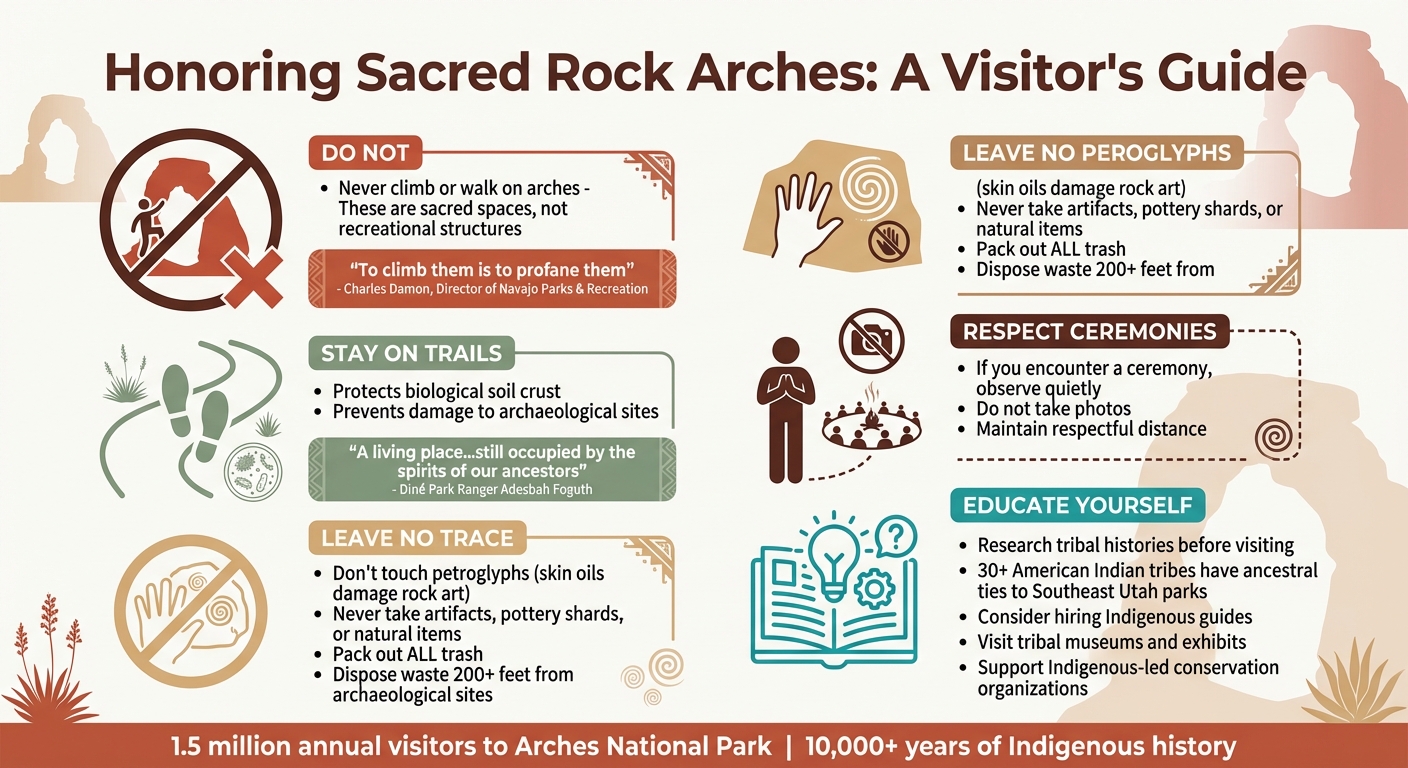
Guidelines for Respecting Sacred Rock Arch Sites
Guidelines for Visiting Sacred Sites
When exploring rock arches in national parks, it’s important to remember these are not just natural wonders – they are sacred spaces deeply tied to Indigenous traditions. Respecting these sites ensures their preservation and honors their cultural significance.
Climbing or walking on arches is strictly off-limits. Charles Damon, Director of Navajo Parks & Recreation Department, emphasized this by saying:
To climb them is to profane them. Protests have been and still are being made by the Navajos about the unauthorized scaling of reservation rocks.
Stick to designated trails. This protects the delicate biological soil crust and prevents damage to archaeological sites. Diné Park Ranger Adesbah Foguth describes these areas as:
a living place, as a place that’s still occupied by the spirits of our ancestors.
Additionally, follow these practices:
- Leave everything as you find it. Avoid touching petroglyphs since oils from your skin can harm the rock art. Never take pottery shards, artifacts, or other items.
- Pack out all trash. Dispose of waste at least 200 feet from archaeological sites to minimize impact.
- Respect ceremonies. If you come across a ceremony, observe quietly, and refrain from taking photos.
By following these steps, you help protect these spaces while fostering a deeper connection to their cultural significance.
Learning from Indigenous Perspectives
Respectful visitation is just the starting point. To truly appreciate these sacred landscapes, take the time to learn about their Indigenous histories. Before your trip, research the tribes who have ancestral ties to the area. For instance, the national parks in the Southeast Utah Group are sacred to over 30 American Indian tribes. Tribal websites are excellent resources for understanding traditional place names and histories.
Consider enhancing your visit by:
- Hiring Indigenous guides or visiting tribal museums to gain firsthand knowledge of the land’s heritage.
- Engaging with exhibits that showcase tribal perspectives and oral histories.
Understanding the traditions, ceremonies, and beliefs tied to these landscapes deepens your connection. Filmmaker Christopher McLeod highlights the importance of this respect:
Sacred places are powerful and sometimes dangerous, invariably have evoked complex cultural protocols, and are always places to be respected.
You can also show support by contributing to Indigenous-led conservation organizations, such as the Native American Rights Fund. This not only helps protect these sacred sites but also demonstrates a commitment to honoring their cultural importance.
Conclusion
Rock arches are far more than geological wonders; they hold deep spiritual significance for Indigenous peoples. For tribes like the Hopi, Zuni, Ute, and Paiute, these formations are seen as bridges to other realms and as connections to the spirits of their ancestors. Dr. Richard Stoffle, a Research Anthropologist at the University of Arizona, beautifully captures this belief:
To Indian people arches are people who were intended at Creation to be life partners.
This understanding adds a profound layer to how we approach these sites. With 1.5 million people visiting Arches National Park each year, there’s a shared responsibility to treat these areas with care and reverence, recognizing their place in over 10,000 years of Indigenous history.
Kate Cannon, Superintendent of the Southeast Utah Group of National Parks, underscores this point:
We wouldn’t want to inadvertently take a management action that adversely affected some of the strong interests of tribal members.
Respecting these sacred landscapes means staying on marked trails, avoiding activities like climbing on arches, and taking the time to learn about the ancestral lands you’re exploring. These small actions help preserve not only the physical beauty of the arches but also their spiritual and cultural significance.
FAQs
Which tribes consider rock arches sacred?
The Ute, Navajo, Hopi, and Southern Ute tribes regard rock arches as sacred. These natural formations hold profound spiritual and cultural significance, deeply tied to their traditions, histories, and connection to the land.
Why are rock arches seen as portals?
Rock arches hold a special place in many Indigenous traditions, often seen as symbolic portals. These natural formations are believed to serve as gateways between worlds, representing spiritual connections or access points to sacred realms. Their meaning goes beyond their physical beauty, reflecting a profound spiritual and cultural importance.
How can visitors be respectful at rock arches?
Visitors can help protect rock arches by adhering to Leave No Trace principles. Stick to marked trails to minimize environmental impact, and avoid climbing or touching the arches to prevent wear and damage. Additionally, recognize and respect the cultural and spiritual significance these formations hold for Indigenous communities. By taking these steps, we can ensure these cherished natural landmarks remain intact for future generations to appreciate.