
If I were picking a U.S. cave trip, I’d start with one question: Do I want big scale, rare rock forms, easy access, or a short family stop? This list covers all four. It includes 10 cave destinations across the country, from Mammoth Cave’s 426+ miles of mapped passages to Ruby Falls’ 145-foot underground waterfall and the lava tubes at Craters of the Moon.
Here’s the short version:
- Best for sheer size: Mammoth Cave and Jewel Cave
- Best for rare formations: Wind Cave for boxwork, Lehman Caves for shields
- Best for easier access: Carlsbad’s Big Room, Luray Caverns, and some access-friendly park tours
- Best for something different: Craters of the Moon for lava tubes and Kartchner Caverns for a cave that is still growing
- Best if you want to plan ahead: Mammoth, Jewel, Lehman, Wind, and Carlsbad often need early booking
- What to bring: a light jacket, closed-toe shoes, and clean gear that has not been used in other caves
- Typical cave temperature: often in the high 40s°F to upper 50s°F, though Kartchner is warmer at 68°F
The 10 caves in this article are:
- Mammoth Cave National Park
- Carlsbad Caverns National Park
- Jewel Cave National Monument
- Lehman Caves at Great Basin National Park
- Wind Cave National Park
- Kartchner Caverns State Park
- Luray Caverns
- Meramec Caverns
- Craters of the Moon Lava Tube Caves
- Ruby Falls
The main takeaway: these cave trips are not all the same. Some are self-guided. Some only allow ranger-led entry. Some have hundreds of stairs. Others are flatter and easier for mixed-age groups. Prices also vary, from free park entry with paid tours to private cave tickets such as $36 at Luray and $30.50 at Meramec.
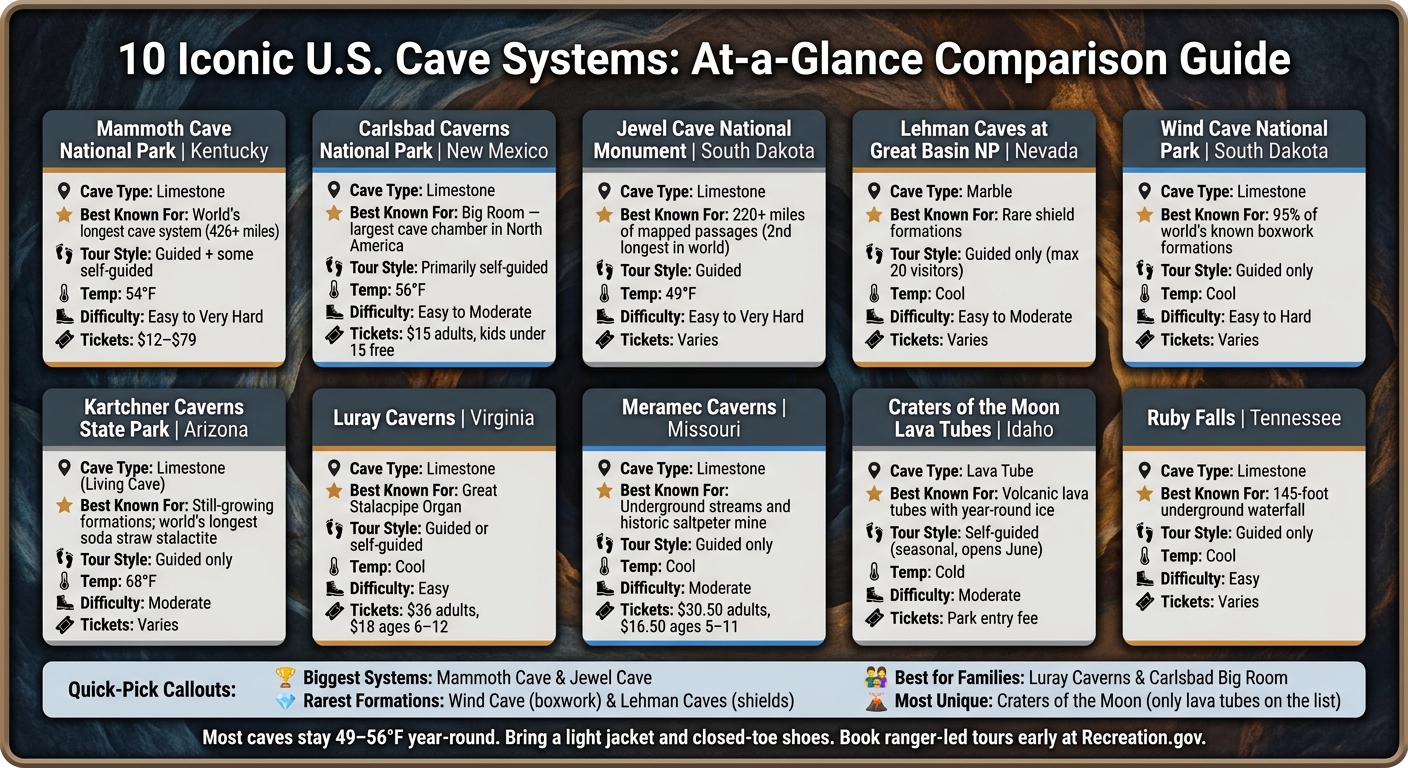
10 Iconic U.S. Cave Systems: At-a-Glance Comparison Guide
Quick Comparison
| Cave | State | Best Known For | Access Style | Trip Effort |
|---|---|---|---|---|
| Mammoth Cave | Kentucky | World’s longest known cave system | Guided + some self-guided | Easy to very hard, depends on tour |
| Carlsbad Caverns | New Mexico | Big Room | Timed entry, mostly self-guided | Easy to moderate |
| Jewel Cave | South Dakota | Crystal-lined passages, 220+ mapped miles | Guided | Easy to very hard |
| Lehman Caves | Nevada | Shield formations | Guided only | Easy to moderate |
| Wind Cave | South Dakota | 95% of known boxwork | Guided only | Easy to hard |
| Kartchner Caverns | Arizona | Living cave | Guided only | Moderate |
| Luray Caverns | Virginia | Great Stalacpipe Organ | Guided or self-guided | Easy |
| Meramec Caverns | Missouri | River cave, saltpeter mine | Guided only | Moderate |
| Craters of the Moon | Idaho | Lava tubes | Self-guided, seasonal | Moderate |
| Ruby Falls | Tennessee | 145-foot underground waterfall | Guided only | Easy |
So if I were giving quick advice, it would be this: pick the cave by access, walking difficulty, and what you want to see most. If you want huge rooms, go to Carlsbad. If you want long cave systems, look at Mammoth or Jewel. If you want a low-stress stop, Luray or Ruby Falls may fit better. And if you want something rougher and darker, Craters of the Moon stands out fast.
sbb-itb-00512f3
What To Know Before You Visit A U.S. Cave System
Book ranger-led tours early. Popular dates at Jewel Cave and Lehman Caves can sell out weeks in advance, especially in summer and on holiday weekends. Reservations for National Park cave tours go through Recreation.gov. As Mammoth Cave Ranger Molly Schroer puts it:
"It is also important to reserve your tickets in advance through Recreation.gov, so you get the tour that you want, at the time you want, on the date you want."
Get there at least 30 minutes before your tour starts. That gives you time to pick up tickets, find parking, and use the restroom before the group heads out.
Access rules can change a lot from one cave to another. Jewel Cave, Lehman Caves, and Wind Cave use ranger-led tours. Carlsbad Caverns allows self-guided access on its main trails. Luray Caverns allows walk-up visits. Ruby Falls and Meramec Caverns use guided tours. And at some Craters of the Moon lava tubes, you’ll need a free permit from the visitor center. Same broad category, very different day-of experience.
Bring a light layer and sturdy closed-toe shoes with good traction. Cave temperatures often feel cool, and footing can be slick or uneven. If you’re booking a wild cave or more adventurous tour, some sites require over-the-ankle boots with at least a 1/4-inch tread depth. Back carriers usually aren’t allowed on tours.
Check the rules before you go. Flash photography is banned at many sites, including Mammoth Cave, though non-flash cameras are usually allowed. Some tours also have age limits. At Jewel Cave, for example, the Scenic Tour includes 732 steps and is advised for ages 6 and up.
Bat-protection rules matter too. Many parks ban clothing, shoes, or gear that has been worn in another cave. The reason is white-nose syndrome, which has killed more than 6 million bats since it was first identified in 2006. The list below breaks down how each destination differs in access, terrain, and tour style.
1. Mammoth Cave National Park
Park Location
Mammoth Cave National Park is in south-central Kentucky, about 100 miles south of Louisville and 10 miles from Cave City. One quick tip: don’t trust mobile GPS too much here. It can send you down narrow back roads or toward the wrong ferry crossing.
Cave Type
Mammoth Cave is a limestone cave system formed when slightly acidic water slowly dissolved the rock over millions of years. And this process isn’t just ancient history. The cave is still forming today at its lowest level, about 350 feet underground.
Key Features
A few spots tend to stick with people.
- Frozen Niagara
- Star Chamber
- Mammoth Dome, which rises nearly 200 feet
The Star Chamber stands out for its gypsum crystals set against a dark ceiling. The cave also carries a long human story, from Native American mineral mining to saltpeter extraction during the War of 1812.
Tours
The cave stays at 54°F (12°C) all year, so a light jacket is a smart idea. Adult tour prices range from $12.00 to $79.00, depending on the tour. Park entry is free.
| Tour Name | Duration | Distance | Key Details |
|---|---|---|---|
| Discovery Tour | 30 min | 0.75 miles | Self-guided; 130 stairs |
| Frozen Niagara | 1.25 hours | 0.25 miles | Easiest ranger-led tour; 64 stairs |
| Historic Tour | 2 hours | 2 miles | 540 stairs; saltpeter works and TB huts |
| Domes & Dripstones | 2 hours | 0.75 miles | 638 stairs; dramatic vertical shafts |
| Grand Avenue | 4 hours | 4 miles | Moderate; broad geological variety |
| Accessible Tour | 2 hours | 0.5 miles | Fully wheelchair accessible via elevator |
| Wild Cave Tour | 6–6.5 hours | Varies | Extremely strenuous; requires crawling and squeezing |
| Trog Tour | 2.75 hours | 1.5 miles | Kids ages 8–12; off-trail crawling |
What To Expect
There are a few rules that catch people off guard. Flash photography, tripods, strollers, and child backpack carriers aren’t allowed.
After the tour, you’ll walk across bio-security mats. That’s part of the park’s effort to help stop the spread of white-nose syndrome to its bat populations.
From Mammoth Cave’s huge passageways, the list heads west to another underground site with a very different geologic backstory.
2. Carlsbad Caverns National Park
Park Location
Carlsbad Caverns sits in the Guadalupe Mountains in southeastern New Mexico, about 20 miles southwest of Carlsbad and around 164 miles east of El Paso, Texas. The park is part of the Chihuahuan Desert, and that dry desert backdrop helped shape both the cave itself and the bat activity the park is known for.
Cave Type
Carlsbad Caverns formed about 4 to 6 million years ago. The cave took shape when sulfuric acid from underground petroleum deposits dissolved an ancient limestone reef that started forming in a 250-million-year-old inland sea.
Key Features
The Big Room is the largest cave chamber in North America by volume. It measures about 4,000 feet long, 625 feet wide, and 255 feet high.
Inside, you’ll see stalactites, stalagmites, cave pearls, flowstone, and gypsum chandeliers. From April through October, up to 500,000 Brazilian free-tailed bats stream out at sunset, which gives the place a whole different feel once the day winds down.
Scale is a big part of the appeal. But so is how easy it is to get in – and how different the visit can feel depending on the route you take.
Tours
Visitors can reach the Big Room in two ways: by elevator or via the 1.25-mile Natural Entrance Trail, which drops a steep 750 feet into the cave. The Big Room Trail is also 1.25 miles long, mostly flat, and partly wheelchair accessible.
Admission for adults is $15, while kids 15 and under get in free. Timed-entry reservations cost an extra $1. Reservations are strongly recommended because walk-in entry is not guaranteed.
A few ranger-guided tours, including Kings Palace and Lower Cave, are suspended.
What To Expect
The cave stays at 56°F (13°C) all year. That sounds mild, but the steep Natural Entrance Trail can be tough on your footing, so sturdy shoes are a smart move. If you’re doing the Big Room, set aside about 1.5 hours.
You’ll also need to follow the park’s bat-protection rules before and after your tour.
Next up is Jewel Cave, another major underground system with a very different tour experience.
3. Jewel Cave National Monument
Park Location
Jewel Cave National Monument sits in the Black Hills of Custer County, South Dakota, about 13 miles west of Custer and 53 miles southwest of Rapid City along Highway 16.
Cave Type
The cave formed in Pahasapa Limestone that is about 345 to 360 million years old. Over millions of years, water dissolved the rock and carved out the passageways. In 1900, local prospectors widened a small opening with dynamite and came across the crystal-lined cavern.
Main Features
Jewel Cave got its name from the sparkling calcite crystals along its walls. That shine is the first thing many people remember.
But there’s more going on underground. The cave also has formations known as cave bacon, cave popcorn, ribbon draperies, flowstone, and gypsum chandeliers. And the scale is huge: with over 220 miles of mapped passages, Jewel Cave is the second-longest cave in the world.
Tour Access
| Tour | Duration | Difficulty | What to Expect |
|---|---|---|---|
| Discovery Tour | 20 mins | Easy | Wheelchair-accessible introductory tour via elevator |
| Scenic Tour | 80–90 mins | Moderately strenuous | 0.5-mile loop, 732 steps, paved and illuminated trail |
| Historic Lantern Tour | Summer-only | Moderate | Hand-held lanterns, follows early explorer routes |
| Wild Cave Tour | 3–4 hours | Extremely strenuous | Off-trail crawling, climbing, tight squeezes |
Tour schedules can shift day to day because of staffing shortages, and some tickets are sold on-site only when staff is available.
Visitor Experience
Inside the cave, the temperature stays at a steady 49°F (9°C). That can feel chilly fast, even in summer.
The Scenic Tour includes 732 steps on metal scaffolding, and the National Park Service recommends it for ages 6 and up. It helps to bring a layer and wear sturdy shoes with good grip. Also, don’t bring gear that has been used in other caves. Biosecurity mats are in place to help stop the spread of white-nose syndrome.
4. Lehman Caves At Great Basin National Park
Lehman Caves feels different from the big, open cave systems that came earlier. Instead of huge passageways, you get a smaller, quieter marble cave tucked away in remote eastern Nevada.
Park Location
Lehman Caves sits in eastern Nevada, close to the Utah border, inside Great Basin National Park. Because the park is so remote, tours tend to stay small and quiet. That changes the whole mood of the visit: fewer people, cool air, and a slower pace.
Cave Type
Lehman Caves is a marble cave formed when groundwater dissolved the surrounding rock.
Main Features
Lehman Caves is best known for its several hundred shield formations, which are circular calcite features found in only a small number of caves around the world. It also includes soda straws, helictites, flowstone, cave popcorn, stalactites, stalagmites, and bubble trails.
One stalagmite in the cave has been confirmed at 2.2 million years old, which gives you a sense of just how old this place is. The walls also hold more than 2,000 historic graffiti notes left by explorers dating back to the 1890s.
Tour Access
You can only visit Lehman Caves on a ranger-led tour. Self-guided access is not allowed. Tours are capped at 20 visitors, so booking through Recreation.gov is strongly recommended.
The main tour is the Parachute Shield Tour. It covers 0.6 miles in about one hour and passes through the Lodge Room, Inscription Room, Grand Palace, and Sunken Garden, with shields and bubble trails along the route. Other tour options may also be offered, but they change based on the season and staffing.
Visitor Experience
Expect cool air, small groups, and a calm visit. Compared with many major cave sites, Lehman Caves has a much quieter feel.
5. Wind Cave National Park
Still in South Dakota’s Black Hills, Wind Cave changes the focus from crystals to boxwork. Wind Cave National Park is one of the world’s most complex mapped cave systems, with more than 140 surveyed miles and only about 5% of the cave mapped. It’s also the top place to see boxwork.
Park Location
The park sits about 58 miles south of Rapid City and 10 miles north of Hot Springs on U.S. Highway 385. Entry to the park is free, but cave tours need a ticket.
Cave Type
Wind Cave is a solution cave formed in limestone through chemical weathering. It’s also drier than many cave systems in the National Park System, so you won’t see as many stalactites and stalagmites as some people expect.
Main Features
Wind Cave is best known for its boxwork, a rare calcite formation that looks a bit like a honeycomb. About 95% of the world’s known boxwork formations are here. You can also see cave popcorn, frostwork, dogtooth crystals, and flowstone.
The cave got its name from the air moving through the entrance as pressure shifts. That same airflow helped lead to its discovery in 1881, when wind from the opening reportedly blew the hats off the Bingham brothers.
If you want a ranger-led cave tour built around a rare geologic feature, this park is a strong pick.
Tour Access
Six ranger-led tours range from a 30-minute accessibility option to a strenuous 4-hour Wild Cave Tour.
| Tour Name | Duration | Notes |
|---|---|---|
| Accessibility Tour | 30 minutes | For visitors with limited mobility or wheelchairs |
| Garden of Eden Tour | ~1 hour | 1/4-mile sampler of boxwork, popcorn, and flowstone |
| Natural Entrance Tour | ~1.25 hours | Focuses on the cave’s discovery and airflow |
| Fairgrounds Tour | ~1.5 hours | Larger rooms and varied formations |
| Candlelight Tour | 2 hours | Summer only; handheld lanterns |
| Wild Cave Tour | 4 hours | Summer only; strenuous off-trail crawling |
Standard tours can be reserved up to three days ahead through Recreation.gov. The Candlelight and Wild Cave tours run only in summer and must be booked by phone up to one month ahead. About half of all tickets are saved for same-day sales, but those often go early.
Visitor Experience
Tours often sell out from March through October, so booking ahead is a smart move. You’ll also need to follow cave-cleaning rules before entering. Bring sturdy shoes and a light jacket – the cave stays cool all year.
6. Kartchner Caverns State Park
After South Dakota, the list heads to Arizona for something quite different: a rare living cave. Kartchner Caverns is one of the few public caves still growing today.
Park Location
Kartchner Caverns State Park is near Benson in southeastern Arizona.
Cave Type
Kartchner Caverns is a living limestone solution cave, which means mineral-rich water is still forming new cave features. Some of those formations grow by about 1 inch per century.
Main Features
The best-known chambers include the Rotunda Room and the Throne Room. The Throne Room holds the world’s longest known "soda straw" stalactite, and the cave’s formations are so delicate that even skin oils can damage them.
Tour Access
That fragility shapes the whole visit. You can only enter on a guided tour, and tours last about 1.5 hours. Photography is prohibited to protect the formations and bats.
Visitor Experience
Kartchner Caverns stays at a steady 68°F all year, so a light layer is usually enough. The cave was discovered in 1974 and kept closed for 14 years so its formations could be protected. That level of care is a big part of what makes this one of the rarest living cave systems open to the public.
7. Luray Caverns
From Arizona’s delicate living cave, the list shifts to Virginia’s best-known show cave.
Luray Caverns sits in Page County, Virginia, just west of Luray and close to Shenandoah National Park. And here’s one thing that sets it apart right away: unlike most caves on this list, it’s privately owned and operated, not part of a national park or national monument.
Cave Type
Luray Caverns is a limestone solution cave. It is also the largest cavern system in the eastern United States.
Main Features
The biggest draw is the Great Stalacpipe Organ, invented in 1954 by Leland W. Sprinkle. It uses solenoid-fired hammers to tap natural stalactites and make musical tones. It’s one of those features people tend to remember long after the tour ends.
You’ll also find Dream Lake and other reflective pools that mirror the ceiling formations, which gives parts of the cave an almost upside-down look. Giant’s Hall adds another major sight, with a 47-foot-tall stone column that feels massive in person.
Tour Access
Visitors can pick either self-guided or guided tours along a 1.25-mile paved path that is bright and level. The walkway is stroller-friendly, and most tours take about 1 to 2 hours.
Admission is $36 for adults, $18 for children ages 6–12, and free for children under 6. Put simply, it’s an easy cave visit without much physical strain.
Visitor Experience
The caverns are open daily year-round. Hours are usually 9:00 a.m. to 4:00 p.m. on weekdays and 9:00 a.m. to 5:00 p.m. on weekends, with longer hours in spring, summer, and fall.
8. Meramec Caverns
After a polished show cave in Virginia, the list shifts to Missouri and one of the country’s best-known river caves. Meramec Caverns sits in Sullivan, Missouri, about 65 miles southwest of St. Louis, just off Highway W. It’s long been a favorite stop for Route 66 travelers, and that old-school roadside fame still draws people in.
Cave Type
Meramec is an active solution cave that groundwater is still shaping today.
Main Features
Inside, you’ll see soda straw stalactites, dripstone, underground streams, and a historic saltpeter mine.
Tour Access
Tours are guided only. They cover about 1 mile and take around 1 hour and 15 minutes. A lot of the walking surfaces stay wet, so sturdy shoes with good traction are a smart idea.
Admission costs $30.50 for adults ages 12 and up, $16.50 for children ages 5 to 11, and children under 5 get in free.
Visitor Experience
Summer hours are 9:00 a.m. to 7:00 p.m. In January and February, the cave is open on weekends only. Above ground, you can find trails along the Meramec River, and nearby Cathedral Cave offers lantern-lit tours.
Next up, the route leaves Missouri’s damp limestone passages behind and heads west to the lava tubes of Idaho.
9. Craters Of The Moon Lava Tube Caves
From Missouri’s limestone caverns, the list moves to Idaho’s volcanic underworld. Craters of the Moon National Monument and Preserve is made up of 60 lava flows from eight major eruptions, spread across 50 miles in the contiguous U.S.. It’s also the only lava-tube cave system on this list.
These caves formed in a pretty stark way: the outer layer of moving lava cooled and hardened first, while the hot lava inside kept flowing. Once that inner lava drained out, it left behind hollow tunnels.
Main Features
During the season, five lava caves are open to visitors. The best-known is Indian Tunnel, which runs 800 feet and has entrances at both ends. Some of the tubes hold cold air so well that they keep ice all year.
Inside, expect lavacicles – lava stalactites – plus jagged rocky floors and pitch-dark passages. This isn’t the polished cave look some travelers picture. It feels raw, rough, and a little otherworldly.
Tour Access
Access is seasonal, and snow usually keeps the caves closed until June. A solid headlamp is a must; phone flashlights won’t cut it. The ground is rough and uneven, so watch every step.
You’ll also need to follow the cave decontamination rules. Don’t bring clothing, shoes, or gear that have been used in another cave or mine, including cameras.
Visitor Experience
If this stop is on your list, aim for June or later. It’s also smart to check with the visitor center before you go for any current permit rules or safety closures.
10. Ruby Falls
The list wraps up with one of the best-known show caves in the United States. Ruby Falls, in Chattanooga, Tennessee, is a limestone cave inside Lookout Mountain with a 145-foot underground waterfall.
Park Location
Ruby Falls is located inside Lookout Mountain, just outside Chattanooga, Tennessee.
Cave Type
Ruby Falls is a limestone cave.
Main Features
Its main draw is the 145-foot underground waterfall. On the way there, visitors also pass cave formations that add to the experience.
Tour Access
This is not a wild-cave stop. Ruby Falls is open through guided tours only, and those tours focus on the waterfall and the cave formations.
Visitor Experience
Ruby Falls is easy to visit and works well for families. If you want a cave trip without rough ground or a hard hike, this is a solid choice.
Side-By-Side Look At All 10 Cave Destinations
Use this chart to compare access, terrain, and trip style before booking.
| Cave Destination | State | Operator / Site Type | Cave Type | Standout Feature | Tour Format | Reservations |
|---|---|---|---|---|---|---|
| Mammoth Cave National Park | Kentucky | National Park Service / national park | Limestone | World’s longest known cave system (426+ miles) | Guided tours, plus an Accessible Tour | Strongly recommended |
| Carlsbad Caverns National Park | New Mexico | National Park Service / national park | Limestone | Big Room – largest cave chamber in North America | Primarily self-guided | Required (timed entry) |
| Jewel Cave National Monument | South Dakota | National Park Service / national monument | Limestone | Over 220 miles of mapped passages (second-longest cave in the world) | Guided tours | Strongly recommended |
| Lehman Caves at Great Basin National Park | Nevada | National Park Service / national park | Marble | Shield formations found in only a small number of caves worldwide | Guided tours only | Strongly recommended |
| Wind Cave National Park | South Dakota | National Park Service / national park | Limestone | 95% of the world’s known boxwork formations | Guided tours | Strongly recommended |
| Kartchner Caverns State Park | Arizona | Arizona State Parks / state park | Limestone | Living cave – formations still actively growing | Guided tours | Not listed in this article |
| Luray Caverns | Virginia | Privately operated / show cave | Limestone | Great Stalacpipe Organ | Guided or self-guided tours | Not listed in this article |
| Meramec Caverns | Missouri | Privately operated / show cave | Limestone | Underground streams and historic saltpeter mine | Guided tours | Not listed in this article |
| Craters of the Moon Lava Tube Caves | Idaho | National Park Service / national monument | Lava tube | Volcanic lava tube system with year-round ice | Self-guided | Not listed in this article |
| Ruby Falls | Tennessee | Privately operated / show cave | Limestone | 145-foot underground waterfall | Guided tours | Not listed in this article |
A quick read of the table shows where planning matters most. National park reservation systems are most important at Mammoth, Jewel, Lehman, and Wind. Carlsbad works a little differently, with timed entry required.
If mobility is a big factor, a few places stand out right away:
- Mammoth’s Accessible Tour
- Carlsbad’s Big Room Trail
- Wind Cave’s Accessibility Tour
- Jewel Cave’s Discovery Tour
The biggest gaps between these cave trips come down to how you get in, how much effort the visit takes, and whether you need to book ahead. Some are mostly self-guided and easier to fit into a road trip. Others are much more structured, with guided access and tighter ticket planning.
How To Pick The Right Cave For Your Trip
Use the table above to narrow your options by access, terrain, and cave type. The easiest way to start is with your top priority. Do you want sheer scale, rare formations, less physical effort, or the simplest entry? If scale is the main draw, Mammoth Cave and Jewel Cave are the largest systems. If you care most about unusual formations, Wind Cave stands out for its boxwork, and Lehman Caves is known for shield formations.
Physical access is often the fastest filter. Carlsbad’s Big Room is mostly flat and elevator-accessible, while Mammoth and Jewel include tours with more stairs and a tougher walk. It helps to pack a light jacket since most caves stay cool all year. If access is your main concern, start with Carlsbad, Luray, or one of the shorter guided tours.
For families, the cave’s name matters less than the tour itself. Length and terrain usually make the biggest difference, especially with mixed-age groups. Luray Caverns and Carlsbad’s Big Room tend to work best in that situation.
For road trips, think about the cave’s role in the trip. Is it the whole point, or just one stop along the way? Mammoth and Carlsbad work well as stand-alone trips. Craters of the Moon makes more sense as part of a broader itinerary. Once you’ve decided whether the cave is the main stop or a side trip, the last choice usually comes down to access rules and tour style.
One more thing: don’t bring gear you’ve worn in other caves. White-nose syndrome can spread through contaminated gear, so use only clean clothing and equipment. Many parks require visitors to walk across bio-security mats and prohibit clothing or gear previously used in other caves. Clean gear before entering.
Conclusion
U.S. cave systems differ a lot in geology, access, and the kind of trip they offer. Some have huge limestone chambers. Others feature lava tubes, rare formations, or underground waterfalls. What matters most is fit – which cave lines up with the trip you want to take.
Choose based on geology, physical difficulty, tour style, and budget. In plain English: the best cave is the one that matches what you want from the day. Then check access rules before you go. Book ranger-led tours early, especially for popular sites. Pick the cave that suits your pace, budget, and interests.
FAQs
Which cave is best for first-time visitors?
For first-time visitors, Carlsbad Caverns National Park in New Mexico is a great pick. The Big Room is easy to visit, with self-guided and ranger-led tours, an elevator, and set trails that help take some of the stress out of a first cave trip.
Florida Caverns State Park is another strong choice, with guided tours through an underground space that feels approachable for beginners. Both parks offer a manageable, educational experience for newcomers.
Are any of these caves wheelchair accessible?
Yes. Several cave systems have wheelchair-accessible options:
- Wind Cave National Park: a dedicated accessibility tour
- Carlsbad Caverns National Park: elevator access to the Big Room Trail, with wheelchair-accessible sections
- Mammoth Cave National Park: a daily Accessible Tour
Access can vary from one site to another, so check the tour details before you go.
When should I book cave tours in advance?
Book cave tours as early as possible. At busy spots like Mammoth Cave and Carlsbad Caverns, peak summer dates and holiday weekends can sell out months in advance.
In many parks, reservations are required or strongly recommended, so it’s smart to check tour availability as soon as you start planning. If tours are already full, some parks may offer a small number of same-day, first-come, first-served tickets. The catch? Those often disappear within the first hour.