
If you’re planning an overnight trip in U.S. national parks, a backcountry camping permit is often required. These permits help protect natural areas and ensure safety by limiting campsite use and providing rangers with your travel details. Here’s a quick breakdown of what you need to know:
- Permit Types: Site-specific, zone-based, or trailhead-based permits, depending on the park.
- Application Timing: Many parks use lotteries or open reservations months in advance. Deadlines vary by park.
- Platforms: Most permits are available on Recreation.gov.
- Costs: Fees vary by park, typically including a flat fee plus a per-person, per-night charge.
- Walk-Up Options: Some parks reserve permits for in-person requests, but availability is limited.
To secure a permit, set up a Recreation.gov account, gather details like group size and itinerary, and apply promptly when reservations open. Always review park-specific rules, as they differ widely. Keep a backup plan in case your preferred dates or routes are unavailable.
Below, we’ll explore permit types, deadlines, and the application process in detail.
How to Book Backcountry Permits on Recreation.gov (Early Access Secrets)
sbb-itb-00512f3
Permit Types, Seasons, and Deadlines
National Park Backcountry Permit Comparison Guide
Types of Permits
The type of permit you need depends on the park you’re visiting.
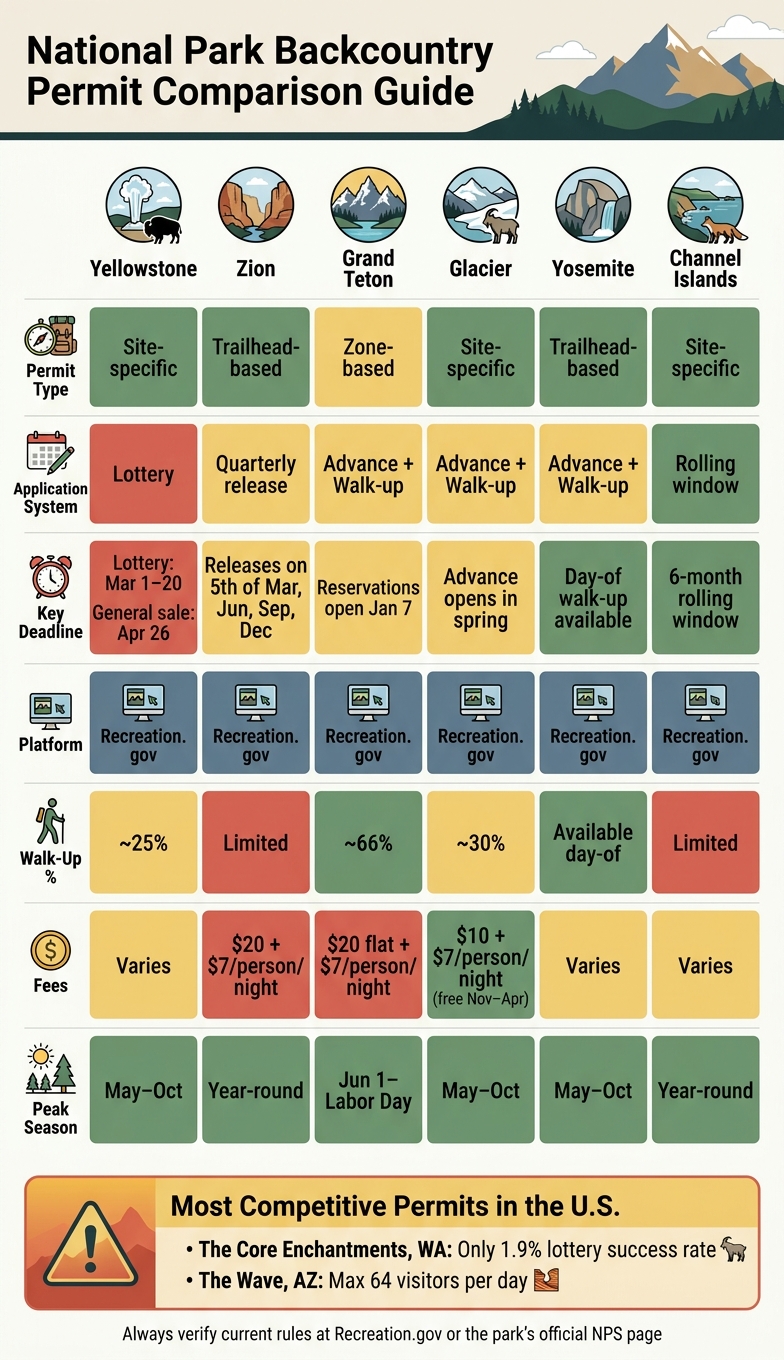
- Site-specific permits assign you to a particular campsite or shelter. For example, Great Smoky Mountains National Park uses this system, allowing up to 8 people per party and charging $8 per person, per night.
- Zone-based permits give you more freedom by assigning you to a general area rather than a specific location. Grand Teton National Park follows this model, with a $20 flat fee plus $7 per person, per night.
- Trailhead-based permits regulate the number of hikers entering through specific trailheads while offering flexibility once inside. In Yosemite, where 95% of the park is designated Wilderness, this system is in place.
There are also specialized permits for activities like thru-hiking major trails (e.g., the Appalachian Trail, Pacific Crest Trail, or John Muir Trail), group outings for 7–12 people, and technical activities such as rock climbing.
Seasonal Structures and Quota Periods
Most parks have strict quotas during their busiest months, typically from May through October. Outside of this peak season, permits are often easier to secure, sometimes available by phone or without needing advance reservations.
Parks often divide their permits between advance reservations and walk-ups. For instance, Grand Teton sets aside one-third of its permits for advance booking and the remaining two-thirds for walk-up visitors. During the peak season, the park also limits backcountry stays to a total of 10 nights between June 1 and Labor Day.
Some areas are so competitive that getting a permit feels like winning the lottery. For example, The Core Enchantments in Washington has a lottery success rate of just 1.9%, while The Wave in Arizona only allows 64 people per day.
Application Deadlines and Processes
Each park has its own deadlines and systems for applying, so planning ahead is crucial.
For example, Yellowstone uses a lottery system. Applications are accepted from March 1–20, with results announced on March 25. After that, general sales for peak season permits begin on April 26. Zion follows a quarterly release schedule, opening reservations on March 5, June 5, September 5, and December 5 at 10:00 am MT for the next three months.
"Most backpacking sites often become fully booked for the next season within minutes of reservations opening." – Zion National Park Service
Channel Islands takes a different approach, offering permits on a rolling 6-month window rather than a single release date.
Here’s a quick comparison of a few major parks:
| Park | Deadline/System | Platform |
|---|---|---|
| Yellowstone | Lottery (Mar 1–20), general sale Apr 26 | Recreation.gov |
| Zion | Quarterly releases on the 5th of the month | Recreation.gov |
| Grand Teton | Reservations open Jan 7; walk-ups available | Recreation.gov / In-person |
| Channel Islands | 6-month rolling window | Recreation.gov |
If you’re flexible, consider midweek or shoulder-season dates (early spring or late fall), which are less competitive – though be prepared for unpredictable weather.
Next, we’ll dive into how to prepare your permit application.
How to Prepare Your Permit Application
Set Up Your Online Account
Most national park backcountry permits are managed through Recreation.gov, a platform used by 14 federal agencies, including the National Park Service. To get started, create a free account by clicking "Sign Up / Log In" and entering your legal name, email, and phone number. After submitting, you’ll receive a confirmation email – be sure to click the link inside to verify your account before making any reservations.
It’s smart to set up your account well before your desired permit release date. During high-demand times – like Rocky Mountain National Park‘s 8:00 a.m. MST opening – every second matters. A verified account lets you jump straight into booking. You can also use the Recreation.gov mobile app for added convenience.
Gather Required Information
Before starting your application, gather all necessary details. Once you click "Book Now", you’ll only have 15 minutes to complete the process, including payment.
Here’s what most parks typically ask for:
| Information Category | Specific Details to Gather |
|---|---|
| Personal/Group | Primary leader name, alternate leader name, total group size, emergency contact info |
| Logistics | Start/end dates, entry/exit trailheads, specific nightly campsite or zone names |
| Transportation | Vehicle make, model, and license plate number |
| Passes/Documents | America the Beautiful, Senior, or Access pass numbers (if applicable) |
| Special Requirements | Coggins test for stock animals; vaccination records for service dogs |
One commonly overlooked detail is the alternate trip leader. The National Park Service strongly advises adding one, as they explain:
"We strongly recommend that you enter an alternate trip leader. If you are unable to make your trip, your reservation cannot be transferred to someone else unless their information is entered here."
This rule applies to parks like Canyonlands and Grand Canyon, where permits are otherwise non-transferable.
With all your information in hand, you’ll be ready to craft a detailed itinerary.
Plan Your Itinerary
A well-thought-out itinerary is crucial for both safety and compliance. Most parks require a contiguous route, meaning you can’t exit one trailhead, drive to another, and continue on the same permit. Your itinerary must include specific campsites or zones for each night, not just general areas.
Group size limits can vary by park and even by individual campsite, so check the park’s official page to confirm limits before finalizing your group size.
It’s also a good idea to prepare 2–3 backup itineraries with different dates or routes, as popular campsites often fill up within minutes of the release window opening. Additionally, verify whether your trailhead requires a separate vehicle reservation – for instance, Glacier National Park’s Polebridge area has this requirement. Keep in mind that a backcountry permit alone doesn’t guarantee vehicle access.
How to Submit Your Permit Application
You can submit your permit application online, by mail, or in person. Once your travel plans are finalized and your account is set up, choose the submission method that aligns with the park’s guidelines. The options available depend on the park, the type of permit, and how far in advance you’re planning your visit.
Applying Online Through Recreation.gov
Start by searching for your park on Recreation.gov with the term "Overnight Backcountry Permits." Click "Check Availability" to access the calendar. From there, select your start date, group size, and build your itinerary. Campsites that are open will appear as blue squares on the calendar.
When ready, click "Book Now" to begin the 15-minute process. You’ll need to confirm details like entry and exit points, vehicle information, emergency contacts, and make payment. Be sure to review the "Need to Know" section carefully before finalizing payment, as it outlines specific park rules you must agree to.
Permit fees differ by park. For instance:
- Zion National Park: $20 non-refundable permit fee, plus $7 per person, per night.
- Glacier National Park: $10 fee, plus $7 per person, per night from May 1 to October 31. Winter permits (November 1 to April 30) are free.
Keep in mind, most online reservations confirm your spot, but you may still need to pick up a physical permit at a visitor center before starting your trip.
"You can modify your reservation, with the exception of the alternate trip leader and trip start date, up until your permit is issued." – National Park Service
For smoother navigation, especially on busy release dates, use a laptop or desktop computer.
If applying online isn’t possible, consider mail-in or in-person options.
Mail-In Applications
While many parks now rely on online systems, some still accept mail or phone requests – particularly during specific seasons or for visitors needing extra assistance. For example, Grand Teton National Park processes winter backcountry permits by phone at 307-739-3309 between November and April.
If you’re unsure whether mail or phone applications apply to your destination, check the park’s official website for the latest details.
Walk-Up and In-Person Applications
Some parks also allow walk-up permits for visitors applying in person. For instance:
- Grand Teton National Park allocates about 66% of its backcountry permits for walk-ups.
- Glacier National Park reserves around 30% of its campground sites for walk-up applicants.
- Yosemite National Park offers unreserved permits in person on the day of the trip.
| National Park | Walk-Up Permit Locations | Typical Availability Window |
|---|---|---|
| Grand Teton | Craig Thomas Discovery & Visitor Center, Colter Bay Visitor Center, Jenny Lake Ranger Station | 1 day before the start date |
| Glacier | Apgar, St. Mary, Polebridge, Two Medicine, Many Glacier stations | Day before or day of the trip |
| Yosemite | Valley Welcome Center and park Wilderness Centers | Day of the trip (for unreserved permits) |
Arrive early, as walk-up spots fill quickly. Bring a valid ID and be ready for a potential ranger briefing on bear safety and Leave No Trace principles before receiving your permit. Double-check office hours beforehand, as many backcountry offices stop issuing permits 30 minutes before closing.
After Approval: Confirming and Carrying Your Permit
Once your permit is approved, it’s time to verify how you’ll receive it, understand any conditions, and ensure you carry it properly during your trip.
Print and Carry Your Permit
The delivery method for your permit depends on the park. Some parks, like Lassen Volcanic National Park, let you print your permit at home after booking through Recreation.gov. Others, such as Yellowstone and Glacier, require you to pick up a physical permit in person at a backcountry office or ranger station. This pickup might need to happen as early as two days before your trip begins.
"A wilderness use permit is required for all overnight camping, and must be in your possession while in the backcountry." – National Park Service
Make sure to sign your permit – without a signature, it’s invalid. Once signed, store it safely in a waterproof sleeve. Lassen Volcanic National Park recommends:
"Attach a copy of the permit to a backpack and display throughout the duration of your trip." – Lassen Volcanic National Park
If you’re leaving a vehicle at the trailhead, many parks also require you to display either a parking slip or a copy of your permit on your dashboard to avoid fines.
Review Permit Conditions
Before heading out, carefully review all permit conditions. These typically include details like your travel dates, designated locations, group size limits, food storage rules, campfire restrictions, and waste management guidelines. Also, check for any last-minute trail updates or changes.
It’s essential to follow all the rules, especially those regarding group size and the length of your stay. If your plans no longer align with the permit details, address these discrepancies right away.
What to Do If Your Plans Change
If your trip plans shift, take immediate action to avoid complications. You can often make modifications through your Recreation.gov account or by contacting the park’s permit office. However, some changes – like altering your trip start date – might not be possible after booking. In such cases, you may need to cancel your permit and rebook.
Refund policies vary by park. For example, Yellowstone offers a refund of the recreation fee if you cancel at least 72 hours in advance, though the $10 reservation fee is non-refundable. At Great Smoky Mountains National Park, the $6 permit fee is non-refundable regardless of timing. Acting quickly can help you protect your fees and secure new dates if needed.
For more complex itinerary changes, such as those at Glacier National Park, you may need to visit specific locations like the St. Mary Visitor Center or Many Glacier Ranger Station, as not all centers handle these updates.
Common Mistakes to Avoid
Navigating the permit process takes more than just preparation – it requires knowing what to steer clear of. Even the most organized applicants can stumble, and a single mistake might cost you your reservation or even your entire trip.
Missing Deadlines or Application Windows
Permit windows open quickly, and competition is fierce. For example, Grand Teton’s peak season reservations start on January 7, while Canyonlands opens its permit window exactly four months before the season begins – both at 8:00 a.m. MT. To avoid disappointment, ensure your account is verified well in advance. Also, use a laptop or desktop instead of a phone for applications, especially if you’re dealing with complex, multi-night itineraries that involve map interfaces.
"Permits must be picked up in-person by the permit holder or alternate permit holder listed on the permit by 10 a.m. on the start date… Your entire reservation will be cancelled as a ‘no show’ and the sites made available for other groups." – Grand Teton National Park Service
Missing the pickup deadline can be just as disastrous as missing the booking window. If you’re delayed on your trip’s start date, call the permits office before 10:00 a.m. to keep your reservation intact.
Timing isn’t the only challenge – errors in your application can also derail your plans.
Incomplete or Incorrect Applications
If the primary permit holder can’t make the trip and no alternate leader is listed during booking, the permit becomes invalid – it can’t be transferred after purchase. Double-check that all necessary details, like alternate leaders, are accurate before you submit your application.
Another common mistake? Incorrectly matching your entry and exit trailheads. In parks like Glacier, you can’t exit one trailhead and drive to another to reach your next campsite during the same trip. Carefully review your route on a map before applying. And don’t skip the "Need to Know" section at checkout – this area includes park-specific rules you must acknowledge, and overlooking it could lead to violations during your trip.
"Never assume that you know the permit rules, because every park is different." – Backpacker’s Pantry
Even with everything in order, it’s smart to have a fallback plan.
Not Having a Backup Plan
Always have alternatives ready. If your preferred dates or trailhead are unavailable, consider midweek departures or trips during the spring or fall – these tend to be less competitive compared to peak summer slots. Research a few backup routes before the application window opens so you can pivot quickly if needed.
For high-demand areas, monitor Recreation.gov as your target dates approach. Last-minute cancellations do happen, and staying vigilant might help you snag a spot that wasn’t available earlier. If online reservations don’t work out, walk-up permits are another option. Keep in mind, though, that availability varies. For example, Yellowstone reserves only 25% of its backcountry campsites for walk-up permits. Arriving early – several hours before the ranger station opens – can improve your chances.
Conclusion
Securing a backcountry permit boils down to one thing: being prepared. Popular parks like Grand Teton, Canyonlands, and Yellowstone have strict quotas, tight deadlines, and varying rules. To succeed, you need to do your homework – understand the specific requirements of the park before the reservation window opens.
When applying, the details you provide – entry and exit trailheads, alternate trip leader, and group size – are set in stone. Recreation.gov gives you only 15 minutes to complete the checkout process, so having all your information ready before hitting "Book Now" can mean the difference between snagging a permit and missing out. This makes following each park’s protocols absolutely crucial.
Preparation doesn’t stop at the application. Adhering to park-specific regulations protects both you and the environment. Rules for food storage, campsite use, and waste disposal aren’t just guidelines – they’re essential for preserving wildlife and maintaining the pristine condition of the trails.
While the permit process might feel daunting at first, it becomes easier with experience. Start small: focus on one park, carefully review its "Need to Know" section, and build your confidence from there. Resources like The National Park Guide can help you navigate the details and plan your next backcountry trip.
"Permits are issued to the permit holder, as the trip leader, who is required to be present on the entire trip for the permit to be valid." – National Park Service
FAQs
What if I don’t get a permit – what are my best backup options?
If you’re unable to secure a backcountry permit, don’t worry – there are still options. Many parks offer first-come, first-served permits or have last-minute availability. Showing up early, especially during off-peak seasons, can increase your chances of snagging one of these limited walk-up permits.
Another approach is to look into alternative parks or trails that have more flexible permit systems. Doing some research and planning ahead can go a long way in helping you find a spot for your adventure.
Can someone else use my permit if I can’t go?
Yes, but there are specific rules. When making a reservation, you can designate an alternate permit holder by including their name and email. However, after the permit is purchased, the alternate cannot be modified. Permits remain linked to either the original holder or the pre-listed alternate if the primary holder is unavailable.
Do I need both a backcountry permit and a vehicle reservation?
Whether or not you need both depends on the park’s specific rules. Generally, a backcountry permit is required for overnight camping, while vehicle reservations may be necessary for parking or access in certain areas. These requirements can vary widely, so it’s essential to review the regulations for the park you plan to visit. Many parks offer online systems for reserving permits, but vehicle reservations are often handled through a separate process.