
I’d boil the whole article down to this: a park pass is not a reservation, many bookings go through Recreation.gov, and the hard part is often the release time, not the booking process itself. In 2026, some parks no longer use broad vehicle-entry rules, but many still require bookings for timed entry, shuttles, campgrounds, backcountry trips, or high-demand hikes.
If I were planning a trip, I’d focus on these points first:
- Check the park’s current rules before booking flights or hotels
- Figure out the exact reservation type: timed entry, shuttle, campsite, lodging, or permit
- Book the hardest-to-get item first, like a backcountry permit or popular campground
- Use the official booking source, usually Recreation.gov or the park’s own page
- Watch release windows closely, because some spots open months ahead, while others drop the night before
- Save proof of booking, since cell service in parks is often weak or missing
A few facts stand out:
- Rocky Mountain timed entry runs from May 22, 2026, to October 12, 2026
- Many NPS campgrounds open on a 6-month rolling window
- Yosemite campground reservations are often released on the 15th of each month
- Some short-notice inventory appears at 7:00 p.m. local time the day before
- Processing fees are often $1 to $2
- Cart holds on Recreation.gov usually last about 15 minutes
Quick Comparison
| Reservation type | What it covers | Where I’d usually book | Common release pattern |
|---|---|---|---|
| Timed entry | Entry during a set arrival window | Recreation.gov or park page | Seasonal release, sometimes with day-before drops |
| Vehicle/road access | Access to a road or corridor | Recreation.gov or park page | Varies by park and season |
| Shuttle ticket | Ride access where car use is limited | Recreation.gov or park page | Advance release, sometimes small late drops |
| Campground | Campsite for overnight stay | Recreation.gov | Often 6 months ahead |
| In-park lodging | Lodge, cabin, or hotel stay | Park lodging system | Often 6 to 12 months ahead |
| Backcountry permit | Overnight travel outside campgrounds | Recreation.gov or park page | Earlier quota-based releases or lottery |
| Special hike permit | Access to a busy trail or summit | Recreation.gov or park page | Lottery or fixed release date |
Bottom line: I’d treat park trip planning like a checklist. First, find out if you need a reservation at all. Then match your trip to the right booking type, track the release date, and keep checking for cancellations if you miss the first round.
sbb-itb-00512f3
Types of Reservations You May Need for a Park Trip
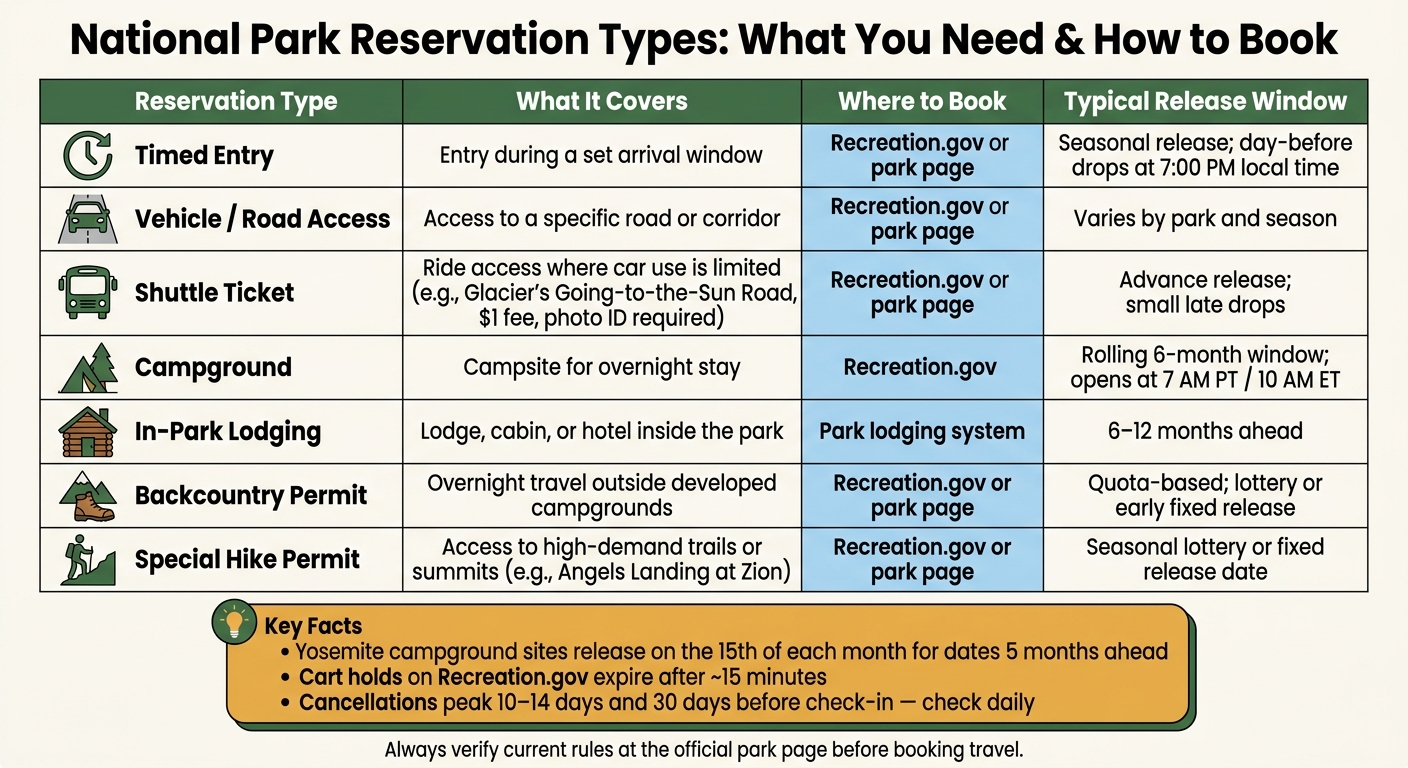
National Park Reservation Types: What You Need & How to Book
Reservation rules change based on the park, the activity, and the time of year. So after you figure out which type of reservation you need, the next job is finding the right place to book it.
Timed Entry, Vehicle Access, and Shuttle Tickets
Timed entry permits give your vehicle a set arrival window. The idea is simple: spread traffic across the day so the park doesn’t get slammed all at once.
Shuttle tickets are a different thing. Parks use them when they limit private cars on a road or in a busy corridor. Glacier National Park dropped its vehicle entry reservation for 2026, but it now requires advance tickets for its free shuttle on Going-to-the-Sun Road for ages 2 and older. There’s a $1 processing fee, the tickets are non-transferable, and riders need a photo ID to board.
You may also run into sunrise and summit reservations. At Haleakala National Park in Hawaii, every vehicle entering between 3 a.m. and 7 a.m. needs a "Summit Sunrise Reservation" year-round.
Campgrounds, Lodging, and Overnight Stays
Overnight bookings run on a different schedule than entry permits. Most National Park Service campgrounds are booked through Recreation.gov on a rolling six-month window. In many cases, sites open at 7 a.m. PT / 10 a.m. ET exactly six months before the stay date, and popular campgrounds can disappear within minutes.
In-park lodging works differently. Cabins, lodges, and hotels inside parks usually use their own booking systems instead of Recreation.gov, and peak-season stays may need to be booked 6 to 12 months ahead.
Some parks still hold back a share of first-come, first-served campsites. If you’re trying for one of those, showing up by 8 a.m. is often needed.
Backcountry, Wilderness, and Special Permits
Some of the toughest reservations have nothing to do with park entry. They cover specific trails, summit access, or overnight travel in restricted areas.
Backcountry and wilderness permits apply to overnight stays outside developed campgrounds. These often come with tighter quotas and earlier release dates than a standard campsite booking. And for high-demand hikes, you may need a separate permit altogether. For example, Angels Landing at Zion National Park has its own permit system through a seasonal lottery.
How to Book Through Recreation.gov and Park-Specific Systems

Using Recreation.gov Step by Step
Once you know which reservation you need, the next move is simple: book it in the right system. Timed-entry permits, campground sites, and shuttle tickets often begin on the park’s reservation page. If your reservation is on Recreation.gov, show up early and be set when the booking window opens. High-demand reservations can sell out within minutes.
Set up your account ahead of time and save your payment details before the release date. Search by park name or activity type, then narrow the results by date, party size, and RV length. For many releases, it helps to log in before the opening time and be ready to click right away.
A few small steps can save a lot of stress:
- Log in early and keep your payment info saved
- Check filters for the right date, group size, and RV length
- Review the listing details before paying
- Save a PDF or screenshot of your confirmation because cell service inside national parks is often unreliable
Cart holds usually expire after 15 minutes. That means you don’t have much time to second-guess yourself once a site or permit is in your cart.
How to Avoid Mistakes When Booking Campgrounds, Timed Entry, and Permits
The most common mistake is booking the wrong reservation for the trip. Before you confirm, check the date, arrival window, vehicle length, and site size limits. If your RV is too large for the site, you could be turned away when you arrive.
Read the full listing, not just the title. The fine print matters. Stay limits, photo ID rules, and non-transfer terms are often tucked into the description. Glacier shuttle tickets, for example, require a photo ID that matches the reservation name.
For high-demand releases like Yosemite camping, timing matters a lot. Use the exact release date and time shown on the reservation page, use an accurate clock, refresh just before the release, and book on a stable internet connection. It sounds a little intense, but when spots disappear fast, those little details can make the difference.
Another smart habit: check for canceled openings the night before arrival.
When a Park Uses a Different Booking System
If a park doesn’t use Recreation.gov, the rule is still the same: book only through the park’s official source. Some reservations go through park-run lodging or tour pages instead of Recreation.gov.
Start with the park’s official reservations page. That’s usually the best place to find the right booking link, photo ID rules, and whether the reservation covers park entry, the activity, or both.
How Release Dates, Lotteries, and Cancellations Work
Once you know what to book, the next step is timing. And this is where a lot of trips get won or lost.
Some park inventory opens every day. Some opens in monthly chunks. Some drops all at once in one big annual release.
Advance Booking Windows and Rolling Releases
Release timing changes by park. Yellowstone usually releases all summer lodging and campground reservations in one annual drop in late March or early April. Yosemite runs on a monthly cycle, with campground sites released on the 15th of each month for dates five months ahead.
Timed-entry and shuttle systems can be a little trickier. Many use a longer booking window, but also hold back a small batch for short-term travelers. For parks like Rocky Mountain and Glacier (shuttle), some parks release extra spots at 7 p.m. local time the night before your visit.
When demand gets too high for a normal release pattern, parks move to lotteries.
Lotteries for High-Demand Access
Some reservations are just too popular for first-come, first-served. That’s why high-demand trails often use a seasonal lottery instead . You apply during the set application window, then wait to find out if you got picked.
A lottery win usually gives you the permit only. You may still need park entry and a vehicle pass on top of that .
If you don’t get selected, cancellations are often your best backup plan.
Cancellation Policies and Last-Minute Availability
Canceled reservations on Recreation.gov usually go back online right away. The biggest wave of cancellations tends to show up 10 to 14 days before check-in, with another smaller bump around 30 days out as fee deadlines get closer .
Most cancellations qualify for a partial refund if you cancel at least 48 hours before arrival. The processing fee, usually $1 to $2 per ticket or permit, is non-refundable. Glacier shuttle tickets also can’t be transferred, and they require a photo ID matching the reservation name.
So in plain English: campground, timed-entry, and shuttle inventory can appear through rolling schedules, fixed release dates, or small night-before drops. And when someone cancels, those spots usually pop back up right away.
If your trip is coming up soon, check inventory every day. Openings can show up out of nowhere.
How to Plan a Trip Around Reservation Rules
Check Current Rules Before Booking Travel
Once you know how the reservation systems work, build your trip around the booking with the tightest rules. These rules can change with the season, so check each park’s current page before you lock in travel plans. Before you buy flights or book nonrefundable lodging, go straight to the official reservation page for every park on your itinerary.
It also helps to check whether certain spots inside the park have their own booking rules. Acadia‘s Cadillac Summit Road, Zion’s Angels Landing, and Glacier’s Going-to-the-Sun Road shuttle can need separate advance reservations even when the park itself doesn’t require general entry reservations.
Start With the Hardest Reservation First
After you confirm which permits you need, book the hardest one first. Treat that reservation as the anchor for the whole trip. In most cases, that means in-park lodging, a backcountry permit, or a high-demand trail permit. Lock that in first, then plan the rest of the trip around those dates.
After that, move on to campgrounds, shuttles, and any other permits still on your list. At some parks, a confirmed campground or backcountry permit may also cover timed entry. Rocky Mountain is one example.
Conclusion: The Basic Steps to Follow Every Time
Use the same basic order for every park trip:
- Figure out which reservation types apply to your park and the places you want to visit.
- Check whether the booking goes through Recreation.gov or a park-specific system.
- Note the exact release date and time for each reservation type, and have your payment details ready.
- Review the cancellation rules before you commit.
- Save every confirmation number before you leave home.
Even if a park doesn’t use entry reservations, roads can still close and traffic can still be turned away when parking areas fill up. Campgrounds still sell out. Permits still disappear. Careful planning won’t make every trip go perfectly, but it can stop a rough surprise like arriving at a closed gate on the morning you’ve been waiting for all year.
FAQs
Do I need both a park pass and a reservation?
Usually, yes – but only at parks that use timed entry or require a special permit.
Many parks don’t need a reservation for general access. But high-demand parks often do. So in some cases, you’ll need both a park pass and a reservation.
How far in advance should I book park reservations?
Most national park reservations open on a rolling six-month window, and the most popular sites can sell out within minutes.
For example, June reservations may open around December 15 at 7:00 AM PT or 10:00 AM ET, depending on the park. That means timing matters a lot. Log in a few minutes early, pre-fill your payment details, and be set to book the moment reservations open.
What should I do if reservations are sold out?
If reservations are sold out, you still have a few options. Try visiting on weekdays or outside peak hours, when spots may open up. You can also watch for cancellations on Recreation.gov with the Notify Me feature or similar tools.
Some parks set aside a small number of first-come, first-served sites on the morning of your visit. It also helps to stay flexible with your dates, arrival time, or the part of the park you want to visit.