
America’s national parks are a treasure trove of history and nature. From iconic symbols like the Liberty Bell to battlefields like Gettysburg, these sites preserve the stories that shaped the United States. Each landmark offers a glimpse into pivotal moments – Revolutionary War debates, Civil War battles, the Civil Rights Movement, and more. Here’s a quick rundown of the highlights:
- Independence Hall (Philadelphia): Birthplace of the Declaration of Independence and U.S. Constitution.
- Gettysburg Battlefield (Pennsylvania): Site of the Civil War’s bloodiest battle and Lincoln’s Gettysburg Address.
- Martin Luther King Jr. National Historical Park (Atlanta): Honoring Dr. King’s legacy, including his birth home and Ebenezer Baptist Church.
- Little Bighorn Battlefield (Montana): Remembering the 1876 clash between U.S. troops and Native American warriors.
- Fort Pulaski (Georgia): A Civil War site showcasing the impact of advanced artillery.
- Salem Maritime (Massachusetts): America’s first National Historic Site, celebrating maritime trade history.
- Gateway Arch (Missouri): Tallest U.S. monument, symbolizing westward expansion.
- Glacier Park Structures (Montana): Swiss-style lodges reflecting early tourism.
- Yellowstone Northeast Entrance (Wyoming): A historic gateway blending architecture with natural beauty.
- George Rogers Clark Memorial (Indiana): Commemorating a key Revolutionary War victory.
These landmarks are more than places – they’re living lessons in history. Whether it’s walking battlefields, touring historic homes, or marveling at architectural feats, national parks connect us to the past in meaningful ways.
Plan your visit wisely: Many sites require advance tickets, and some offer free entry. Check schedules, pack essentials, and explore ranger-led programs for a richer experience.
Ready to step into history? Let’s dive into what makes these landmarks so special.
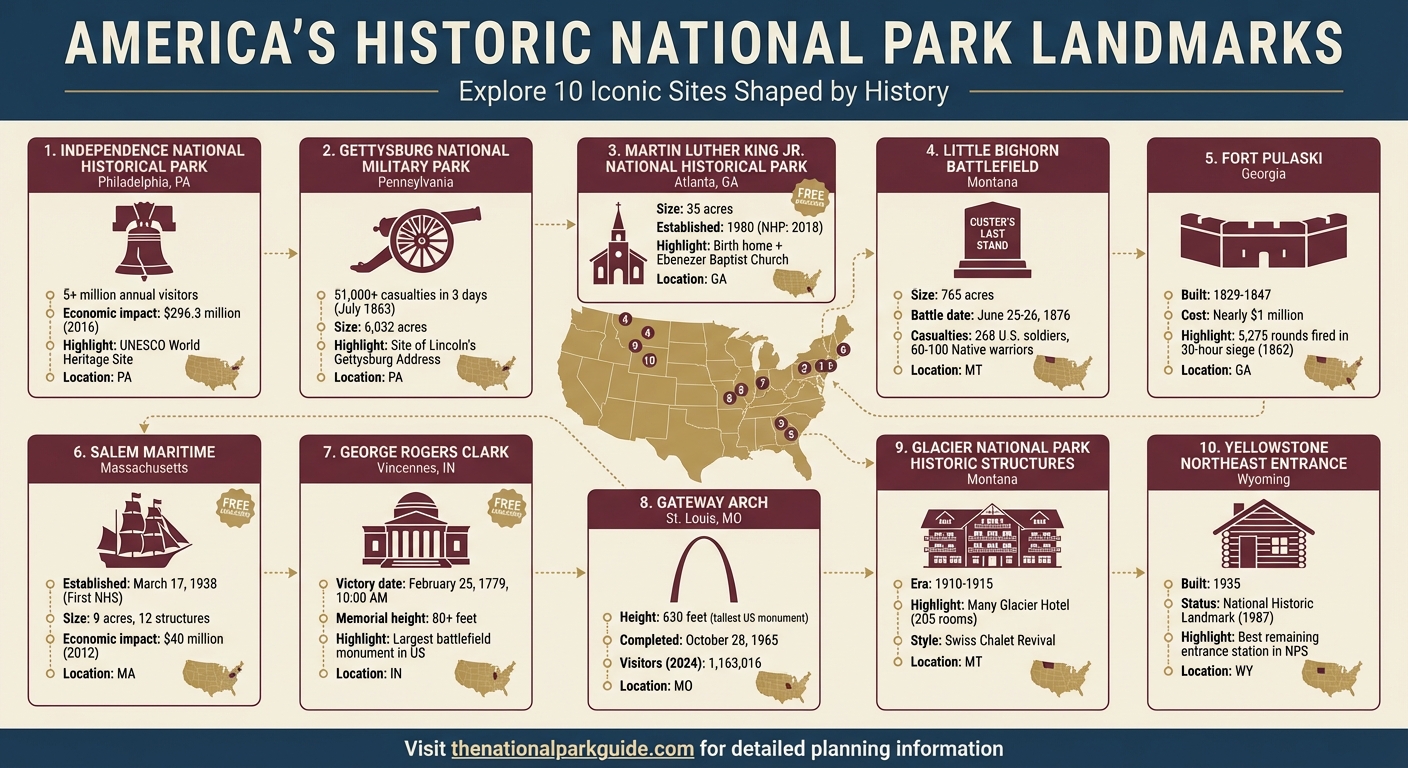
Top 10 Historic Landmarks in US National Parks Quick Reference Guide
Top 10 Best National Park Service Sites (Minus the Big 63)- 300 Subscriber Special
1. Independence National Historical Park
Independence National Historical Park in Philadelphia is often called "America’s most historic square mile", covering 55 acres packed with key moments from the nation’s founding. As a UNESCO World Heritage Site, it draws over 5 million visitors each year. In 2016 alone, visitor spending at the park contributed $296.3 million to the economy and supported 4,585 jobs.
At the heart of the park is Independence Hall, where the Declaration of Independence and the U.S. Constitution were debated and signed. The Assembly Room, central to these events, was carefully restored by the National Park Service between 1955 and 1965 to reflect its original appearance. The West Wing also displays the silver Syng inkstand, thought to have been used during these historic signings.
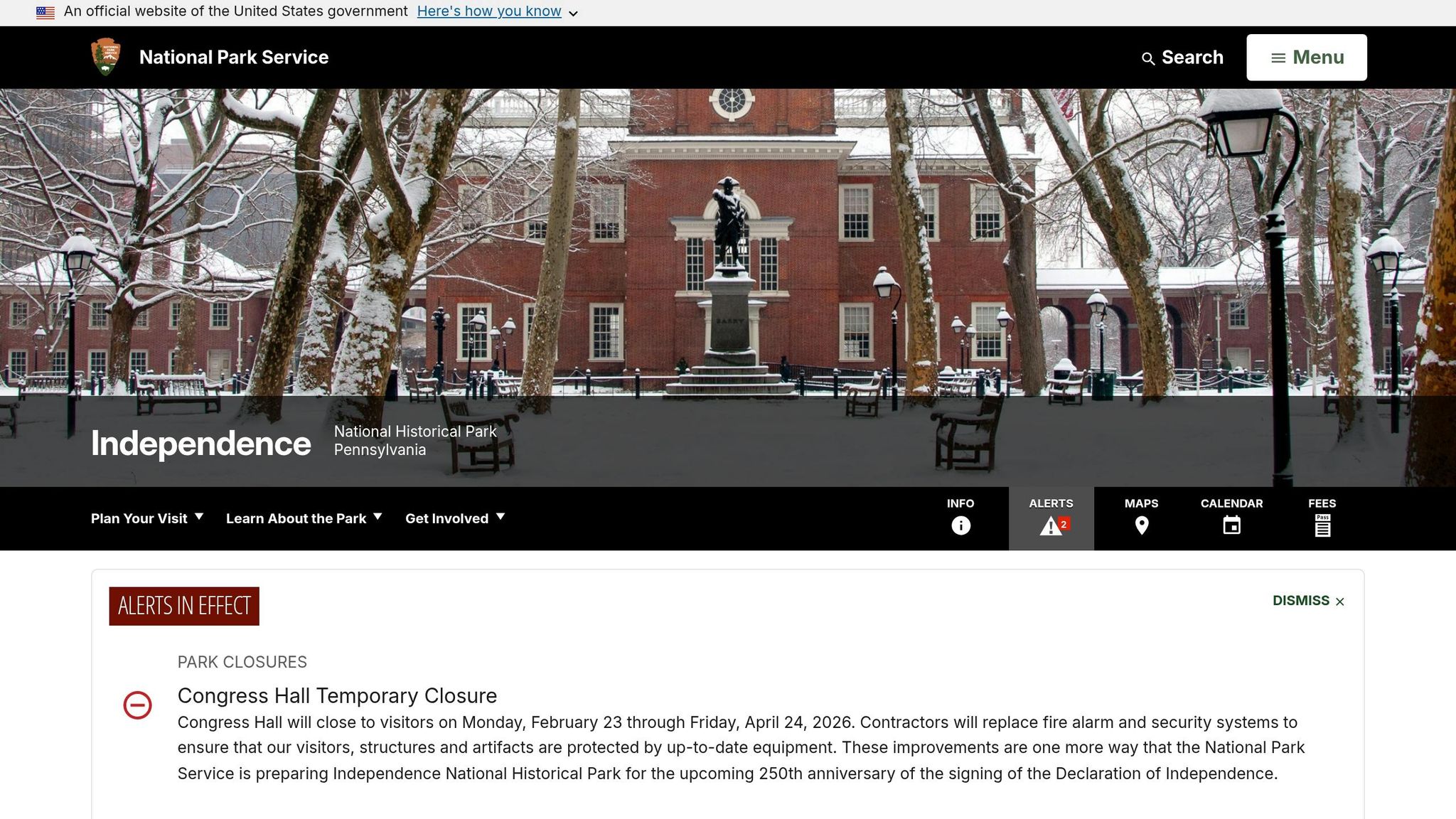
The Liberty Bell Center is another iconic feature of the park. The 2,080-pound bell, made of 70% copper and 25% tin, is housed in a building with glass walls that offer a stunning view of Independence Hall. Meanwhile, Congress Hall, which served as the meeting place for Congress from 1790 to 1800 and hosted both George Washington’s second inauguration and John Adams’s first, is temporarily closed for upgrades until April 2026. Beyond these artifacts, the park tells the broader story of America’s journey.
The President’s House Site adds another layer to this history. This outdoor exhibit marks the location of the nation’s first executive mansion (1790–1800) and honors the nine enslaved individuals who lived and worked there during George Washington’s presidency. Open 24/7, it offers a sobering reminder of the tension between the ideals of liberty and the reality of slavery.
For visitors, planning is straightforward. A timed ticket is required to enter Independence Hall, with a $1.00 reservation fee available through recreation.gov. However, there’s an "open house" window from 9:00 a.m. to 10:00 a.m. that doesn’t require tickets. The Liberty Bell Center is open to all without tickets. With $85 million allocated in 2024 to address maintenance needs, the park is preparing to shine as the nation celebrates its 250th anniversary.
2. Gettysburg National Military Park
Gettysburg National Military Park in Pennsylvania stands as a solemn reminder of the Civil War’s bloodiest battle. Over three days in July 1863, more than 51,000 soldiers were killed, injured, or went missing during this pivotal conflict. Today, the park spans 6,032 acres (as of 2020) and preserves the land where Union forces halted General Robert E. Lee’s second invasion of the North.
The battlefield itself is filled with key landmarks that tell the story of those fateful days. Fighting began on July 1 at McPherson and Oak Ridges. By July 2, the battle had shifted to critical areas like Little Round Top, the Wheatfield, the Peach Orchard, and Culp’s Hill. The conflict reached its dramatic conclusion on July 3 with Pickett’s Charge, which resulted in the loss of about 5,000 Confederate soldiers in just one hour. Among the battlefield’s most poignant features is the Copse of Trees, a small cluster that served as a guide for the Confederate advance. The National Park Service refers to it as the "High Water Mark of the Rebellion".
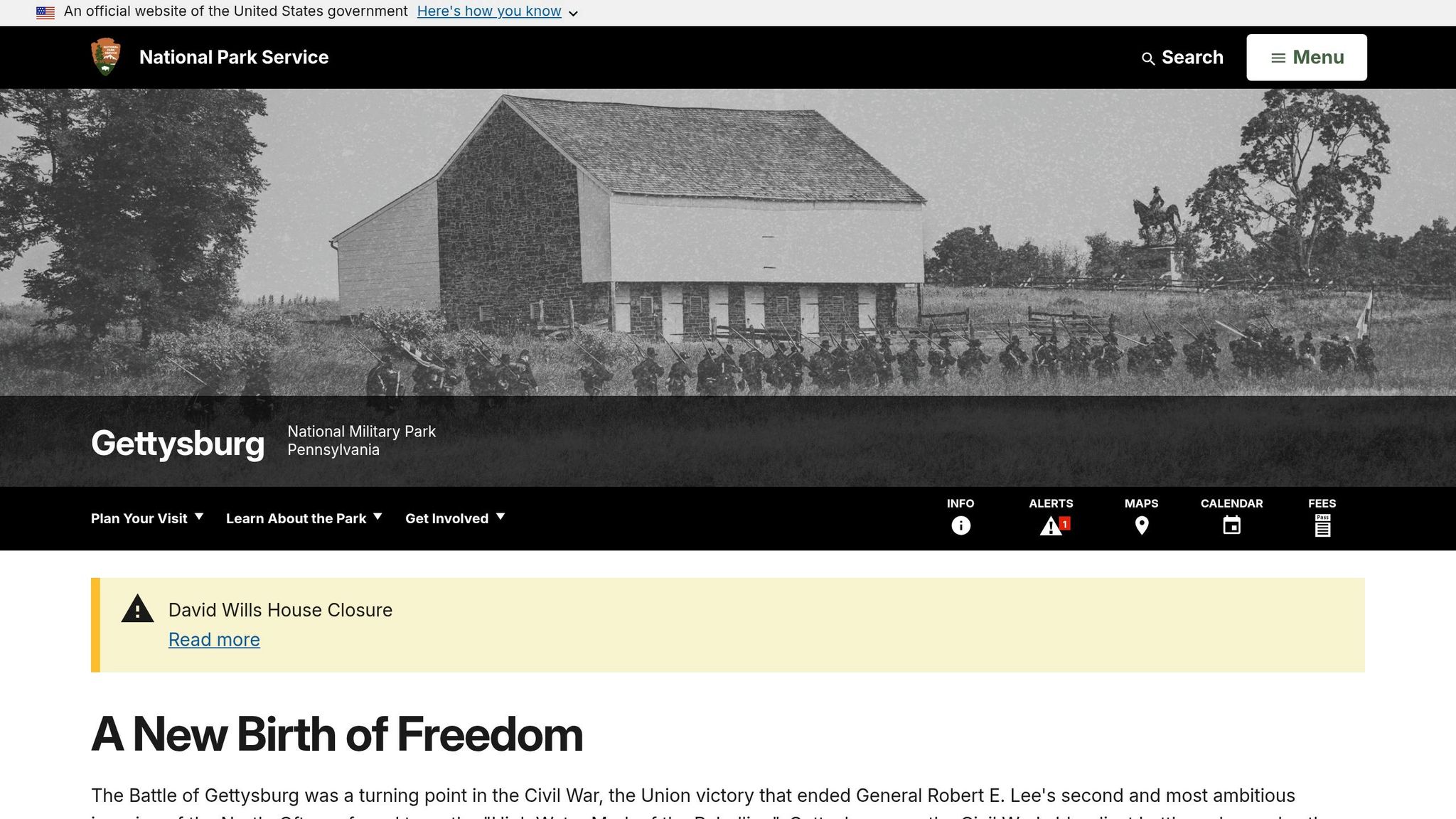
Beyond the battlefield, Soldiers’ National Cemetery provides a resting place for more than 6,000 U.S. soldiers. It’s also where President Abraham Lincoln delivered the Gettysburg Address on November 19, 1863, famously calling for "a new birth of freedom". Just a short distance away in the town of Gettysburg, visitors can see the David Wills House, where Lincoln finished drafting his iconic speech. Another significant site is the Mary Thompson House on Seminary Ridge, which served as General Lee’s headquarters and witnessed the devastating losses of the 13th North Carolina. These locations not only preserve military history but also highlight the enduring spirit of the nation.
The park’s Museum and Visitor Center adds another layer to the experience by housing 43,000 Civil War artifacts. Among its most impressive features is the Gettysburg Cyclorama, a massive 377×42-foot oil painting from the 1880s that weighs 12.5 tons and includes a three-dimensional foreground. Visitors can also view nearly 400 cannons arranged to replicate the battle’s artillery formations.
For those looking to immerse themselves further, overnight stays are available in historic structures like the 1808 Michael Bushman House or the Slyder House. These accommodations can be reserved through Recreation.gov with a $250 refundable deposit and additional fees.
3. Martin Luther King Jr. National Historical Park

This park, located in Atlanta’s historic Sweet Auburn neighborhood, preserves the birthplace and legacy of Dr. Martin Luther King Jr., one of the most influential civil rights leaders in American history. Spanning 35 acres, it was initially established in 1980 and later designated a National Historical Park in 2018. The park features several key sites that reflect Dr. King’s life, work, and vision for justice and equality.
The Birth Home, located at 501 Auburn Avenue, is the heart of the park. This two-story Queen Anne Victorian house was purchased in 1909 by Dr. King’s grandfather, Rev. Adam Daniel Williams, for $3,500. It is here that Dr. King was born on January 15, 1929, and spent the first 12 years of his life. While tours of the Birth Home are currently suspended for rehabilitation, ranger-led sessions are expected to resume in June 2026, offering free, guided visits limited to small groups of 15.
The Historic Ebenezer Baptist Church played a central role in shaping Dr. King’s spiritual and moral foundation. He was baptized here, ordained at just 19 years old, and later served as co-pastor alongside his father from 1960 to 1968. Restoration efforts have been carefully planned in two phases. Phase I focused on structural repairs, climate control, and relighting the iconic historic sign, while Phase II is restoring the sanctuary to its 1960–1968 appearance, preserving original features like the stained glass and pipe organ. These efforts were supported by a Save America’s Treasures Grant and private donations.
Founded by Coretta Scott King in 1968, The King Center is another highlight of the park. It includes the outdoor memorial tombs of Dr. and Mrs. King, accompanied by an "Eternal Flame." Inside Freedom Hall, visitors can explore exhibits dedicated to Dr. King, Rosa Parks, and Mahatma Gandhi. Nearby, Fire Station No. 6, built in 1894 and recognized as Atlanta’s first integrated fire station, now houses exhibits on the history of desegregation.
Admission to the park and its ranger-led activities is free. Visitors are encouraged to spend about 2.5 to 3 hours exploring its many attractions, including the "Courage to Lead" exhibit at the Visitor Center, The King Center, and Fire Station No. 6.
4. Little Bighorn Battlefield National Monument
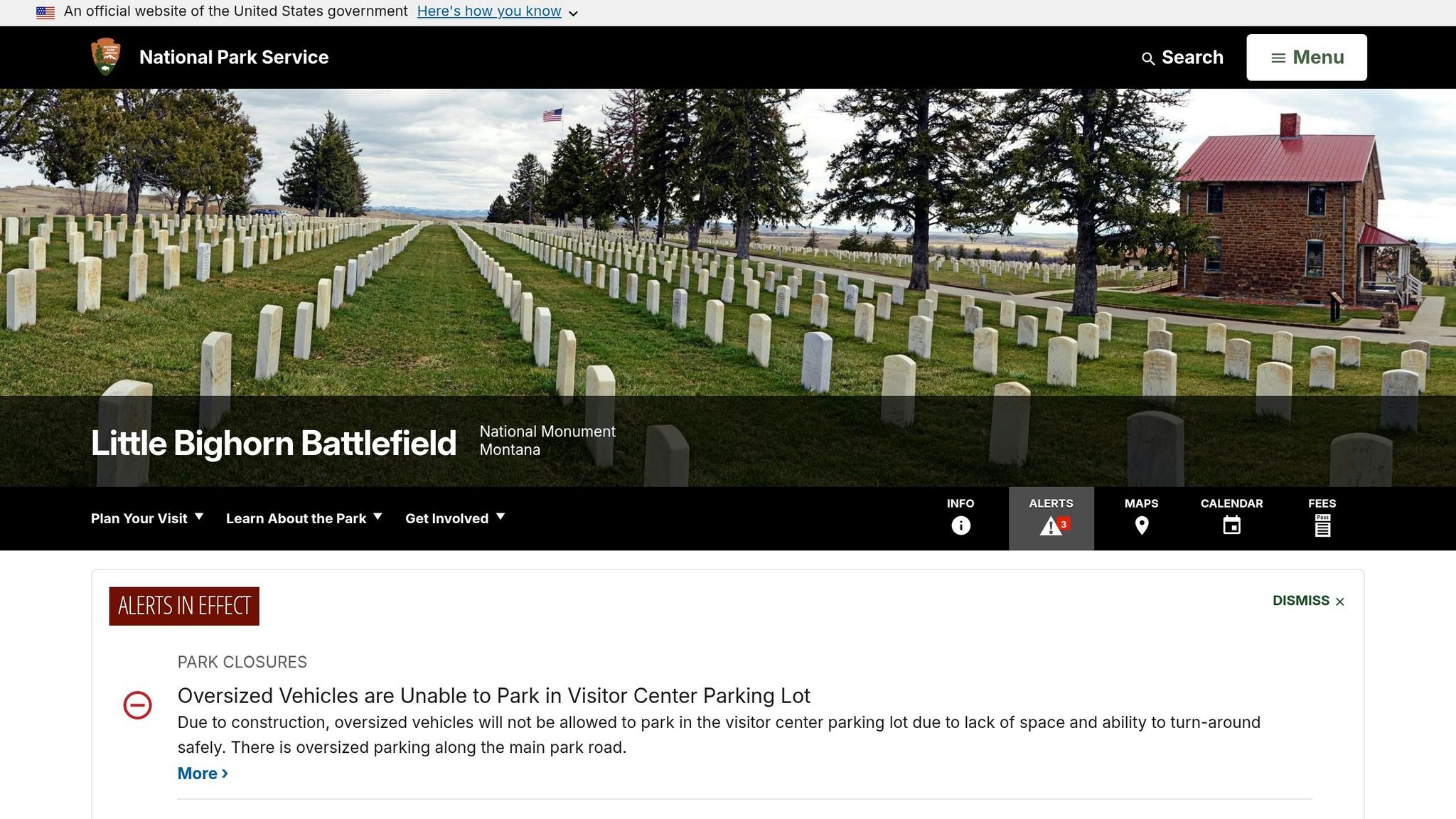
Spanning 765 acres in Montana, this monument commemorates one of the most pivotal battles in American history. On June 25–26, 1876, Lt. Col. George A. Custer and the 7th U.S. Cavalry faced a coalition of Lakota, Cheyenne, and Arapaho warriors. The confrontation resulted in the deaths of all 210 of Custer’s men, marking the U.S. Army’s most devastating loss during the Plains Wars. In total, 268 U.S. soldiers, civilians, and scouts perished, while Native American casualties are estimated between 60 and 100 warriors. The site stands as a testament to both U.S. military and Native American histories.
At the heart of the monument is Last Stand Hill, where a granite obelisk, erected in 1881, marks a mass grave containing the remains of fallen soldiers and scouts. Scattered across the battlefield, white marble markers indicate where individual cavalrymen fell, while red granite markers – added since 1999 – pay tribute to Lakota and Cheyenne warriors. The Indian Memorial, unveiled on June 25, 2003, exactly 127 years after the battle, includes a "Spirit Gate" and a bronze sculpture that reflect Native American perspectives. Oglala Lakota Elder Enos Poor Bear, Sr. captured the memorial’s intent, saying:
"If this memorial is to serve its total purpose, it must not only be a tribute to the dead; it must contain a message for the living…power through unity…"
Visitors can explore the battlefield via the 4.5-mile Battlefield Tour Road, which leads to the Reno-Benteen Battlefield, where 350 soldiers endured a two-day siege. For a closer look at the battle’s final moments, the Deep Ravine Trail offers a half-mile round-trip walk. Additionally, the Custer National Cemetery honors over 5,000 veterans from conflicts ranging from the Indian Wars to the Korean War.
Currently, the park is open only on Fridays, Saturdays, and Sundays. While the main Visitor Center is closed for renovations, a temporary contact station and bookstore are available near the restrooms. Entrance fees are $25.00 for private vehicles, $20.00 for motorcycles, and $15.00 for pedestrians or cyclists. Payments are cashless, with credit cards, debit cards, and mobile payments accepted.
5. Fort Pulaski National Monument
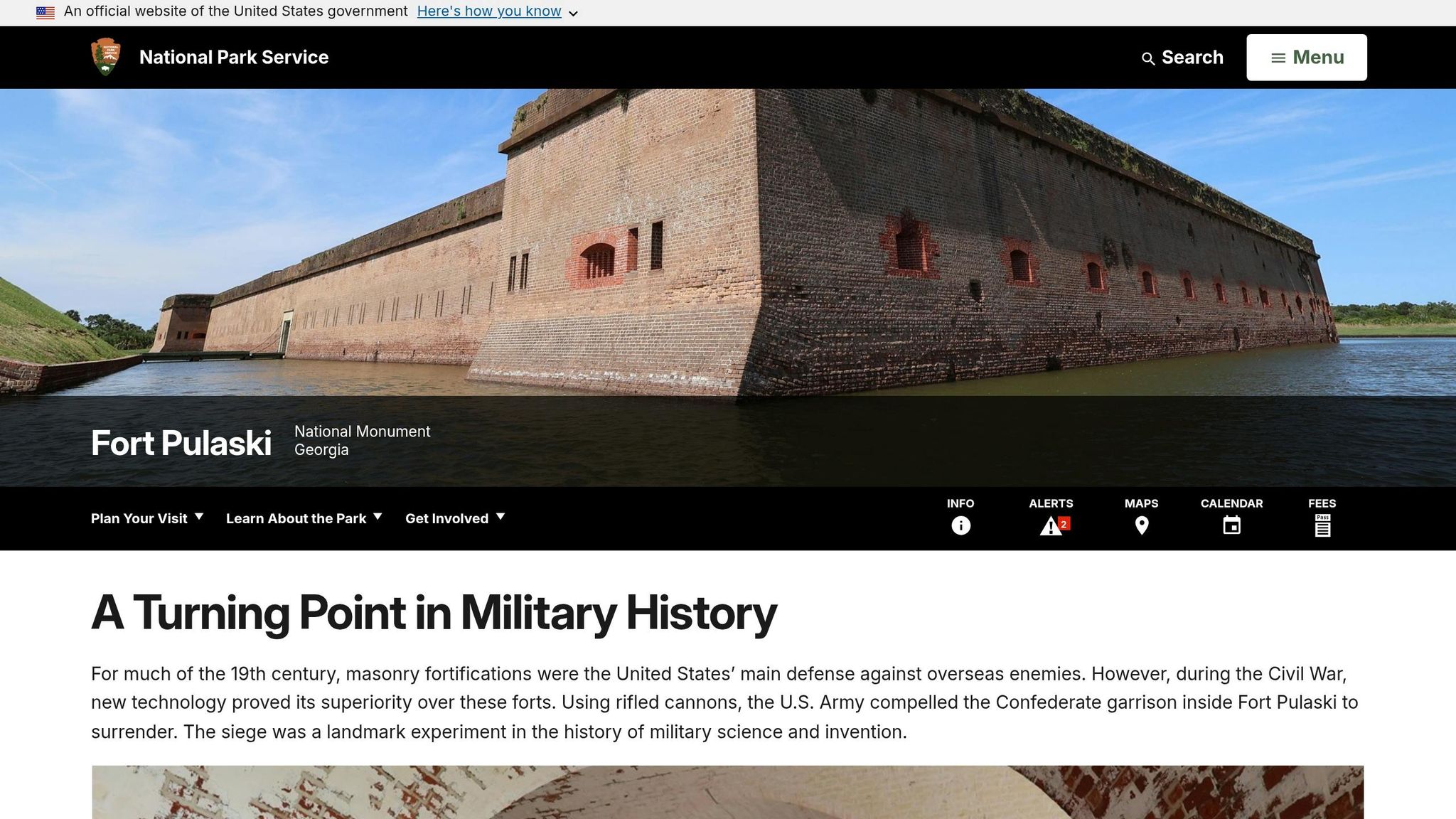
Nestled on Cockspur Island near Savannah, Georgia, Fort Pulaski played a pivotal role in military history. During a 30-hour siege on April 10–11, 1862, Union forces introduced rifled cannons, a game-changing advancement in artillery. Positioned on Tybee Island, they fired 5,275 rounds, breaching the fort’s seemingly invincible walls. General Totten, the United States Chief of Engineers, had once confidently dismissed the idea of such a breach, stating:
"You might as well bombard the Rocky Mountains."
The Union artillery, with a striking range of 1,640 yards, tore through the fort’s 7.5-foot-thick brick walls. This breach exposed the northwest magazine, which housed 40,000 pounds of black powder. To avoid a catastrophic explosion, Confederate Colonel Charles H. Olmstead surrendered, stating:
"I yield my sword, but I trust I have not disgraced it."
Built between 1829 and 1847, Fort Pulaski cost nearly $1,000,000 and required about 25 million Savannah Gray bricks, made locally. The fort’s construction was a feat of engineering, with Second Lieutenant Robert E. Lee contributing to its early drainage and foundation work from 1829 to 1831. The pentagonal structure stands 32 feet tall, with walls ranging from 7.5 to 11 feet thick, supported by wooden pilings driven 70 feet into marshy ground.
After its capture, the fort became a beacon of hope for those seeking freedom. It served as a stop on the Underground Railroad and a refuge for freed individuals. In April 1862, General David Hunter issued General Order Number Seven from Fort Pulaski, declaring enslaved people in Florida, Georgia, and South Carolina free. Though this order was later rescinded by President Lincoln, it marked a significant step toward the Emancipation Proclamation. During the later years of the war, the fort also served as a prison for Confederate officers known as "The Immortal Six Hundred." Thirteen of these prisoners died and were buried just outside its walls.
Today, Fort Pulaski stands as a testament to its rich history. Visitors can explore its casemates, see the scars left by the 1862 bombardment, and stroll along the historic dike system, which remains remarkably intact nearly 200 years later. The park welcomes guests daily from 9:00 AM to 4:30 PM. Admission is $10.00 for adults aged 16 and up, while children under 16 enjoy free entry. National Parks passes are also accepted for complimentary access.
6. Salem Maritime National Historical Park
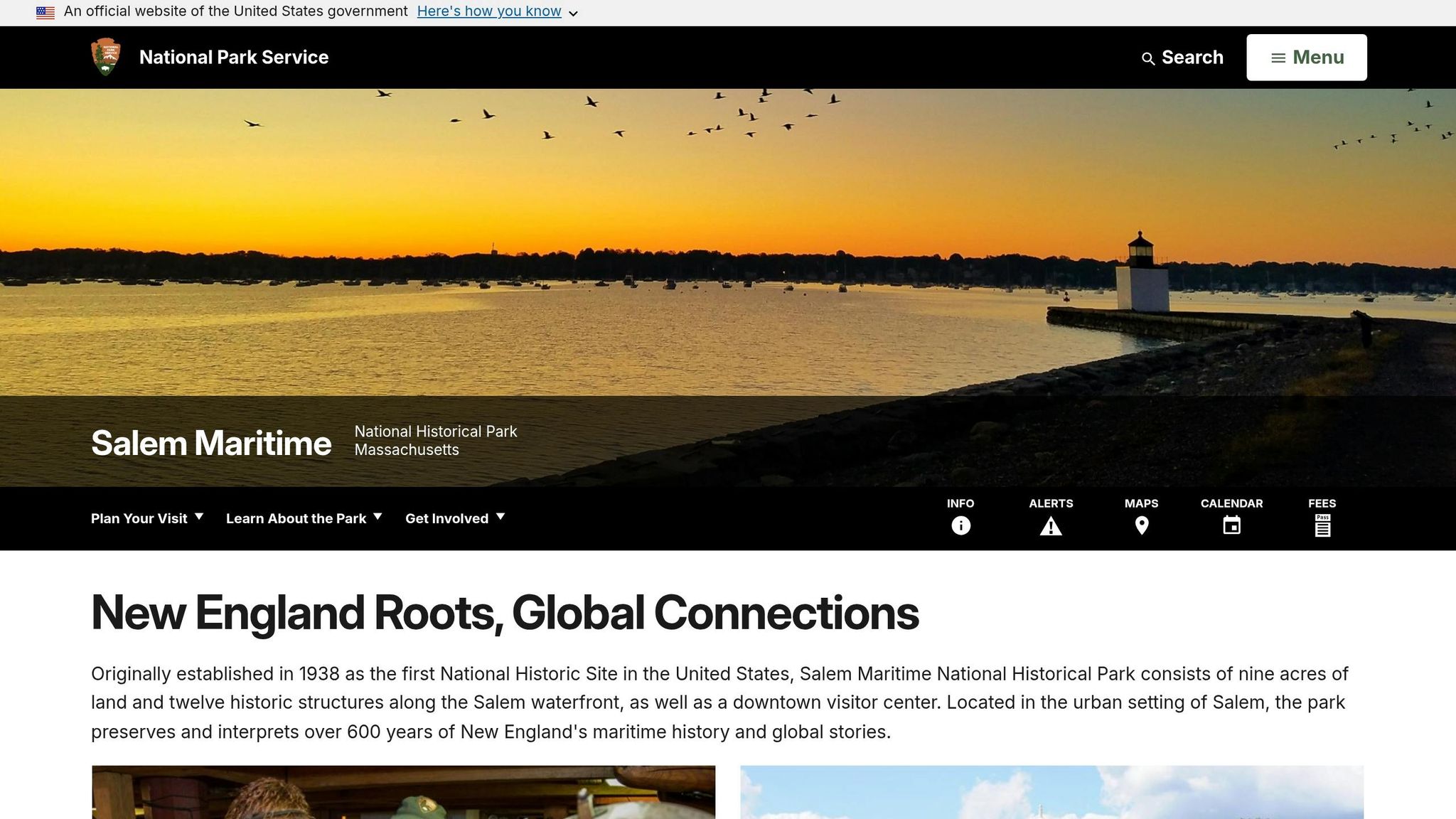
Nestled along the Salem waterfront in Massachusetts, the Salem Maritime National Historical Park holds the distinction of being the first National Historic Site in the United States, established on March 17, 1938, and later redesignated as a National Historical Park on July 16, 2025. Spanning 9 acres and featuring 12 historic structures, the park highlights the crucial role of maritime trade in shaping early American prosperity.
One of its standout features is Derby Wharf, originally constructed in 1762 and extended by 1806 to stretch nearly half a mile. Once the hub of a thriving international trading network, Derby Wharf remains the longest of the four historic wharves still standing. Today, visitors can enjoy walking along the Derby Wharf National Recreation Trail, open 24/7 year-round, and admire the solar-powered Derby Wharf Light.
The Salem Custom House, completed in 1819, served as a key site for collecting taxes on imported goods. This building also boasts a literary connection – Nathaniel Hawthorne worked here and referenced its carved eagle in The Scarlet Letter. Nearby, the Derby House, built in 1762 as a wedding gift for Captain Richard Derby’s son, offers a glimpse into the opulence of merchant families. Free 30-minute guided tours are available during the season, though reservations are needed for groups of up to eight.
Another highlight is the Friendship of Salem, a full-scale replica of a 1797 East Indiaman. This vessel completed 15 global voyages before being captured during the War of 1812. Now a museum ship, it provides a vivid look at the daily lives of sailors from that era. The Narbonne House, built in 1675, is another fascinating site. Having stood through the infamous 1692 witch trials, it later became home to middle-class families for nearly 300 years. Archaeological digs at the site have uncovered nearly 150,000 artifacts.
Admission to the park is free throughout the year. While the grounds and wharves remain open 24/7, many historic buildings close during the winter, so checking seasonal hours before visiting is a good idea. In 2012, the park welcomed 756,038 visitors, generating an estimated $40 million for the local economy. Start your journey at the Salem Armory Regional Visitor Center, where you can watch orientation films and learn more about the Essex National Heritage Area.
sbb-itb-00512f3
7. George Rogers Clark National Historical Park
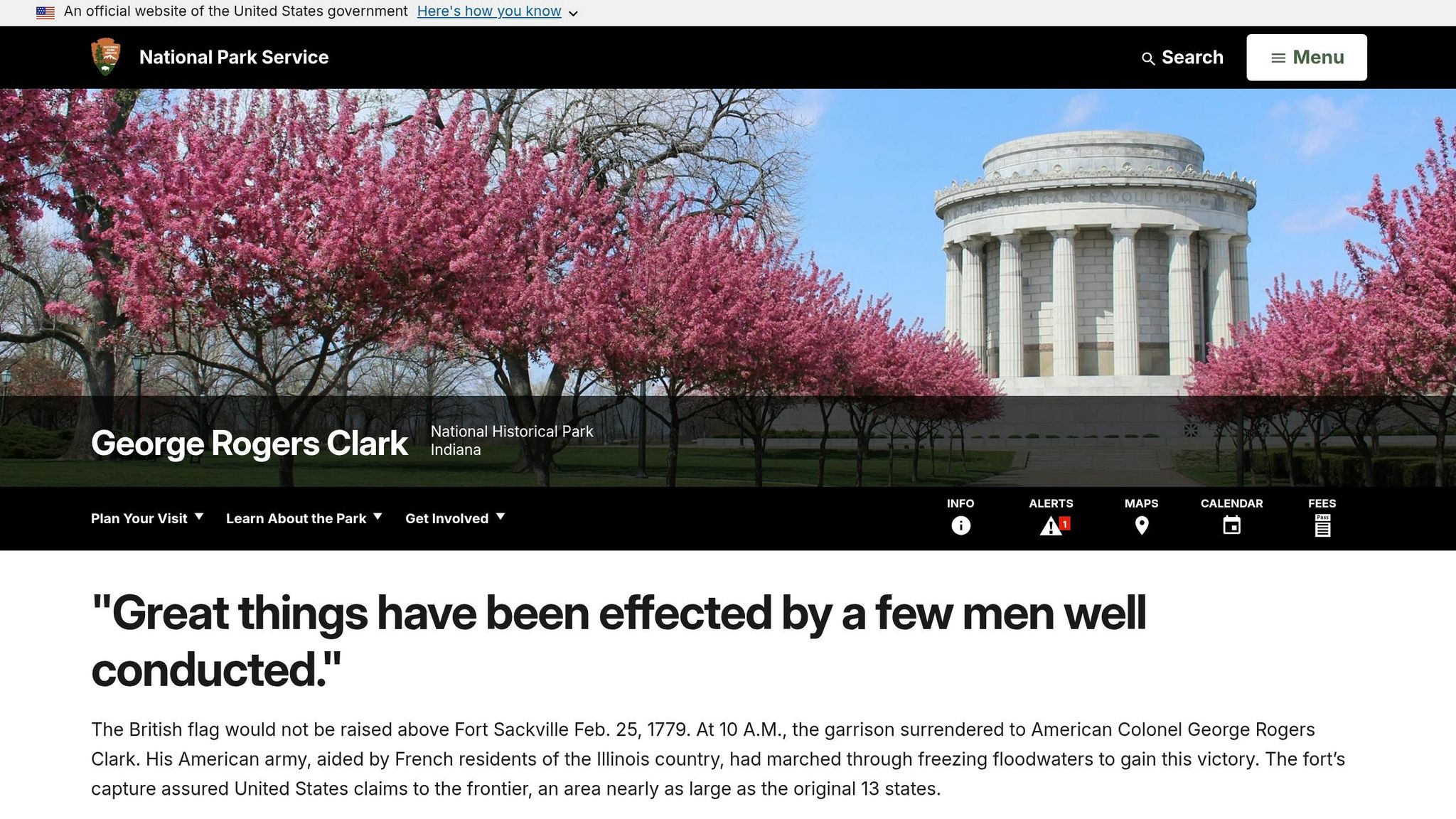
Sitting along the Wabash River in Vincennes, Indiana, the George Rogers Clark National Historical Park honors a key moment in the American Revolution. On February 25, 1779, at 10:00 a.m., Colonel George Rogers Clark, alongside 170 frontiersmen and French volunteers, compelled the British to surrender Fort Sackville. This came after an arduous 18-day, 180-mile trek through freezing conditions. The victory was a game-changer, solidifying American claims to the Old Northwest Territory – an area nearly matching the size of the original 13 colonies, which later became Ohio, Indiana, Illinois, Michigan, Wisconsin, and eastern Minnesota.
The park’s focal point is the George Rogers Clark Memorial, a towering Beaux-Arts masterpiece. Rising over 80 feet high and spanning 90 feet at its base, it’s the largest monument on an American battlefield and the biggest national monument outside Washington, D.C.. Constructed in the 1930s for around $2.5 million, the memorial boasts 16 Greek Doric columns, two-foot-thick walls, and seven massive murals by Ezra Winter, each measuring 16 by 28 feet. At its heart is a bronze statue of Clark, sculpted by Hermon Atkins MacNeil, the artist behind the Standing Liberty quarter.
Between August 2008 and September 2009, the memorial underwent a $3 million restoration under the guidance of Park Superintendent Dale Phillips. Frontier Waterproofing, Inc. meticulously removed and numbered roughly 1,000 granite paving stones to install new waterproofing, solving drainage issues first noted in 1939. The monument was rededicated on October 3, 2009.
Admission is free all year. Start your visit at the Visitor Center, where you can watch the 30-minute film Long Knives, and then explore the memorial (note: it closes 15 minutes before the center). In 2011, the park welcomed 145,596 visitors. For a deeper dive into history, consider attending the "Spirit of Vincennes Rendezvous" over Memorial Day weekend. This event features over 400 living history reenactors recreating an 18th-century frontier camp.
"Great things have been effected by a few men well conducted." – George Rogers Clark
8. Gateway Arch National Park
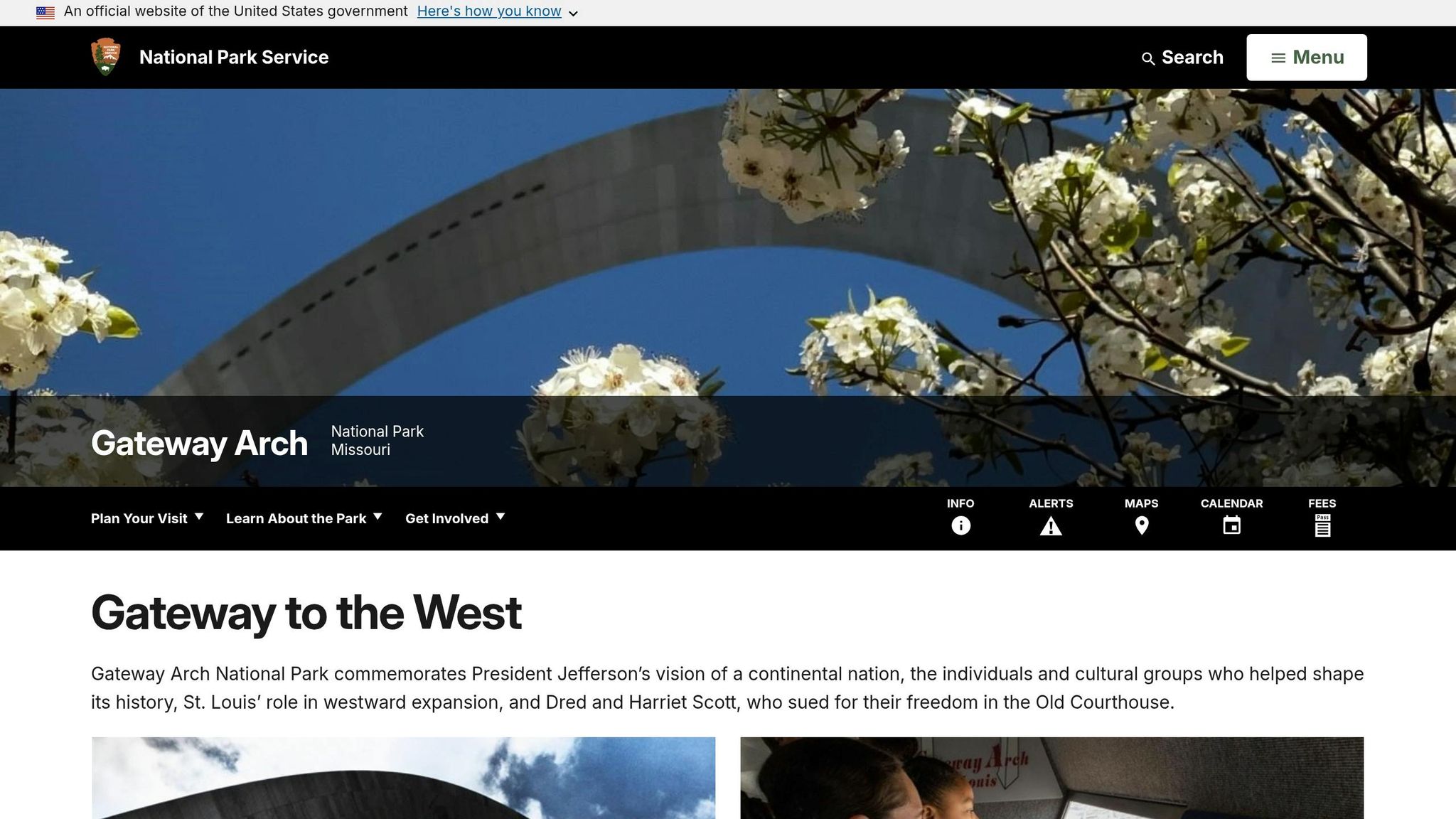
Standing 630 feet tall along the Mississippi River in St. Louis, Missouri, the Gateway Arch claims the title of the tallest monument in the United States. Beyond its towering presence, the Arch tells a story of America’s past. Finnish-American architect Eero Saarinen designed this masterpiece after winning a national competition in 1947. Construction wrapped up on October 28, 1965, with a price tag of about $15 million. The monument commemorates the 1803 Louisiana Purchase and highlights St. Louis’s key role in westward expansion, including the famous Lewis and Clark Expedition.
The design of the Arch is as extraordinary as its historical significance. Built as a weighted catenary arch, its structure channels weight into foundations sunk 60 feet into bedrock. Unlike most buildings, it lacks an internal frame; instead, its strength comes from a double-walled steel exterior. The outer layer uses 886 tons of stainless steel, while the inner layer contains 2,157 tons of carbon steel. At its base, the Arch’s legs span 54 feet wide, narrowing to just 17 feet at the top. Even under 150 mph winds, it sways only 18 inches.
"Neither an obelisk nor a rectangular box nor a dome seemed right on this site or for this purpose. But here, at the edge of the Mississippi River, a great arch did seem right."
– Eero Saarinen, Architect
This iconic design not only represents westward expansion but also offers visitors a one-of-a-kind experience. Gateway Arch National Park, the smallest national park in the country, spans just 192.83 acres and welcomed 1,163,016 visitors in 2024. The park also includes the Old Courthouse, where the Dred Scott trials of 1847 and 1850 unfolded – key moments in the nation’s struggle over slavery. Between 2013 and 2018, the $380 million CityArchRiver project revitalized the area, adding 7.5 acres of green space and reconnecting the Arch with downtown St. Louis through a "Park Over the Highway".
For visitors, the park offers a mix of history and modern amenities. Admission to the Museum at the Gateway Arch and the Old Courthouse is free, though tickets for the Tram Ride to the Top must be purchased in advance. The tram system is a marvel in itself, using eight capsules – each holding five passengers – that rotate to stay level as they climb the Arch’s curve. The ride takes about four minutes, and on clear days, the observation room offers views stretching up to 30 miles in every direction. Parking is available at the Stadium East Garage for roughly $10 for the first five hours. Whether you’re drawn by its history, design, or breathtaking views, the Gateway Arch delivers an unforgettable experience.
9. Glacier National Park Historic Structures
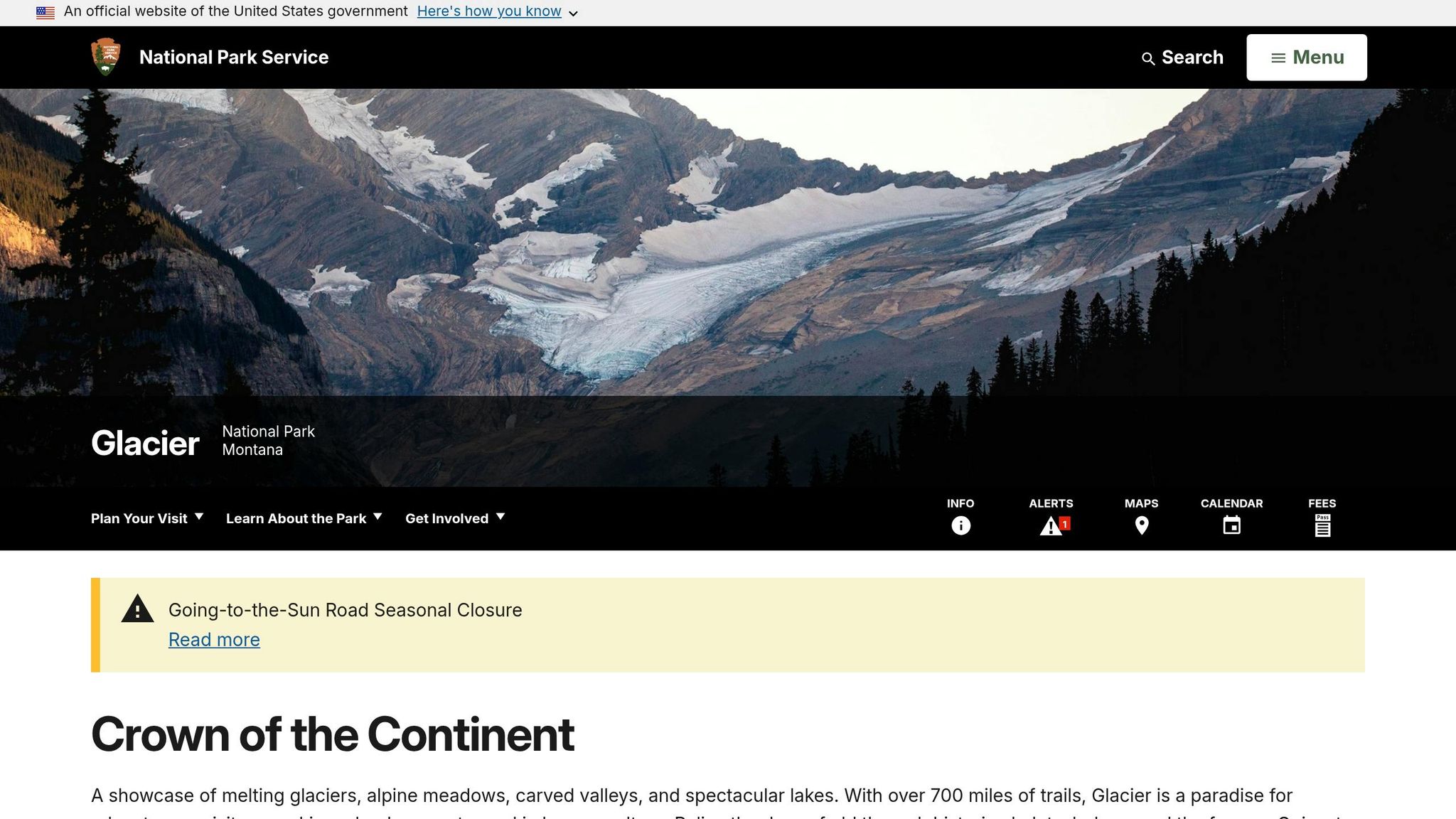
Glacier National Park, set in Montana’s rugged wilderness, offers more than just breathtaking landscapes – it tells a story of early tourism through its historic architecture. Among its treasures are a collection of early-20th-century Swiss Chalet Revival buildings, crafted to evoke the charm of the Alps. Between 1910 and 1915, the Great Northern Railway (GNR), under the leadership of Louis W. Hill, developed nine chalet complexes to market Glacier as the "American Alps". These structures, with their steep gabled roofs, exposed beams, intricate woodwork, and large stone fireplaces, created a cohesive alpine aesthetic that continues to captivate visitors.
The standout among these is the Many Glacier Hotel, completed in 1915. Dubbed the "Gem of the West" by the railway, it was Montana’s largest hotel at the time. With 205 guest rooms and a stunning four-story lobby featuring tiered balconies, it remains a focal point of the park. In 2016, parts of the hotel were carefully renovated to preserve its National Historic Landmark status while staying true to the original design by Thomas D. McMahon.
The park’s remote chalets are equally fascinating. Two of the original backcountry chalets are still in operation today. The Sperry Chalet, built in 1913 at an elevation of 6,560 feet, offers rustic accommodations and full-service dining, accessible only by trail. After a fire in 2017 destroyed its dormitory, a meticulous restoration was completed in 2020, preserving its native stone exterior. The Granite Park Chalet, constructed between 1914 and 1915 at 6,693 feet along the Highline Trail, provides a more self-sufficient experience. Accommodating up to 40 guests in 12 bunk rooms, it requires visitors to bring their own food and use a communal propane stove. Rates for the 2025 season start at $155 for the first guest and $102 for each additional person.
In 1987, four of these GNR complexes – Sperry Chalet, Granite Park Chalet, Many Glacier Hotel, and Two Medicine General Store – were recognized as a discontiguous National Historic Landmark District, showcasing the largest collection of Swiss Chalet architecture in the United States. Another gem, Lake McDonald Lodge, built between 1913 and 1914, combines Swiss Chalet Revival style with hunting lodge influences. Its three-story lobby features a concrete floor inscribed with Native American messages, adding a layer of cultural depth to its design. Together, these structures not only reflect the early days of tourism but also contribute richly to the narrative of America’s national heritage.
10. Yellowstone National Park Northeast Entrance
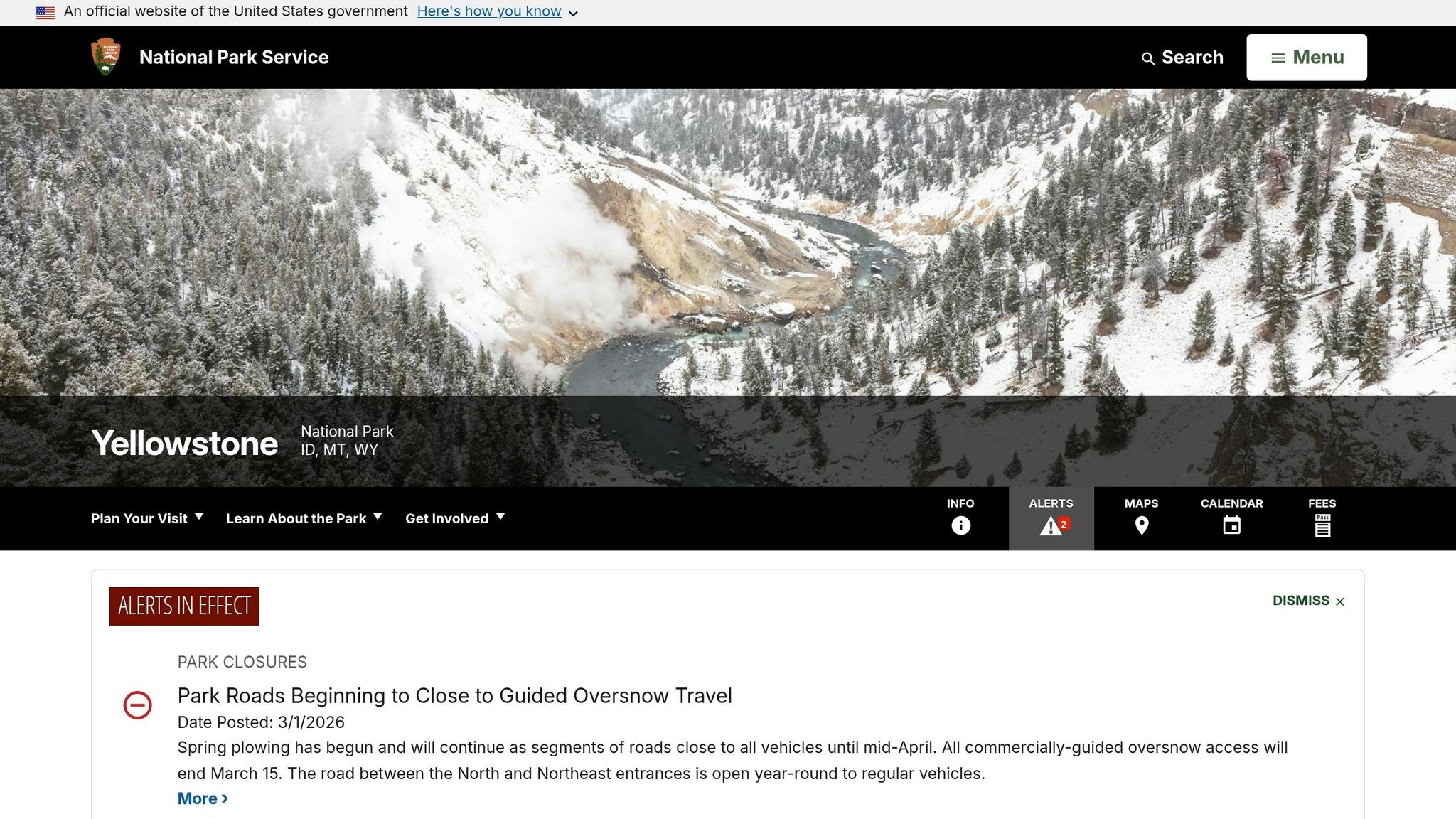
The Northeast Entrance Station of Yellowstone, built in 1935 as part of a Public Works project, is a prime example of "Parkitecture" – a design philosophy that harmonizes structures with their natural surroundings. Created by the National Park Service’s Branch of Plans and Design in San Francisco during the Great Depression, the station functions as both a practical gateway and a symbolic transition:
"The building was not only the physical boundary, but the psychological boundary between the rest of the world and what was set aside as a permanently wild place"
This carefully crafted entry point reflects Yellowstone’s historical focus on creating a meaningful visitor experience.
The station includes two log structures: a drive-through checking station and a seven-room ranger residence. Both buildings were constructed using locally sourced lodgepole pine, with a central office flanked by two wings under a continuous gable roof. Architectural historian Laura Soulliere Harrison highlighted the craftsmanship:
"The most expressive aspect of the logwork is the gentle concave curve of the log ends from the foundation up to the eaves. This sophisticated treatment adds an elegant touch to a building constructed of such simple materials"
The logs feature saddle-coped joints and axe-cut ends, with tapering carefully controlled to no more than 1 inch over 15 feet.
Recognized as a National Historic Landmark in 1987, the station has retained its original architectural character. Updates have been made over the years, including bypass lanes for taller vehicles and a 1984 restoration that repaired log ends with epoxy, replaced the roof, and preserved the original chinking.
The station’s design gained national attention when it was featured in the 1938 NPS publication Park and Recreation Structures as a benchmark for entrance stations across the country. According to the National Park Service, it remains:
"the best of its type remaining in the National Park System"
Adding to its accessibility, the road linking the North and Northeast entrances is the only stretch in Yellowstone open year-round to regular vehicles, ensuring visitors can experience this historic site in every season.
11. The National Park Guide
When planning visits to historic landmarks across America’s national parks, having a reliable and well-rounded resource can make all the difference. The National Park Guide serves as an essential companion, combining logistical details with historical insights to help visitors explore, understand, and engage with the nation’s rich heritage. It’s a one-stop tool that ensures every trip is more organized and meaningful.
The guide allows users to search by state, offering concise summaries of each landmark’s historical importance, architectural features, and role in key periods like the Civil Rights Movement or the New Deal era. Since 1960, the National Park Service has cataloged over 2,600 National Historic Landmarks, making it an invaluable resource for history enthusiasts.
For those who can’t visit in person, virtual tours provide a unique opportunity to explore historic halls and artifacts from the comfort of home. The guide also includes practical tools like event calendars, accessibility details, and park maps, making trip planning much easier.
For visitors heading to the parks, the guide highlights activities like collecting passport stamps at various historic sites and participating in Junior Ranger programs, which celebrate the stories behind each landmark. Some locations, such as the Frederick Douglass House, require scheduled ranger-led tours for interior access, so it’s a good idea to check the "Plan Your Visit" page before your trip.
As the National Park Service puts it:
"History is not just names and dates to memorize before a test and immediately forget. It is our origin story".
This guide brings that origin story to life, connecting visitors to the landmarks that shaped the country.
Tips for Visiting Historic Sites
Making the most of a trip to historic landmarks requires a bit of planning. Popular destinations like the Lincoln Home and Ford’s Theatre often have limited ticket availability, which can sell out quickly – sometimes by mid-afternoon. For example, the Lincoln Home, which sees over 150,000 visitors annually, restricts guided tours to 15 people per session, each lasting about 25 minutes. Arriving early is your best bet to secure a spot for later in the day.
Be prepared for remote locations by downloading offline maps through the NPS App and packing essentials like water and snacks. Many sites, such as El Morro National Monument (designated in 1906 and the second oldest national monument in the U.S.), lack cell service and dining options.
When exploring, stick to designated trails to help preserve fragile archaeological sites. Avoid touching rock art, as even small actions can cause irreversible harm. The National Park Service emphasizes:
"Petroglyphs are fragile, non‑renewable cultural resources that, once damaged, can never be repaired nor replaced"
Even the natural oils from your skin can darken petroglyphs, affecting their scientific dating. Vandalizing these areas carries serious penalties, including fines up to $100,000 and up to 10 years in prison.
Understanding the history behind these sites can turn a simple visit into a powerful learning experience. In fact, two-thirds of national park sites in the U.S. are designated as historically or culturally significant. Geoffrey Burt from the National Park Service explains:
"Direct engagement with, and an enhanced comprehension of, cultural resources and processes allows for a richer appreciation of our diverse history – what it means to be an American"
To deepen your experience, check The National Park Guide for ranger-led tours and special educational programs.
Practical tips can also make your visit smoother. Wear layers to accommodate changing weather and sturdy shoes for uneven terrain. If you’re bringing pets, follow the BARK principles: Bag waste, Always leash your pet, Respect wildlife, and Know designated areas. For groups of 15 or more, make reservations at least two weeks in advance. Many sites also offer free Junior Ranger programs, which include booklets and badges to help kids engage with the site’s history in a hands-on way.
Conclusion
Visiting historic landmarks in national parks offers a unique opportunity to step into the very landscapes where pivotal moments in American history unfolded. Walking along the ridges of the Little Bighorn River or tracing the paths of historic figures transforms history from words on a page into a vivid, tangible experience.
Out of the 398 national park units, two-thirds focus on history as a central part of their visitor experience. In 2012 alone, about 70 million people visited monuments, historic sites, military parks, and battlefields. These numbers highlight the enduring connection Americans feel to their heritage, with each landmark telling a story that resonates deeply.
These stories capture both triumph and adversity. The Liberty Bell, for example, remains a powerful symbol of the nation’s fight for freedom. Meanwhile, the Indian Memorial at Little Bighorn, dedicated on June 25, 2003, honors all the tribes that played a role in the battle. Together, these sites encourage reflection on themes of sacrifice, conflict, and the ongoing pursuit of equality. Each landmark not only preserves history but invites visitors to engage with the struggles and victories that shaped the United States.
To make the most of these experiences, The National Park Guide is an invaluable resource. It offers curated itineraries, expert advice, and interactive maps to help you plan your visits. Whether you’re touring the Frederick Douglass home at Cedar Hill or collecting passport stamps at multiple sites, these tools enrich your journey. Soon, the site will also connect you with travel companies to streamline your trip planning.
Start exploring America’s past today. These landmarks are waiting to share the complex, evolving story of the nation’s history with you.
FAQs
Which sites need advance tickets?
Advance tickets are a must for visiting Ford’s Theatre National Historic Site and Independence Hall. These sites require timed reservations for entry, so make sure to book in advance to guarantee your spot.
What’s the best season to visit these landmarks?
Choosing the best season to visit a national park often depends on its location and climate, but spring and fall tend to be favorites. Late September and October, for instance, bring comfortable weather, smaller crowds, and stunning scenery as the leaves change. Summer, while popular for its extended daylight hours, can often mean packed trails and busy parking lots. Winter, on the other hand, transforms parks into serene, snowy landscapes, perfect for those seeking solitude. For a mix of pleasant weather and fewer visitors, late spring and early fall strike a great balance.
How can I plan a multi-park history road trip?
Begin by pinpointing the historic landmarks and trails within national parks that spark your interest. The National Park Service website is a fantastic resource for finding detailed itineraries, maps, and important alerts to help you plan.
You might want to explore iconic routes like the Santa Fe Trail or the Lewis and Clark National Historic Trail, both rich in history and stories. As you map out your trip, take time to plan entry points and schedules carefully. Be mindful of the significance of certain areas, especially those that cross indigenous lands. Respecting these culturally important sites adds depth and meaning to your journey, turning your trip into an opportunity for learning and reflection.