
Choosing between guided bike tours and self-guided rides depends on your preferences for structure, support, and flexibility. Guided tours offer professional guides, group camaraderie, and full logistical support, but they cost about 30% more and follow fixed schedules. Self-guided rides are more affordable, allow for independence, and let you set your own pace, but require basic bike maintenance skills and navigation.
Key Differences:
- Guided Tours: Professional guide, group setting, fixed itinerary, on-the-spot assistance, higher cost.
- Self-Guided Rides: Independent navigation, flexible schedule, lower cost, remote support for emergencies.
Quick Comparison:
| Feature | Guided Tours | Self-Guided Rides |
|---|---|---|
| Navigation | Handled by guide | GPS or maps provided |
| Cost | ~30% higher | Lower |
| Support | Immediate (guide + support van) | Remote (hotline assistance) |
| Flexibility | Fixed schedule | Fully customizable |
| Social Aspect | Group interaction | Private with chosen companions |
Guided tours are ideal for those who value structure and expert insights, while self-guided rides cater to those seeking freedom and privacy. Both options provide incredible ways to experience America’s national parks.
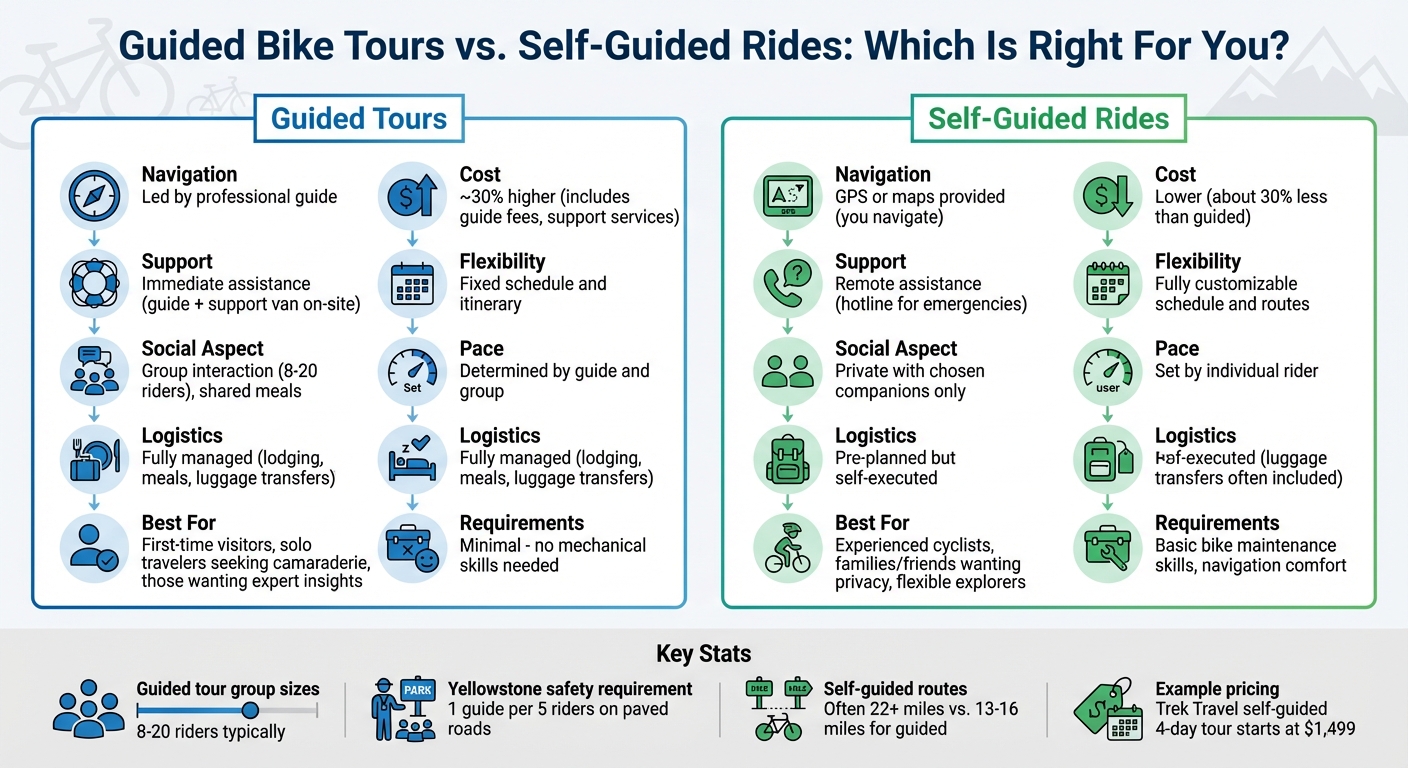
Guided Bike Tours vs Self-Guided Rides Comparison Chart
Unsupported vs Supported Bike Touring: Which one to choose?
sbb-itb-00512f3
What Are Guided Bike Tours?
A guided bike tour is a group cycling experience led by a professional guide who takes care of all the logistics. From navigation and mechanical support to sharing fascinating insights about the area, the guide ensures you can focus entirely on the ride. These tours typically include groups of 8 to 20 riders, follow a set daily schedule, and often feature a support van – commonly called a "sag wagon" – to transport luggage and assist with challenging sections.
The guide’s role goes beyond just leading the way. They provide commentary on the area’s history, wildlife, and geology, share local tips, and handle any mechanical issues or emergencies. As Global Journeys highlights:
Being led by a guide on a group tour gives you access to a wealth of knowledge that you just don’t get travelling independently.
In places like Yellowstone National Park, guided tours must comply with safety protocols established by the National Park Service. These include wearing reflective vests, carrying bear spray, using proper lighting, and sticking to approved routes, such as the stretch from the West Entrance to Madison Junction. These guidelines ensure both safety and an enriching experience.
Features of Guided Bike Tours
Guided bike tours are designed to make the entire experience seamless and enjoyable. The guide takes care of route-finding, so you’re not worried about getting lost, and is always ready to help with flat tires, bike adjustments, or offering assistance if you’re feeling tired. One of the highlights is the educational aspect – guides provide in-depth knowledge about the park’s ecosystem and geological features. For instance, Canyon Adventures offers guided tours at the Grand Canyon South Rim from April 1 to October 31, focusing on the area’s rich history and unique geology.
Safety is a top priority on these tours. In Yellowstone, for example, commercial tour operators ensure there’s one guide for every five riders on paved roads, and groups are limited to six people (including the guide) to maintain safe riding conditions. Groups must also stay at least half a mile apart from one another. Many tours include accommodations at comfortable 3- and 4-star hotels or charming local inns, while the support van offers water, snacks, and a place to rest when needed.
Pros and Cons of Guided Bike Tours
Guided bike tours come with a range of benefits. All logistics are taken care of, and you have access to the guide’s expertise and on-the-spot support. Many participants also enjoy the social aspect – meeting new people, sharing meals, and riding as part of a group. As BikeTours.com puts it:
If you enjoy traveling with a group, meeting new people, and having a guide and structured daily schedule, then a guided group bike tour is probably the best fit for you.
However, guided tours do have some limitations. They lack flexibility, as you’re tied to a fixed itinerary with scheduled stops and meal times. The group pace may also feel restrictive if it doesn’t match your preferred speed. Additionally, guided tours tend to be more expensive because they include professional services, support vehicles, and often meals.
| Feature | Guided Bike Tours | Self-Guided Rides |
|---|---|---|
| Navigation | Led by a professional guide | Follow maps or GPS |
| Pace | Determined by the guide | Set by the individual |
| Logistics | All managed (lodging, meals, luggage) | Pre-planned; executed independently |
| Support | Immediate assistance (guide and van) | Remote support (hotline/local contact) |
| Social Experience | High: group interaction and shared meals | More private, focused on chosen companions |
| Flexibility | Fixed dates and routes | Flexible start dates and detours |
Before booking, check what’s included in the price. Some tours provide rental bikes, while others may require you to bring your own or pay an additional fee. Keep in mind that many operators don’t rent helmets due to hygiene concerns, so it’s a good idea to bring your own.
What Are Self-Guided Rides?
A self-guided ride puts you in charge of your cycling adventure. Using a map, GPS device, or smartphone app, you navigate your own route, decide your pace, and choose where to stop. Whether you bring your own bike or use a rental included in a package, the experience is all about flexibility. Many packages even take care of details like luggage transfers, so you can focus on the ride. While you’re responsible for navigation and basic bike upkeep, most operators provide preloaded GPS devices or apps to guide you along carefully planned routes. As BikeTours.com explains:
"Self-guided individual bike tours have become increasingly popular because of the flexibility and independence they offer. They cost less than guided bicycle tours but still maintain a level of support and convenience."
That said, "self-guided" doesn’t mean you’re entirely on your own. Many operators offer remote support, such as emergency hotlines, assistance with bike replacements for major issues, and detailed route information that points out scenic spots and local attractions. EZ Ride LV, which offers tours at Red Rock Canyon, emphasizes this balance:
"Self-guided is an important distinction from independent travel. You and your companions are on a private tour without sweating the logistics."
This setup is perfect for riders who value privacy and flexibility. Want to linger at a scenic overlook? Go for it. Spot an interesting detour? Take it. You can adjust your pace and schedule without worrying about keeping up with others. For example, Trek Travel offers a 4-day/3-night self-guided tour starting at $1,499. It includes a Trek bike, curated routes via the Ride with GPS app, and hotel accommodations – giving you the freedom to explore while they handle the planning.
One tip: make sure someone in your group knows how to fix a flat tire, and keep your devices fully charged.
Features of Self-Guided Rides
Self-guided rides are all about control. You decide when to start your day, how long to enjoy viewpoints, and whether to explore that side road that caught your eye. There’s no fixed schedule, so you can ride at your own pace without feeling pressured by a group.
Cost is another big plus. Self-guided tours typically cost about 30% less than guided ones because you’re not paying for guides, support vehicles, or as many included meals. For instance, while guided tours might cover multiple meals, self-guided packages often include just breakfast, leaving you free to pick your own dining spots.
The routes are thoughtfully planned, often covering longer distances than guided tours. At Red Rock Canyon, for example, EZ Ride LV’s self-guided route spans about 22 miles, compared to the 13–16 miles typical of guided tours in the area. You’ll get maps or GPS routes highlighting must-see landmarks, local wildlife, and great places to eat.
Practical support is another key feature. Many packages include luggage transfers between accommodations, so you don’t need to carry all your gear. Riders are usually provided with basic repair tools, a helmet, and a lock. For major mechanical problems, operators often have hotlines to arrange bike replacements, though you’re expected to handle minor issues like flat tires on your own.
Pros and Cons of Self-Guided Rides
The standout benefit of self-guided rides is freedom. You can ride with your chosen companions, set your own pace, and explore on your terms without the pressure of sticking to a group schedule.
Self-guided rides are also more affordable and private. By skipping guide fees and extensive support services, you get a more personal experience with friends or family.
However, this independence comes with added responsibility. You’ll need to be comfortable navigating with GPS or maps and ready to handle basic mechanical issues. Trek Travel makes this clear:
"You don’t need van support. You believe it is your responsibility to get back to the hotel rain or shine."
Unlike guided tours, you won’t have immediate on-road assistance if you get tired or encounter bad weather. While remote support is available, it’s not the same as having a guide on hand for quick help.
How to Choose Between Guided Tours and Self-Guided Rides
Factors to Consider
Start by evaluating your cycling experience and mechanical know-how. If fixing a flat tire or dealing with a dropped chain feels overwhelming, a guided tour might be your best bet. In these tours, you’ll have quick access to support for any mechanical hiccups. On the other hand, self-guided rides require you to handle basic repairs on your own.
Think about your social preferences too. If you’re traveling solo and enjoy meeting new people, guided tours can provide a built-in group dynamic. But if you’re with family or friends and want to keep the experience private, self-guided rides let you enjoy the journey without outside participants.
Budget and flexibility are also important. Self-guided rides often cost less than guided tours, but you’ll miss out on the structured support and storytelling that guides bring to the table. Guided tours stick to fixed schedules and planned stops, while self-guided options allow for more spontaneity – whether that’s starting your ride later, lingering at scenic spots, or taking unplanned detours.
For groups with mixed fitness levels, consider e-bikes for self-guided rides or support vehicles available with guided tours. Both options can help balance varying abilities within your group.
Now, let’s see how these factors play out in popular national parks like Yellowstone and Acadia.
Examples from Popular National Parks
These considerations become particularly relevant when exploring national parks.
In Yellowstone National Park, strict regulations shape both guided and self-guided options. Under the 2025 Commercial Use Authorization, guided tours are restricted to specific routes, such as the West Entrance to Madison Junction and Canyon Junction to Norris Junction. Group sizes are capped at six people (including the guide), and guides must carry bear spray and wear reflective vests. Additionally, all bikes must have flashing front and rear lights when on vehicle-accessible roads. For first-time visitors, especially in areas with active wildlife, guided tours offer a safer and more manageable experience.
Acadia National Park highlights the contrast between guided and self-guided formats. For example, Acadia Ebike Adventure runs a 4-hour guided tour covering 20–25 miles of the park’s iconic Carriage Roads. Along the way, a local expert shares stories about the Rockefeller Bridges and the region’s geology. Alternatively, their self-guided rental provides a 6-hour window and detailed maps outlining routes from 18 to 30 miles. This option lets you set your own pace and decide where to stop, with both formats including a visit to the Jordan Pond House. Guided tours are great for families who enjoy structure and educational insights, while self-guided rentals cater to seasoned riders looking for flexibility.
Lastly, don’t overlook how weather and terrain might influence your decision. Guided tours are ideal for unpredictable conditions or challenging routes, while self-guided riders should double-check park trail access rules before heading out.
Conclusion
Deciding between a guided bike tour and a self-guided ride comes down to what you value most: the structured support and expert knowledge of a guide, or the freedom to explore at your own pace. If you lean toward independence, just be sure you’re comfortable with basic bike repairs and navigation.
Think about your cycling experience, social preferences, and budget as you weigh your options. Guided tours can offer camaraderie, especially for solo travelers eager to meet others, while self-guided rides might be more appealing to those traveling with family or friends who prefer privacy. Another factor to consider is how local park conditions might shape your decision.
Park regulations and terrain can impact tours, so it’s smart to check ahead for any challenges, weather concerns, or specific rules tied to your chosen destination. This way, you’ll avoid surprises and be better prepared for the ride.
Preparation is key no matter which route you take. Pack essentials like paper maps, layered clothing, and fully charged devices, and aim to start early to dodge traffic and midday heat. If you’re venturing into higher elevations or areas with active wildlife, make sure to follow safety guidelines and bring equipment like bike lights.
With thoughtful planning, biking in national parks can be an unforgettable adventure. Whether you choose the guided route or go solo, both options let you soak in the breathtaking beauty of America’s landscapes. For even more planning tips and park-specific advice, check out The National Park Guide.
FAQs
What skills do I need for a self-guided bike ride?
To have a safe and enjoyable self-guided bike ride, there are a few essential skills you’ll want to have under your belt. First up is basic bike handling – this means being comfortable with balancing, braking smoothly, signaling your intentions, and staying alert to what’s happening around you. You’ll also need to know how to tweak your bike setup, like adjusting the saddle height and making proper use of gears and brakes.
Another key factor is route planning and safety awareness. This involves wearing bright or reflective clothing to stay visible, knowing and following traffic rules, and being ready for changes in terrain or weather conditions. With these skills in place, you’ll feel more confident navigating on your own while keeping safety a top priority.
What makes guided bike tours a great way to explore national parks?
Guided bike tours are an excellent way to experience national parks, blending expert insights with a thoughtfully crafted route. With professional guides leading the way, you’ll gain a deeper understanding of the park’s history, geology, and wildlife, creating a stronger connection to the environment around you.
These tours often highlight breathtaking viewpoints and tucked-away spots that you might miss if exploring alone. Beyond that, having a guide enhances your experience with added safety, logistical support, and engaging stories that bring the park to life. Whether it’s your first visit or you’re a seasoned explorer, guided tours can offer a level of ease and discovery that’s hard to match with solo rides.
How do I choose between a guided bike tour and a self-guided ride?
Choosing between a guided bike tour and a self-guided ride depends on what kind of experience you’re looking for.
Guided tours take the stress out of planning. A guide handles everything from mapping out the route to booking accommodations, making it a great choice if you prefer a structured, worry-free trip. Plus, you get the added bonus of learning from an expert who knows the area inside and out. It’s also a social experience, giving you the chance to connect with fellow travelers. This option works well if you’re exploring a new destination and want the comfort of having everything organized for you.
If you lean toward independence, self-guided rides might be more your speed. You’re in control – set your own pace, pick your routes, and enjoy the freedom to make the adventure entirely your own. It’s often a more budget-friendly choice and suits travelers who are confident navigating on their own. If you like the idea of flexibility and creating a more personal experience, this is the way to go.
When deciding, think about how comfortable you are with navigation, how much social interaction you want, and whether you prefer a planned itinerary or the freedom to explore on your own terms.