
Planning a multi-day rafting trip through the Grand Canyon? Here’s what you need to know:
- Permits Are Required: Non-commercial trips need a permit from the National Park Service (NPS), obtained through a competitive lottery system.
- Lottery System: Permits are highly competitive, especially for summer dates (success rates can drop below 1%). Winter dates often have higher chances (>20%).
- Eligibility: Trip leaders must be 18+ and have whitewater experience. At least one group member must be skilled in navigating Class I-IV rapids.
- Costs: Application fee is $25. If selected, deposits start at $200, with total costs per person ranging from $2,179 to $3,079, including gear, food, and fees.
- Trip Duration: Trips span 12-25 days, covering 226 miles from Lees Ferry to Diamond Creek. Duration depends on the season.
- Group Size: Standard groups can include up to 16 people; smaller groups are capped at 8.
The process ensures fair access, protects the river’s ecosystem, and prioritizes safety. Keep reading for tips on applying, improving your odds, and planning your trip.
Non-Commercial Rafting Permits Explained
Definition and Purpose of Non-Commercial Permits
Non-commercial permits are required for self-guided river trips, where you and your group handle every aspect of the journey without relying on professional guides. This contrasts with commercial trips, where an NPS-approved outfitter provides the guides, equipment, and meals.
The permit holder or a designated Potential Alternate Trip Leader (PATL) must lead the trip. Someone in the group must also possess advanced skills for managing Class I-IV rapids. This includes prior experience on challenging rivers like the Grand Canyon, Cataract Canyon, or the Middle Fork of the Salmon.
"Noncommercial river trips are self-guided river trips… for individuals who have previously acquired the river skills to coordinate and safely lead their own trips through technical, world-class rapids." – National Park Service
These requirements form the foundation for planning your route and understanding the timeline of your adventure.
Route Details and Trip Duration
Once you have your permit, the primary route spans 226 miles along the Colorado River, from Lees Ferry to Diamond Creek. This stretch is the main option for multi-day trips and typically takes between 12 and 25 days to complete, depending on the season. Winter and off-season trips often take the full 25 days due to shorter daylight hours and colder weather.
In comparison, commercial trips on this route range from 3 to 18 days. There are also shorter trips available, running from Diamond Creek to Lake Mead, which last 2 to 5 days. For non-commercial trips, group size is limited to 16 people, while smaller groups are capped at 8 participants.
sbb-itb-00512f3
Who Can Apply and What You Need
Basic Requirements
To apply for a non-commercial permit, the trip leader must be at least 18 years old. Any Potential Alternate Trip Leaders (PATLs) listed on the application must also meet this age requirement.
"The trip leader must be at least 18 years old. PATLs must be at least 18 years old by the launch date." – National Park Service
There are no restrictions based on residency or citizenship, so anyone meeting the age and skill requirements can apply. However, technical whitewater experience is a must. At least one member of the group should have prior experience navigating boats through demanding rapids, such as those found in the Grand Canyon or rivers with similar challenges. Examples of acceptable rivers include:
- Cataract Canyon
- Middle Fork Salmon
- Westwater Canyon
- Lodore Canyon
- Selway River
- Yampa River
- Rogue River
- Tuolumne River
- Main Salmon
It’s important to note that non-commercial permits are exclusively for self-guided trips. Hiring professional guides is not allowed under National Park Service rules, and all trip expenses must be shared equally among participants.
Application Limits
If you meet the eligibility requirements, there are a few limits to keep in mind when applying.
Each applicant can be listed on two lottery applications per drawing – once as a trip leader and once as a PATL. However, applicants are restricted to one trip per calendar year. Winning an application will reset your lottery points to one, regardless of whether the trip actually takes place.
Additionally, you cannot participate in more than one recreational river trip – whether commercial or non-commercial – through the Lees Ferry to Diamond Creek section in a single calendar year.
How to win a Grand Canyon River Permit; a data driven approach
How the Weighted Lottery System Works
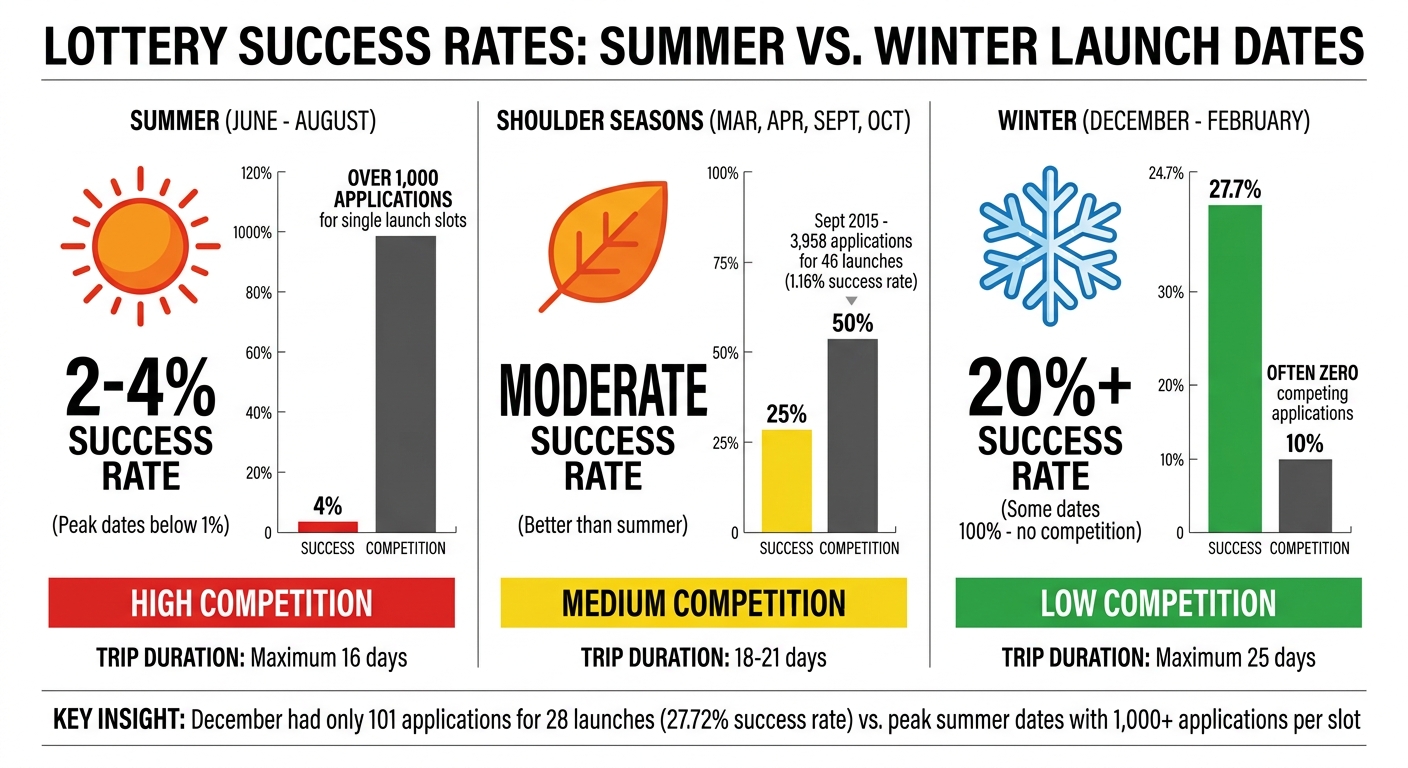
Grand Canyon Rafting Permit Lottery Success Rates by Season
The Points-Based Lottery
The Grand Canyon lottery uses a weighted points system, where each point acts as an additional entry. For example, if you have 5 points, your chances are five times higher than someone with just 1 point.
Your total points depend on how long it has been since your last recreational trip through the Grand Canyon’s Lees Ferry to Diamond Creek section. If it’s been five years or more – or if you’ve never gone – you earn the maximum 5 points. Four years earns you 4 points, three years gets you 3 points, two years equals 2 points, and if you rafted within the last year, you only have 1 point. As RaftingGrandCanyon Wiki puts it, "You only gain points by NOT GOING BOATING".
Adding Potential Alternate Trip Leaders (PATLs) to your application can affect your chances. The lottery uses the lowest point total among everyone listed on the application. For instance, if your application has 5 points but you include a PATL with only 2 points, the entire application is weighted at 2 points.
Commercial trips also reset your points. Whether you organize the trip yourself or join a guided tour, any recreational trip through this section reduces your points to 1 for the following year. Winning the lottery has the same effect – even if you cancel and never actually launch.
But understanding your points is just one part of the process. The dates you choose for your trip can significantly impact your odds.
Tips for Better Lottery Odds
Choosing the right launch dates is critical. Summer dates (June through August) are highly competitive, with success rates ranging from 2% to 4%. Peak dates can drop below 1%. On the other hand, winter launches in December and January often have success rates above 20%, and some dates even see no competing applications, giving you a 100% chance.
To boost your odds, only include PATLs with the maximum 5 points. If someone in your group rafted the canyon within the past two years, consider leaving them off the application. You can always add them to your trip roster later if you win since PATL status only affects the lottery itself.
Use all five allowed launch dates on your application and spread them across different seasons. Avoid clustering all your dates in the same month. Shoulder seasons like March, April, September, and October offer a good balance of weather and better odds than the busy summer months. For example, in 2015, September had 3,958 applications competing for 46 launches (a 1.16% success rate), while December had only 101 applications for 28 launches (a 27.72% success rate).
Another strategy is to form a "permit posse", where everyone in your group applies as a trip leader for different dates. This increases your group’s overall chances. Many successful applicants report applying consistently for three to five years before finally securing a permit.
Finally, opt in for email notifications. These alerts can help you catch less competitive follow-up lotteries for canceled permits throughout the year.
Trip Lengths by Season
Maximum Trip Lengths for Each Season
The National Park Service sets limits on how many days you can spend on the river, and these limits depend on the season of your launch. Summer trips are capped at 16 days, while winter trips allow up to 25 days, which is the maximum. Regardless of the season, all trips must last at least 12 days.
Winter trips require more days due to safety concerns, as shorter daylight hours and colder conditions necessitate extra time. Spring and fall trips typically fall in the range of 18 to 21 days. According to the National Park Service, "the number of days that trips can spend on each segment of the river above Diamond Creek are not dictated by the CRMP; only total trip lengths are restricted and vary by the season within which the launch occurs".
High-Demand Dates and Success Rates
Seasonal demand for permits varies greatly. Summer dates, especially those from June through August, dominate the lottery system. Success rates for summer launches hover between 2% and 4%, with the most sought-after dates dipping below 1%. Some peak summer days attract over 1,000 applications for just one launch slot.
Winter, on the other hand, offers a completely different experience. Launch dates from December through February often see no competing applications, meaning anyone willing to face the cold has a 100% success rate. The difference is striking: while hundreds of applicants vie for a single July launch, a January launch might have no competition at all. This stark contrast encourages successful applicants to consider a variety of launch dates across different seasons.
Permit Fees and Payment Schedule
Initial Fees and Deposits
Submitting a lottery application requires a $25 non-refundable fee, paid once per launch year between February 1 and 25. Missing this payment disqualifies your entry.
If you win, you’ll need to pay a trip deposit within 24 hours of the lottery results, typically announced in late February. Deposits vary by group size: $400 for standard trips (up to 16 people) and $200 for smaller groups (8 or fewer). The River Permits Office emphasizes:
"River trips with trip deposits that remain unpaid after the due date/time have passed are subject to automatic cancellation".
Prepare funds in advance because missing the 24-hour deadline results in losing your launch date. While the deposit goes toward your final permit cost, it’s non-refundable.
Final Payment Details
Once the deposit is secured, the next step is the final payment, which must be completed 90 days before your launch. The fee for participants aged 16 or older is $310 per person, a sharp increase from $90 as of March 1, 2025. Additionally, there’s a $20 National Park entrance fee per person aged 16 and older, though an Interagency Pass can cover the passholder and up to three other adults.
The National Park Service makes it clear:
"A final river permit is not issued until all costs have been paid".
If you decide to add participants after your permit is issued, you’ll face a $100 late fee per person, in addition to the standard $310 permit fee. This can be done up to 14 days before your launch. All payments are handled through your online river user account.
Important Reminder: All fees – application fee, trip deposit, and final payment – are non-refundable.
Once payments are squared away, you can focus on wrapping up your permit application and organizing your trip plans.
After Winning the Lottery
Completing Your Permit Application
Once you’ve paid your deposit, the next step is to submit your permit application online through your river user account. At this stage, you’ll need to provide a draft list of trip participants, but don’t stress too much – this list can be updated until 14 days before your launch date. Just keep in mind that adding participants after the permit has been issued will come with a per-person late fee.
One crucial detail: a confirmed trip leader or a Potential Alternate Trip Leader (PATL) must be part of your expedition. If you, as the trip leader, can’t make it, only a PATL confirmed before the lottery can step in. Permits are strictly non-transferable to anyone outside this arrangement.
You’ll also need to name at least one experienced boat operator who knows how to handle a boat on the Grand Canyon or similar rivers like Cataract Canyon, the Middle Fork Salmon, or Westwater Canyon. This experience is non-negotiable, as rangers will confirm the qualifications of your designated operator during the mandatory orientation at Lees Ferry. Make sure your operator meets all National Park Service (NPS) requirements.
Once you’ve made your final payment – due 90 days before your launch date – your permit will be officially issued. Don’t forget to print your permit and bring along a copy of your final participant list to the launch site. Both documents will be checked by rangers before you’re allowed to start your journey.
With the permit in hand, it’s time to focus on the nitty-gritty of planning your adventure.
Planning Your Trip
With your permit secured, it’s time to dive into the logistics of your expedition. Noncommercial trips are entirely self-guided, so you’ll need to gather all the necessary gear yourself. This includes essentials like rafts, frames, oars, life jackets, and a well-stocked medical kit. If you don’t own this equipment, look into rental options early. Full rental packages typically cost between $1,100 and $1,400 per person.
Food is another key consideration. Plan on spending about $15–$25 per person per day for provisions, which adds up to roughly $225–$625 for a 15- to 25-day trip. Don’t forget to arrange transportation between Lees Ferry and your exit point. If you’re exiting at Diamond Creek, you’ll need additional permits from the Hualapai Game and Fish Department. These permits include a $64.25 per person access fee and a $100 per person camping fee.
The NPS requires that all costs be shared equally among participants. This means you’ll need to split expenses fairly across the group. When everything is tallied up, participants should budget between $2,179 and $3,079 for a complete self-guided trip.
Conclusion
Getting a non-commercial permit for a Grand Canyon river trip requires thoughtful planning and quick action. The weighted lottery system, which replaced the old waitlist that could stretch for nearly 20 years, has improved the process, but competition is still intense. Success rates vary widely – summer launch dates can dip below 1%, while winter dates often see success rates over 27%.
To improve your chances, consider aiming for shoulder or winter months and focus on maximizing group points. Keep in mind that your total points are determined by the group member with the lowest count, and winning a permit resets your points to one. Also, the one-trip rule restricts individuals from participating in more than one recreational river trip per year between Lees Ferry and Diamond Creek. These rules are designed to ensure fairness and set the stage for the next steps in your adventure.
If you win a permit, be ready to act fast. You’ll need to pay the deposit within 24 hours and start organizing key details like hiring a qualified boat operator and arranging equipment rentals. With only about 450 non-commercial permits issued annually by the National Park Service, each one is a rare opportunity.
Budgeting is crucial once your permit is secured. The $310 per-person permit fee (as of March 2025), equipment rentals (ranging from $1,100 to $1,400 per person), food costs, and potential tribal fees for exiting at Diamond Creek should all be factored in. In total, you’re looking at expenses between $2,179 and $3,079 per person. While the costs are significant, they cover an extraordinary 226-mile journey through one of the most breathtaking river corridors in the United States. Careful preparation will ensure this once-in-a-lifetime experience is as smooth and rewarding as possible.
FAQs
When is the best month to apply for the best odds?
February offers the best chance to secure a permit, as this is when the annual lottery opens and the largest number of permits are up for grabs. Submitting your application during this period significantly boosts your odds of landing a spot for a multi-day rafting adventure.
How do PATLs affect my lottery points and chances?
Potential Alternate Trip Leaders (PATLs) must have a river user account to accumulate lottery points. Including PATLs in your application can influence your chances in the lottery, as it increases the number of applications associated with your group. The extent of this impact depends on factors like your current points and application history, as the lottery system takes these details into account when distributing permits.
What happens if I miss the 24-hour deposit deadline?
If you miss the 24-hour deposit deadline, you risk losing your permit. This could mean forfeiting your opportunity to take part in the lottery or launch date you were granted. Make sure to submit your deposit on time to keep your spot secure.