
The short answer: the ESA has helped stop species loss in parks, but recovery is slow, expensive, and often changes how parks work.
From what I see in the research, the law does three big things at once: it helps protect animals and plants, it can limit access to some park areas, and it pushes parks to spend years on monitoring, planning, and agency review. The numbers make that plain: more than 95% of listed species are still alive, about 291 extinctions were prevented, but only 46 to 54 species had recovered enough to come off the list by 2020.
If you want the main points fast, here they are:
- Recovery can work, but it usually takes decades
- Money matters a lot: recovered species got about 60x more funding than species still listed
- Parks often change visitor access through closures, route limits, and wildlife rules
- Wildlife viewing has money value too: wolves bring about $82 million a year to Yellowstone gateway towns
- Visitors usually accept rules when rangers and signs explain them well
- Park land alone is not enough because many species need habitat outside park borders
A few examples show the pattern. Grizzly bears in the Greater Yellowstone area grew from 136 in 1975 to 727 by 2021. Wolves brought back to Yellowstone helped shift elk pressure, which helped aspen and willow in some places. At the same time, those same species led to road rules, habitat review, court fights, and access limits.
For you as a visitor, this often shows up in simple ways: seasonal closures, wildlife-distance rules, short traffic stops, and trail changes. Those limits can be frustrating, but they are part of how parks try to protect species while still staying open to the public.
So my takeaway is simple: the ESA has had a clear effect on parks, but not in a fast or easy way. It protects species, shapes tourism, and changes park decisions on land use, roads, building plans, and visitor movement.
That gives you the core picture before getting into the details.
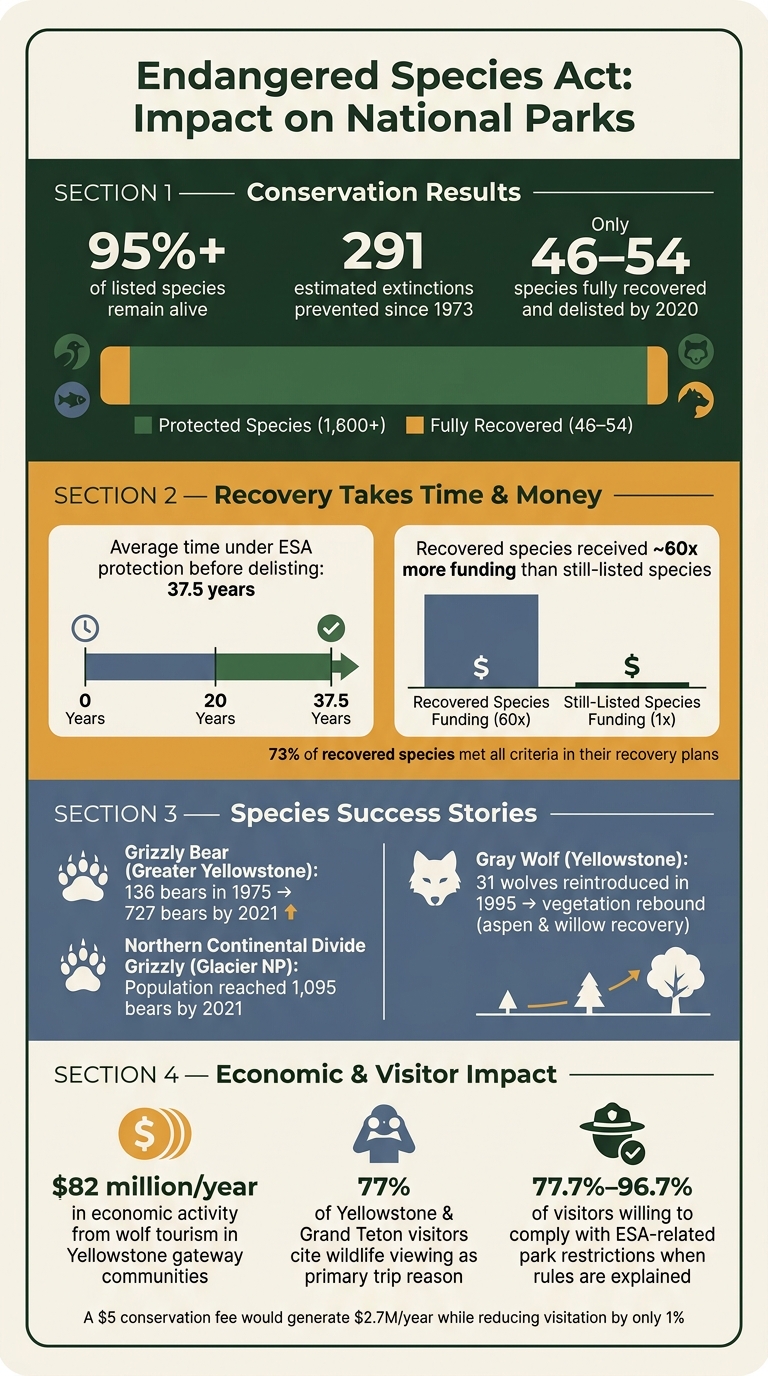
Endangered Species Act Impact on National Parks: Key Stats & Outcomes
National Parks Traveler Podcast | The Future of the Endangered Species Act
sbb-itb-00512f3
What research shows about conservation results in parks
ESA protections have helped some park species, but recovery usually takes a long time and doesn’t happen at the same pace for every species. By January 2020, 46 native species had been delisted after recovery, and they had spent an average of 37.5 years under ESA protection.
The strongest results show up where species had long-term habitat protection and clear recovery plans.
Species recovery and habitat protection
Some of the clearest documented results involve large carnivores. In the Greater Yellowstone Ecosystem, grizzly numbers climbed from 136 in 1975, when the species was listed, to 727 by 2021.
Gray wolves show a similar pattern. After 31 wolves were reintroduced to Yellowstone National Park in 1995, the change didn’t stop with the wolves themselves. It set off an ecological ripple effect. With less elk browsing, aspen and willow recovered in heavily grazed areas.
Those ecological shifts also affect park decisions about visitor access and how staff interpret the landscape for the public.
Why funding and recovery planning matter
ESA listing by itself doesn’t mean a species will recover. Species with dedicated funding and science-based recovery plans tend to do better. Recovered species received about 60 times more recovery funding, and 73% met all criteria in their recovery plans before delisting.
That helps explain why recovery targets need to be specific, based on science, and funded for the long haul.
Park species case studies: comparison table
The cases below show that ESA results vary by species, place, and management approach.
| Species | Park Unit / Region | ESA Status History | Major Management Actions | Documented Ecological Outcomes | Remaining Challenges |
|---|---|---|---|---|---|
| Grizzly Bear | Greater Yellowstone Ecosystem (GYE) | Listed as threatened in 1975; delisting attempts in 2007 and 2017 vacated by courts | IGBC coordination; Primary Conservation Area management; mortality limits | Population grew from ~136 to 727 | Human-bear conflicts; livestock depredation; delisting litigation |
| Gray Wolf | Yellowstone National Park | Reintroduced in 1995; delisted/relisted multiple times due to litigation | Reintroduction of 31 wolves; 4(d) management rules | Vegetation rebound; aspen and willow recovery | Human-wildlife conflict on park borders; disease (mange, distemper) |
| Aleutian Canada Goose | Aleutian Islands | Recovered; delisted in 2001 | Translocation to predator-free islands; predator removal | Population rebounded; breeding colonies returned | Maintaining predator-free status of nesting islands |
| Northern Continental Divide Grizzly | Glacier NP & surrounding areas | Listed as threatened; currently under status review for delisting | Habitat-based criteria; 2018 plan supplement | Population reached 1,095 bears by 2021 | Genetic isolation; road density standards |
These results also shaped later decisions around visitor use, public education, and park operations.
How ESA protections affect visitors, tourism, and education
Those recoveries also shape how people use parks, how nearby towns make money, and how parks teach conservation. When species come back, parks have to manage something new at the same time: how visitors spot them, how close they get, and what they learn from the experience.
Wildlife viewing and local economic value
77% of visitors to Yellowstone and Grand Teton national parks cite wildlife viewing as a primary reason for their trip. That number helps show why ESA protections for species like wolves and grizzly bears affect more than the parks. They also shape local business activity.
Wolves alone account for $82 million in annual economic activity for Yellowstone gateway communities. In those communities, wildlife viewing drives tourism spending, including guided businesses built around safe wolf and grizzly observation. Wolf recovery in the Northern Rockies has also directly led to the creation of hundreds of jobs. Wildlife viewing is a major force behind gateway tourism.
That level of interest means visitor cooperation isn’t a side issue. It’s part of what makes conservation work.
Visitor attitudes and compliance with conservation rules
Visitors also show a strong willingness to follow ESA-related restrictions when the purpose is explained clearly. Across 8 U.S. national parks, studies found that 77.7% to 96.7% of visitors were willing to comply with measures such as seasonal or year-round cave closures, decontamination protocols, and equipment restrictions.
What moves people most? Park staff and official signs. Between 39.2% and 68.8% of visitors said rangers strongly affected their decisions, compared with 35.5% to 61.9% for signage and 25.2% to 46.0% for other visitors. Put simply, face-to-face contact with rangers seems to do the most to improve attitudes and behavior around sensitive species protections.
Visitors also showed willingness to pay more for wildlife conservation. A $5 fee would cut visitation by only 1% while generating $2.7 million annually, and many said they would pay about 50% more if the money funded park wildlife directly.
These findings make one point pretty clear: visitor education and rule-following can matter just as much as the legal protections on the books.
Visitor-facing conservation programs: comparison table
The table below shows how different ESA-related programs shape visitor behavior and park use.
| Program Type | Park Context | Visitor Behavior Studied | Documented Effects | Practical Relevance |
|---|---|---|---|---|
| Guided wildlife viewing | Yellowstone National Park | Ethical observation and distance rules for wolves and grizzlies | Generated $82 million annually; guides educate visitors on natural history and safe viewing | Booking a guided tour can give visitors more context and safer viewing |
| Cave closure policies | 8 U.S. cave parks | Compliance with seasonal and year-round closures to prevent White-nose Syndrome | 77.7%–96.7% willingness to comply; strongly influenced by rangers | Check park websites for seasonal closures during bat hibernation periods |
| Decontamination stations | Cave-heavy parks (e.g., Jewel Cave, Wind Cave) | Use of decontamination mats and non-contaminated clothing | 65.6% of visitors rated decontamination mats very desirable | Visitors generally accept these low-friction interventions |
| Mandatory wildlife traffic stops | Denali National Park | Mandatory 10-minute vehicle stops for Dall sheep road crossings | Met conservation standards 100% of the time in 2022–23, versus 60% previously | Expect brief mandatory stops in high-traffic wildlife corridors |
| Multi-point education | Lava Beds National Monument | Combined permits, fee-booth talks, and trailhead signs | Estimated 98% visitor engagement in WNS prevention | Especially important for parks without a single entry point |
How the ESA changes park operations and management decisions
The ESA doesn’t just shape what visitors can do in a park. It also affects what parks can build, what they may need to close, and what land they restore. In practice, it shapes planning, construction, and day-to-day operations by requiring review of projects that could affect habitat. That review is part of the same conservation system that influences species recovery and visitor management.
Access limits, project changes, and habitat safeguards
When park staff aren’t sure how much harm a project might cause, NPS policy puts natural resource protection first. That means facility replacement or relocation has to lean toward restoration, mitigation, and pollution prevention. Superintendents can also close areas during breeding seasons or when safety is at stake.
That can lead to hard calls. In May 2026, DHS waived the ESA and the NPS Organic Act to authorize 17 miles of vehicle barriers and 205 miles of patrol roads near Big Bend, bypassing Section 7 – the Section 7 process that reviews federal actions for species and habitat impacts. Former superintendents said large-scale barriers and roads are not the right solution for border security.
These clashes make the tension plain: ESA-driven decisions often push parks to weigh access, infrastructure, and habitat protection against each other.
Monitoring, adaptive management, and agency coordination
Approval isn’t the end of the story. Once a project moves ahead, the ESA still shapes how parks track impacts and change course when needed. Compliance continues after planning through monitoring, data collection, and adaptive management. Work across agencies is also a big part of species recovery.
One of the clearest cases is the Interagency Grizzly Bear Committee (IGBC). It coordinates NPS, USFWS, USFS, BLM, and USGS work across grizzly recovery areas. Under the 1993 Recovery Plan, that work led to road density standards, protection of linkage zones between populations, and Demographic Monitoring Areas used to track population trends and habitat quality.
Court fights have changed projects too. A review of 65 legal challenges to projects affecting grizzly habitat found that 11 were stopped and 9 were modified.
Management trade-offs in parks: comparison table
The table below shows how major ESA-driven management actions can help species while also changing park operations and visitor access.
| Management Action | Conservation Benefit | Visitor-Access Effect | Operational Constraint | Observed Outcome |
|---|---|---|---|---|
| Seasonal/Permanent Closures | Protects species during sensitive periods such as breeding | Temporary loss of access to specific trails or zones | Requires active enforcement and public notification | Can prevent displacement of sensitive species from high-quality habitat |
| Facility Relocation | Restores fragmented habitats and natural processes | May move popular facilities farther from primary attractions | High initial capital cost for demolition and rebuilding | Reduces habitat fragmentation and disturbance |
| Road Density Standards | Reduces human-wildlife conflict and habitat fragmentation | Limits motorized access and may increase hiking distances | Requires long-term monitoring of vehicle counts and bear movement | Core tool in grizzly recovery zones since 1993 |
| Habitat Restoration | Reestablishes native plant and animal communities | Temporary closures during active restoration work | Requires removal of non-historic structures and exotic species | Supports population growth and range expansion |
| Long-term Monitoring | Provides data for adaptive management and delisting decisions | Minimal direct impact; may involve temporary research-related closures | Requires sustained funding and multi-agency data sharing | Essential for determining whether objective, measurable recovery criteria are met |
Conclusion: What the evidence says about the ESA’s overall impact on parks
Across recovery, visitor use, and park operations, the ESA has a clear impact on parks, but it doesn’t play out the same way everywhere. The law lowers extinction risk, yet recovery tends to move slowly and unevenly. Since 1973, the ESA has helped prevent an estimated 291 species extinctions and kept more than 95% of listed species extant, but only about 46 to 54 species have recovered enough to be delisted.
Recovery also hinges on time, funding, and coordination. Species that recovered received about 60 times more of their proposed recovery budgets than species that are still listed. That gap says a lot. Protection on paper matters, but species usually need years of steady work, money, and follow-through before numbers start to turn around.
At the same time, park protection by itself doesn’t solve the whole problem. Climate change and invasive species make recovery harder, and many species need help beyond park lines. In 55% of U.S. ecoregions, protected areas are no better for endangered species than randomly chosen sites. And more than half of endangered land vertebrates need conservation work on private lands to meet even a basic 30% range-protection threshold.
Key takeaways for readers planning park visits
For visitors, this usually shows up as access limits and seasonal closures. Those rules often line up with breeding seasons, habitat repair, or population monitoring. Yellowstone’s wolf recovery is a good example of what long-term management can do. But it didn’t happen overnight. It took decades of steady management, and some of the limits visitors deal with are part of that process.
Before your trip, check park-specific alerts at The National Park Guide. Closures and trail limits can shift based on breeding, restoration, and monitoring needs. Staying on marked paths and following posted rules, especially near nesting sites or sensitive habitat, is one of the most direct ways visitors can support the conservation work that keeps these parks worth visiting.
FAQs
Why does ESA recovery take so long in parks?
Recovery under the Endangered Species Act takes time. Restoring biodiversity is a long game, and there’s no fast fix for it. Threats like habitat loss, climate change, invasive species, and pollution are layered and hard to undo in a short span of time.
Progress also depends on funding, how many threats a species is dealing with when it’s listed, and how long it stays under protection. In many cases, agencies have spent more time trying to stop immediate extinction than pushing species toward recovery from the start.
How does the ESA affect my park visit?
The Endangered Species Act (ESA) can shape your park visit in a few direct ways.
For one, it can change the wildlife you see. Some parks are home to reintroduced species, like wolves in Yellowstone. Their return can shift animal behavior and even help vegetation recover.
The ESA can also affect where you can go. Parks may put temporary closures or use limits in place in sensitive areas to protect critical habitat and species at risk.
Why isn’t park land enough to recover species?
Park land alone often isn’t enough. Many endangered species need habitat that stretches well beyond park boundaries, and protected areas don’t always include the full ranges those species rely on.
That’s where things get tricky. Threats like climate change, invasive species, and habitat fragmentation don’t stop at the edge of a map. They cut across public and private lands, which means management has to do the same.