
Climate change is splitting park habitats apart – and many species may not be able to move fast enough to keep up.
If I boil the article down to its core, here’s the plain answer: parks are warming, drying, burning, and flooding in ways that turn connected habitat into isolated patches. And when land outside parks is built up or used for roads, drilling, or grazing, movement routes get cut off even more.
Here’s what stood out to me right away:
- 99% of U.S. natural resource parks are now above their past average annual temperature.
- Species may need to move 200 to 300 miles to stay in a climate they can still live in.
- Housing density around U.S. national parks grew by more than 740% from 1940 to 2014.
- Human-caused climate change has doubled the area burned by wildfire in the western United States.
- About 30% of protected-area-centered landscapes may lose their current ecosystems by 2030.
In simple terms, the main issue is no longer just habitat loss. It’s connectivity: whether plants and animals can still travel between places as heat, drought, fire, pests, and sea-level rise change the land.
If I had to sum up the full article in one line, it would be this: national parks cannot function as islands anymore, because what happens outside their borders now shapes what survives inside them.
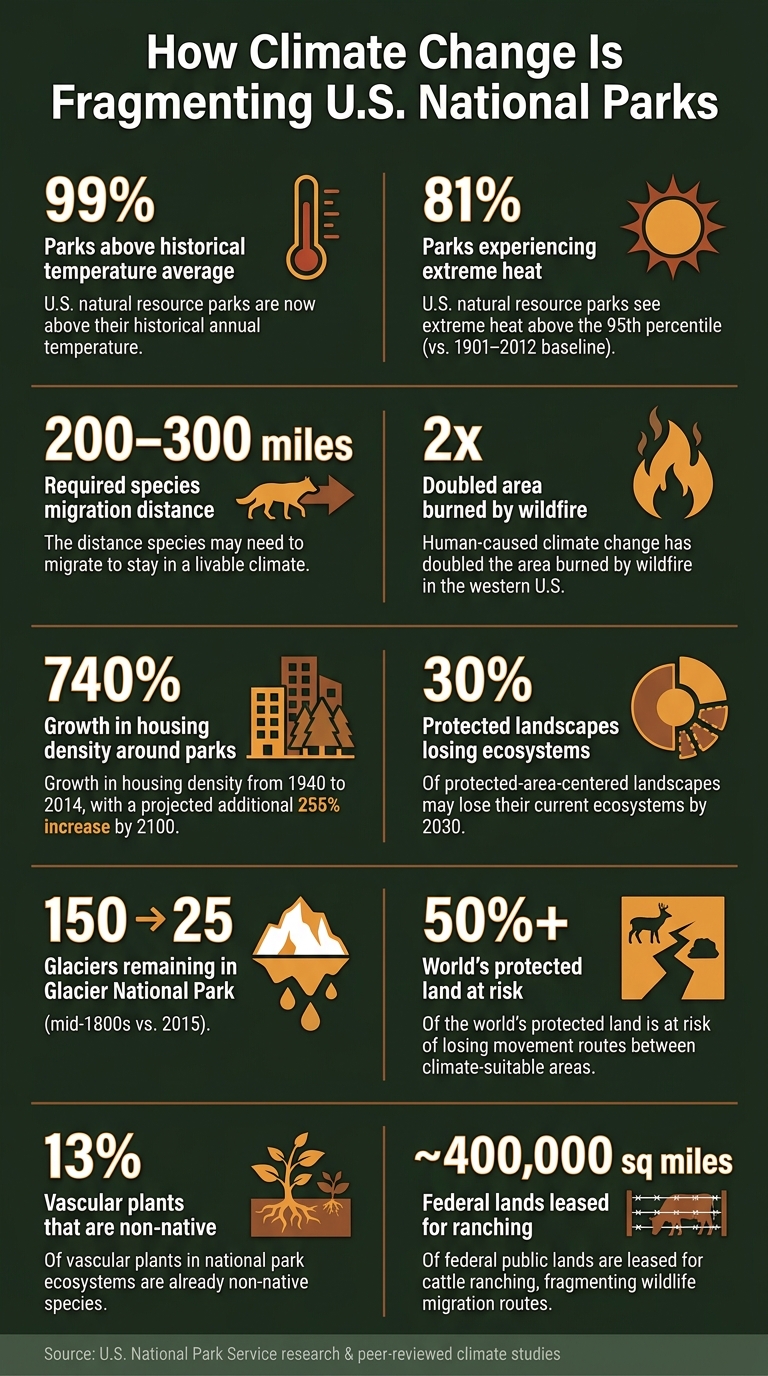
How Climate Change Is Fragmenting U.S. National Parks: Key Stats
Climate Refugia: A Buffer from Climate Change
sbb-itb-00512f3
Climate Drivers That Break Up Park Habitats
Climate fragmentation usually doesn’t come from one thing. It happens when several pressures hit at once: heat, drought, wildfire, pests, and sea-level rise. Each one chips away at the links plants and animals rely on.
Heat, Drought, and Shifting Water Patterns
Rising temperatures are the most common pressure across the park system. Right now, 99% of U.S. natural resource parks are recording annual mean temperatures above the historical median, and 81% are seeing extreme heat above the 95th percentile compared with their 1901–2012 baseline.
That heat, paired with drought, cuts streamflow, dries out wetlands, and breaks apart riparian corridors that animals use to move through the landscape. You can think of those corridors as nature’s travel lanes. When water drops, those lanes shrink or disappear.
In the Grand Canyon region, projections show 40 to 50 more days per year above 90°F within roughly 20 years. That would further reduce flow in the Colorado River and tighten those movement routes even more.
Wildfire, Pests, and Vegetation Shifts
Human-caused climate change has doubled the area burned by wildfires in the western United States. For habitats, that matters a lot. High-intensity fires can split continuous forest canopies into smaller patches, which increases edge effects and leaves wildlife with less connected cover.
Insect outbreaks work in a similar way. With fewer frost days, pests can survive longer and spread farther. Parks such as Sequoia and Kings Canyon are already seeing giant sequoias threatened by a mix of extreme heat, fire, and insect pressure that breaks up what used to be continuous forest stands.
Sea-Level Rise in Coastal Parks
Coastal parks face a different problem: coastal squeeze. Rising seas and stronger storm surges push salt marshes and beaches up against park boundaries or nearby development, with little or no room to move inland.
At Point Reyes National Seashore, managers are weighing inland migration for shorelines and intertidal wetlands. That shift leaves a more patchwork landscape, with fewer routes for species to move through.
Taken together, these pressures turn continuous habitat into smaller, more isolated patches.
How Parks Lose Connectivity Inside and Beyond Their Boundaries
Climate stress doesn’t just wear down habitat. It also cuts off the paths animals and plants use to move across the landscape.
Species Range Shifts and Blocked Movement
Park climates are shifting 200 to 300 miles south this century, but broken-up terrain can stop species from moving with those changes.
That problem is large in scope. More than half of the world’s protected land is at risk of losing movement routes between places with suitable climate conditions. So even if a species tries to move from one protected area to another, the land in between may be too damaged or too climatically unsuitable to cross.
Smaller Habitat Patches and Stronger Edge Effects
Heat, fire, and insect outbreaks can split habitat into smaller patches and create more edge. And edge habitat is a rough place to survive. It’s more exposed to invasive species, predators, and human disturbance than the interior of a healthy forest or meadow.
Research that tracked the broader ecosystems around U.S. national parks found that about 13% of vascular plants in those areas are already non-native species. As edge zones spread, native species face more contact with non-native competitors and other pressures.
How Roads and Development Outside Parks Narrow Movement Routes
A park can lose usable habitat even when its acreage stays the same. The reason is simple: housing, drilling, and grazing outside the boundary can block the routes wildlife needs.
Housing density in the ecosystems around national parks grew by more than 740% between 1940 and 2014, and projections show another 255% increase by 2100. Near Theodore Roosevelt National Park, well pads from oil and gas operations break up the surrounding landscape . On top of that, about 400,000 square miles of federal public lands are leased for cattle ranching, which can foul water sources and cut wildlife survival during migration.
In plain terms, what happens outside the park line shapes whether the park still works as connected habitat.
When nearby lands shift from corridors to barriers, wildlife loses the links it needs to move. Those broken links also increase risk for species and make park management harder.
Long-Term Effects on Wildlife, Ecosystem Function, and Park Management
Greater Risks for Wildlife and Plant Communities
When movement routes break apart, the fallout doesn’t stop at where animals can and can’t go. It shows up in genetics, in how ecosystems work, and in how parks have to be managed.
One big problem is gene flow. When populations can’t mix, they get smaller, more isolated, and less able to deal with change. In plain terms: fewer animals moving between groups means less genetic diversity. And that leaves populations with less room to handle new pressures.
About 30% of protected-area-centered landscapes may lose their current ecosystems by 2030 as climates shift. That matters because biomes are moving faster than many species can keep up with. As that gap grows, local extinction risk goes up, especially for plants and animals already living near the edge of the conditions they can tolerate.
Isolated parks also lose part of their role in the larger landscape. They may stop supplying nearby areas with dispersing plants and animals. Fragmentation can isolate populations and limit new individuals from outside populations.
Changes to Fire, Water, Carbon, and Visitor Experience
The effects reach far beyond single species. Fragmented forests store less carbon and are more vulnerable to disturbance. And this isn’t a small shift at the margins. About 50% of the 22 largest protected area complexes in North America are projected to have substantially different dominant vegetation by the late 21st century. When dominant vegetation changes, fuel types change too. That can reshape fire behavior across whole landscapes.
Water adds another layer of strain. Glacier National Park had 150 glaciers in the mid-1800s; by 2015, only 25 remained. As glaciers disappear and snowpack shrinks, streams and other water-dependent habitats become less reliable. That affects fish, wetlands, riparian areas, and the broader park experience people come to see.
Management Responses and Research Summary Table
The research points in the same direction: this has to be handled at the landscape scale, not one park at a time.
Current studies support a few clear responses:
- Protect climate refugia
- Restore movement corridors between fragmented public lands
- Coordinate across agency boundaries, including the National Park Service, the Forest Service, and the Bureau of Land Management
The Yellowstone to Yukon (Y2Y) initiative shows what that can look like on the ground. It works to keep wild lands connected across the U.S.-Canadian border.
There’s also a basic planning problem. Park missions are built for the long run, but federal budgets run on annual cycles. That mismatch makes long-term adaptation planning harder.
The table below pulls together the main climate drivers, how they fragment landscapes, the ecological effects, and the matching responses.
| Driver | Fragmentation Mechanism | Ecological Effects | Management Response |
|---|---|---|---|
| Heat & Drought | Forces species uphill or north | Vegetation mortality; loss of alpine communities | Protect climate refugia; forest thinning for drought resistance |
| Wildfire | Alters disturbance regimes and successional paths | Conversion of forests to shrub/grasslands | Prescribed fire; managing for fire-resilient species |
| Pests | Insect outbreaks interact with heat stress | Rapid loss of dominant canopy species | Monitoring; move resilient populations into suitable habitat |
| Sea-Level Rise | Floods coastal habitats | Loss of terrestrial connectivity in coastal zones | Protect inland migration corridors; land acquisition |
| Human Land Use | Development, mining, and logging on park borders | Blocks movement between suitable habitats | Cross-boundary planning; landscape-scale connectivity |
Conclusion: What the Research Means for the Future of National Parks
The research points to a clear shift: climate change is breaking up park ecosystems. So the main problem isn’t just habitat loss anymore. It’s connectivity – whether plants and animals can still move as conditions change.
Key Takeaways From the Studies
Across heat, drought, fire, pests, and sea-level rise, the trend looks the same: habitats are getting smaller and more cut off from one another.
Parks are warming fast, and the hardest-hit places are changing the most. High-elevation and high-latitude parks are seeing the sharpest shifts, with habitat loss speeding up where warming is strongest.
Connectivity determines whether species can track climate shifts. More than 50% of protected land area around the world is at risk of connectivity failure. In plain English, species may not be able to move between protected areas as habitats become unsuitable.
Management must work across park boundaries. The research keeps pointing to the same responses: protect corridors, coordinate across agencies, and plan for climate refugia.
That means the core job now is planning for the conditions parks are likely to face next, not the ones they had before. National parks will remain resilient only if conservation planning follows climate, not boundaries.
FAQs
Why can’t species adapt in place?
Species often can’t stay where they are because climate change is changing temperature, moisture, and habitat conditions faster than many can adjust. For species with narrow needs or small ranges, that can lead to range loss, fragmentation, and disrupted ecological processes.
Some species can move. But fragmented landscapes and human development often get in the way. Smaller, isolated populations then face a higher risk of extinction and have a harder time adjusting.
Which parks are most at risk from fragmentation?
Parks under the most pressure are the ones getting hit from both sides: climate change and land-use change.
Take Great Sand Dunes. It faces high climate exposure. Point Reyes is another example, but its main pressure comes from land-use change.
Many parks in Alaska and mountain regions are also highly vulnerable due to rising temperatures.
What can park managers do to keep habitats connected?
Park managers can help keep habitats connected by building ecological corridors between protected areas and cutting barriers like highways with wildlife overpasses and underpasses. That gives species more room to move as climate conditions shift.
They can also plan at the landscape level and work with federal agencies, tribes, and conservation groups to keep linkages in place, support gene flow, and improve long-term resilience.