
Climate change is reshaping landscapes tied to history and human activity, making preservation more challenging. National parks across the U.S. are witnessing changes to historic structures, vegetation, and sacred spaces due to rising temperatures, extreme weather, and shifting ecosystems. These shifts threaten the stories and memories embedded in these sites.
Key points:
- Historic Structures: Storms, flooding, and erosion are damaging monuments and buildings.
- Vegetation Changes: Warmer climates and pests are altering plant life, impacting native species and historic agricultural areas.
- Wildfires: Fires destroy trees and landmarks, permanently changing landscapes.
- Preservation Efforts: Park managers use monitoring tools, erosion control, and sometimes relocate structures to protect these spaces.
When visiting, stay on trails, avoid disturbing plants or artifacts, and follow park rules to help preserve these landscapes for future generations.
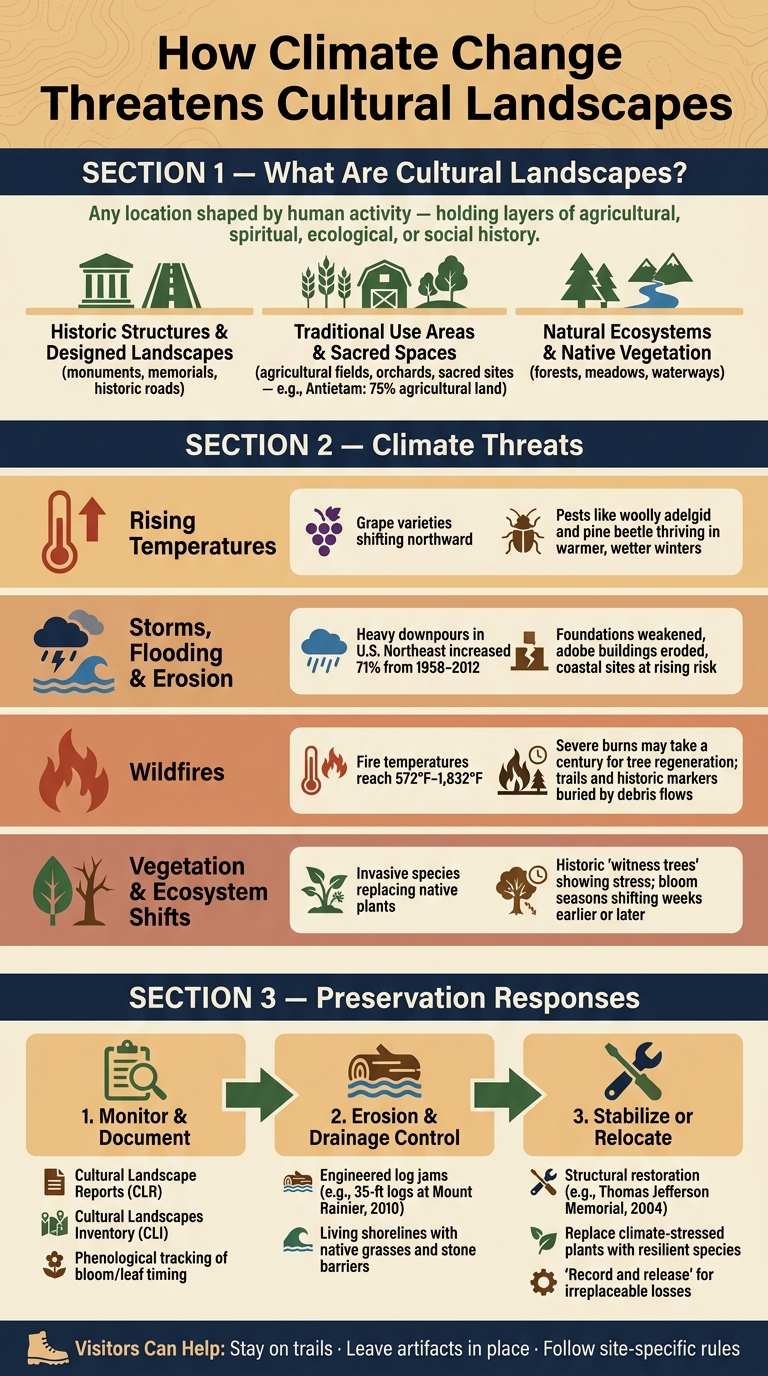
How Climate Change Threatens Cultural Landscapes: Key Impacts & Preservation Strategies
Diane Menzies – Cultural Landscapes and Climate Change: Protecting Indigenous Places
sbb-itb-00512f3
What Are Cultural Landscapes?
A cultural landscape is any location shaped by human activity. Robert Melnick, a Professor of Landscape Architecture at the University of Oregon, explains:
"A cultural landscape is really, any landscape that’s been modified by people."
These landscapes hold layers of history – whether agricultural, spiritual, ecological, or social. However, they are irreplaceable. Once a cultural landscape loses its historical integrity, that connection to the past is permanently gone. This idea sets the stage for understanding the different elements that make up these spaces.
Historic Structures and Designed Landscapes
This category includes monuments, memorials, historic roads, and intentionally planned outdoor spaces. Picture geometric hedges, carefully designed "outdoor rooms", or a historic light station. A prime example is the Castillo de San Marcos in St. Augustine, Florida – the oldest fort in the continental United States. It stands as a piece of built heritage within a broader coastal cultural landscape. These physical structures create the visual framework of a place and anchor its stories.
But cultural landscapes are more than just physical features – they also reflect lived traditions.
Traditional Use Areas and Sacred Spaces
Some landscapes gain their significance through how they are used rather than through their structures. This includes agricultural fields, orchards, ranches, and sacred sites. For instance, at Antietam National Battlefield, agricultural fields make up 75% of the park’s landscape. To maintain its historical authenticity, the National Park Service collaborates with local farmers to cultivate the land in ways that reflect its Civil War-era usage. This allows visitors to experience the battlefield’s spatial layout as it was during that time – not just as a site with monuments. These ongoing practices help preserve the cultural memory tied to the place.
Natural Ecosystems and Native Vegetation
Plants, forests, meadows, and waterways are not just scenic elements – they are integral to a cultural landscape’s identity. At Saint-Gaudens National Historic Site in New Hampshire, an allee of birch trees serves as a "contributing feature", creating visual enclosures that define the site’s historic character. Preservationists warn that losing these trees would significantly diminish the site’s historical value. Similarly, native vegetation – like lodgepole pine forests, willow thickets, or camas meadows – plays a vital role across various sites. These natural elements ground us in the place’s unique story and significance.
Understanding these diverse components highlights how climate change threatens not only our environment but also the historical and cultural connections embedded in these landscapes.
How Climate Change Affects Cultural Landscapes
Cultural landscapes are always changing, but climate change pushes these shifts beyond what can be controlled. Robert Melnick explains:
"For a landscape, you want it to change. You just want to manage that change and have it change within certain boundaries and within certain limits."
When those boundaries are broken, the effects can become irreversible.
Rising Temperatures and Shifting Weather Patterns
Higher temperatures are transforming vegetation and farming practices. For example, on the West Coast, grape varieties are moving north as their traditional growing areas become unsuitable. This shift threatens the agricultural identity of regions shaped by generations of cultivation. It’s a reminder that when climate disrupts historic land uses, the cultural memories tied to them may vanish forever.
Changing weather patterns also bring new challenges. Warmer, wetter winters combined with drier summers create ideal conditions for pests like the woolly adelgid and pine beetle, which endanger historic tree populations. Seasonal shifts further disrupt culturally significant species, throwing off the delicate timing of their historical cycles.
On top of these changes, extreme weather events are causing physical harm to cultural sites.
Storms, Flooding, and Erosion
Intense storms and flooding are increasingly threatening cultural landmarks. From 1958 to 2012, heavy downpours in the U.S. Northeast surged by 71%. This leads to soil erosion, weakens building foundations, and speeds up the decay of historic structures. In the American Southwest, even brief rainstorms can severely damage adobe buildings.
The National Park Service highlights the growing risks:
"Historic buildings once safe from river floods and ocean levels will be in jeopardy, and park infrastructure will be at higher risk."
Coastal areas and sites like Mount Rainier face heightened threats from erosion and flooding. To counteract these risks, measures such as log jams are being used to redirect floodwaters.
Wildfires and Vegetation Changes
Wildfires are another major climate-driven hazard for cultural landscapes. These fires can reach temperatures between 572°F and 1,832°F, with severe burns scorching the soil so deeply that it could take a century for trees to regenerate. If native trees fail to return, shrubs like mountain white thorn may take over, permanently altering forested areas into scrubland.
Fires also destroy the features that define cultural landscapes. Trails, field boundaries, and historic markers can be buried or displaced by erosion and debris flows following a fire. The National Park Service warns:
"As soil erodes, cultural resources can be buried, displaced, or toppled if in the path of a debris flow."
Additionally, firefighting efforts, such as constructing firelines, can physically disturb artifacts and disrupt the boundaries of these landscapes.
Spotting Climate Impacts When You Visit
Knowing what to look for can transform an ordinary park visit into a deeper exploration. Climate change leaves visible traces on cultural landscapes, and being observant can reveal these subtle yet impactful changes.
Changes in Plant Life and Ecosystem Patterns
One of the clearest signs of climate change is a shift in the local vegetation. In many areas, invasive plants are taking over spaces once dominated by native species, altering the historic character of the landscape. For example, at Antietam National Battlefield, where agricultural fields and crops make up 75% of the cultural landscape, visitors might see crops that look drought-stressed or overly saturated due to unpredictable weather patterns.
Pay attention to historic "witness trees" – trees that were present during significant historical events. Signs like thinning canopies, fungal growth, or sparse leaves often indicate stress caused by rising temperatures, higher humidity, or increased pest activity. If you visit during a traditional bloom season, check whether flowering occurs as expected. Trees blooming weeks earlier or later than historical records suggest shifts in seasonal cycles.
The National Park Service has acknowledged how these environmental changes are altering the landscapes we cherish:
"The iconic views visitors enjoy from our national parks may look upon very different landscapes."
These changes don’t just affect natural elements – they leave marks on historic features as well.
Damage to Historic Features
Beyond vegetation, climate pressures are evident in the built environment. Look closely at stone surfaces on memorials or historic structures. A dark crust on marble or limestone often points to acid rain eroding the stone’s calcite. Wooden structures might show signs of warping, splintering, or soft spots caused by rot, which is worsened by rising humidity. In the American Southwest, intense rainstorms can erode adobe buildings, leaving rounded edges or even collapsing walls.
In flood-prone areas, you might notice water lines or stains on monuments, marking previous flood levels. Warmer temperatures also increase termite activity, which can severely damage historic wooden structures – materials that are often difficult to replace.
Loss of Landscape Shape and Boundaries
Climate change doesn’t just affect individual features; it transforms entire landscapes. Shoreline and riverbank erosion can physically remove parts of historic paths or roads. In some cases, structures have been relocated to prevent damage, as with the Cape Hatteras Light Station in 1999. While efforts are made to preserve the historic alignment, moving these structures inevitably alters the original spatial arrangement.
You may also notice changes in how vegetation defines a site. Field edges overtaken by invasive species, hedgerows thinned by pest damage, or tree screens that have receded are all signs of shifting ecosystems. These changes go beyond appearances – they represent a loss of the cultural integrity that gives these places their historical significance.
How Cultural Landscapes Are Being Preserved
Preservation teams across the country are taking active steps to protect cultural landscapes. Park managers, engineers, and researchers work together to monitor, plan, and implement strategies that safeguard these important sites.
Monitoring and Documentation
Understanding what exists and how it’s changing is the first step in preservation. The National Park Service (NPS) uses tools like the Cultural Landscape Report (CLR) and the Cultural Landscapes Inventory (CLI) to document current conditions, track changes over time, and guide treatment recommendations.
One method gaining attention is phenological tracking, which records biological events such as the timing of "first leaf" or "first bloom" in plants. For example, at Saint-Gaudens National Historical Park, researchers monitor historic apple trees to see how blooming times have shifted since the late 19th century. This information not only informs how invasive species are managed but also helps determine the best timing for visitor events.
"The NPS compiles a considerable amount of information about the landscape and how it has changed over time in the form of photos, aerials, historic maps, correspondence, contemporary descriptions, numerical data, and maps." – National Park Service
Pest activity is another critical focus. Teams monitor threats like the hemlock woolly adelgid to determine when treatments – whether chemical or biological – are needed to prevent irreversible damage.
While monitoring is essential, physical measures are equally important in preserving these landscapes.
Erosion and Drainage Management
After documenting changes, preservation teams address erosion and drainage issues using nature-based solutions rather than traditional hard infrastructure. At Mount Rainier National Park, for instance, five engineered log jams were installed in 2010 at the Carbon River Entrance. These log jams, made from 35-foot logs with deep vertical piles, help absorb flood energy while maintaining the area’s natural and historic appeal.
"By imitating the function of naturally-occurring logjams, these constructed features protect historic roads from damage without detracting from the scenic quality and historic character of the landscape." – National Park Service
Coastal areas also benefit from innovative approaches like living shorelines. These combine native grasses with stone barriers to stabilize soil and reduce wave impact, helping protect sites from rising tides.
Stabilization and Relocation of At-Risk Features
As climate-related challenges increase, stabilizing or relocating key features becomes vital to preserving their historical significance. A notable example is the Thomas Jefferson Memorial, which underwent restoration in 2004. Structural supports were added to its columns, and a damaging "black crust" caused by acid rain was carefully removed from the marble.
For living elements, managers sometimes replace plants vulnerable to climate stress with hardier species that match the original’s appearance. At the Eleanor Roosevelt National Historic Site (Val-Kill), red pines lost to rising temperatures and red pine scale are being replaced with more resilient pines to maintain the site’s historic character.
In extreme cases, entire structures are moved to protect them. When relocation isn’t feasible, the NPS employs a "record and release" strategy – documenting the resource thoroughly before allowing natural processes to take over.
"Some resources will not be able to be saved. The only practical recourse will be to record them and let them go, preserving their stories and lessons through cultural practices." – National Park Service
What Visitors Can Do to Help
While preservation teams work on advanced techniques to protect landscapes, the actions of visitors play a crucial role in safeguarding these areas. How visitors behave can directly impact the survival of cultural landscapes facing climate challenges.
"Resources that are maintained in good condition are better positioned to adapt to a changing climate." – National Park Service
Stay on Designated Paths and Areas
Wandering off marked trails can significantly worsen erosion in areas already strained by climate conditions. Heavy rainfall, for instance, loosens soil and weakens historic structures. Every step off-trail in such regions accelerates this damage, especially in places recovering from wildfires or drought, where the soil is fragile and vegetation is sparse. Simply staying on designated paths is an easy yet powerful way to help protect these vulnerable landscapes.
Leave Plants, Stones, and Artifacts in Place
Cultural landscapes are protected by law, meaning artifacts and structures must remain untouched to preserve their historical significance. After events like wildfires, previously hidden artifacts might become exposed, making them more susceptible to damage or theft. If you discover something that seems historically important, report it to a site manager rather than handling it yourself.
Additionally, avoid pouring water on sun-heated historic stones, as this can cause thermal shock. Refrain from disturbing plants or stones, as even small actions can undermine the site’s historical integrity.
Follow Site-Specific Rules and Guidelines
Each cultural landscape has unique rules designed for its protection. For instance, at Hawai’i Volcanoes National Park, mowing schedules are carefully planned around the breeding season of the endangered nēnē (Hawaiian Goose) to avoid disrupting nesting. At Big Hole National Battlefield and Redwood National Park, prescribed burn zones are marked clearly, as controlled fires are essential for maintaining historic forest boundaries and managing invasive species.
"Communicating these efforts with visitors, neighbors, and partners brings relevance and immediacy to the impact of climate change on cultural resources, and it demonstrates best practices and solutions for action." – National Park Service
Conclusion: Recognizing and Protecting Cultural Landscapes
Cultural landscapes are constantly evolving – they adapt to shifts in climate, human activity, and time itself. As Robert Melnick, Professor of Landscape Architecture at the University of Oregon, pointed out, the aim is to manage these changes within set boundaries. However, climate change is testing those limits more aggressively than ever before.
Rising temperatures, stronger storms, and altered plant zones are reshaping landscapes that are deeply tied to American heritage. These changes don’t just affect the physical environment – they impact the stories and history rooted in these places. This growing challenge demands a collective, informed response from all involved.
By recognizing these transformations, visitors, park managers, and local communities can take steps to preserve these landscapes. The National Park Service emphasizes this necessity:
"Understanding the impacts and implications of climate change for places and people is central to landscape preservation."
FAQs
What makes a landscape “cultural” instead of just natural?
A landscape is considered cultural when it showcases the influence of human activity, history, or community importance. Unlike untouched natural areas, these landscapes include elements like historic buildings, landmarks, artifacts, and spaces that reveal how people have shaped and engaged with their surroundings throughout history.
Which U.S. parks and heritage sites are most at risk right now?
The Everglades in Florida is a prime example of a natural treasure under threat, with rising sea levels posing a serious challenge to its unique ecosystem. Similarly, numerous historic landmarks across the country are grappling with the effects of climate change. These growing vulnerabilities emphasize the need to not only appreciate these sites but also to take steps to protect them during visits.
How can I tell if climate change is affecting a site during my visit?
Changes in the environment can often be spotted through visible clues like altered vegetation, increased erosion, or noticeable shifts in water features, such as flooding or melting ice. You might also observe signs of instability in the landscape, like early snowmelt or river channels that appear less stable. For additional context, check interpretive signs, attend ranger talks, or visit the local visitor center for updates. Noticing these changes can provide a deeper understanding of how climate change is influencing the landscapes around us.