
Camping here is simple to choose once you match your trip to the right setup. If I want the easiest stay, I’d pick Piñon Flats. If I have a high-clearance 4WD, I’d look at Medano Pass. If I want space and can handle sand, wind, and no services, I’d go with backcountry camping.
This park is beautiful, but it can be harsh. The dunes sit above 8,200 feet, sand can hit 150°F, and nights can drop below freezing. Costs range from free on Medano Pass Primitive Road to about $20 per night at Piñon Flats, with backcountry permits at $6.
Before I go, I’d keep these points in mind:
- Piñon Flats is the only developed campground inside the park
- Backcountry dune camping means a 1.5+ mile hike over sand
- Sand Ramp Trail gives more cover and designated sites
- Medano Pass is free, but AWD is not enough
- Private campgrounds near the entrance have hookups, showers, and stores
- Summer storms, strong wind, and hot sand can turn a simple trip into a hard one
- Booking early matters, especially for summer weekends
Quick Comparison
| Option | Access | Cost | Best fit |
|---|---|---|---|
| Piñon Flats | Paved road | $20/night | First-time campers, families, RVs |
| Dunes Backcountry | Hike-in over sand | $6 permit | Backpackers who want solitude |
| Sand Ramp Trail | Hike-in | $6 permit | Campers who want more cover |
| Medano Pass Primitive Road | High-clearance 4WD only | Free | Remote vehicle camping |
| Great Sand Dunes Oasis | Park entrance | $20–$45+ / night | Hookups and showers |
| Zapata Falls | Rough dirt road | $11/night | Cooler nights, nearby waterfall |
If I had to sum it up in one line: pick your campsite based on access, weather, and how much comfort you want – not just price.
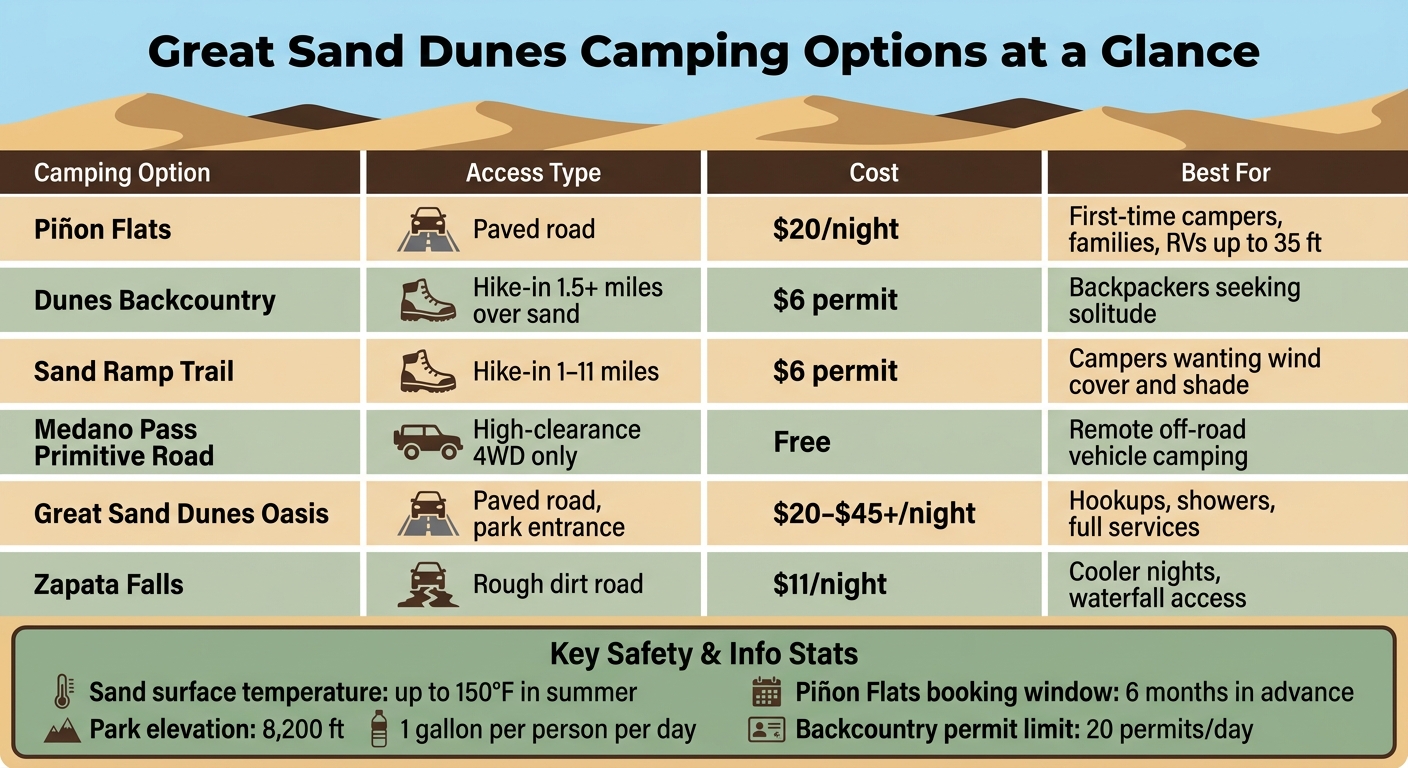
Great Sand Dunes Camping Options Compared: Cost, Access & Best Fit
A weekend backcountry camping at the Great Sand Dunes National Park in Colorado
sbb-itb-00512f3
Camping Options at Great Sand Dunes
Great Sand Dunes gives you a few very different ways to camp. You can stay in the park’s main developed campground, hike into the backcountry, camp along a 4WD route, or book a spot at a nearby private campground. In a place like this, access and elevation matter a lot, so it helps to pick your site based on how you’re getting there, what permit you need, and how much comfort you want.
| Campground | Access | Fee (USD) | Best For |
|---|---|---|---|
| Piñon Flats | Paved; tents & RVs up to 35 ft | $20/night for individual sites; $65–$80/night for group sites | Families and RVs |
| Dunes Backcountry | Hike-in (1.5+ miles over sand) | $6 permit fee | Solitude and backpacking |
| Sand Ramp Trail | Hike-in (1–11 miles) | $6 permit fee | Wind protection and forested sites |
| Medano Pass Primitive Road | High-clearance 4WD only | Free | Remote camping for off-road vehicles |
| Great Sand Dunes Oasis | Paved; at the park entrance | $20–$45+ per night | Hookups and more services |
| Zapata Falls | Rough dirt road | $11 per night | Cooler nights and waterfall access |
Piñon Flats Campground
Piñon Flats is the only developed campground inside the park. It has 88 individual sites and 3 group sites, all reached by paved road. There are no electric or water hookups, but you do get flush toilets, potable water, fire grates, and sinks. The campground is open from April 1 through October 31, and it sits within about 1 mile of the dunefield.
If you want the simplest in-park setup, this is it. It works well for families, tent campers, and RVs up to 35 feet.
Backcountry and 4WD Camping in the Park and Preserve
If you want more space and fewer neighbors, the park has a few remote options.
Dunes Backcountry camping starts with a hike of at least 1.5 miles over sand beyond the first high ridge. There are no marked sites and no facilities, so this choice is pretty bare-bones. The park caps it at 20 permits per day for groups of up to six people.
The Sand Ramp Trail is a different kind of backcountry stay. It has seven designated sites along the foothills at the base of the Sangre de Cristo Mountains, including Indian Grove and Little Medano. These sites tend to have more shade and better wind cover than the open dunes, which can make a big difference after a long day outside. Some sites also have privies and fire grates. Both Dunes Backcountry and Sand Ramp Trail permits come with a $6 non-refundable processing fee through Recreation.gov.
Medano Pass Primitive Road is for people with the right vehicle and a taste for rough travel. This 22-mile route has 21 numbered campsites and is free on a first-come, first-served basis. You’ll need a high-clearance 4WD vehicle. The road includes up to nine creek crossings plus sections of deep, soft sand, and AWD vehicles are not allowed.
Campgrounds Near the Park
If you want more services close to the dunes, a few nearby campgrounds make that easier.
Great Sand Dunes Oasis is right at the park entrance. It offers full RV hookups, showers, laundry, a restaurant, and a store. Tent and RV sites usually run about $20 to $45 per night, and cabins are available at higher rates.
Zapata Falls Campground, managed by the BLM about 10 miles south of the park, costs $11 per night. It sits at about 9,000 feet, so summer nights are often cooler than down near the dunes. It’s also within walking distance of Zapata Falls.
For glamping, Ramble at Great Sand Dunes is about 30 minutes from the park. It offers a glamping-style stay across 25 campsites on 640 acres. Rates range from $30 to over $100 per night depending on the site type.
Next, check reservation and permit rules before choosing a site.
Reservations, Permits, and Campground Rules
A little prep here goes a long way. Some camping areas need a reservation months ahead, some need a backcountry permit, and some are still first-come, first-served. The easiest way to avoid a headache is to check how your site is booked first, then look at the rules for fires, pets, food storage, and parking once you’re on-site.
| Camping Area | How to Book | Fee | Fires | Pets | Food Storage |
|---|---|---|---|---|---|
| Piñon Flats | Recreation.gov (6 months out) | $20/night | Metal fire grates only | Leashed, 6 ft max | Bear boxes required |
| Group Sites A & B | Recreation.gov (4+ days out) | $80/night | Metal fire grates only | Leashed, 6 ft max | Bear boxes required |
| Group Site C | Recreation.gov (4+ days out) | $65/night | Metal fire grates only | Leashed, 6 ft max | Bear boxes required |
| Dunes Backcountry | Recreation.gov (3 months out) | $6 permit fee | Gas stoves only | Prohibited | Bear hang not required; pack out all trash |
| Sand Ramp Trail | Recreation.gov (3 months out) | $6 permit fee | Gas stoves only (Sand Creek site excepted) | Prohibited | Bear-resistant container or bear hang; Sand Creek site has a bear box |
| Medano Pass Primitive Road | First-come, first-served | Free | Fire rings provided | Leashed, 6 ft max | Secure food in approved storage |
How to Reserve Piñon Flats and Group Sites
Piñon Flats is the most straightforward option, but it also goes fast. All 88 individual sites must be reserved through Recreation.gov, and there’s no walk-up camping.
Individual sites open on a rolling 6-month window at 8:00 AM Mountain Time. Summer weekends are in high demand and can fill within minutes, so logging in early gives you a better shot.
The three group sites are tent-only and must be reserved at least 4 days ahead. Piñon Flats also closes each year from November 1 through March 31.
Backcountry Permits and Allowed Camping Areas
Once you move beyond the developed campground, the rules get tighter. You can apply for backcountry camping permits through Recreation.gov and cost a $6 nonrefundable fee. They open on a rolling 3-month window, with only 20 permits issued per day and group size capped at 6 people.
The camping rules also change by area:
- In the Dunes Backcountry, you must hike at least 1.5 miles and go beyond the first high ridgeline before camping.
- On the Sand Ramp Trail, camping is allowed only at seven designated sites, and you must stay within 50 feet of the metal arrowhead post.
- Backpacking in the national preserve does not require a permit, but if you leave a vehicle inside the national park, you still need a parking permit.
Rules for Fires, Food Storage, Pets, and Overnight Parking
After your campsite is booked, these are the rules that shape your stay day to day. Fires are allowed only in approved fire rings or metal grates, and you can’t collect wood in the park. The one backcountry exception is the Sand Creek site on the Sand Ramp Trail, where a fire ring is provided.
Pet rules are easy to miss, so it’s worth double-checking them. Pets are allowed in the main dunefield and at Piñon Flats, but they must stay on a leash no longer than 6 feet. They are not allowed on the Sand Ramp Trail or in most other backcountry areas.
Overnight parking has limits too. You may sleep in a vehicle only at designated campsites, and backcountry campers must park in the specific lot listed on their permit.
When to Camp and How to Stay Safe on the Dunes
Season matters here. Weather can flip fast, the sand gets dangerously hot by midday, and the park’s high elevation makes nights feel much colder than many people expect. Once you pick a campsite type, line it up with the time of year. In general, developed campgrounds fit spring and summer best, while winter is backcountry-only.
| Season | Campground Availability | Typical Temps (Day/Night °F) | Wind & Storm Patterns | Best Camping Styles |
|---|---|---|---|---|
| Spring (Mar–May) | Piñon Flats opens April 1; Medano Pass Primitive Road typically opens in late May | 47–70° / 21–35° | High afternoon winds; sandstorms; late snow possible | Car camping at Piñon Flats; creekside camping in late May |
| Summer (Jun–Aug) | All sites open; Piñon Flats often books up quickly | 75–80° / 45–50° | Frequent afternoon thunderstorms and lightning | Family tent or RV; Medano 4WD sites |
| Fall (Sep–Oct) | Piñon Flats closes October 30; Medano Pass Primitive Road closes in late October | 46–71° / 20–42° | Stable and calm; crisp, clear nights | All styles; ideal for photography |
| Winter (Nov–Feb) | Backcountry only; Piñon Flats and Medano Pass Primitive Road closed | 20–45° / -5–15° | Frigid cold; occasional blizzards | Experienced winter backcountry only |
Seasons, Temperatures, and Sand Heat
September is usually the best month to camp. You get steadier weather, fewer crowds, and nights that are cool but still manageable. Spring can be much less predictable, especially in March and April, when snow and strong wind still show up often.
Summer is a different beast. The dunes may look inviting, but by afternoon the sand can get hot enough to hurt you fast. Plan dune hikes for dawn or dusk, wear closed-toe boots, and bring at least 1 gallon of water per person per day. The park says it this way:
"The sand surface becomes extremely hot under direct sun; by afternoon, sand temperatures can burn your feet (150°F+), so plan your dune treks for early morning or evening." – Great Sand Dunes National Park and Preserve Camping Guide
Thunderstorms, Wind, Creek Conditions, and Winter Hazards
In July and August, afternoon thunderstorms can build in a hurry. If you hear even the first thunderclap, get off the dunes right away and move to lower ground. Out on open sand, you do not want to wait and see what happens.
Spring brings its own problems. March and April often mean afternoon sandstorms, so secure your tent well and put loose gear inside before leaving camp. A chair, towel, or stove left out can disappear in a gust.
Medano Creek usually peaks in late May and early June, then often dries up by July. That timing matters if you’re hoping for creekside camping or driving Medano Pass Primitive Road. Spring runoff can make the road’s nine creek crossings deep enough to stop travel, and the park is clear on the vehicle need: a high-clearance 4WD is required; AWD is not enough.
Winter is the hardest season here. Camping then is for experienced backpackers only. Temperatures can drop below 0°F, and wind-driven snow can wipe out trails and landmarks within minutes.
Pack for sand, wind, sun, and cold before you head in.
Gear, Camping Techniques, and Trip Logistics
What to Pack for Sand, Wind, Sun, and Cold Nights
Once you’ve picked your campsite and season, pack for four main problems: heat, cold, wind, and sand. Great Sand Dunes doesn’t cut you much slack. A warm afternoon can turn into a freezing night, and soft sand can make normal camping gear feel useless.
| Category | Frontcountry (Piñon Flats) | Dunes Backcountry |
|---|---|---|
| Shelter | Standard tent, standard stakes | Freestanding tent; sand stakes or sandbags |
| Sleep | 30°F–40°F bag, standard pad | 20°F–30°F bag, insulated pad |
| Water/Cooking | Camp stove, water from spigots | Gas stove only; at least 1 gallon of water per person per day |
| Clothing/Footwear | Layers, sun hat, sandals for camp | Closed-toe boots, gaiters, buff/bandana, warm puffy jacket |
| Safety | SPF 50+, first aid kit, polarized sunglasses | SPF 50+, polarized sunglasses, bandana/buff, headlamp |
| Navigation | Park map | GPS with offline maps, compass, power bank |
A few items do most of the heavy lifting here.
- Sand stakes or sandbags: Standard stakes usually fail in loose sand.
- Closed-toe boots: Sand can hit 150°F, so exposed feet are a bad idea.
- Polarized sunglasses: They help cut UV glare bouncing up off the sand surface.
How to Camp in Deep Sand
Packing the right gear helps, but where you camp matters just as much. In the Dunes Backcountry, you need to camp at least 1.5 miles from the road and beyond the first high ridgeline. If you can find a low depression between dunes, even better. It can block some wind. High crests and ridgelines may look tempting, but they leave you exposed.
Navigation can get tricky fast. Wind wipes out footprints, and there are no marked trails in the dunefield. Pin your vehicle location before you head out, and download offline maps while you still have service. It’s one of those small steps that can save a lot of trouble later.
Fine sand gets into everything. Keep electronics in zip-top bags or dry bags so ports and zippers don’t get clogged.
Bring a gas stove. For bathroom use, dig a 6-inch cathole at least 200 feet from water or trails, and pack out toilet paper and trash.
Driving Routes, Park Entry, and Nearby Services
Before you get there, fill up your tank and download your maps. Services inside the park are limited, so it’s smart to show up prepared instead of hoping you can grab something later.
The park is open 24 hours a day, year-round. Entry is $25 per vehicle for a 7-day pass, or $80 for an America the Beautiful annual pass.
The usual route is I-25 to Walsenburg, US-160 to Blanca, then CO-150 north. Drive times are about:
- 4 hours from Denver
- 3 hours from Colorado Springs
- 35 miles from Alamosa
There are no services inside the park. Just outside the entrance, the Oasis Store has basic snacks, fuel, and sandboard rentals for around $20 per day. Alamosa is the closest place for full grocery stores, gear shops, and a hospital. Showers are available at the Oasis and nearby private campgrounds.
Cell service is unreliable in the park and absent on the dunes.
Conclusion: Choosing the Right Camping Style for Your Trip
Once you look at access, permits, and site conditions, the decision mostly comes down to one thing: how far off the grid you want to be.
A simple way to pick:
- Piñon Flats works best for first-time visitors
- Medano Pass is a better fit for high-clearance 4WD travelers
- Dunes Backcountry is best for experienced backpackers who want solitude
Book early. The best sites go fast, so reserve your spot as soon as your dates open.
You’ll also want to pack for sand, wind, sun, and cold. Sand stakes or sandbags help keep tents in place, and closed-toe shoes are a must on hot sand.
If you want hookups and showers, private campgrounds like Ramble at Great Sand Dunes and Great Sand Dunes Oasis are the better match.
Pick the campsite that lines up with your access, comfort, and skill level.
FAQs
Which campsite is best for beginners?
Piñon Flats Campground is the best pick for beginners. It’s the only developed campground inside the park, so getting to the dunes and Medano Creek is simple.
It also works well for families and first-time visitors. You get the basics that make camping less of a hassle: restrooms, sinks, flush toilets, and potable water.
Do I need a 4WD vehicle to camp here?
No. You do not need a 4WD vehicle to camp at Great Sand Dunes National Park if you’re using the main park road or staying at Piñon Flats Campground.
That said, you do need a high-clearance 4WD for dispersed campsites along Medano Pass Primitive Road. That road has deep sand and creek crossings, so a standard car won’t cut it.
What time of year is best for camping?
The best time depends on what you want from the trip. For most visitors, late spring and early fall bring the nicest mix of weather, crowd levels, and trail conditions.
Late May is your best bet for peak Medano Creek flow. September stands out for steady weather, lighter crowds, and comfortable hiking temperatures. Summer is the warmest season, but it also brings the biggest crowds, sand that can top 150°F, and afternoon thunderstorms. Winter is much quieter and can turn the dunes snowy, but it calls for solid cold-weather skills.