
If I want the short answer: the best birding parks are the ones where habitat, migration routes, and season line up. In this list, that means marsh-heavy parks like Everglades, migration traps like Point Reyes and Cape Hatteras, desert-meets-river parks like Big Bend, and high-country parks like Yellowstone and Grand Teton.
I’d use this guide in a simple way:
- Go to Everglades in December–April for dense wading bird action
- Pick Point Reyes, Padre Island, or Cape Hatteras during migration for the biggest mix
- Choose Big Bend in late April to early May for its huge species list – 450+ birds
- Head to Yellowstone or Grand Teton in late spring or summer for lakes, raptors, and valley birding
- Try Saguaro in cooler months and Channel Islands for island birds you won’t get on the mainland
The article’s main point is simple: there isn’t one “best” park for every birder. The right pick depends on what you want to see – shorebirds, warblers, raptors, desert birds, seabirds, or waterbirds – and when you can travel.
Here are 20 of the Greatest Birding Hotspots of All Time!
sbb-itb-00512f3
Quick Comparison
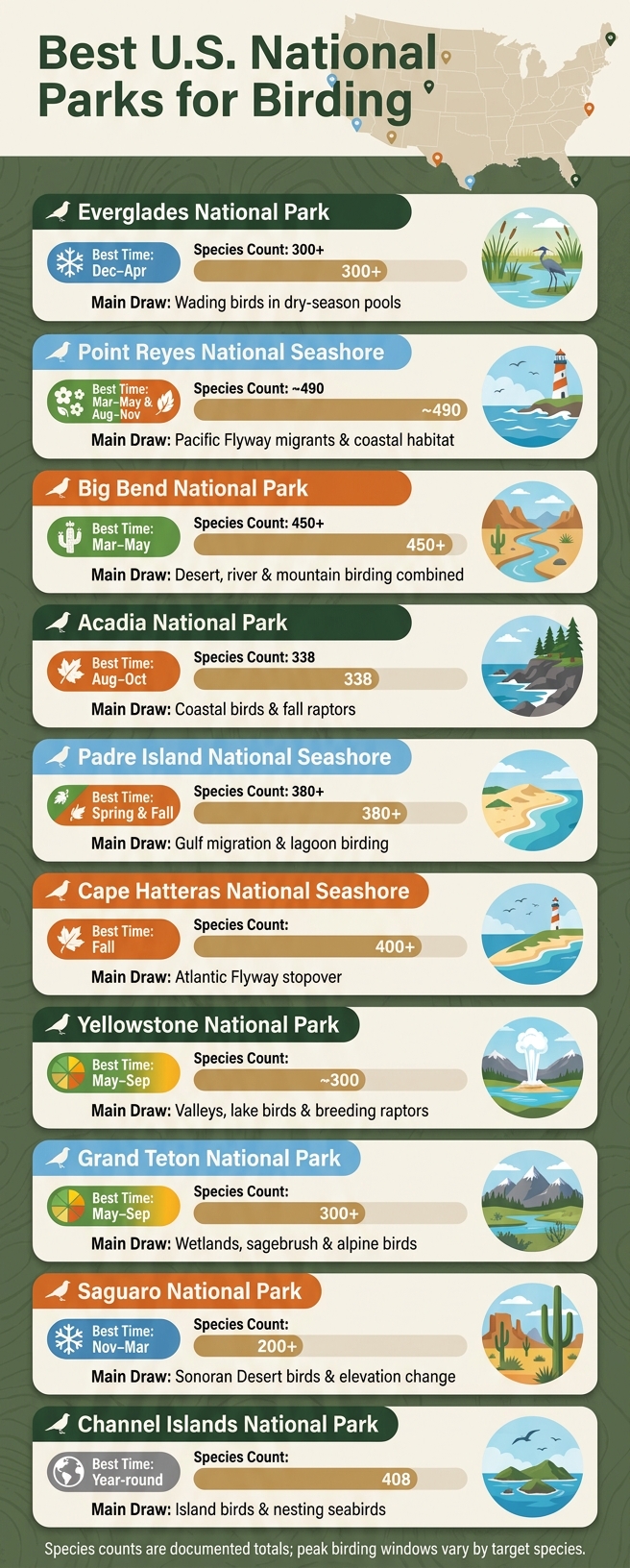
Best U.S. National Parks for Birding: Species, Season & Habitat
| Park | Best Time | Main Draw | Species Count |
|---|---|---|---|
| Everglades | Dec–Apr | Wading birds in shrinking dry-season pools | 300+ |
| Point Reyes | Mar–May, Aug–Nov | Pacific Flyway migrants and coastal habitat | ~490 |
| Big Bend | Mar–May | Desert, river, and mountain birding in one trip | 450+ |
| Acadia | Aug–Oct | Coastal birds and fall raptors | 338 |
| Padre Island | Spring and fall | Gulf migration and lagoon birding | 380+ |
| Cape Hatteras | Fall | Atlantic Flyway stopover on barrier islands | 400+ |
| Yellowstone | May–Sep | Valleys, lake birds, and breeding raptors | ~300 |
| Grand Teton | May–Sep | Wetlands, sagebrush, and alpine birds | 300+ |
| Saguaro | Nov–Mar | Sonoran Desert birds and elevation change | 200+ |
| Channel Islands | Year-round | Island birds and nesting seabirds | 408 |
What stands out most to me is how much timing changes the trip. A park that feels slow in summer can be packed with birds in spring or winter. That is the thread running through the full article.
Plan Your Birding Trip to National Parks
Before you pick a park, line up your trip with bird activity and habitat.
Birding usually works best at dawn and dusk. If you want more species, aim for migration periods. If you’d rather watch nesting behavior, go during the breeding season.
For gear, bring 8×42 binoculars. If you’re heading into open habitat, add a spotting scope. Wear muted colors and leave the bright clothing at home. You can use Merlin for call ID, but skip playback. And if birds start showing alarm, back away.
On trails and boardwalks, keep it simple:
- Move slowly
- Stay on marked trails
- Respect seasonal closures, including Raptor Advisories
Calm mornings are usually your best bet, and overcast skies can keep birds active longer. Good timing and the right gear make a big difference when you’re trying to get the most out of each park’s habitat.
For park-specific timing, maps, and trip ideas, use The National Park Guide.
Use these basics to choose the right park and season below.
1. Everglades National Park
Everglades National Park covers 1.5 million acres of subtropical habitat and supports more than 300 bird species. That range of habitat is a big part of the draw. You can bird across sawgrass marshes, freshwater sloughs, mangrove estuaries, and tropical hardwood hammocks.
For birders, the dry season is the sweet spot. From December through April, falling water levels push wading birds into the pools that remain, so species like Roseate Spoonbills, Wood Storks, and Great Egrets are much easier to see. Winter also brings migratory birds down from the north, including Painted Buntings and White Pelicans.
For close-up views, start at Anhinga Trail at Royal Palm. It’s a accessible boardwalk, and it puts you right next to Anhingas, Purple Gallinules, and herons. At Shark Valley, an observation tower looks out over the sawgrass prairie. If you can, take a late-afternoon tram tour. It’s a great time to watch hundreds of birds head back to their roosting sites for the night. Mrazek Pond, a roadside pull-off, is known in winter for dense feeding flocks of spoonbills and Wood Storks.
Arrive early for the best light and the quietest viewing. Anhinga Trail, the Shark Valley tram, and the Mahogany Hammock boardwalk are all wheelchair accessible.
2. Point Reyes National Seashore

Point Reyes National Seashore sits on a 10-mile Pacific peninsula that channels migrants along the Pacific Flyway. The result is a birding spot with almost 490 bird species spread across rocky headlands, estuaries, grasslands, forests, and beaches. The lighthouse area matters even more because it gives landfall birds a rare place to stop and rest. That’s why so many birders treat it as one of the best places to catch migrants moving through.
October is the big month for fall migration. South-to-southeast winds and fog can push rare eastern strays like American Redstart, Chestnut-sided Warbler, and Rose-breasted Grosbeak into the lighthouse cypresses. In winter, the focus shifts to raptors and waterfowl at Abbott’s Lagoon and Drakes Estero, where birds like Ferruginous Hawks, Tundra Swans, and Northern Pintails show up. From March through May, attention turns to shorebirds and migrants arriving from farther south.
If you want the easiest birding along national park trails, stick to three main spots:
- Bolinas Lagoon for roadside views of egrets, herons, and pelicans
- Abbott’s Lagoon for a 3.2-mile out-and-back trail and Western Snowy Plovers nesting in the dunes
- Bear Valley Visitor Center for wheelchair-accessible forest birding, with chances for Northern Spotted Owls and Hairy Woodpeckers
A small planning note can save a headache. From late December through mid-April, private vehicles aren’t allowed on weekends on the lighthouse and Chimney Rock road, so you’ll need to use the shuttle. On fall weekends, it’s smart to arrive before 9:00 AM if you want parking. There’s no entrance fee to visit Point Reyes National Seashore.
3. Big Bend National Park
Big Bend moves this list away from the coast and into a very different kind of birding. Here, desert, river, and mountain habitats all meet in one park, which helps explain why Big Bend has more than 450 documented bird species – the highest total of any U.S. national park.
The mix is what makes the place stand out. Big Bend sits at the meeting point of the Chihuahuan Desert, the Rio Grande riparian corridor, and the Chisos Mountains. That overlap brings in a huge range of birds, often within the same trip.
On the desert flats, birders often look for the Greater Roadrunner, Lucifer Hummingbird, and Scaled Quail. Along the Rio Grande corridor, especially around Rio Grande Village and Cottonwood Campground, the list can shift fast. That area draws the Common Black Hawk, Gray Hawk, Green Kingfisher, and Vermilion Flycatcher.
The mountains add another layer. In the Chisos, many birders come with one species in mind: the Colima Warbler. It’s the park’s signature bird and the only species in the United States known to nest there. Getting to Boot Canyon is no small outing, though. The route takes a hard 5- to 6-hour hike with a 1,600-foot climb on the Pinnacles Trail.
Timing matters here. Late April to early May is the top window, when migrants move through, summer birds arrive, and the park hits its peak for variety. Mid-March is less ideal because Spring Break crowds can make parking a headache.
For easy access, Rio Grande Village is the park’s top year-round birding spot. The nature trail, boardwalk over wetlands, and direct access to riparian habitat can produce a long species list in a single morning. Dugout Wells and Sam Nail Ranch are also strong picks. Both are short walks from the road, and their windmill-fed water sources tend to pull in tight groups of desert birds.
As of May 2026, the Chisos Basin is closed during a projected two-year construction period, so birders should put more attention on the desert and river zones. The park entrance fee is $30 per vehicle and stays valid for 7 days (use our national park budget planner to estimate total costs).
That sharp contrast between dry flats, wet river habitat, and mountain terrain is a big reason the park produces such strong birding, especially along the river corridor.
4. Acadia National Park
After Big Bend’s desert-and-river birding, Acadia takes things to Maine’s Atlantic coast.
Acadia National Park blends rocky shoreline, spruce-fir forest, freshwater ponds, and high ridges. That mix gives birders a lot to work with, and the park has recorded 338 bird species.
Ship Harbor Trail and Otter Point are top spots for Black Guillemot, Common Eider, and Great Cormorant. Jordan Pond and Eagle Lake are good places to look for Common Loon, Bald Eagle, and Red-breasted Merganser. In fall, Cadillac Mountain turns into a prime raptor lookout, with chances to see Broad-winged Hawk, Osprey, and Sharp-shinned Hawk.
One detail that stands out: at the Precipice Trail parking lot, park staff use spotting scopes to watch nesting Peregrine Falcons from a distance. The trail also often closes during nesting season.
Timing matters here. May is strong for warblers and songbirds. September is the high point for raptors along Cadillac North Ridge Trail’s Hawk Watch. In winter, you may spot Snowy Owls and Long-tailed Ducks.
Getting around is fairly simple, which helps. The Park Loop Road has pull-offs for roadside birding, and the Island Explorer bus connects major trailheads and overlooks. Otter Point Parking Area also gives you accessible coastal birding, with a gentle trail leading to Ocean Path.
5. Padre Island National Seashore
After Big Bend’s dry inland desert, Padre Island is a sharp change. Here, the focus shifts to the Gulf Coast and one of the best migration routes in Texas.
Padre Island protects 70 miles of undeveloped barrier island coastline. It also sits on the Central Flyway, which helps explain why the park has recorded more than 380 bird species over the course of the year.
Different parts of the park attract different birds. Laguna Madre is a magnet for roseate spoonbills, American white pelicans, long-billed curlews, white ibis, and redhead ducks. Along the Gulf beaches, you can spot brown pelicans, ruddy turnstones, red knots, piping plovers, black skimmers, and willets. The grasslands add another layer, with crested caracaras, sandhill cranes, and Aplomado falcons. If you want an easier viewing setup, a wheelchair-accessible bird blind south of Park Headquarters has nine viewing cutouts.
Timing matters here. A lot.
Late April through May is the main stretch for spring migration. When cold fronts move through, they can push waves of warblers, tanagers, and flycatchers into the shrubby cover near Malaquite Beach. September through November is strong for fall migration, while winter is a steady bet for waterfowl and shorebirds across Laguna Madre.
If you can, skip June through August. That’s when the heat, humidity, and biting insects are at their worst.
A spotting scope helps on the open water. And if beach driving is allowed where you are, use it when you can – birds tend to flush less from vehicles than from people walking in on foot.
6. Cape Hatteras National Seashore

Cape Hatteras National Seashore sits on the Atlantic Flyway and stands out as one of the East Coast’s best barrier-island birding stops. The seashore runs for 70 miles of barrier island coastline along North Carolina’s Outer Banks and includes Bodie, Hatteras, and Ocracoke Islands. The park has recorded more than 400 bird species, while the broader Outer Banks region has logged 427 species. That puts it among North America’s top birding destinations.
A big reason for that high species count is simple: this place gives birds a little bit of everything. You’ll find coast, marsh, forest, dunes, ponds, tidal flats, and pocosin wetlands, often within a short drive of each other. And unlike some more remote Outer Banks spots, most of the main birding areas here sit right along NC Highway 12, which makes the seashore much easier to work into a day of birding.
Each part of the park offers something a little different. Bodie Island is a strong pick for freshwater marsh and pond habitat. Good starting points include the Bodie Island Lighthouse Pond, the Marsh Blind, which is open from April through mid-November, and the Open Ponds Trail. Just to the south, Pea Island National Wildlife Refuge covers 5,800 acres of beach, dunes, marshes, and ponds set aside to protect migratory bird habitat. Its North Pond Wildlife Trail is a flat, 0.5-mile walk that ends at a two-level observation tower, and the Visitor Center has mounted scopes pointed at the pond.
Farther down, Hatteras Island has several birding stops people come back to again and again, including Buxton Woods, Cape Point, and the Frisco Campground area. Ocracoke Island, which you reach by ferry, adds South Point and the Hammock Hills Nature Trail, where maritime forest meets salt marsh.
Timing matters here. May is the high point for spring migration, with strong movement of ocean birds and shorebirds, plus rarities such as Arctic tern. Summer is nesting season for piping plovers and American oystercatchers, so it’s important to stay out of marked nesting areas. Fall is best known for warblers, including Wilson’s, Nashville, and Blackburnian, along with rare shorebirds like the Hudsonian godwit. In winter, Pea Island fills with large flocks of tundra swans and snow geese, and boat tours can turn up great skua.
One more nice detail: entrance to both the seashore and Pea Island National Wildlife Refuge is free. That helps make Cape Hatteras a solid year-round stop, not just a migration hotspot.
7. Yellowstone National Park

Yellowstone has nearly 300 documented bird species, around 150 nesting species, and 19 breeding raptors spread across riparian areas, sagebrush, forests, geothermal zones, and alpine habitat. A smart way to bird here is to start in the open valleys, then move to the lake and canyon overlooks.
Hayden Valley, near the middle of the park, is one of the top places for bald eagles, ospreys, northern harriers, and sandhill cranes. Lamar Valley, in the northeast corner, is a strong pick for golden eagles and river dippers. If you’re after waterbirds, Yellowstone Lake stands out. American white pelicans, common loons, and trumpeter swans all use the lake on a regular basis.
The Grand Canyon of the Yellowstone is also worth a stop, especially for ospreys. With high-powered binoculars or, better yet, a spotting scope, you can sometimes pick out birds on canyon nests. For distant birds and overlook viewing, a spotting scope makes a big difference.
Timing matters here. Mid-May to early July is the top stretch for migrants and nesting birds, and Yellowstone Lake is at its best for breeding waterbirds during that period. In fall, especially through early October, Hayden Valley becomes one of the better spots for hawk watching. During this peak window, birders can log 50 to 60 species in a day.
A few rules are worth keeping in mind. Audio playback is illegal in Yellowstone. Stay at least 25 yards from birds and 100 yards from nests. A 7-day vehicle pass costs $35.
8. Grand Teton National Park
Just south of Yellowstone, Grand Teton feels different right away. The spotlight here shifts to lakes, sagebrush, and birds of the high country.
Grand Teton National Park has more than 300 documented bird species spread across five main habitat types: riparian wetlands, sagebrush flats, coniferous forests, alpine tundra, and aspen groves. That range means you can see waterbirds, sagebrush birds, and raptors in the same park.
One of the park’s most dependable birding stops is Oxbow Bend, 1 mile east of Jackson Lake Junction. Birders regularly spot Trumpeter Swans, American White Pelicans, Ospreys, Bald Eagles, and Common Mergansers here. If you’re after sagebrush birds, head to Mormon Row and Antelope Flats, where Greater Sage-Grouse, Northern Harriers, and American Kestrels are often seen. Over at Colter Bay and along Moose-Wilson Road, keep an eye out for Western Tanagers and Great Gray Owls.
The best stretch for breeding birds runs from June through early July, including Mountain Bluebirds at elevations up to 12,500 feet. Spring is the time for Sage-Grouse lek displays. Fall, on the other hand, brings migrating hawks and more waterfowl at Oxbow Bend.
Timing matters here. Get to the main birding spots at sunrise. Bird activity is highest then and tends to fall off by midday.
Give birds space. Stay 25 yards away, and if an adult bird flushes or starts alarming, back off.
9. Saguaro National Park
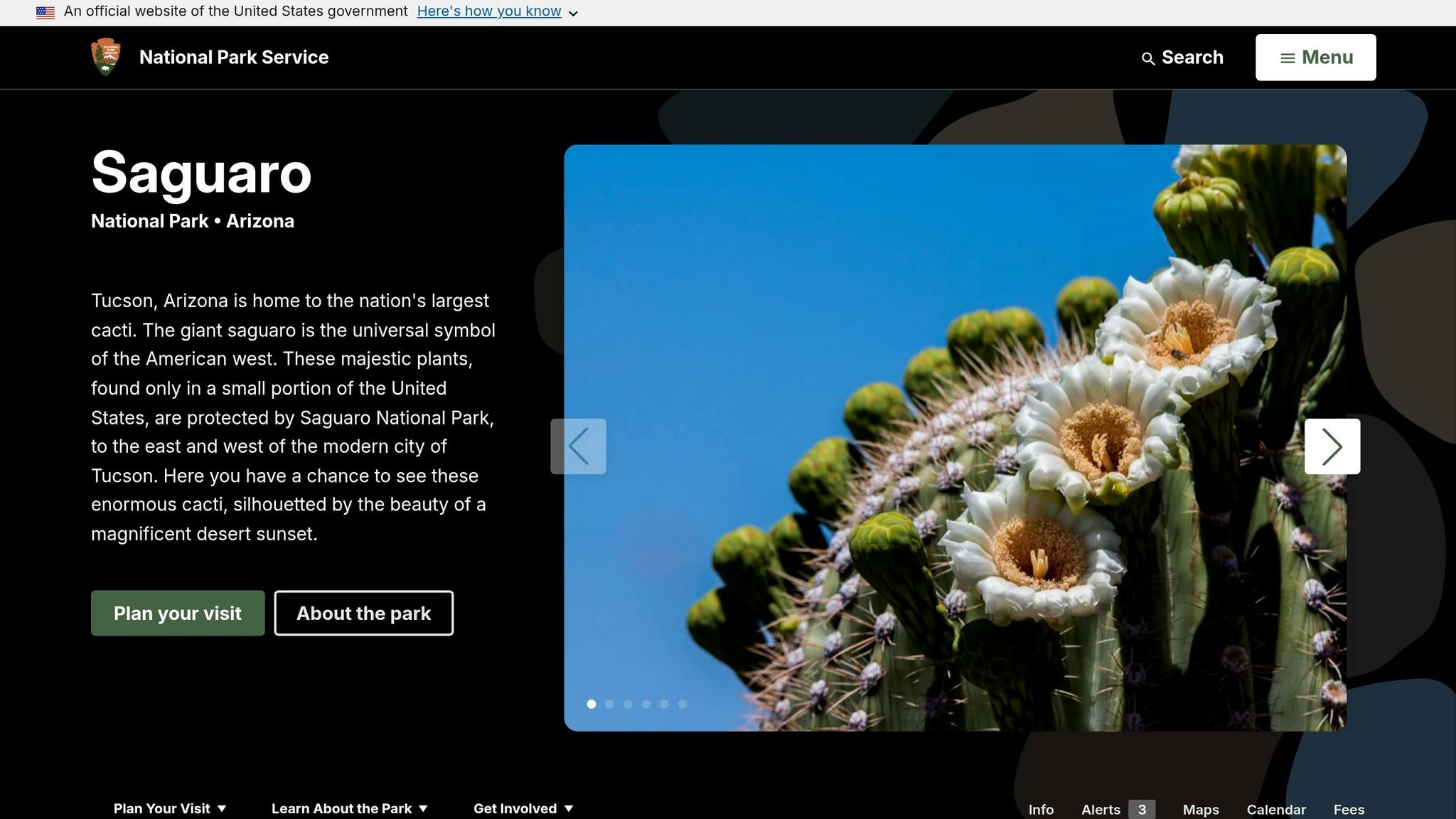
Saguaro National Park is one of the best birding stops in the Sonoran Desert. The park is split between the lower Tucson Mountain District and the higher Rincon Mountain District, which climbs to 8,666 feet. That big elevation spread creates a sharp habitat shift, from desert scrub and saguaro forest to oak woodland and pine-conifer areas. More than 200 bird species have been recorded here. That means you can spot classic desert birds in one part of the park and then run into mountain species not far away.
One of the park’s standout bird stories starts with the Gila Woodpecker. These birds carve nest cavities into saguaros, and those holes later get used by Lucy’s Warblers, Purple Martins, American Kestrels, and Elf Owls. It’s a small desert chain reaction. While you’re out there, watch for Cactus Wrens, Gambel’s Quail, Greater Roadrunners, Curve-billed Thrashers, Gilded Flickers, and Pyrrhuloxias. Cactus Wrens often perch on tall saguaros, while Pyrrhuloxias tend to show up in palo verde.
Season matters here more than people expect. Spring and summer bring Broad-billed Hummingbirds, Brown-crested Flycatchers, Bell’s Vireos, Scott’s Orioles, and Lucy’s Warblers. Head higher and you can add Olive Warblers, Pygmy Nuthatches, and Mexican Spotted Owls. Spring and fall usually bring the biggest mix of birds, while winter is a good time for Vermilion Flycatchers. Summer birding takes a bit of planning: get out early, before temperatures climb past 100°F, because bird activity often drops after 8:00 a.m..
If you’re deciding where to begin, start in the Rincon Mountain District at dawn, when birds are most active. Cactus Forest Loop Drive opens at 7:00 a.m. and gives you pullouts for roadside birding. Later in the morning, after the dawn chorus starts to fade, the Desert Ecology Trail and Freeman Homestead Trail are good bets. The park is cashless, so bring a credit or debit card. Entrance is $25 per vehicle, good for seven days and valid at both districts.
From desert birding, the list shifts to island habitats on the California coast.
10. Channel Islands National Park

After desert birding, Channel Islands moves this list offshore, where island habitat and local specialties take center stage. Channel Islands National Park protects five islands and the nearby waters off Southern California. Across sea cliffs, sea caves, oak woodlands, grasslands, and kelp forests, the park supports 408 bird species, including 12 seabirds that breed here.
Santa Cruz Island is the top spot for the Island Scrub-Jay, the only bird species in the continental U.S. limited to a single island. It’s bigger and a darker blue than its mainland relatives, and birders regularly find it around Scorpion Anchorage.
Anacapa Island is a major nesting site for seabirds. It holds one of the largest Western Gull nesting colonies and the only nesting site for California Brown Pelicans on the U.S. West Coast. Bald Eagles, brought back in 2002, now nest on Santa Cruz, Santa Rosa, and Anacapa.
Timing matters here. April through mid-August is the main season for seabird nesting on Anacapa, though it comes with plenty of noise and a strong smell. Spring also works well for landbird migration. Fall can produce rare vagrants and migrating shorebirds. Winter is less predictable, but offshore birds such as Northern Fulmars and gulls may show up.
Getting there takes a bit of planning. All islands are reached by Island Packers ferry from Ventura or Oxnard Harbor, and once you land, you’ll be getting around on foot only. Santa Cruz and Anacapa are the easiest visits, with crossings of about 1 to 1.5 hours. Santa Rosa and San Miguel take about 2.5 to 4 hours each way and face more weather-related cancellations. Santa Barbara Island is currently closed to public ferry access because of severe dock damage.
Park entry is free, but round-trip ferry tickets cost about $63 to $84 per adult, depending on the island. For summer weekends, it’s smart to book 4 to 6 weeks in advance.
Next, use the summary below to match each park with its best season, habitat, and signature birds.
Top Spots and Species to Look for in Each Park
Here’s a quick-reference table with the most reliable birding stop in each park. If you want the short version, this is it.
| Park | Top Hotspot | Habitat | Target Species |
|---|---|---|---|
| Everglades | Anhinga Trail | Freshwater marsh | Roseate Spoonbill, Wood Stork, Snail Kite |
| Point Reyes | Abbott’s Lagoon | Coastal wetlands | Snowy Plover, Tundra Swan, Northern Pintail |
| Big Bend | Boot Canyon, Chisos Mountains | Chisos Mountains | Colima Warbler, Lucifer Hummingbird |
| Acadia | Cadillac Mountain | Mountain summit | Peregrine Falcon, Broad-winged Hawk |
| Padre Island | Bird Blind south of Park Headquarters | Laguna Madre | Redhead Duck, American White Pelican, Roseate Spoonbill |
| Cape Hatteras | Pea Island NWR, North Pond Trail | Freshwater marsh and ponds | Tundra Swan, Snow Goose, Piping Plover |
| Yellowstone | Hayden Valley | River corridor and meadow | Trumpeter Swan, Bald Eagle, Sandhill Crane |
| Grand Teton | Oxbow Bend | Riparian wetlands | Trumpeter Swan, Osprey, American White Pelican |
| Saguaro | Rincon Mountain District | Desert scrub and oak woodland | Gila Woodpecker, Elf Owl, Cactus Wren |
| Channel Islands | Scorpion Anchorage, Santa Cruz Island | Island scrub | Island Scrub-Jay, Bald Eagle, Western Gull |
Some of these spots are famous for a reason. Anhinga Trail in Everglades gives you close looks in a marsh setting that’s often busy with waders and raptors. Oxbow Bend in Grand Teton is the kind of place birders talk about long after the trip is over, thanks to its wetland edge and strong chance for species like Trumpeter Swan and Osprey.
Others are more about being in the right habitat at the right moment. Abbott’s Lagoon at Point Reyes is a strong stop for coastal wetland birds, while Boot Canyon in Big Bend is where many people hope to find the Colima Warbler. And if you’re heading to Santa Cruz Island, Scorpion Anchorage is the place to look for the Island Scrub-Jay, a bird you won’t find anywhere else.
Next, match these hotspots to the best time of year for each park.
Best Times of Year to Go Birding at These Parks
Timing matters a lot. When you plan your national park trip, bird activity can shift fast from one season to the next, so the best park in April may not be the best one in September. Bird activity can shift fast from one season to the next, so the best park in April may not be the best one in September. The table below lines up each park with the season when birding is usually at its strongest.
| Park | Best Window | Why It Peaks |
|---|---|---|
| Everglades | December–April | Dry season concentrates wading birds. |
| Point Reyes | March–May / August–November | Peak Pacific Flyway migration. |
| Big Bend | March–May | Peak spring migration; Colima Warbler window. |
| Acadia | August–October | Fall hawk migration peaks. |
| Padre Island | Spring and fall | Spring and fall migration stopover. |
| Cape Hatteras | Fall | Fall cold fronts push migrants through. |
| Yellowstone | May–September | Best from late spring through early fall. |
| Grand Teton | May–September | Best from late spring through summer. |
| Saguaro | November–March | Cooler months are best. |
| Channel Islands | Year-round | Year-round for Island Scrub-Jay and offshore birds. |
These windows track closely with each park’s habitat. Marshes, coastlines, desert basins, and alpine valleys all run on different seasonal rhythms. That’s why birding peaks at different times from park to park.
Next, those habitat differences explain why these windows work, or you can ask our park information chatbot for real-time updates.
Bird Habitats Found Across These National Parks
The seasonal windows above start to click once you look at habitat. Each park in this list sits in a different ecological setting, and that setting shapes the birds people are most likely to spot. That’s also why the top birding areas in these parks tend to gather around marsh edges, shorelines, water sources, and high-elevation openings.
Coastal marshes and freshwater wetlands define much of Everglades National Park. Sawgrass, mangroves, and tidal flats draw in wading birds and shorebirds. Roseate Spoonbills, Wood Storks, Snowy Egrets, and White Ibis all match this habitat. Point Reyes and Padre Island also bring coastal marsh along tidal edges, where shorebirds and waders bunch up.
Barrier islands serve as major flyway stopovers. Padre Island National Seashore and Cape Hatteras National Seashore provide nesting habitat for birds like Piping Plovers and Black Skimmers. Along the shoreline, Red Knots and Ruddy Turnstones feed as they move through.
Farther inland, bird life shifts into drier desert systems. Desert scrub at Big Bend and Saguaro favors roadrunners, cactus wrens, and ladder-backed woodpeckers. In Big Bend, most sightings gather near water, especially the Rio Grande.
At higher elevations, forests and open valleys support a different mix of species. Montane forests and high-elevation valleys add warblers, jays, and owls. The Chisos Mountains in Big Bend and the mature forests of Acadia support warblers and owls. Yellowstone’s Hayden Valley, on the other hand, offers open high-elevation habitat for Trumpeter Swans, Bald Eagles, and American White Pelicans.
| Habitat Type | Parks | Species to Expect |
|---|---|---|
| Coastal Marshes | Everglades, Point Reyes, Padre Island | Roseate Spoonbill, White Ibis, Snowy Egret |
| Barrier Islands | Padre Island, Cape Hatteras | Piping Plover, Red Knot, Black Skimmer |
| Freshwater Wetlands | Everglades, Acadia | Anhinga, Wood Stork, Common Loon |
| Desert Scrub | Big Bend, Saguaro | Greater Roadrunner, Cactus Wren, Ladder-backed Woodpecker |
| Montane Forest | Big Bend (Chisos), Acadia | Colima Warbler, Mexican Jay, Blackburnian Warbler |
| High-Elevation Valleys | Yellowstone (Hayden Valley) | Trumpeter Swan, Bald Eagle, American White Pelican |
Conclusion
These parks make one thing clear: habitat and season shape the birding experience. What sets them apart is their mix of habitats, access to major flyways, and bird activity you can count on at the right time of year.
The best move is simple. Pick the park that lines up with the bird and habitat you want most, then plan your trip around peak activity.
The U.S. National Park System gives birders a huge range of options. Use The National Park Guide to plan your next birding trip.
FAQs
Which park is best for beginners?
Everglades National Park is a great place to start birding. It has easy, flat paths like the Anhinga Trail, and the boardwalk makes it simple to spot birds without a tough hike.
Ranger-led birding walks at parks like the Everglades, Point Reyes, and Big Bend can help new birders learn the basics from experts. They can also point out nesting sites that birders return to again and again.
What birds can I see by season?
Birding in U.S. national parks shifts with migration, weather, and breeding cycles. That’s why spring (March through May) and fall (August through November) are usually the busiest times.
Spring is often the top pick if you want nesting activity and colorful songbird migrations. Fall tends to bring hawks, geese, and other waterfowl into view.
Winter (December through February) usually has fewer species, but it can still be a good time for raptor and waterbird viewing. Summer, by contrast, mainly features resident birds.
How many days should I plan per park?
There’s no fixed number of days for a park visit. The right trip length depends on what you want to do and how big the park is.
If you’re going for birding, a stay of several days is often the better call. Birds tend to be most active in the early morning, so extra days give you more chances to be out at the right time. A multi-day trip also gives you room to catch peak spring or fall migration, check out different habitats, and move at your own pace instead of rushing from spot to spot.