
Standing before a waterfall in a U.S. national park is an experience like no other. From towering drops to hidden cascades, these natural wonders are spread across the country, each offering its own charm. Here’s a quick look at the 10 best waterfalls to visit:
- Yosemite Falls (Yosemite National Park): Tallest in North America at 2,425 feet. Best seen in late spring.
- Lower Falls (Yellowstone National Park): A 308-foot drop into the Yellowstone Canyon, with peak flow in May and June.
- Narada Falls (Mount Rainier National Park): A 168-foot horsetail fall, accessible year-round.
- Vernal Fall (Yosemite National Park): A 317-foot waterfall with the iconic Mist Trail hike.
- Virginia Falls (Glacier National Park): A 50-foot multi-tiered cascade, best in early summer.
- Grotto Falls (Great Smoky Mountains National Park): A 25-foot fall you can walk behind, surrounded by lush greenery.
- Overall Run Falls (Shenandoah National Park): At 93 feet, it’s the park’s tallest; spring offers the best flow.
- Marymere Falls (Olympic National Park): A 90-foot horsetail fall near Lake Crescent, flowing year-round.
- Nevada Fall (Yosemite National Park): A 594-foot cascade with dramatic spring runoff views.
- Abrams Falls (Great Smoky Mountains National Park): A 20-foot fall known for its powerful flow and scenic surroundings.
Best Time to Visit: Late spring to early summer (April–June) offers the most dramatic water flow due to snowmelt and rains. Many waterfalls are accessible via easy to moderate hikes, with options for all skill levels.
These waterfalls not only provide stunning views but also showcase the diverse landscapes of America’s national parks. Whether you’re up for a challenging hike or a short walk, there’s a waterfall waiting to be discovered.
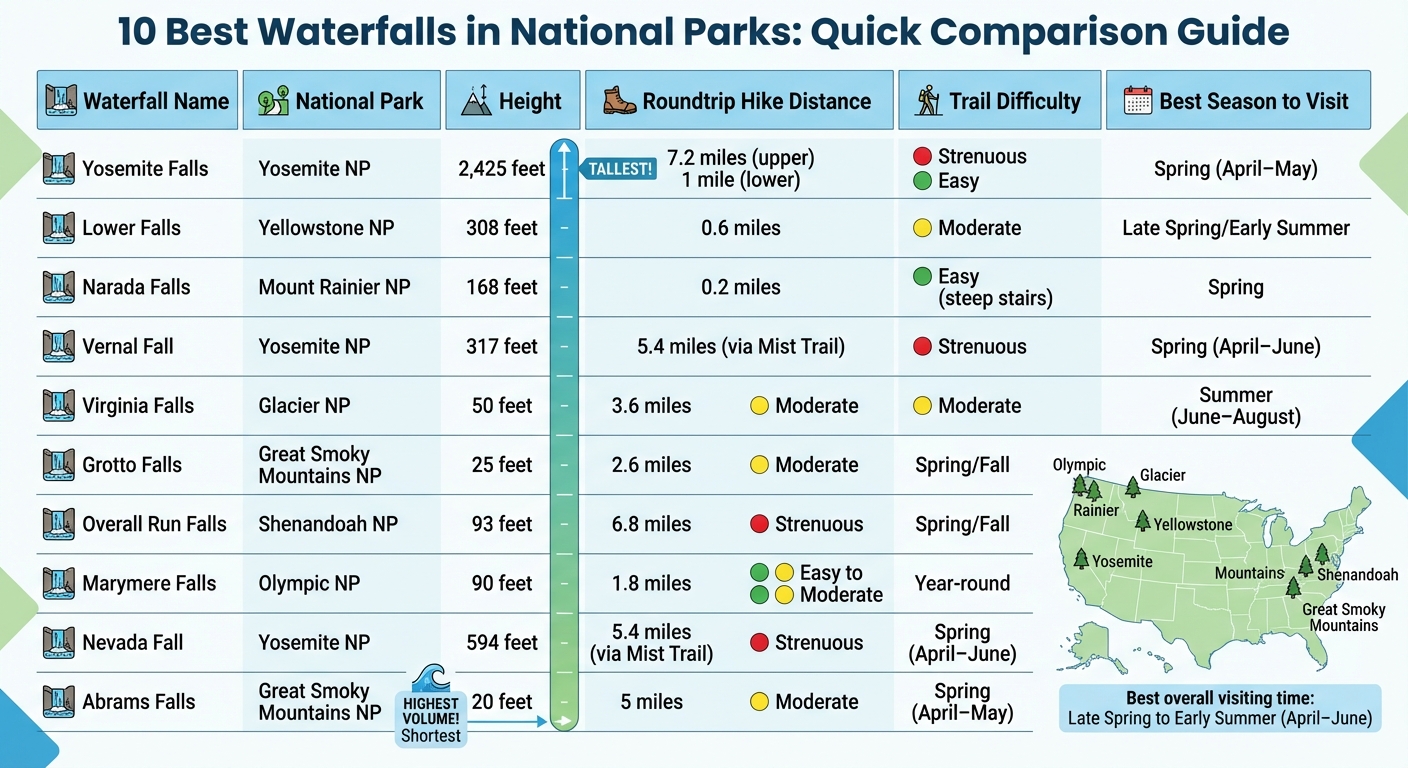
Top 10 National Park Waterfalls: Height, Hike Distance, and Best Visiting Season Comparison
Top 10 Most Beautiful Waterfalls in U.S. National Parks
1. Yosemite Falls in Yosemite National Park
Yosemite Falls, the tallest waterfall in North America, drops an impressive 2,425 feet in three distinct sections: the Upper Fall (1,430 feet), the Middle Cascades (675 feet), and the Lower Fall (320 feet). At its peak flow, this breathtaking cascade dominates Yosemite Valley, standing over four times higher than Nevada Fall (594 feet) and nearly four times the height of Bridalveil Fall (620 feet). Below, you’ll find helpful details about hiking trails, difficulty levels, and the ideal times to visit.
Hike Length
There are two main trails to explore Yosemite Falls:
- A 1-mile paved Lower Loop that takes about 30 minutes to reach the base of the falls. The eastern section of this loop is wheelchair-accessible, making it a great choice for all visitors.
- A more challenging 7.2- to 7.6-mile Upper Trail, which requires 6–8 hours to complete.
Trail Difficulty
The Lower Loop is an easy, paved path, perfect for families or those seeking a leisurely stroll. On the other hand, the Upper Trail is steep and rocky, with a 2,700-foot elevation gain. For this trail, starting early in the day is essential to avoid crowds and make the climb more manageable.
Best Season to Visit
The best time to visit Yosemite Falls is from late April to early June, with May offering peak water flow. By August, the falls often slow to just a trickle. If you plan to visit during peak flow, waterproof clothing is a smart choice to stay dry from the mist. The trailhead is conveniently accessible via Yosemite Valley shuttle stop #6.
2. Lower Falls in Yellowstone National Park
Lower Falls is Yellowstone’s standout waterfall, plunging an impressive 308 feet into the Grand Canyon of the Yellowstone – almost twice as high as Niagara Falls. Surrounded by vibrant volcanic rock, the falls deliver a breathtaking spectacle. Back in 1870, N. P. Langford of the Washburn expedition described it as:
"A grander scene than the lower cataract of the Yellowstone was never witnessed by mortal eyes".
Today, it’s the second most photographed spot in the park, trailing only Old Faithful Geyser. Here’s what you need to know about its height, trails, and the best times to visit.
Waterfall Height
The sheer force of Lower Falls is unforgettable. During the spring melt, over 60,000 gallons of water cascade over the edge every second. By autumn, this flow decreases to around 5,000 gallons per second. The mist from the falls often creates rainbows, especially mid-morning between 9:30 and 10:00 AM.
Hike Length
Visitors can explore several trails to experience the falls up close:
- Brink of the Lower Falls Trail: A 0.8-mile roundtrip hike that takes you to the top of the falls.
- Uncle Tom’s Trail: A shorter 0.6-mile roundtrip, featuring a descent of 328 metal grate steps.
- Lookout Point: Perfect for those who prefer less walking, with just a 275-foot paved path leading to a fantastic view.
Trail Difficulty
The Brink Trail is a challenging hike, with steep switchbacks and a significant elevation change. For an easier option, Lookout Point and Artist Point both offer paved, accessible paths. If parking near the Brink Trail is full, consider checking out eastern lookout areas, which tend to have more available spaces. Each trail provides a unique perspective on the falls’ seasonal beauty.
Best Season to Visit
Spring and early summer, particularly May and June during peak snowmelt, showcase the falls at their most dramatic. While the falls are accessible year-round, winter offers a quieter, magical scene with portions of the waterfall frozen into ice. For the best photos and rainbow sightings, visit mid-morning at Artist Point. If you’re looking for solitude, sunrise is an excellent choice with fewer visitors. The changing seasons only add to the grandeur of Lower Falls and its stunning canyon surroundings.
3. Narada Falls in Mount Rainier National Park
Narada Falls is one of Mount Rainier’s most accessible and stunning waterfalls, located just 150 feet from the road to Paradise. Standing at 188 feet tall, it’s the largest waterfall in the park that you can drive to. The falls flow in two distinct tiers: a 168-foot horsetail upper cascade and a 20-foot plunge, tumbling over a rugged andesite lava cliff. Unlike many glacier-fed rivers in the park, the Paradise River remains crystal clear, as it originates from snowfields rather than sediment-filled glaciers.
Waterfall Height
Narada Falls boasts a total drop of 188 feet, making it a breathtaking sight no matter the season. In winter, the upper tier transforms into a 150-foot wall of icicles, drawing ice climbers to the area. The name "Narada", derived from a Hindu sage, translates to "pure" or "uncontaminated", perfectly reflecting the pristine nature of the falls.
Hike Length
Reaching the lower viewpoint of Narada Falls is a quick and manageable 0.2-mile hike each way, totaling 0.4 miles round-trip. The trail includes a 200-foot descent and ascent, offering a short yet rewarding walk. Despite its brevity, the trail’s steepness and damp surface require careful footing.
Trail Difficulty
Although the trail is rated as easy, the constant mist keeps the path slick, making it trickier than it appears. Sturdy, non-slip footwear is essential, and during winter, microspikes or trekking poles are highly recommended due to icy patches. If the trail conditions are unsafe, visitors can still enjoy the falls from the upper parking lot.
Best Season to Visit
Narada Falls offers a unique experience in every season. Early summer provides dramatic views, as melting snow swells the water flow, while autumn brings a renewed vigor to the falls with seasonal rains. On sunny days, visiting after mid-morning enhances the chance of spotting rainbows in the mist. However, icy conditions can persist into June and early July, so checking trail conditions beforehand is wise. Like the iconic waterfalls of Yosemite and Yellowstone, Narada Falls is a year-round attraction that combines easy access with seasonal beauty, making it a must-visit destination.
4. Vernal Fall in Yosemite National Park
Vernal Fall, standing at 317 feet, is one of Yosemite National Park’s most popular waterfalls. It’s famous for the Mist Trail, a steep granite staircase of over 600 steps that often leaves hikers soaked by its spray. Unlike some of Yosemite’s seasonal waterfalls, Vernal Fall flows all year, though its volume decreases significantly by late summer, sometimes splitting into smaller streams. Originally named Yan-o-pah, meaning "little cloud" by indigenous peoples, it was renamed "Vernal" in 1851. While it’s about half the height of Nevada Fall (594 feet), Vernal Fall offers an immersive experience that’s tough to beat. Below, we’ll dive into its height, hiking options, trail challenges, and the best time to visit.
Waterfall Height
At 317 feet, Vernal Fall is slightly shorter than Lower Yosemite Fall (320 feet) and much smaller than Yosemite Falls, which towers at 2,425 feet. Its powerful flow and easy accessibility make it a favorite stop for visitors.
Hike Length
Reaching the top of Vernal Fall via the Mist Trail is a 2.4-mile round-trip hike with a 1,000-foot elevation gain. For those looking for a shorter trek, the Vernal Fall Footbridge route is 1.6 miles round-trip with a 400-foot elevation gain. The full Mist Trail hike takes about 3 hours, while the shorter Footbridge route can be completed in 1 to 1.5 hours.
Trail Difficulty
The hike to the footbridge is considered moderate, but the climb to the top of Vernal Fall is much more challenging. The steep granite steps – over 600 of them – are often wet and slippery, making sturdy hiking boots and waterproof gear essential. Swimming in the Emerald Pool or Silver Apron above the fall is extremely dangerous due to strong currents that have claimed lives in the past. During winter, the lower Mist Trail is usually closed because of ice and falling rocks, with the John Muir Trail serving as an alternate route.
Best Season to Visit
The best time to visit Vernal Fall is in late May or early June when snowmelt creates a powerful flow, often accompanied by rainbows in the mist. To avoid heavy crowds and secure parking, aim to arrive at Happy Isles (Shuttle Stop #16) between 6:00 and 7:00 AM. While the waterfall flows year-round, spring and early summer offer the most dramatic and memorable views.
5. Virginia Falls in Glacier National Park
Virginia Falls, a 50-foot, multi-tiered waterfall in Glacier National Park’s St. Mary Valley, offers a stunning experience with its powerful mist and roaring waters. While it doesn’t reach the heights of Beaver Chief Falls (1,291 feet) or Bird Woman Falls (492 feet), Virginia Falls provides an intimate and invigorating encounter. Along the same trail, you’ll also pass St. Mary Falls (35 feet), giving you two breathtaking waterfalls in one hike. With a 4.9/5 rating on TripAdvisor and a Travelers’ Choice Award, it’s ranked #3 among 58 attractions in the park. Here’s a closer look at what makes this destination special.
Waterfall Height
Virginia Falls stands at 50 feet, cascading over multiple tiers before plunging into a pool below. Though smaller than towering waterfalls like Grinnell Falls (960 feet), it surpasses nearby St. Mary Falls in height. During peak flow, the mist at the base is so intense that it can provide a refreshing cool-down on a hot summer day.
Hike Length
The hike to Virginia Falls is about 3.1 miles round-trip from the St. Mary Falls trailhead, with an elevation gain of 452 feet. If the small 19-spot parking lot is full, you can start from Sun Point, which extends the hike to roughly 6 miles and includes a stop at Baring Falls. Most hikers complete the standard route in 1.5 to 3 hours.
Trail Difficulty
This trail is rated as easy to moderate, making it a great choice for families and casual hikers. However, the path can get rocky and slippery near the falls due to mist and snowmelt. The hike is mostly downhill on the way there, but you’ll face a steady uphill climb on the return. As TripAdvisor reviewer Dan B shared:
"The hike is almost entirely uphill but the payoff at the end is so worth it".
Keep bear spray handy, as both grizzly and black bears are known to frequent the area.
Best Season to Visit
The best time to visit Virginia Falls is late spring through early summer, especially in June and July, when snowmelt from the surrounding peaks fuels the waterfall’s powerful flow. TripAdvisor user MaryEllenM27 noted:
"St Mary Falls and it’s neighbor…Virginia Falls are the most beautiful in Late Spring and Early Summer when snow melt keeps the falls rushing full".
To avoid crowds and secure parking, aim to arrive before 8:00 AM or after 3:00 PM, or use the free park shuttle. For a quieter experience, September offers golden larch trees and fewer visitors, though the water flow is much reduced by then.
6. Grotto Falls in Great Smoky Mountains National Park
Grotto Falls offers a rare chance to walk behind a waterfall, making it a standout destination in the Great Smoky Mountains National Park. This 25-foot cascade is tucked into a grotto surrounded by eastern hemlocks and rhododendrons, creating a cool, misty spot that’s perfect for escaping the summer heat. With a 4.7/5 rating on AllTrails from over 9,115 reviews and a #11 ranking on U.S. News‘ Best Things To Do list, it’s no wonder this spot is a favorite among visitors [61,64].
Waterfall Height
Standing at 25 feet, Grotto Falls isn’t the tallest waterfall in the park – that honor belongs to Ramsey Cascades at 100 feet [67,68]. However, what it lacks in height, it makes up for in charm. The grotto’s unique setting allows visitors to walk behind the curtain of water, offering a one-of-a-kind perspective. As the SmokyMountains.com Local Expert Team puts it:
"Only at Grotto Falls can you actually walk behind the cascading waterfall, one of the most unique views and photo opportunities in the Great Smoky Mountains National Park".
This feature makes it a memorable stop for hikers and photographers alike.
Hike Length
The hike to Grotto Falls is a 2.6-mile roundtrip journey along the Trillium Gap Trail, with an elevation gain of 585 feet. Most hikers complete the trek in 1.5 to 3 hours. The trail meanders through an old-growth hemlock forest and crosses several small streams, requiring careful rock-hopping at times. During the winter months (December through mid-March), when the Roaring Fork Motor Nature Trail is closed, access requires a longer 7-mile roundtrip hike from the Rainbow Falls Trailhead.
Trail Difficulty
The trail is rated as easy to moderate, making it a good option for families. While the path is well-maintained, it can get muddy and slippery after rain, and the rocks near the waterfall are often wet. Sturdy, waterproof hiking shoes are highly recommended to navigate these conditions and the stream crossings. Parking can be a challenge, as the Trillium Gap Trailhead lot only holds about 16 vehicles and fills up quickly during peak times. Arriving early or later in the day can improve your chances of finding a spot.
Best Season to Visit
Spring, particularly May, is the ideal time to visit Grotto Falls. During this season, the waterfall’s flow is at its strongest thanks to spring rains and snowmelt, and the surrounding wildflowers – like trillium, white violets, and Dutchman’s breeches – are in full bloom [57,71]. Summer offers lush greenery and a cool retreat, though it also brings larger crowds. In fall, the foliage creates a stunning backdrop, but water levels tend to be lower [70,71]. As Hiking in the Smokys notes:
"The 25-foot high waterfall provides a cool, shaded retreat for summer hikers".
Keep in mind that a valid parking tag is required: $5 for a daily pass, $15 for a weekly pass, or $40 for an annual pass.
sbb-itb-00512f3
7. Overall Run Falls in Shenandoah National Park
Overall Run Falls stands as the tallest waterfall in Shenandoah National Park, measuring an impressive 93 feet. It surpasses other notable cascades in the park, such as Upper Whiteoak Falls at 86 feet and South River Falls at 83 feet. However, as a seasonal waterfall, its flow can diminish significantly during the dry summer months. The National Park Service describes the experience as:
"A hike into federally designated Wilderness to a view of the highest waterfall in the Park at 93 feet."
While access to the falls is unsafe for close-up views, visitors can enjoy the sight from rocky overlooks that also offer sweeping panoramas.
Waterfall Height
At 93 feet, Overall Run Falls is the tallest in the park, towering over other favorites like Dark Hollow Falls, which measures 70 feet and draws the most visitors.
Hike Length
The most common route to Overall Run Falls begins at Mathews Arm Campground. This trail is a 5.1-mile roundtrip with a 1,291-foot elevation gain, typically taking about 4 hours to complete. For a longer trek, the "lollipop" hike from the Thompson Hollow boundary trailhead stretches 8.8 miles and includes a 2,028-foot elevation gain. Another option is to park at Mile 21 and add about one mile by incorporating a section of the Appalachian Trail. Along the way, hikers will encounter three rocky overlooks offering stunning views.
Trail Difficulty
The trail is rated moderately strenuous, making it more demanding than shorter, easier hikes like the 1.3-mile trail to Lands Run Falls. The rugged terrain calls for sturdy, waterproof hiking boots due to rocky paths and stream crossings. Wet rocks can be especially slippery, so caution is essential. Additionally, hikers should stay vigilant for rattlesnakes near overlooks or off-trail areas. Keep in mind that Shenandoah National Park charges a $30 entrance fee per vehicle.
Best Season to Visit
Spring is the best time to visit Overall Run Falls, particularly before June, when seasonal rains ensure a strong flow over the 93-foot cascade. As Hau Nguyen points out:
"The best time to visit is typically before June when the rainier season ensures the falls are flowing strongly."
During summer, the waterfall’s flow may decrease, but the lower sections of the trail feature inviting swimming holes and "blue pools" for a refreshing break. In the fall, the overlooks provide breathtaking views of the Shenandoah Valley, framed by colorful autumn foliage, even if the waterfall’s flow is reduced. Early arrival is recommended, as parking fills quickly on weekends and during peak seasons.
Next, consider venturing to Marymere Falls in Olympic National Park for another memorable waterfall hike.
8. Marymere Falls in Olympic National Park
Marymere Falls is a stunning 90-foot horsetail waterfall located near Lake Crescent, about 20 miles west of Port Angeles. National Park Expert James Ian highlights:
"At 90 feet, this is the tallest waterfall in Olympic National Park."
The waterfall gracefully clings to its rock face during its descent, creating a classic horsetail cascade that flows year-round. To reach it, the trail takes you across two bridges: a sturdy metal bridge spanning Barnes Creek and a rustic log bridge over a smaller stream. These lead to viewing platforms offering clear, picture-perfect views of the falls. Below, you’ll find essential details about its height, trail, and the best times to visit.
Waterfall Height
At 90 feet, Marymere Falls is the tallest single-drop waterfall in Olympic National Park, far exceeding the 48-foot height of Sol Duc Falls.
Hike Length
Visitors can pick between two trail options: a 1.8-mile roundtrip from the Storm King Ranger Station or a 2.1-mile loop starting at Lake Crescent Lodge. Both routes include an elevation gain of 300–500 feet and can typically be completed in under an hour.
Trail Difficulty
This hike is considered easy and is ideal for families, though the final loop does feature a 36% incline and a short stair climb. Sturdy hiking boots are a good idea, especially since the trail can get muddy after rain and includes rocky sections and tree roots. Keep in mind that dogs are not allowed on this trail, even on a leash. Parking at the Storm King Ranger Station can fill up quickly, so plan to arrive early in the morning or later in the evening. Entry to Olympic National Park requires a $30.00 fee per vehicle.
Best Season to Visit
Spring and early summer are the most scenic times to visit, as snowmelt enhances the water flow and the surrounding forest comes alive with lush green foliage. National Park Travel Expert Jenny Sullivan suggests late winter or early spring for a quieter experience, with fewer crowds and rising water levels creating a peaceful atmosphere. While Marymere Falls flows year-round, summer tends to attract more visitors, whereas fall and winter offer a more tranquil setting, albeit with reduced water flow.
Continue your journey to discover even more spectacular waterfalls across America’s national parks.
9. Nevada Fall in Yosemite National Park
Nevada Fall is one of Yosemite’s most captivating waterfalls, offering visitors a striking display of nature’s power and beauty.
This waterfall plunges 594 feet along the Merced River, creating a frothy, snow-like cascade that matches its name, which translates from Spanish to "snow-covered." The water’s forceful descent over granite gives it a striking white appearance. Unlike many Yosemite waterfalls that fade by mid-summer, Nevada Fall typically flows throughout the year. Located just upstream from Vernal Fall, it forms the upper tier of what is known as the "Giant Stairway".
Waterfall Height
Standing at 594 feet, Nevada Fall is nearly double the height of Vernal Fall, which measures 317 feet. While it doesn’t surpass the towering Yosemite Falls, its size and power make it one of the park’s standout cascades.
Hike Length
Reaching Nevada Fall requires a 5.4-mile round-trip hike via the Mist Trail, starting at Happy Isles in Yosemite Valley. Many hikers prefer to ascend the Mist Trail, which offers close-up views, and descend via the John Muir Trail for a different perspective. The National Park Service estimates the hike takes between 5 and 6 hours.
Trail Difficulty
The hike is considered strenuous, with an elevation gain of around 2,000 feet. The Mist Trail alone includes over 600 steep granite steps leading to Vernal Fall and onward to Nevada Fall. Proper hiking boots are essential, and each person should carry 3–4 quarts of water. Entry to Yosemite National Park costs $35 per vehicle (valid for seven days). Note that during winter, icy conditions often close the upper portion of the John Muir Trail between Clark Point and Nevada Fall.
Best Season to Visit
Spring and early summer are the best times to visit, as snowmelt from the Sierra Nevada peaks, typically from late May through June – and sometimes into July during wet years. At its peak, the waterfall creates misty winds, roaring sounds, and even rainbows in the spray. While Nevada Fall flows year-round, the dramatic scenes during spring runoff make it especially photogenic and unforgettable. This seasonal display cements Nevada Fall as a must-visit landmark in Yosemite National Park.
10. Abrams Falls in Great Smoky Mountains National Park
Abrams Falls may not be the tallest waterfall in the Great Smoky Mountains National Park, but it certainly stands out for its sheer volume. Found in the Cades Cove section of the park at stop #10 on the Cades Cove Loop Road, this 20-foot cascade is celebrated as the park’s most voluminous waterfall. Its powerful flow feeds into a natural pool about 100 feet wide at the base. However, swimming here is strictly prohibited due to dangerous undertows that have unfortunately claimed lives.
Waterfall Height
Though Abrams Falls measures only 20 to 25 feet in height, its expansive and forceful flow makes it remarkable. As noted by U.S. News & World Report:
"While the falls are just 20 feet high, they pump out a large volume of water, creating a long, deep pool at its base."
Hike Length
Reaching Abrams Falls requires a 5-mile roundtrip hike with a 640-foot elevation gain, typically taking between 2.5 and 4 hours. The trailhead is conveniently located along the Cades Cove Loop Road. To beat the crowds and secure parking, plan to arrive before 8:00 AM on a weekday.
Trail Difficulty
The trail is rated moderate, with frequent elevation changes, exposed tree roots, and rocky stretches. The uphill portions on the way back can be particularly challenging. Wearing sturdy hiking boots is a must, and bringing plenty of water and snacks will help you stay energized.
Best Season to Visit
Spring, especially in April and May, is the ideal time to visit Abrams Falls. During this period, snowmelt boosts the water flow, wildflowers are in full bloom, and wildlife activity is high. Fall offers breathtaking foliage but tends to attract larger crowds. Winter visits, while quieter, can be rewarding with increased water levels from rain – though icy conditions may occasionally close the Cades Cove Loop Road. Summer, on the other hand, is less favorable due to high temperatures (often over 85°F), humidity, and heavy traffic.
Although entry to Great Smoky Mountains National Park is free, vehicles parked for more than 15 minutes require a parking tag. Fees are $5 for a daily pass, $15 for a weekly pass, or $40 for an annual pass.
Take a look at the table below to compare Abrams Falls with other waterfalls in the park.
Waterfall Comparison Table
Here’s a handy table to quickly compare some of the most stunning waterfalls across U.S. national parks. It covers key details like height, roundtrip hike distance, trail difficulty, and the best season to visit.
| Waterfall | National Park | Height | Roundtrip Hike Distance | Trail Difficulty | Best Season |
|---|---|---|---|---|---|
| Yosemite Falls | Yosemite National Park | 2,425 feet | 7.2 miles (upper) / 1 mile (lower) | Strenuous / Easy | Spring (April–May) |
| Lower Falls | Yellowstone National Park | 308 feet | 0.6 miles | Moderate | Late Spring/Early Summer |
| Narada Falls | Mount Rainier National Park | 168 feet | 0.2 miles | Easy (steep stairs) | Spring |
| Vernal Fall | Yosemite National Park | 317 feet | 5.4 miles (via Mist Trail) | Strenuous | Spring (April–June) |
| Virginia Falls | Glacier National Park | 50 feet | 3.6 miles | Moderate | Summer (June–August) |
| Grotto Falls | Great Smoky Mountains National Park | 25 feet | 2.6 miles | Moderate | Spring/Fall |
| Overall Run Falls | Shenandoah National Park | 93 feet | 6.8 miles | Strenuous | Spring/Fall |
| Marymere Falls | Olympic National Park | 90 feet | 1.8 miles | Easy to Moderate | Year-round |
| Nevada Fall | Yosemite National Park | 594 feet | 5.4 miles (via Mist Trail) | Strenuous | Spring (April–June) |
| Abrams Falls | Great Smoky Mountains National Park | 20 feet | 5 miles | Moderate | Spring (April–May) |
This table is a quick guide to help you choose waterfalls that align with your hiking skills, seasonal preferences, and overall adventure goals. Whether you’re looking for a short, easy walk or a challenging hike with breathtaking views, there’s something here for everyone.
Conclusion
From the towering 2,425-foot drop of Yosemite Falls, North America’s tallest waterfall, to the more secluded charm of Abrams Falls, waterfalls in America’s national parks showcase an incredible range of natural beauty. Whether you’re after a quick roadside stop or a demanding hike, there’s a waterfall experience for every type of adventurer.
But these falls offer more than just a visual treat – they’re a feast for the senses. As Jenny Sullivan, Owner of Discover Parks & Wildlife, notes:
"There’s just something downright magical about waterfalls… Their cascade’s roar delivers a powerful, unique experience."
That thunderous roar, paired with the refreshing mist and the raw energy of rushing water, creates an unforgettable encounter with nature that’s hard to replicate.
For the best experience, aim to visit in late spring (April–June) when snowmelt fuels the strongest flows. Early mornings and weekdays often provide quieter trails, and waterproof boots are a smart choice for navigating muddy spring paths.
Ready to plan your trip? The National Park Guide (https://thenationalparkguide.com) is packed with resources like trail maps and seasonal advice to help you explore these breathtaking wonders.
These waterfalls aren’t just places to visit – they’re living reminders of the power and beauty of the natural world. Lace up your hiking boots, grab your camera, and immerse yourself in the magic of America’s incredible cascades.
FAQs
Which waterfalls are best for a quick, easy visit?
If you’re looking for waterfalls that are easy to reach, some offer breathtaking views without requiring a long trek. For instance, Brandywine Falls in Cuyahoga Valley National Park is accessible via a short trail, making it perfect for a quick outing. Similarly, Niagara Falls provides stunning vistas from convenient overlooks, allowing visitors to enjoy its grandeur without much effort. These spots combine beauty with accessibility, making them ideal for a brief but memorable visit.
How can I avoid crowds and find parking at popular falls?
To enjoy popular waterfalls without the hustle and bustle, try visiting during off-peak times – think weekdays, early mornings, or late afternoons. Many parks now require reservations for parking or entry during busy seasons, so planning ahead is key. If possible, opt for less-used entrances and take time to explore quieter corners of the park. Arriving early or later in the day not only boosts your chances of finding parking but also allows you to soak in the scenery with fewer distractions.
What safety hazards should I watch for near waterfalls?
Waterfalls are stunning, but they come with their share of risks. Slippery rocks and trails, strong currents, and hidden dangers like submerged debris or sudden drops in water depth can all pose threats. Never jump into pools unless you’re absolutely sure the water is safe. Stick to marked trails, keep a close eye on children and pets, and resist the urge to climb near the falls. During heavy rain, exercise extra caution – rising water levels can make the area even more dangerous.