
Don’t trust clear water in the wild – it could be hiding bacteria, viruses, or parasites like Cryptosporidium. Water purification tablets are lightweight, easy to use, and can keep you safe from waterborne illnesses while camping or hiking. Here’s what you need to know:
- Chlorine Dioxide Tablets: Effective against all major pathogens, including Cryptosporidium, but require up to 4 hours for full treatment. Tasteless and reliable.
- Iodine Tablets: Quick (30–35 minutes) but ineffective against Cryptosporidium and have a strong taste. Not suitable for pregnant women or those with thyroid issues.
- Chlorine-Based Tablets (NaDCC): Treats water in 30 minutes, effective against bacteria and viruses, but not Cryptosporidium. Leaves a mild chlorine taste.
Key factors to consider: pathogen coverage, treatment time, water conditions (cold or murky water takes longer), and taste preference. For the safest option, chlorine dioxide tablets are your best bet for comprehensive protection, especially in wildlife-heavy areas.
Quick Comparison
| Product | Active Ingredient | Kills Cryptosporidium? | Wait Time | Price (Approx.) | Taste |
|---|---|---|---|---|---|
| Katadyn Micropur MP1 | Chlorine Dioxide | ✅ Yes | 15 min–4 hours | $15.95 / 30 tabs | Tasteless |
| Aquatabs | NaDCC | ❌ No | 30–40 minutes | $12.99 / 100 tabs | Mild chlorine |
| Aquamira Tablets | Chlorine Dioxide | ✅ Yes | 4 hours | $16.95 / 114L | Slight chemical |
| Potable Aqua ClO2 Tablets | Chlorine Dioxide | ✅ Yes | 4 hours | $18.99 / 30 tabs | Neutral |
| Potable Aqua Iodine + PA Plus | Iodine + Neutralizer | ❌ No | 35 minutes | $9.99 / 50 pairs | Neutral (after neutralizer) |
For extended trips or areas with high wildlife activity, chlorine dioxide tablets like Katadyn Micropur MP1 are the safest pick. For short hikes or emergencies, Aquatabs offer a fast, budget-friendly solution. Always pre-filter murky water and follow treatment instructions for the best results.
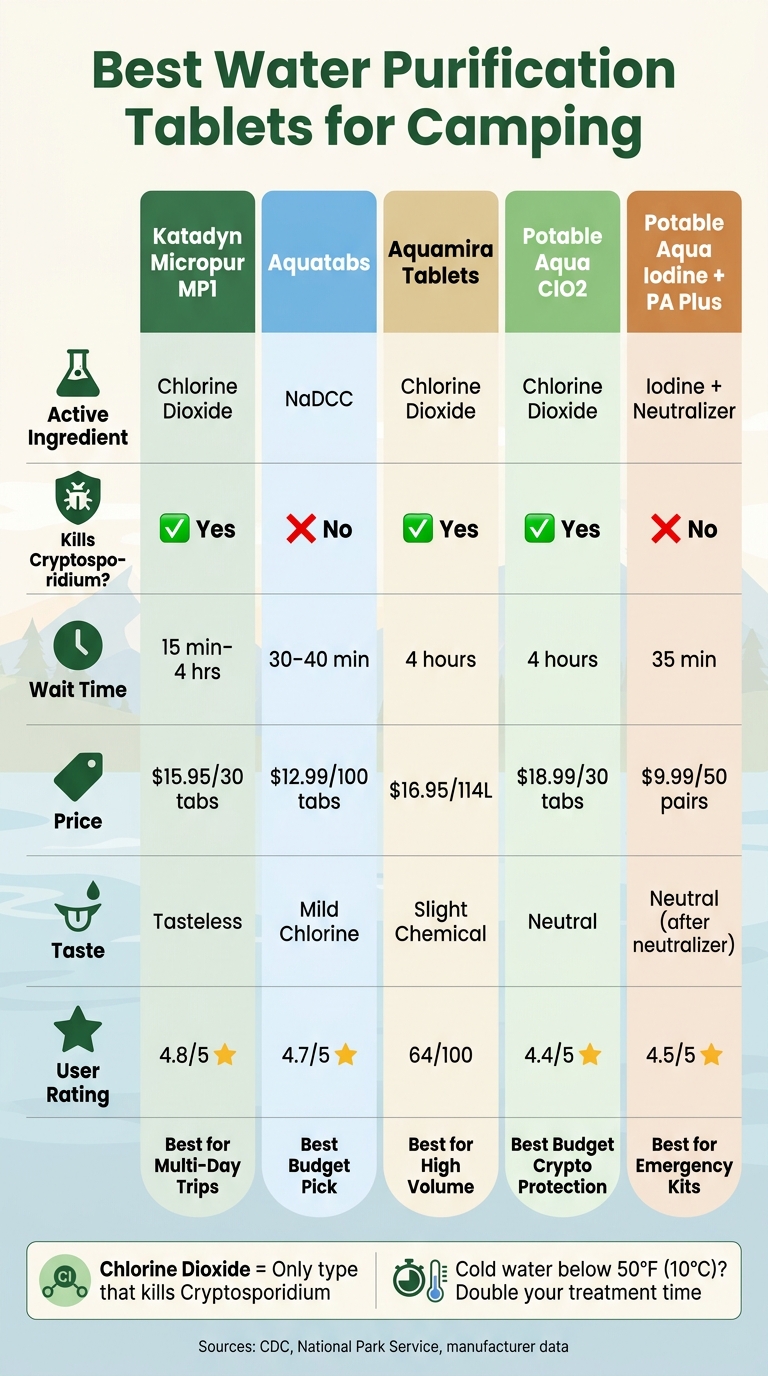
Best Water Purification Tablets for Camping: Side-by-Side Comparison
Best Water Purification Tablets Review (2022 Buyers Guide) ✅
sbb-itb-00512f3
How Water Purification Tablets Work
Grasping how water purification tablets operate can help you choose the right one for your outdoor adventures. When you drop a tablet into water, it releases chemicals that kill harmful microorganisms. These chemicals work by either oxidizing or halogenating the pathogens, breaking down their cell walls, destroying proteins, and stopping them from reproducing. The type of tablet you use determines which pathogens it targets and how long it takes to work. Let’s dive into the specifics of how each method works, along with its pros and cons.
Chlorine Dioxide Tablets
Chlorine dioxide (ClO₂) is often considered the top choice for purification tablets. It works through oxidation, which breaks down cell membranes and protein coatings of harmful microorganisms. This makes it effective against bacteria, viruses, Giardia, and even Cryptosporidium – a pathogen that resists many other chemical treatments.
However, the treatment time varies. While bacteria and viruses are neutralized in as little as 15–30 minutes, Cryptosporidium requires a much longer exposure – up to 4 hours. As Rob B. from PrepnSkills explains:
"The oocyst wall of Cryptosporidium requires extended chlorine dioxide exposure to be breached; reducing concentration does not compensate for reduced time." – Rob B., PrepnSkills
Chlorine dioxide performs well across a wide pH range (4 to 10), making it reliable in diverse water conditions. The Centers for Disease Control and Prevention (CDC) also supports its effectiveness:
"Chlorine dioxide is more potent than equivalent doses of chlorine and effective against all waterborne pathogens, including Cryptosporidium." – CDC
Iodine-Based Tablets
Iodine tablets use halogenation to attack pathogens by breaking down their cell walls and proteins. They are effective against bacteria and viruses but do not work against Cryptosporidium. This limitation is crucial if you’re camping in areas where livestock or wildlife activity is common, as Cryptosporidium is present in about 90% of surface water samples in such regions.
Iodine has a strong metallic taste, which can be off-putting, and there are health considerations to keep in mind. Pregnant women, individuals with thyroid conditions, or those allergic to iodine should avoid using these tablets. Additionally, the CDC advises limiting iodine use to short-term situations, typically no more than a few weeks.
If the taste or health restrictions are a concern, chlorine-based tablets offer a more palatable and versatile alternative.
Chlorine-Based Tablets
Chlorine-based tablets, typically made with Sodium Dichloroisocyanurate (NaDCC), release hypochlorous acid (HOCl) upon dissolving. This acid destroys cell membranes and disrupts the DNA of pathogens. One notable feature of NaDCC is its "reservoir effect", which releases about half of its chlorine immediately while holding the rest in reserve to maintain ongoing disinfection as needed. This makes it particularly stable for outdoor use.
These tablets work quickly – neutralizing bacteria, viruses, and Giardia in about 30 minutes – and leave behind a milder chlorine taste compared to iodine. They are ideal for water sources where Cryptosporidium is not a concern or when paired with a mechanical filter.
| Chemical Type | Kills Crypto? | Wait Time | Taste |
|---|---|---|---|
| Chlorine Dioxide (ClO₂) | Yes (4 hours) | 15 min–4 hours | Neutral |
| Iodine | No | 30–35 minutes | Strong/Metallic |
| Chlorine (NaDCC) | No | 30 minutes | Mild Chlorine |
Key Factors When Choosing Water Purification Tablets
Choosing the right water purification tablet comes down to understanding the risks in your water source, how much time you have for treatment, and the specific conditions of your environment.
Microbial Protection Level
The first thing to consider is: what pathogens might be in your water? Purification tablets are designed to target three main types of pathogens: bacteria (like E. coli and Salmonella), viruses (like Norovirus and Hepatitis A), and protozoan cysts (like Giardia and Cryptosporidium).
For example, backcountry streams near wildlife or livestock are often contaminated with Cryptosporidium. Studies show it’s present in about 90% of tested samples. What’s more, it takes as few as 10 oocysts to cause a serious infection. Only chlorine dioxide tablets are capable of neutralizing Cryptosporidium effectively. Iodine and NaDCC-based tablets, on the other hand, can’t penetrate the pathogen’s tough outer shell, no matter how long you wait.
These risks make it clear that understanding the specific pathogens in your water source is critical when choosing a purification method, especially in challenging conditions.
Treatment Time and Water Conditions
Environmental factors like water temperature and clarity can significantly impact how well purification tablets work.
Cold water – anything below 50°F (10°C) – slows down chemical reactions, meaning you’ll need to double the treatment time. Similarly, turbid or cloudy water poses a challenge because silt and organic particles can shield pathogens and reduce the effectiveness of disinfectants. The U.S. National Park Service emphasizes this point:
"If the water is cloudy or has floating material in it, you should filter it even if you plan to boil or disinfect it." – U.S. National Park Service
To improve results, pre-filter the water using a bandana or coffee filter to remove debris before using tablets. Following these steps ensures that your water treatment efforts are as effective as possible.
Taste and Odor
When you’re on a multi-day trip, the taste of treated water can make a big difference. Chlorine dioxide tablets are virtually tasteless, NaDCC tablets leave a mild chlorine flavor, and iodine tablets have a strong medicinal taste unless paired with a neutralizer.
If you’re using iodine tablets, adding a neutralizer tablet (usually ascorbic acid or Vitamin C) after treatment can eliminate both the taste and discoloration. However, it’s important to wait until the full treatment time has passed before adding any neutralizers, electrolyte powders, or drink mixes. Adding these too early will stop the disinfection process immediately. Once treatment is complete, products like Nuun or Liquid IV can help mask any lingering chemical taste, making your water more enjoyable to drink.
| Tablet Type | Taste Profile | Color Change | Neutralizer Needed? |
|---|---|---|---|
| Chlorine Dioxide | Neutral / Tasteless | None | No |
| NaDCC (Aquatabs) | Mild Chlorine | None | Optional |
| Iodine + Neutralizer | Neutral (after 2nd step) | Clears after 2nd step | Yes |
| Basic Iodine | Strong Medicinal | Brown / Yellow | Recommended |
Best Water Purification Tablets for Camping
Now that you know what to consider, here’s how some of the top water purification tablets perform in camping scenarios. Each product stands out for specific strengths, so your choice should align with your trip’s duration, water source, and how much time you can spare for water treatment. Let’s dive into the details.
Katadyn Micropur MP1 Tablets
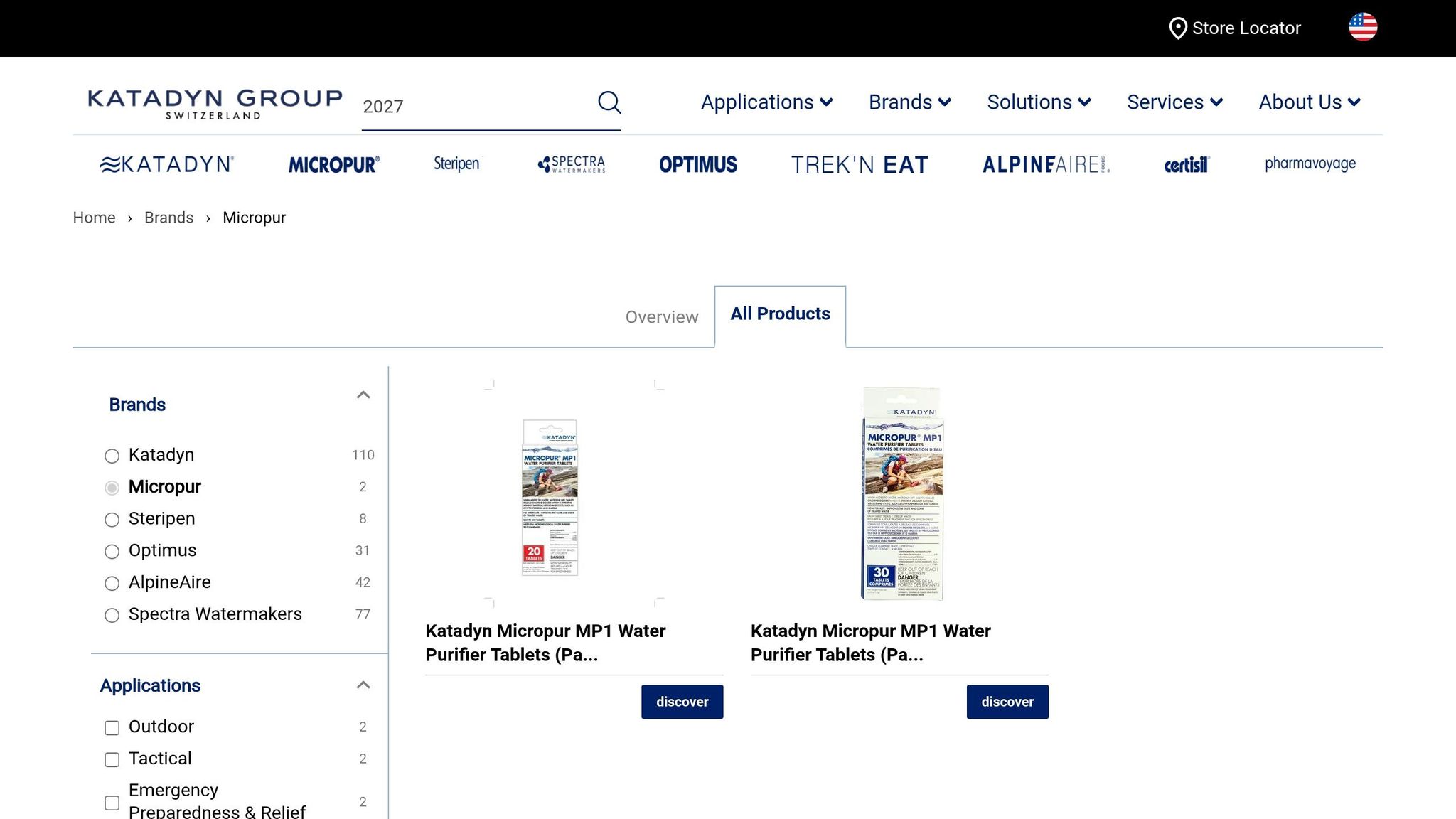
Ideal for: Multi-day backpacking trips needing comprehensive protection
Katadyn Micropur MP1 tablets are designed to tackle bacteria, viruses, Giardia, and Cryptosporidium, making them a solid choice for extended trips in areas with high wildlife activity. While bacteria and viruses are neutralized in just 15–30 minutes, Cryptosporidium requires a longer contact time of 4 hours. To make this manageable, treat your water during breaks or before sleeping so it’s ready when you need it.
"Katadyn Micropur MP1 is the brand to choose. It has decent flavor, combats against cryptosporidium and its odor is generally well-tolerated." – Alex Gulsby, 99Boulders
Each tablet treats 1 liter, and the 30-tablet pack weighs just 0.9 oz. With a shelf life of up to 5 years in its original packaging, it’s a reliable option for long-term storage. Priced between $15.95 and $17.95 for 30 tablets, it offers peace of mind for serious backcountry adventurers. It also boasts a 4.8/5.0 rating from 2,847 reviews.
Aquatabs Water Purification Tablets
Best for: Short trips, day hikes, and emergency use
Aquatabs are a budget-friendly option at $12.99 for 100 tablets (~13¢ per liter). They work quickly, treating water in 30–40 minutes, and are effective against bacteria, viruses, and Giardia. However, they don’t protect against Cryptosporidium, which could be a concern when camping near areas with livestock or abundant wildlife.
These tablets are widely trusted, being NATO and WHO approved, and are commonly used in disaster relief efforts. While the mild chlorine taste is noticeable, it’s not overwhelming. With a 4.7/5.0 rating from 3,219 reviews, Aquatabs are a dependable addition to any emergency kit or short trip supply.
Aquamira Water Purifier Tablets
Best for: Longer trips where taste and Crypto protection are priorities
Aquamira tablets use chlorine dioxide to eliminate a wide range of pathogens, including Cryptosporidium, although they require a 4-hour contact time. This makes them particularly suitable for water sources in remote areas. At $16.95 for a package treating 114 liters, the per-liter cost is competitive for extended use.
While effective, these tablets do emit a strong chemical odor, and the treated water has a slightly chemical taste. Despite this, they’re a practical choice for base camps or high-volume water treatment scenarios.
Potable Aqua Chlorine Dioxide Tablets
Best for: Budget-conscious backcountry campers needing Crypto protection
Potable Aqua’s chlorine dioxide tablets provide full-spectrum pathogen coverage, including Cryptosporidium, with a 4-hour treatment time. At $18.99 for 30 tablets, they’re a reasonably priced option for those who camp occasionally but don’t want to compromise on safety.
Rated 4.4/5.0 from 1,892 reviews, these tablets are well-regarded, though some users report experiencing a scratchy throat after drinking the treated water. This could be worth considering if you have a sensitive throat or are planning a high-activity day where hydration is key.
Potable Aqua Iodine Tablets with PA Plus
Best for: Emergency kits and short-term use
The Potable Aqua Iodine + PA Plus system uses a two-step process: iodine tablets disinfect the water, and a second tablet neutralizes the iodine taste and yellow tint. Treated water is ready in 35 minutes. At ~$9.99 for 50 tablet pairs (~43¢ per liter), it’s a cost-effective option for emergencies, though it doesn’t protect against Cryptosporidium.
These tablets come with health warnings for pregnant women and those with thyroid conditions, making them better suited for short-term or backup use. With a 4.5/5.0 rating from 4,103 reviews, they’re one of the most reviewed iodine-based options on the market.
| Product | Active Ingredient | Kills Crypto? | Wait Time | Price (approx.) | Rating |
|---|---|---|---|---|---|
| Katadyn Micropur MP1 | Chlorine Dioxide | ✅ Yes | 4 hours | $15.95 / 30 tablets | 4.8/5.0 |
| Aquatabs | NaDCC | ❌ No | 30–40 min | $12.99 / 100 tablets | 4.7/5.0 |
| Aquamira Tablets | Chlorine Dioxide | ✅ Yes | 4 hours | $16.95 / 114L | 64/100 (expert) |
| Potable Aqua ClO2 | Chlorine Dioxide | ✅ Yes | 4 hours | $18.99 / 30 tablets | 4.4/5.0 |
| Potable Aqua Iodine + PA Plus | Iodine + Neutralizer | ❌ No | 35 min | $9.99 / 50 pairs | 4.5/5.0 |
Tips for Using Water Purification Tablets in National Parks
Using water purification tablets effectively involves careful water collection, proper pre-treatment, and understanding how to maximize their performance.
Collecting and Pre-Filtering Water
The National Park Service warns:
"Never drink water from a natural source that you haven’t purified, even if the water looks clean." – National Park Service
Start by choosing clean, flowing water from areas at higher elevations, away from campsites or places where animals graze. If the water looks murky, pre-filter it using a bandana, coffee filter, or something similar. For water with heavy sediment, let it sit for a while so the particles can settle, then pour off the clearer water for treatment.
Dosage, Timing, and Temperature
Once you’ve collected and pre-filtered the water, it’s time to focus on proper dosing and timing to ensure effective purification.
Always follow the manufacturer’s instructions for the correct dosage. If the water temperature is below 50°F, you’ll need to double the treatment time. For dealing with Cryptosporidium, chlorine dioxide tablets require about 4 hours at room temperature, but colder water – especially near freezing – may need 6 hours or more. To speed things up, keep your water bottle inside your jacket to warm it slightly.
After adding the tablet, wait 1–2 minutes before loosening the cap and squeezing the bottle slightly to flush water through the threads. This step ensures complete disinfection. Avoid adding electrolyte powders or vitamin C until the full treatment time is over, as these can interfere with the process.
By following these steps, you can ensure the tablets work as intended and provide safe drinking water.
Combining Tablets with Filters
Pairing purification tablets with a mechanical filter can further improve water safety. Pre-filtering removes sediment and many pathogens, while the tablets handle viral contaminants. This layered method is especially helpful if your filter gets clogged or freezes.
The CDC emphasizes this approach:
"The next best option is to filter water and then disinfect the filtered water." – CDC
As outdoor enthusiasts often say, "Two is one, one is none." This principle highlights the importance of redundancy when it comes to water safety in the wilderness. Combining methods gives you extra peace of mind while exploring national parks.
Conclusion
Staying hydrated safely is essential, and purification tablets make it much easier. Whether you’re heading out for a day hike or spending a week deep in the wilderness, the right tablet can shield you from harmful pathogens like Giardia, E. coli, and Cryptosporidium. Did you know that Cryptosporidium is the leading cause of recreational waterborne illness in the U.S.? However, not all tablets are created equal. For example, chlorine dioxide tablets, while requiring a 4-hour wait, are effective against Cryptosporidium. On the other hand, faster options like Aquatabs work in just 30 minutes but don’t offer the same level of protection. Your choice should depend on factors like trip length, water conditions, and how much weight you’re willing to carry.
Using the tablets correctly is just as important as choosing the right ones. Small but crucial steps – like checking for water quality alerts on park websites before your trip – can make a big difference. Some issues, like harmful algal blooms, can’t be solved with tablets. A great resource for planning your outdoor adventures is The National Park Guide (thenationalparkguide.com), which provides hiking tips, water safety updates, and park-specific advice.
"Water purification tablets are your ultralight, fail-proof insurance policy against waterborne illness." – The Outdoor Champ
So, pack those tablets, plan your water treatment schedule, and enjoy your adventures with peace of mind.
FAQs
Do tablets make water safe from chemicals or algae?
Water purification tablets are effective at eliminating biological pathogens such as bacteria, viruses, and protozoa (like Giardia and Cryptosporidium). However, they won’t tackle chemicals, heavy metals, or physical debris. They also don’t work against algae. If the water appears cloudy or has visible particles, it’s a good idea to pre-filter it using a cloth or coffee filter. This step ensures the tablets can properly target and neutralize harmful microorganisms.
Should I filter first or use tablets first?
If the water appears cloudy or contains debris, it’s crucial to filter it before using purification tablets. Particles in the water can interfere with the tablets’ ability to work properly. For clear water, filtering isn’t absolutely necessary. However, many campers prefer filters as their primary method for quick treatment and removing particulates, keeping tablets as a lightweight backup for situations like filter malfunctions, freezing temperatures, or addressing viruses.
How do I adjust wait time for very cold water?
Chemical purification takes longer in cold water. If the water temperature drops below 40°F (5°C), you’ll need to double the standard wait time. For instance, a treatment that usually takes 4 hours might require 6 or more hours when the water is near freezing. To make the process faster, try warming the water slightly before adding the purification tablet and keep it insulated – placing it in a sleeping bag can help. No matter the temperature, always stick to the minimum recommended contact time to ensure safety.