
If you’re backpacking with a service dog, Yellowstone is the only park here that asks for an extra permit. The other three – Great Smoky Mountains, Joshua Tree, and Yosemite – use their standard backcountry or wilderness permit system.
Here’s the short version:
- Yellowstone: backcountry permit plus Yell 470 service-animal permit
- Great Smoky Mountains: standard backcountry permit only
- Joshua Tree: standard wilderness permit only
- Yosemite: standard wilderness permit only
A few rules matter right away:
- Yellowstone has the most paperwork and peak-season in-person pickup.
- Great Smoky Mountains opens permits only 1 month ahead and may place you in shelters.
- Joshua Tree opens permits up to 6 months ahead, but water and heat are major planning issues.
- Yosemite ties permits to a set trailhead and entry date, with 60% by lottery and 40% released 7 days before the trip.
Also, not every dog qualifies. Under NPS and ADA rules, only a dog trained to do work or tasks for a person with a disability counts as a service animal. Emotional support animals do not count and are usually treated like pets.
Quick comparison:
| Park | Extra service-dog permit | Booking window | Main trip limit |
|---|---|---|---|
| Yellowstone | Yes | Lottery March 1–20 | In-person pickup in peak season |
| Great Smoky Mountains | No | Up to 1 month ahead | Shelter and site assignment rules |
| Joshua Tree | No | Up to 6 months ahead | Water load and desert heat |
| Yosemite | No | 24 weeks lottery + 7-day release | Fixed trailhead/date rules |
In this guide, I compare the four parks by permit steps, timing, campsite rules, leash rules, and the planning issues that can affect a trip with a working dog.
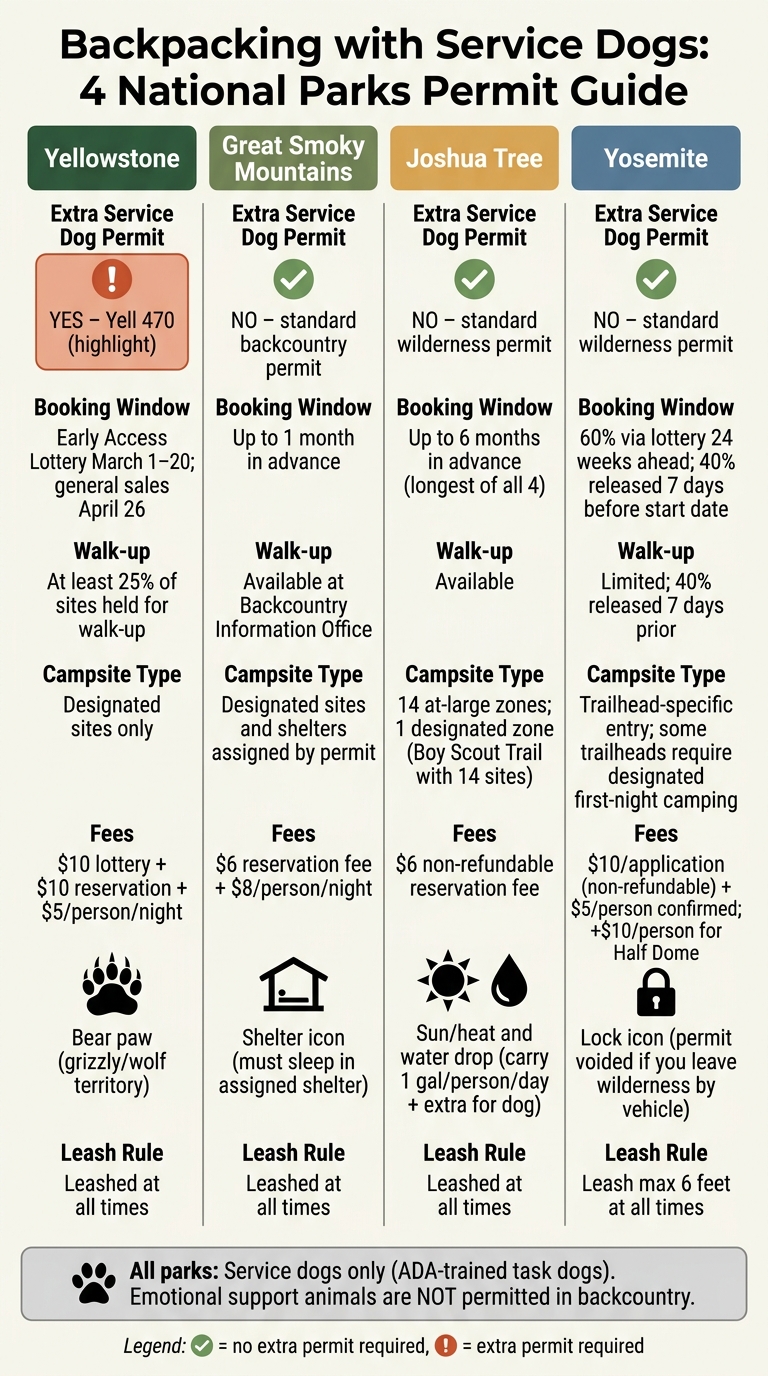
Backpacking with Service Dogs: Permit Requirements by National Park
Bringing Your Service Dog to National Parks: Complete Guide!
sbb-itb-00512f3
1. Yellowstone National Park
Yellowstone requires two approvals before you head into the backcountry with a service dog: a backcountry permit and a Guide/Service Animal Permit (Yell 470). You make reservations through Recreation.gov, but there’s a catch during peak season. From May 15 to October 31, you still need to pick up the permit in person at a park backcountry office within two days of your trip start date. So this isn’t a set-it-and-forget-it process. It comes with extra fees and a timed reservation window.
Permit Costs
The fees add up in a pretty clear way:
- $10 Early Access Lottery fee
- $10 reservation fee
- $5 per person, per night in backcountry fees
The Early Access Lottery runs from March 1–20, and about 73% of applicants get a reservation timeslot.
Service Dog Access and Safety Rules
Yellowstone also puts firm limits on where service dogs can go. They may use trails, designated campsites, and boardwalks. In thermal areas, the rule gets tighter: dogs must stay on boardwalks or established trails.
The extra permit can also come with ranger safety advisories tied to wildlife risk, including grizzly bear areas and wolf-pack territories. That’s not just paperwork. It affects route choices and day-to-day safety in the field.
Backcountry Planning Constraints
Those limits matter even more because Yellowstone’s backcountry can be tough in very plain ways. Most of the park sits above 7,000 feet. Snow can stick around on passes until late July, and spring runoff can turn river crossings into a serious problem for both handlers and dogs.
Food storage rules are strict too. Dog food has to be stored the same way human food is stored: either hung from a food pole with at least 35 feet of rope or locked in an IGBC-approved hard-sided bear-resistant container. Soft-sided containers are not permitted. And if you’re traveling on foot, you’re limited to Backpacker sites.
2. Great Smoky Mountains National Park
Great Smoky Mountains National Park doesn’t use a separate service-dog permit like Yellowstone. Instead, everyone uses the standard backcountry permit process through Recreation.gov, including visitors traveling with service dogs. Before your trip, call the Backcountry Information Office at 865-436-1297.
Permit Costs
Backcountry permit fees are pretty straightforward:
- $6 non-refundable reservation fee per permit transaction
- $8 per person, per night in backcountry camping fees
Permits become available up to one month in advance of your first night. After you print the permit, it’s considered issued and can’t be changed or canceled.
Service Dog Access
Service dogs can go anywhere visitors are allowed to go, including trails, campsites, and shelters. They’re exempt from the park’s pet ban. The dog must stay leashed at all times.
Camping and Shelter Rules
This is where many people get tripped up. The issue usually isn’t whether your service dog can come. It’s how the park handles shelters and campsites.
If your permit includes a shelter, you must sleep in that shelter. Tents aren’t allowed unless an Appalachian Trail thru-hiker fills the shelter.
Stay limits are also tight. You can stay up to 3 consecutive nights per campsite, but only 1 night at shelters or site 113. The maximum party size is 8 people.
Backcountry Planning Constraints
Food storage rules matter a lot here. Bear cables are required at every campsite and shelter. That means all odorous items, including dog food and waste bags, must be hung on the park-provided bear cable systems.
Cell service is poor through most of the backcountry, so download offline maps before heading out.
3. Joshua Tree National Park
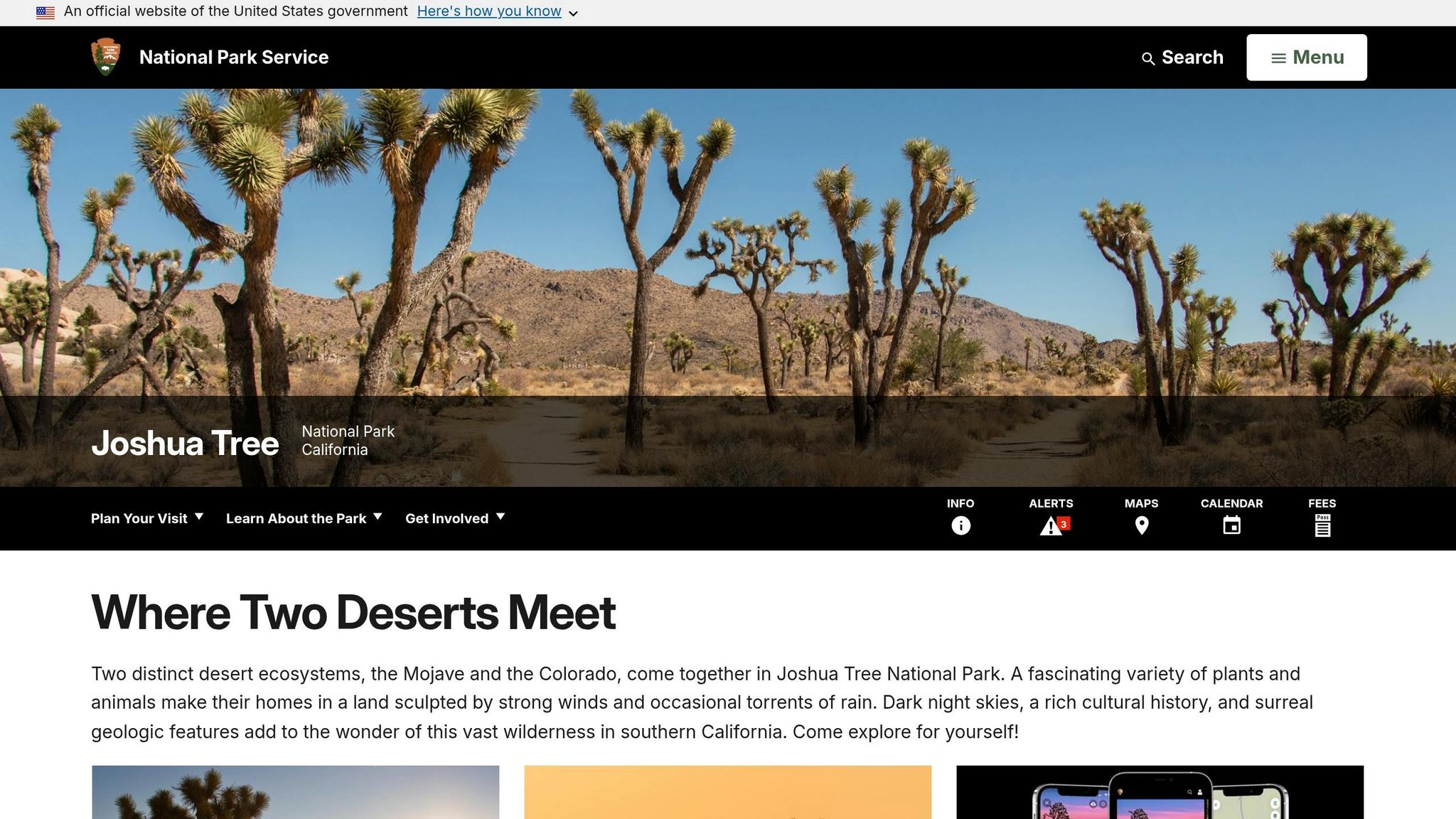
Joshua Tree keeps things pretty simple for service dog handlers. If you’re planning an overnight backcountry trip, you need a wilderness permit. Service dog handlers follow the same permit process as everyone else, and reservations are made through Recreation.gov up to 6 months in advance. The permit comes with a $6.00 non-refundable reservation fee and covers groups of 1 to 12 people.
Permit System
Joshua Tree’s backcountry is split into 15 zones. Of those, 14 zones use at-large camping, while the Boy Scout Trail zone uses designated sites.
That means the setup is pretty clear:
- In the Boy Scout Trail zone, you must reserve one of 14 designated campsites.
- In all other zones, you can pick your own campsite within the zone.
Service Dog Access
Service dogs can go anywhere visitors are allowed to go, including trails and backcountry campsites. That’s the key rule.
Emotional support animals and service dogs in training are treated as pets, which means they are not allowed on trails or in the backcountry.
Camping and Reservation Rules
For at-large zones, your campsite has to meet a few spacing rules. It must be at least 1 mile from any backcountry trailhead, 0.5 miles from any road, and 200 feet from any trail.
You can stay up to 3 consecutive nights in one zone and no more than 14 nights total on a trip. Campfires are not allowed anywhere in the backcountry, so if you need to cook, bring a gas or propane stove.
Backcountry Planning Constraints
What makes Joshua Tree tricky isn’t the permit system. It’s the desert.
Water and heat shape almost every part of trip planning here. Do not count on seeps or springs for drinking water. The park says to carry at least 1 gallon of water per person per day, plus extra for your dog. If that sounds like a lot, in this landscape it isn’t. You can also cache water in hard-sided containers at approved spots like Upper Covington Flats and Juniper Flats, but each cache must be labeled with your name, contact information, and dates of use.
Heat is also a big issue for service dogs. Ground temperatures can burn paw pads fast, especially in the middle of the day. Dog booties can help, and so can hiking during cooler hours.
For waste, pack it out with a wag bag or bury it in a 6-inch-deep cat hole at least 200 feet from water, trails, and campsites.
In the comparison below, Joshua Tree stands out for simple permitting and tough desert conditions.
4. Yosemite National Park
About 95% of Yosemite is designated wilderness. That means overnight trips come with tight rules from the start: you need a wilderness permit year-round for any overnight stay in the Yosemite Wilderness. If you’re backpacking with a service dog, the main friction points are fixed entry dates, strict camping limits, and required bear storage.
Permit System
Yosemite issues permits for a specific trailhead and specific entry date. So before you apply, you need to know exactly where you’re starting.
Permits come out in two rounds:
- 60% are available through a lottery 24 weeks in advance
- The remaining 40% are released online 7 days before your start date at 7:00 AM PDT
Fees are $10 per application and that fee is non-refundable, plus $5 per person once the permit is confirmed. If your trip includes Half Dome, add $10 per person.
There’s also a timing rule that can trip people up. If you can’t pick up your permit by 11:00 AM on your start date, you need to mark "late arrival" in Recreation.gov within one week. If you don’t, the permit is canceled.
Service Dog Access
Service dogs may travel on Yosemite wilderness routes that are open to visitors. Emotional support animals, therapy dogs, and companion animals are not allowed in the Yosemite Wilderness.
Your dog must stay on a leash no longer than 6 feet or be physically restrained at all times. In plain terms, Yosemite doesn’t give much room for off-leash movement, even in remote backcountry areas.
Camping and Backcountry Planning Constraints
The permit is only part of the puzzle. Yosemite’s wilderness rules shape almost every route decision after that.
If you leave the wilderness by vehicle or bus, your permit becomes void and you need a new one. The only exceptions are road crossings and one overnight stay at the Tuolumne Meadows Backpackers Campground. So if you’re thinking about a mid-trip shuttle, a town stop, or a simple resupply by bus, that plan can fall apart fast.
Some trailheads also lock in your first night. For example, Happy Isles requires camping in a designated first-night area. On top of that, camping is banned in certain sensitive places no matter what your permit says, including the top of Half Dome and Lukens Lake.
Bear storage is mandatory. All scented items, including dog food, must go in an approved bear-resistant canister. Yosemite does rent canisters at permit stations, but you’ll want to check capacity ahead of time. A canister that works for one person may get tight once you add kibble, treats, and the rest of your dog’s food.
Put all of that together, and Yosemite gives you less wiggle room than many other parks when it comes to route changes and resupply. That makes it a useful point of comparison for the parks covered next.
How the Parks Compare on Key Permit Rules
Yellowstone is the only park in this group that requires a separate Guide/Service Animal Permit, called Yell 470, on top of the backcountry permit.
That’s the big divider. After that, the main things to watch are when reservations open, whether walk-up spots exist, and how each park handles campsite assignment.
| Criteria | Yellowstone | Great Smoky Mountains | Joshua Tree | Yosemite |
|---|---|---|---|---|
| Permit required | Backcountry permit plus separate Guide/Service Animal Permit (Yell 470) | Standard backcountry permit; no separate service-animal permit | Standard wilderness permit; no separate service-animal permit | Standard wilderness permit; no separate service-animal permit |
| Advance reservations | Early Access Lottery March 1–20; general sales begin April 26 | Up to 1 month in advance | Up to 6 months in advance | Lottery 24 weeks in advance; remaining 40% released 7 days before start date |
| Walk-up availability | At least 25% of campsites held for walk-up | Walk-up permits available at the Backcountry Information Office | Walk-up permits available | 40% released 7 days before start date; some walk-up availability |
| Campsite assignment | Designated sites only | Designated sites and shelters assigned by permit | 14 at-large zones; 1 zone with designated sites (Boy Scout Trail) | Trailhead-specific entry; some trailheads require designated first-night camping |
| Leash rule | Leashed at all times | Leashed at all times | Leashed at all times | Leash no longer than 6 feet at all times |
In plain English, Yellowstone has the most paperwork, while Joshua Tree gives you the longest booking window. Great Smoky Mountains is much shorter on advance timing, with permits available up to 1 month ahead. Yosemite, meanwhile, uses a split system: a lottery 24 weeks out, then the remaining 40% goes live 7 days before the trip start date.
Camping rules also feel pretty different from park to park. Yellowstone keeps things tight with designated sites only. Great Smoky Mountains also assigns designated sites and shelters through the permit. Joshua Tree is looser, since most of its backcountry setup uses 14 at-large zones, though Boy Scout Trail is the one zone with designated sites. Yosemite sits somewhere in the middle, with trailhead-based entry and, for some trailheads, a designated first night requirement.
The leash rules are mostly the same at a glance, but Yosemite spells it out more closely: the leash must be no longer than 6 feet at all times. The other three parks simply state that the animal must be leashed at all times.
Those differences shape the pros and cons of each park below.
Pros and Cons by Park
Each park handles permits a little differently, and those differences matter fast when you’re backpacking with a service dog. Some parks make the paperwork simple but add tough field conditions. Others have tighter rules up front, but more support once you’re there.
| Park | Pros | Cons |
|---|---|---|
| Yellowstone | The separate Yell 470 permit adds a layer of accountability and helps rangers spot permit holders so they can give park-specific wildlife safety guidance. Accessible campsites include Canyon Loop L and Madison. | Permits are required year-round, and during peak season you have to pick them up in person. If your dates change, you need to cancel and book again. |
| Great Smoky Mountains | There’s no separate service-animal permit. The standard backcountry permit applies to all visitors. Walk-up permits are available at the Backcountry Information Office. | Permits open only 1 month ahead, which makes long-term trip planning harder. After a permit is printed, it can’t be changed or canceled. If you’re assigned a shelter, you have to stay there; tents aren’t allowed unless an AT thru-hiker takes the shelter spot. |
| Joshua Tree | It has the longest advance booking window of the four parks at 6 months. The permit process is simple, with no separate service-animal permit. Most zones allow at-large camping, which gives handlers more freedom when picking a campsite. | Backcountry water sources aren’t reliable, so handlers need to carry at least 1 gallon per person per day, plus extra for the dog. Heat is a direct hazard for service dogs, and the ground can get hot enough to burn paw pads. |
| Yosemite | The split permit setup gives you two shots: a lottery 24 weeks out and a 40% permit release 7 days before the trip starts. Bear canisters can be rented at permit stations. | Permits are tied to both trailhead and date, so there’s not much room to improvise. If you leave the wilderness by car or bus, the permit is void. Some trailheads also require designated first-night camping, which cuts down route freedom at the start. |
Yellowstone stands out for structure. The Yell 470 form adds one more step, but it also gives rangers a clearer way to track who is traveling with a service dog and step in with park-specific safety advice. The tradeoff is simple: less wiggle room if your plans shift.
Great Smoky Mountains goes in the other direction. The permit setup is easier because everyone uses the same backcountry permit. But once that permit is printed, you’re locked in, and shelter rules can box in your overnight setup more than some hikers expect.
Joshua Tree looks simple on paper, and in some ways it is. A 6-month booking window and at-large camping can make route planning feel less rigid. But the desert doesn’t cut anyone a break. Water load and heat risk are front-and-center, especially for a working dog.
Yosemite lands somewhere in the middle. The two-part permit release gives hikers another shot if they miss the first round, and canister rentals remove one gear headache. At the same time, trailhead rules and first-night limits mean your route has to match the permit closely from day one.
Conclusion
Yellowstone is the only park in this group with one extra step: you need a Guide/Service Animal Permit (Yell 470) for all backcountry travel. Permit systems, quotas, and seasonal rules can shift, sometimes with little warning. So before you head out, check each park’s Alerts and Plan Your Visit pages for the latest backcountry rules.
The permit piece is only part of it. Service-dog access still depends on current NPS policy. Under that policy, only dogs individually trained to perform tasks tied to a disability count as service animals. Emotional support animals do not. In plain terms, permit rules only apply if your dog meets the current NPS service-animal standard. The NPS updated its service-animal policy in 2025 to match ADA standards, and staff cannot require medical documentation, special ID, or training papers .
For park-specific resources, start with The National Park Guide and the official NPS pages for each park.
FAQs
Do I need proof my dog is a service animal?
Generally, no. In U.S. national parks, you usually do not need to show proof, medical records, certification, or other paperwork.
If it isn’t obvious that the animal is a service animal, NPS staff may ask only:
- whether the animal is required because of a disability
- what work or tasks the animal has been trained to perform
Comfort or emotional support animals are not service animals.
Which park is easiest to plan for with a service dog?
In general, planning is simplest for frontcountry visits. In most cases, service dogs can go anywhere visitors can go, including visitor centers, campgrounds, and accessible trails.
Backcountry trips can get a bit more complicated in some parks. For example, Yellowstone requires a free Guide/Service Animal Permit for backcountry travel. Check with the specific park before your trip to confirm any local rules or permit needs.
What food storage rules apply to dog food?
Dog food attracts animals, so store it with care to help avoid wildlife encounters. Don’t leave dog food or its containers unattended.
In bear country, use bear-proof storage containers. Also, check the rules for the park you’re visiting so you can follow current backcountry guidance.