
If you’re planning an overnight trip in a national park’s wilderness, you’ll likely need a backcountry permit. These permits are required year-round for camping outside developed areas and help protect natural areas, manage visitor numbers, and ensure safety. Here’s a quick breakdown:
- Why Permits Matter: They limit overcrowding, protect ecosystems, and help rangers track visitors for emergencies.
- How to Get One: Most permits are available through online reservations (e.g., Recreation.gov) or lotteries for high-demand locations.
- When to Apply: Timing varies by park – some open months in advance, while others allow last-minute walk-ins.
- Costs: Fees differ by park, often including a reservation fee plus nightly charges per person or group.
- Rules: Permits specify campsite locations, group sizes, and stay durations.
Planning ahead is key. Popular parks like Yellowstone and Glacier often fill up quickly, especially during peak season (May–October). For last-minute trips, consider walk-in permits or monitor cancellations. Always check specific park guidelines to avoid surprises.
How to Book Backcountry Permits on Recreation.gov (Early Access Secrets)
How to Apply for a Backcountry Permit
Securing a backcountry permit is a key step in planning your adventure. Whether you go through online reservations or a lottery system, knowing the process can make all the difference.
Online Reservations in Advance
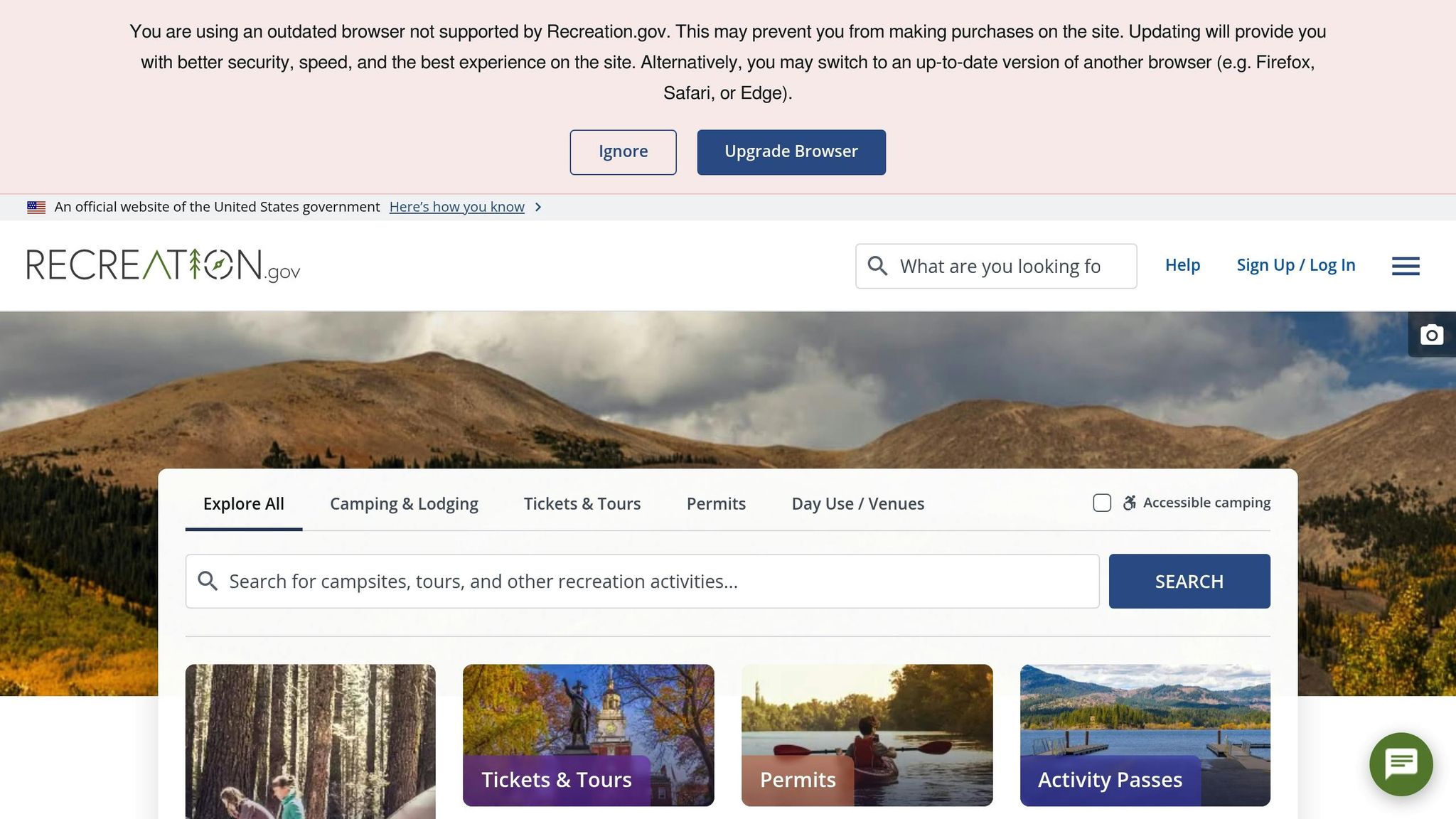
For most backcountry permits across the U.S., Recreation.gov is your go-to platform. With access to over 3,600 facilities and 103,000 individual sites, it simplifies the reservation process. Start by searching for the national park or backcountry area you want to visit, then log into your account. From there, select your dates and check campsite or route availability. Once you’ve made your selection, complete the payment to finalize your reservation. Some parks may require you to print your permit or have a digital copy ready when you arrive, so double-check the requirements for your destination.
Lottery Systems
For highly sought-after backcountry routes, lottery systems ensure a fair distribution of permits. Take Grand Canyon National Park, for instance – it uses a lottery for its most popular trails due to overwhelming demand. Lottery applications usually open several months before your planned trip. During the application period, you’ll submit your preferred dates, routes, and group size, along with alternate options to improve your chances. After the window closes, a random drawing determines the winners, who are then notified via email. Keep an eye on the lottery dates – missing the entry period means you’ll have to wait for the next cycle.
Next, find out the best times to apply so you can lock in your ideal travel dates.
When to Apply for Your Permit
Timing matters when it comes to securing a backcountry permit. Popular trails can book up months in advance, and missing the application window might mean postponing your adventure. Since each park operates on its own schedule, knowing when to apply is just as important as the application process itself.
Permit Booking Windows
National parks have varying timelines for opening their backcountry permit reservations, ranging from two days to six months before your trip. Let’s break down a few examples:
- Rocky Mountain National Park: Reservations open on March 1 at 8:00 a.m. MT for trips between May 1 and October 31. Campsites fill up fast – sometimes within hours – so be ready to act quickly if you’re planning a summer trip.
- Glacier National Park: This park uses a single lottery system, accepting applications only on March 15 for the entire season. If your application is selected, you’ll later submit your detailed itinerary. Planning ahead is crucial here, as there’s no flexibility with the lottery date.
- Yellowstone: A two-phase system is in place for peak season permits (May 15–October 31). The early access lottery runs from March 1–20, and the general on-sale period begins April 26 for any leftover permits. For a July trip, you’d need to enter the lottery by mid-March.
- Olympic National Park: Reservations for the summer season (May 15–October 15) open on April 15.
- Grand Canyon: Backcountry permits open four months before your trip. For a May trip, applications are due by January 1.
- Mount Rainier: Reservations can be made up to two days before your trip, but an optional Early Access Lottery is available for high-demand routes like the Wonderland Trail.
- Everglades: Reservations are available year-round, starting 90 days in advance. New openings occur daily at 10:00 a.m. EST.
Because each park has its own system, it’s essential to research your destination’s specific requirements. Set reminders a week or two before the application window opens to prepare all your details. Missing the window – even by a few hours – can mean losing out on your preferred campsite.
Peak and Off-Peak Seasons
Peak season, generally from May through October, sees a surge in demand for backcountry permits. During this time, many parks implement lotteries or strict quotas to manage visitor numbers. Popular trails can be especially competitive. For instance, less than 3% of Wilderness Permit applications for the John Muir Trail are successful during peak season.
If you’re planning a summer trip, expect intense competition. Parks like Yellowstone, Rocky Mountain, and Glacier have specific peak-season windows where permits are limited. To secure a spot, you’ll need to apply as soon as the lottery or reservation system opens. First-come, first-served permits often disappear within hours.
Off-peak seasons offer a quieter, more flexible experience. For example, the BWCA Wilderness requires quota permits for overnight trips from May 1 to September 30. From October 1 to April 30, however, self-issued permits are available, and no reservations or recreation fees are required. Similarly, Yellowstone offers backcountry access year-round, but the process becomes much simpler outside the peak months.
Shoulder seasons – April to May and September to October – strike a nice balance for many hikers. Demand is lower, weather conditions are still favorable, and permits are easier to secure. You’ll enjoy quieter trails and more flexibility with your plans. However, shorter daylight hours and cooler temperatures can present challenges, so preparation is key.
If you’re open to traveling outside peak times, you’ll likely spend less energy competing for permits and more time enjoying your adventure. Just make sure to check each park’s specific requirements, as some maintain consistent rules year-round, regardless of the season.
sbb-itb-00512f3
Costs and Requirements for Backcountry Permits
Backcountry permit fees and requirements can vary significantly depending on the park you’re visiting. Being aware of these costs and rules ahead of time can help you plan your trip more effectively and avoid last-minute surprises.
Permit Fees and Nightly Costs
Most national parks charge backcountry permit fees that typically include a non-refundable reservation or application fee plus a nightly per-person charge. For example:
- Grand Canyon National Park: There’s a $10 reservation fee, plus $15 per person or stock animal per night. A three-night trip for four people would cost $190.
- Mount Rainier National Park: Follows a similar fee structure.
- Everglades National Park: Charges a $21 non-refundable reservation fee and $2 per person per night. A five-night trip for two people would total $41 ($21 + $2 × 2 × 5).
- The Enchantments in Washington: Permits cost $5 per person per day. For a group of six on a four-day trip, the total would be $120 ($5 × 6 × 4).
Other parks have their own systems. For instance, the Great Smoky Mountains National Park requires permits for overnight camping year-round, with fees managed through their backcountry permit website. Yellowstone and Rocky Mountain National Parks adjust their fees based on the season and specific campsites.
Keep in mind that reservation fees are generally non-refundable. Be sure to check each park’s cancellation policies on their official websites or through Recreation.gov before making a reservation.
Once you’ve confirmed the costs, it’s equally important to review the park’s rules for permit pick-up and usage.
Permit Pick-Up and Usage Rules
Each park has its own process for picking up and using backcountry permits, so make sure you’re familiar with these details before your trip.
For instance, in The Enchantments, if you secure a permit through their lottery system, you must confirm and pay for it by March 31, 2025. Once finalized, you’ll need to print and sign the permit. At the Grand Canyon, permits must be picked up in person at the Backcountry Information Center before your trip begins.
Some parks, like the Boundary Waters Canoe Area Wilderness (BWCA), offer walk-up permits that can be obtained at issuing stations on the day of entry – or even one day prior, depending on availability. Self-issued permits are also available at kiosks near entry points or at Forest Service offices in the BWCA, and these don’t require reservations.
When applying for a permit, you’ll need to provide detailed trip information. For example:
- Glacier National Park: If your lottery application is selected, you must submit a detailed wilderness camping itinerary, including dates and designated campsites.
- The Enchantments: You’ll need to specify your party size (up to 8 people), the length of your stay, and finalize all trip details.
Many parks also require you to designate a group leader through a Recreation.gov account.
There are additional rules about group sizes and length of stay. For example:
- Yellowstone National Park: Limits stays to 3 consecutive nights at a single campsite and has restrictions on group size, stock animals, and boats.
- Great Smoky Mountains National Park: Allows overnight camping permits for up to 7 nights.
- The Enchantments: Limits group sizes to a maximum of 8 people.
Always carry your permit with you, as rangers may ask to see it during patrols. Even in parks where day hikes don’t require permits, overnight backcountry camping often does. This is the case in places like Great Smoky Mountains and Olympic National Parks.
Tips for Last-Minute Permit Requests
If your advance reservation plans fall through, don’t panic – there are still ways to secure backcountry permits. Many national parks set aside a portion of their campsites specifically for last-minute visitors. However, during peak seasons, competition for these spots can be intense. Flexibility is key to improving your chances.
Same-Day Walk-In Permits
Some parks offer walk-in permit systems, allowing you to snag backcountry access with little to no advance notice. The trick is knowing which parks provide this option and showing up prepared.
For example, Grand Teton National Park reserves two-thirds of its permits for first-come, first-served backpackers. These permits are available no more than one day before your trip starts. Similarly, North Cascades National Park sets aside 40% of its backcountry campsites for walk-in permits, issued just one day in advance.
In the Boundary Waters Canoe Area Wilderness (BWCA), walk-up permits can be obtained at any permit station on your entry date or the day before, depending on the quota for each entry point. From October 1 through April 30, the BWCA simplifies things even further by offering self-issued permits with no reservations required.
Timing is everything when it comes to walk-in permits. For instance, The Enchantments in Washington runs a walk-up lottery starting May 15 at 8:30 a.m. at the Leavenworth Ranger Station. Arrive at least 15 minutes early with your group leader, who must have a Recreation.gov account. This early-bird approach applies to most ranger stations – getting there before opening increases your odds.
That said, not all parks offer walk-in options. Everglades National Park, for instance, has done away with walk-up permits entirely, requiring reservations to be made 90 days in advance. Always double-check with the park office to confirm current policies.
When pursuing walk-in permits, come prepared with essential details: names and ages of your group members, camping dates, trip duration, and payment for fees. Having backup dates and alternative trailheads can also improve your chances.
However, relying solely on walk-in permits during peak season (May through October) is risky. Most parks operate under strict reservation systems during these months, leaving same-day availability extremely limited.
Want another strategy? Monitoring cancellations could be your ticket to securing a permit at the last minute.
Cancellations and Waitlists
Keeping an eye on cancellations through Recreation.gov is one of the best ways to secure permits when advance reservations are full. Plans change, and groups often release their permits back into the system.
While formal waitlists are rare, persistence pays off. Check Recreation.gov frequently, especially on weekday mornings, and set reminders during the 30-60 days leading up to your trip – this is when cancellations are most likely to occur.
Flexibility is your best friend here. Be open to adjusting your trip dates, exploring less-trafficked trails, or entering the park through alternative trailheads. For instance, in Yellowstone, backcountry permits are assigned by trailhead, so opting for a quieter route can boost your chances of finding availability.
Understanding permit release schedules can also help. For example, Grand Canyon backcountry permits are released four months in advance, while John Muir Trail permits open 24 weeks ahead. Knowing these timelines allows you to focus your efforts when availability is most likely to change.
Consider planning your trip during the shoulder seasons – late April to mid-May or mid-September to early October. During these times, demand drops, cancellations are more frequent, and competition for released permits is lower, all while the weather often remains favorable.
For highly sought-after routes like the Grand Canyon’s Rim-to-Rim or the John Muir Trail, permits are notoriously difficult to secure, even through cancellations. To avoid disappointment, have several backup options in mind: different parks, alternative trails, or flexible dates.
Preparing for Your Backcountry Adventure
Now that you’ve got a handle on securing your permit, it’s time to dive into the nitty-gritty of trip preparation. This step is about more than just paperwork – it’s what ensures your backcountry adventure is both safe and enjoyable. Start by researching the specific requirements for your chosen park, as permit systems and rules can vary widely. Parks often have unique guidelines regarding group sizes, camping limits, and designated areas for overnight stays.
Double-check all your trip details. Make sure the group leader’s account is active and ready to go. Pin down your entry point or trailhead and map out where you’ll camp each night. Many parks – like Rocky Mountain National Park, Glacier National Park, and Yellowstone – require reservations for specific campgrounds. Have your trip dates locked in, including both start and end dates, and confirm how many people are in your group. Don’t forget to review the permit fees and application timelines to keep everything running smoothly.
It’s a good idea to review the park’s fee structure on its official website to avoid any last-minute surprises. Also, check the timeline for submitting permit applications and set reminders – popular dates can fill up fast.
Once your permit is secured, take the time to familiarize yourself with park-specific regulations. For example, Yellowstone allows up to three consecutive nights at a single campsite unless stated otherwise. Meanwhile, Canyonlands permits up to 14 consecutive nights in total, but no more than seven nights in one zone. Knowing these details ahead of time can save you from headaches later.
For extra help with planning, The National Park Guide (https://thenationalparkguide.com) is a fantastic resource. Their guides cover everything from detailed itineraries to trail maps and insider tips, helping you craft a backcountry plan that checks all the boxes. Don’t forget to check the Park News section for updates on closures, events, or anything else that might affect your trip.
Always have a backup plan. If your preferred dates or entry points aren’t available, explore alternative trailheads or adjust your schedule. Planning during the shoulder seasons – like April through May or September through October – can also make it easier to snag permits and enjoy fewer crowds. With careful preparation and a bit of flexibility, you’ll be ready to tackle the permit process and fully enjoy your backcountry adventure.
FAQs
What can I do if I miss the backcountry permit application window for a popular national park?
If you miss the application window for a backcountry permit, don’t panic – there are still ways to get out there. Many parks provide same-day or walk-up permits on a first-come, first-served basis. Just be sure to arrive early, as these permits tend to disappear fast, especially during busy seasons.
Another option? Keep an eye out for cancellations. Some parks let you track availability online or by calling their visitor center. Being flexible with your travel dates and route plans can also improve your chances of snagging a permit. And if nothing works out, don’t give up – try exploring different trails or parks where backcountry permits aren’t required.
What can I do to increase my chances of getting a backcountry permit for popular trails during peak season?
Securing a backcountry permit for popular trails during peak season can feel like a challenge, but there are ways to improve your odds. Start by applying as early as you can – many permits are either first-come, first-served or allocated through lotteries with strict deadlines. Be sure to check the park’s official website for the exact dates and application process.
Flexibility is also key. If you can adjust your travel dates or consider less crowded trailheads, like visiting on weekdays, your chances increase. Before applying, make sure you’ve gathered all the required details – things like group size, entry and exit points, and your planned itinerary. A complete, error-free application is essential.
Finally, dive into the park’s rules and options. Some parks offer walk-up permits or maintain cancellation waitlists, which can be great alternatives if your initial application doesn’t pan out.
What can I do to secure a last-minute backcountry permit if my plans change?
If your original plans fall apart and you’re scrambling for a backcountry permit, don’t worry – there are a few ways to improve your chances. First, check the park’s visitor center or website for last-minute cancellations or same-day openings. Parks often release permits on short notice, so it’s worth keeping an eye out. Second, get there early in the morning to ask about walk-up permits. Many parks set aside a limited number of these, and they’re handed out on a first-come, first-served basis.
Being flexible with your dates and having backup routes in mind can also increase your odds. If you can, try planning your visit for mid-week or during quieter times of the year when competition for permits is lower. A little preparation and flexibility can go a long way in snagging that coveted permit!