
If your dates, camp spot, group size, and gear match your permit, most checks are short and simple. In U.S. national parks, rangers usually look for a few basic things: your permit, your photo ID, where you are camped, how many people are with you, and whether you have any gear the park requires.
Here’s the short version:
- Bring your permit where you can reach it fast
- Keep a photo ID with it
- Stay on your listed dates and route
- Camp only in the site or zone on the permit
- Do not go over your group or tent limit
- Carry required food-storage gear if the park says so
- Tell the ranger at once if weather, injury, or a closure changed your plan
A few points stand out. The permit holder usually must be with the group for the whole trip. Some parks may void the rest of the trip if you miss a required night. And if your trip does not match the permit, a ranger may give a warning, move you, write a citation, or tell you to leave the backcountry.
About 100% of a permit check comes down to one thing: does your trip match what the permit says? The guide below explains what rangers look at, what they ask for, and what can happen if there is a mismatch.
What rangers verify during a permit check
A permit check is a field verification. Rangers compare what your group is doing on the ground with what your permit allows.
The permit details rangers focus on
Rangers look at the specific terms on the permit and check whether your trip lines up with them:
| Permit Condition | What Rangers Check in the Field |
|---|---|
| Trip dates | The current date falls within the permit’s start and end dates. |
| Assigned location | The group is at the campsite or camping zone listed for that date. |
| Group size | The group does not exceed the number of people authorized on the permit. |
| Tent count | The number of tents stays within site limits. |
| Required equipment | The group has required gear such as hard-sided bear canisters or 35-foot or longer ropes for hanging food. |
| Travel method | The group is using the permitted travel method, such as on foot, by boat, or by stock animals. |
| Route / itinerary | The group is following the approved path and schedule. |
| Identification | The permit holder shows matching photo ID and is part of the group. |
One detail matters a lot: the permit holder must be present for the full trip.
Who checks permits and where
Wilderness rangers and law enforcement rangers conduct permit checks in the field. You’re most likely to run into them on busy trails, at designated campsites, and in cross-country zones. In high-use areas, checks happen more often.
"Rangers in the field may request to verify your permit during your trip."
After rangers confirm the permit terms, the next step is simple: show the permit fast and clearly. If your plans changed, say so up front before they compare your trip to the permit.
sbb-itb-00512f3
How to carry, show, and explain your permit
How to keep your permit easy to reach
Once a ranger stops you, keep the check simple.
Carry a signed paper copy of your permit in a waterproof bag so it stays readable during a check. Put it in an outer pocket of your pack, or attach it to your tent if your park requires that, so you can show it fast.
Some parks require the permit to be posted on your tent to make checks easier. Check that park’s rules before you set up camp.
Permit formats and pickup rules change from park to park. Carry the version your park accepts, and if your permit is digital, save it offline too.
What rangers typically ask during a check
Rangers usually ask for your photo ID, permit, and any gear the park requires. Keep your ID and permit together so you can hand them over without digging through your pack. It also helps to have any required gear ready to show.
How to respond if your plans changed
Weather, injury, or closures can change your route. If that happens, tell the ranger right away. How much you can change your plan depends on the park.
Explain what changed, then follow the ranger’s instructions.
What happens when your trip does not match the permit
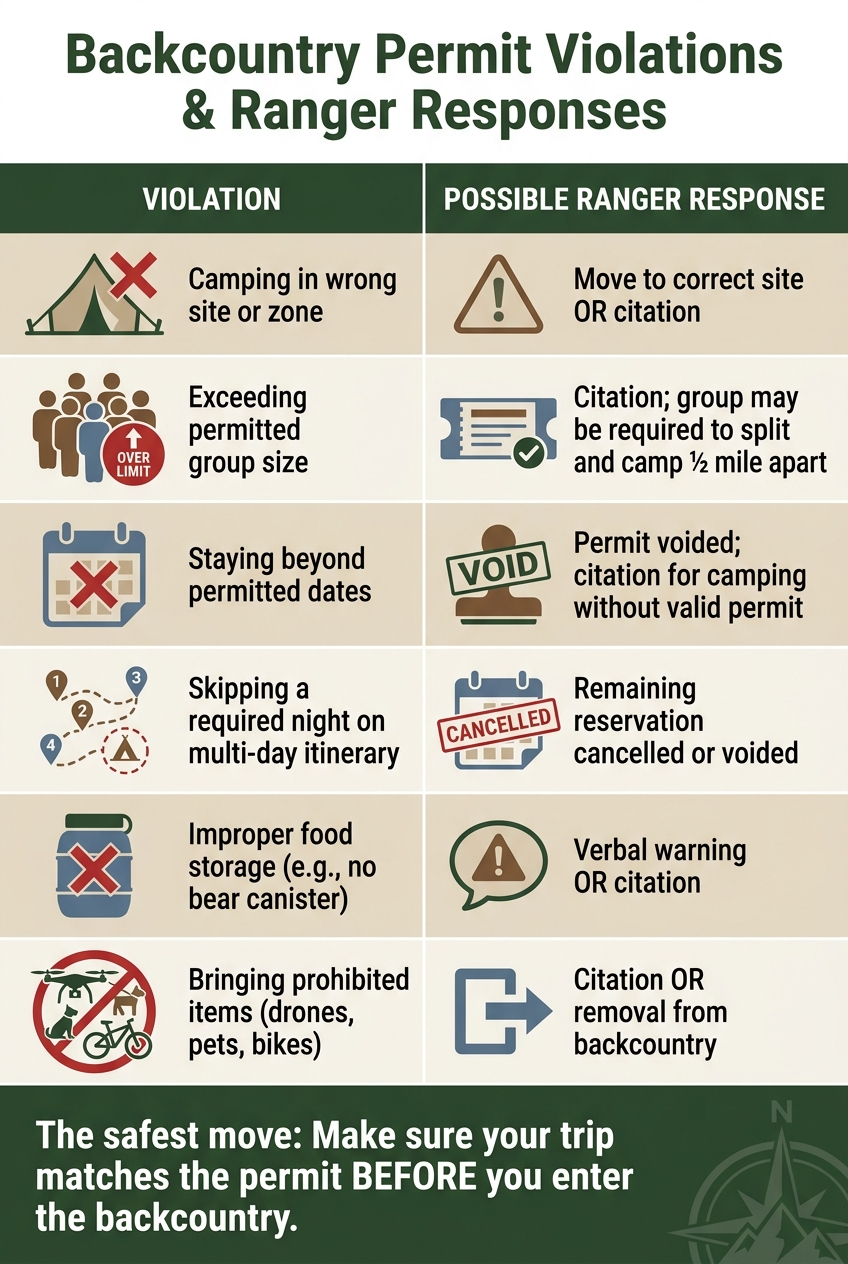
Backcountry Permit Violations & Ranger Responses
When a ranger finds a mismatch, the response usually comes down to how far your actual trip drifts from what the permit says.
Common mismatches that cause problems
A permit covers only the dates, site or zone, and group size printed on it. If your trip falls outside those terms, you can end up with a violation.
The issues rangers run into most often are pretty simple: people camp in a different site than the permit lists, stay past the approved dates, or bring more people than the permit allows. That might sound minor on paper, but it can create real problems. Camping outside the approved itinerary can damage resources, take up sites other people booked, and add safety issues.
Some parks void the rest of the permit if you skip a required night. And once the mismatch gets bigger, ranger action is more likely to turn formal.
How rangers respond to violations
Ranger response depends on the type of violation. A small route change caused by weather might lead to a verbal warning or directions to move to another site. But camping in the wrong place, going over group size limits, or ignoring food-storage rules is more likely to lead to a citation. Rangers can also tell you to change your plans or leave the backcountry.
The permit holder is not the only person at risk. Participants can be cited too.
| Violation | Possible Ranger Response |
|---|---|
| Camping in a different site or zone than the permit lists | Move to the correct site or citation |
| Exceeding the permitted group size | Citation; the group may have to split and camp 1/2 mile apart |
| Staying beyond the permitted dates | Permit is void; citation for camping without a valid permit |
| Skipping a night on a multi-day itinerary | Remaining reservation cancelled or voided |
| Improper food storage (e.g., no bear canister) | Verbal warning or citation |
| Bringing prohibited items (drones, pets, bikes) | Citation or removal from the backcountry |
The safest move is simple: make sure your trip matches the permit before you head into the backcountry.
Conclusion: How to get through a permit check without problems
A permit check tends to go smoothly when your trip lines up with the permit. Rangers are checking the same basics every time: dates, route, campsite, group size, and the gear they expect to see.
Key points to remember on every trip
Read your permit before you leave so your route, dates, and group size all match. Keep the permit somewhere easy to grab, and save a digital copy for offline use. If the park asks you to post it at camp, do that too.
If your plans shift, say something before the ranger checks your trip against the permit. The safest move is simple: make sure your trip matches the permit before you enter the backcountry.
FAQs
Can someone else use my permit without me?
Usually, no. Permits are generally non-transferable, which means you can’t just hand yours to someone else.
If you can’t go, only you or an authorized alternate trip leader can use the permit. Most systems let you name up to three alternates when you book. And if no alternate was listed at that point, the reservation usually can’t be transferred later.
What should I do if weather forces me off my route?
If weather pushes you off your planned route, put safety first. Check park alerts and closure notices before you head out, and follow official instructions during your trip.
If rough conditions are already on the radar, rangers may help you switch to a different itinerary when you pick up your permit. In severe weather, that could mean heading back to a shelter or leaving the area.
Can I be cited if I have a permit but camp in the wrong place?
Yes. A backcountry permit is valid only for the exact dates, party size, and locations listed on the permit.
If you camp outside your assigned site or zone, you’re not following the permit terms. That can lead to a citation or other enforcement action.